

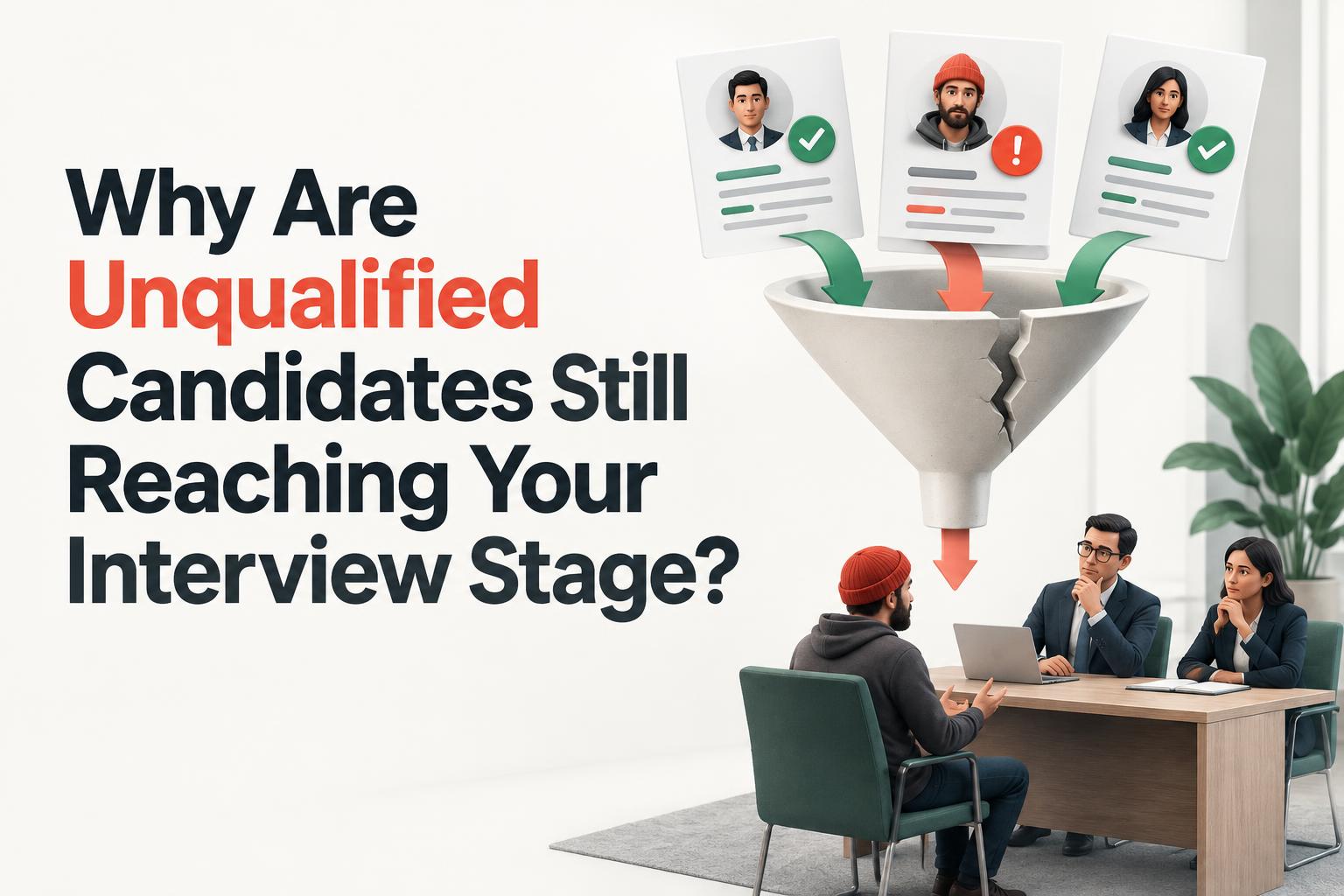
Unqualified candidates keep reaching the interview stage because nothing before it asks them to show any skill. Resumes, keyword filters and short recruiter calls all measure how well someone describes their abilities, so the first real test of ability ends up happening in the interview, with your most senior people running it. Put a short, job-relevant skills check in front of the first interview and the hiring manager only meets candidates who have already shown they can do the core of the job.
Table of Contents
It’s Tuesday afternoon, and Meera, a data team lead, has four first-round interviews for an analyst role back to back. Twenty minutes into the second one, she stops taking notes. The candidate’s resume lists SQL, Python and “stakeholder reporting.” When she asks him to talk through how he’d join two tables to find customers who churned last quarter, he goes quiet, then starts describing a dashboard he once used.
She finishes the hour politely. The third candidate is much the same. That evening she sends recruiting a short message: “Can we talk about the shortlist?”
The recruiter didn’t do anything wrong. Every candidate on that list matched the job description on paper. The process just had no step where anyone was asked to do anything, so the interview became the test, paid for with a team lead’s afternoon.
TL;DR – Key Takeaways!
- Unqualified candidates keep reaching the interview stage when every step before it collects claims rather than evidence of ability.
- AI-polished resumes have made those claims harder to tell apart.
- The interview is the most expensive step in hiring, so it works best as the final filter rather than the first real one.
- A short, proctored, role-specific skills check before the first interview is the most direct way to fix the leak.
- You’ll know it’s working when interviews per hire fall and new hires still perform at 90 days.
Why do unqualified candidates keep getting through to interviews?
The steps before the interview were mostly built to sort applications quickly, not to check whether anyone can do the job. That gap is the whole reason testing skills before you hire exists. A few things have made it wider recently.
Resumes tell you what people say they can do
A resume is self-reported. A keyword filter, even a smart AI resume screen, mostly checks whether the right words are on it. Neither one asks the candidate to show anything. We’ve written about why resumes are the biggest lie in hiring in more detail, so here’s the short version: if the resume is your main filter, the interview becomes your first real test by default.
There are more applications, and they all look good
Korn Ferry reported that LinkedIn applications rose more than 45% in a year, to roughly 11,000 a minute. A lot of that volume is AI-assisted, which means more resumes that mirror your job post almost word for word. The recruiter-workload side of that story is covered in why recruiters waste 850 hours a year on irrelevant applications. What matters here is the polished-but-weak profiles that make it through and land on a hiring manager’s calendar.
Job posts read like wish lists
Vague job posts attract almost everyone. Phrases like “strong communication skills,” “experience with cloud platforms,” or “data-driven mindset” do little to separate qualified candidates from the rest. Instead, identify three to five skills or requirements that someone must have to succeed in the role. Clear requirements can narrow your applicant pool far better than relying on keyword filters alone. If your job descriptions have become too broad, use a role-specific JD template to review them and make the requirements more precise.
Recruiters are asked to judge skills they can’t see
A recruiter covering a data engineer, a payroll specialist and an inside sales rep in the same week can’t judge all three properly, so titles and company names end up standing in for skill. That’s one reason more teams now hand the first functional check to role-specific tests and AI interviewing.
Where does your hiring funnel leak?
Take one open role and walk through it step by step. At each stage, ask what evidence you actually have when someone moves forward.
| Stage | What it really checks | What to change |
| Job posting | Who is interested | Name three to five must-have skills in plain language |
| Resume screen | How well candidates describe themselves | Use it for context and eligibility, not as the main pass or fail |
| Recruiter call | Confidence talking about the role | Keep it for motivation, logistics and salary fit |
| Skills check (often missing) | Whether candidates can do core tasks | Add a short, proctored, role-specific assessment |
| Hiring manager interview | Depth, judgment and team fit | Only interview people who passed the skills check |
Read down the middle column and you’ll notice something uncomfortable. Every step before the interview collects words. The interview is the first place anyone checks the work.
Track When Reality Differs From the Resume
One simple way to find out why unqualified candidates are reaching the interview stage: for the next month, ask hiring managers to add one line to their notes whenever a first-round candidate clearly lacks a must-have skill. Just the role, the skill and the date. After a few weeks you’ll have a short list that tells you exactly which skills your early stages are failing to check, and that’s where your first test should focus.
What does it cost when the wrong people reach interviews?
Take one role as an example (your numbers will be different). Twenty first-round interviews at an hour each, plus half an hour of prep and write-up for each one, comes to thirty hours of senior time. If half of those candidates never had the basics, fifteen of those hours went into confirming something a short test could have shown.
The slower cost is time to fill. SHRM’s 2025 benchmarking puts the average at about a month and a half, and a calendar full of weak interviews only pushes it out. Meanwhile, strong candidates are talking to other companies. Gartner found that only 51% of candidates accepted an offer in their most recent process in 2Q25, down from 74% in 2Q23.
The cost people talk about least is what it does to judgment. After four disappointing interviews, an average fifth candidate can look excellent by comparison. The bar slips without anyone deciding to lower it, and that’s how decent teams end up making hires they later regret.
How do you stop unqualified candidates from reaching the interview stage?
The goal: nobody reaches a hiring manager until they’ve shown they can handle the core of the job.
Agree on the must-haves with the hiring manager
Start with one simple question: What must this person already know to succeed during their first 90 days? For a data analyst, that could mean working with real SQL data, catching an error in a report, or turning a data trend into a clear explanation for a non-technical manager. These are the skills worth testing early. You can leave the rest for the interview.
Choose tests that look like the work
The research points in a clear direction. In a 2022 re-analysis in the Journal of Applied Psychology, Sackett and colleagues found job knowledge tests (.40) and work samples (.33) were among the stronger predictors of job performance, well ahead of years of experience.
In practice, that means a SQL task for an analyst, a coding exercise for a developer or a written customer reply for a support agent. Xobin’s library has more than 3,400 ready-made skills tests and 2,500 job-role tests, and job simulations cover tasks that look like the real role.
Our guide to skills testing covers customizing them. Whatever you choose, ask for its reliability and validity evidence before you use it as a gate.
Keep it to one sitting
Keep the assessment short enough for a qualified candidate to complete in one sitting. Tell candidates how much time they should set aside before they start. Adaptive tests can also reduce the length by changing the difficulty based on each answer.
Make sure the score belongs to the candidate
An unproctored test today measures the candidate plus whatever AI tool is open in the next tab. At a minimum, use identity checks, a locked browser and AI proctoring that flags behavior for a person to review rather than rejecting anyone automatically.
Pick the pass mark on purpose
Start by asking three or four trusted employees to take the test. Use their results to set an initial benchmark, then adjust it once you have data from your first few hires. For example, one Xobin customer said they shortlisted candidates who scored above 60%, which helped make their interview process faster. The right cutoff will vary based on the role and the test, so choose a score that fits your hiring needs and review it as you learn more.
Add a structured first round if volume is high
For busy roles, put a short structured interview between the test and the hiring manager, with the same questions and scoring for everyone. AI-led interviews can run this round at any hour, and your team still makes the decision. Send the results to the interviewer beforehand, so the conversation can start with “walk me through how you approached that task” rather than “tell me about yourself.”
Want to try a skills-first funnel on one of your roles? Xobin helps hiring teams add a proctored, role-specific skills check and structured AI interviews before the first hiring manager conversation. Book a 30-minute personalized demo to see how it would work for a role you’re hiring for now.
What does a skills-first funnel look like for one role?
Take a hypothetical customer support associate role, where one posting pulls in a few hundred applications. Here’s how the steps could stack up before anyone from your team spends time on a call:
| Step | What the candidate does | Rough time | What it filters out |
| Application form | Answers three knockout questions on shift availability, location and language | 3 minutes | People who can’t work the role’s schedule or location |
| Proctored skills test | Replies to two customer emails and works through a short troubleshooting scenario | 25 minutes | People who can’t write clearly or follow a support process |
| Structured AI interview | Answers five scenario questions about difficult customers, scored on a shared rubric | 15 minutes | People who struggle with pressure or empathy |
| Hiring manager interview | Talks through the weak spots flagged earlier | 30 minutes | Final fit and judgment calls |
Every candidate the hiring manager meets has already written a decent customer reply, and she knows exactly what to probe. Swap in a SQL task, a sales roleplay or a spreadsheet exercise and the same shape works for other roles.
How do you know the fix is working?
Compare a few numbers for the roles where you add the skills check, before and after:
| Metric | Direction you want |
| Interviews per hire | Down |
| First-round pass rate | Up |
| Assessment completion rate | Steady or up |
| Quality of hire (90-day performance or retention) | Steady or up |
If interviews per hire drop but 90-day performance drops too, the test or the pass mark is off. Revisit the must-haves before adding anything else.
See a skills-first funnel on your own roles
Xobin has run more than 5.3 million assessments for over 5,000 organizations. It brings role-specific skills tests, AI proctoring and structured AI interviews into one hiring flow, and Xobin Grow carries the same skills data into development after the hire. Book your 30-minute personalized demo and we’ll map a pre-interview skills check to one of your open roles.
Frequently asked questions
How long should a pre-interview skills test be?
Long enough to cover the must-have skills and short enough to finish in one sitting. Test only what the role needs from week one and put the expected time in the invite.
Won’t a test make strong candidates drop out?
Not if it’s short, relevant and clearly explained. Candidates walk away from long, generic tests. A focused one tells them your process is well run.
Does pre-interview screening work for non-technical roles?
Yes. Sales, support, operations and finance roles all have core skills you can test, such as written communication, accuracy with data or situational judgment.