

Placement season starts, and your inbox is already overflowing. Overnight, 4,000 students have applied, while three recruiters have just two weeks to narrow the list. Meanwhile, the hiring manager is asking why some of the strongest students from last year’s career fair never applied. Does this sound familiar?
Table of Contents
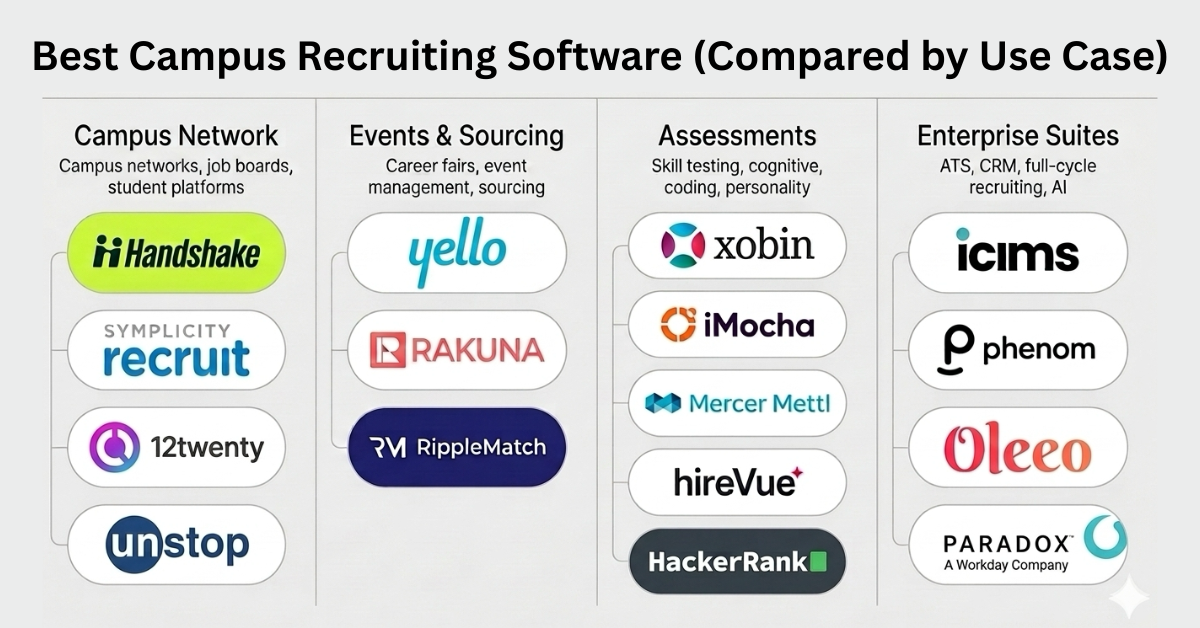
Here’s what most buyer’s guides skip: there’s no single best campus recruiting software, only the one that fixes the part of that morning that hurts most. If you can’t reach enough students, you need a campus network like Handshake or Unstop. Career fairs producing leads that go nowhere? Event tools like Yello or Rakuna are built for that. When applications pile up faster than your team can read them, an assessment platform like Xobin, iMocha, or Mercer Mettl will help more. And if campus hiring runs separately from the rest of HR, an enterprise suite like iCIMS or Workday (which now owns Paradox) is the place to look.
Most teams that do this well end up running two or three of these side by side. Below, we walk through 16 of the most popular campus hiring software options: what each one is good at, where it falls short, and how to build a shortlist around your actual problem instead of someone else’s top 10.
A quick disclosure
Xobin publishes this guide, and Xobin is one of the assessment platforms in it. We’ve described every tool, competitors included, by what it does well. Where another tool is the better fit, we say so.
TL;DR – Key Takeaways!
- Campus hiring tools fall into four groups: campus networks, event and CRM tools, assessment platforms, and enterprise ATS suites.
- Decide which group you need before comparing vendors. Reaching students and screening them are different jobs.
- A résumé alone no longer gives recruiters the full picture. Students often have limited work experience, while AI can make cover letters sound equally polished. That makes structured assessments more useful when hiring in 2026.
- If you test online, plan for integrity. Proctoring helps, and so do questions an AI tool can’t answer in seconds.
- Judge each campus by the people who joined and stayed, not by booth traffic or application counts.
Which Campus Recruiting Software Fits Your Hiring Bottleneck?
Find the row that sounds like your problem, then shortlist two to four vendors from it. The table maps the top campus recruitment platforms to the bottleneck each one handles best.
| If your main problem is… | Start with | Platforms to evaluate |
| Not enough applications from target universities | Campus-network platform | Handshake, Symplicity Recruit, 12twenty, Unstop |
| Career-fair leads that never turn into applications | Event and candidate-relationship tool | Yello, Rakuna |
| A thin or undiverse graduate pipeline | Early-careers sourcing and matching | RippleMatch |
| Too many applicants to screen by hand | Assessment platform | Xobin, iMocha, Mercer Mettl |
| Engineering graduates who need coding evaluation | Technical assessment platform | Xobin, HackerRank |
| Slow or inconsistent interviews | Video or AI interviewing platform | Xobin, HireVue |
| Scheduling delays and the same candidate questions over and over | Conversational AI | Paradox (Workday) |
| Campus hiring cut off from the rest of your HR systems | Enterprise ATS or talent-acquisition suite | iCIMS, Phenom, Oleeo, Workday Recruiting |
Platform-by-platform comparison
| Platform | Category | Best for | Standout capability |
| Handshake | Campus network | Broad US student reach | Career-services platform used by US university career centers |
| Symplicity Recruit | Campus network | Career-center relationships | Career-services workflows on the university side |
| 12twenty | Campus network | MBA and graduate programs | Business-school recruiting workflows |
| Unstop | Campus network | Engagement through competitions | Hackathons, case challenges, branded campaigns |
| Yello | Event and CRM | High-volume career fairs | Event check-in, CRM, scheduling, event-to-hire reporting |
| Rakuna | Event and CRM | Fast mobile lead capture | QR registration and post-event follow-up |
| RippleMatch | Sourcing | Proactive graduate matching | Automated candidate matching and outreach |
| Xobin | Assessment | Assessment-led mass screening | 3,400+ pre-built tests, coding in 40+ languages, AI proctoring, AI interviews, 25,000+ concurrent test-takers |
| iMocha | Assessment | Skills-first technical and functional tests | Broad skills taxonomy |
| Mercer Mettl | Assessment | Proctored psychometric testing at scale | Psychometrics and large-scale proctoring |
| HireVue | Video interviewing | Structured interviews at volume | On-demand video interviews |
| HackerRank | Technical assessment | Standardized developer screening | Developer skills library and coding interviews |
| iCIMS | Enterprise ATS | Governed, centralized recruiting | ATS, onboarding, integration marketplace |
| Phenom | Talent experience suite | Recruitment marketing and CRM | Personalized career sites and talent CRM |
| Oleeo | Enterprise ATS | Regulated, structured graduate schemes | Structured selection and diversity analytics |
| Paradox (Workday) | Conversational AI | Scheduling and candidate FAQs | Conversational assistant for screening and self-scheduling |
Campus Hiring Needs Different Tools than Experienced Hiring
Campus recruiting software, also called campus recruitment software, helps employers attract, engage, assess, interview, and hire students, interns, and recent graduates. It usually covers university outreach, career fairs, screening, interview scheduling, and reporting, so a small team can run a big hiring season without losing track of anyone.
Hiring a 22-year-old is not like hiring someone with ten years on their CV. There’s very little work history to go on, so a resume says almost nothing about what the person can actually do. The volume is lumpy, too. One campus drive can bring in thousands of applicants in a week, followed by months of quiet. That mix is why campus teams lean on structured tests and automation far more than experienced-hire recruiters do.
Core capabilities to expect in the Best Campus Hiring Tool
Not every tool does all of this, and you probably don’t need one that does. These are the jobs campus software is built for:
- Reach: access to universities and student networks, job distribution, and employer branding.
- Engagement: career-fair registration, check-in, lead capture, a CRM, and automated follow-up.
- Evaluation: aptitude, cognitive, behavioral, communication, technical, and coding tests, with proctoring.
- Interviewing: scheduling, reminders, video or AI interviews, and structured scorecards.
- Operations: ATS and HRIS integration, consent, data retention, accessibility, and audit controls.
- Measurement: source quality, stage-by-stage conversion, offer acceptance, joining, and early performance.
How did we evaluate these platforms?
We sorted each of these campus hiring platforms by the hiring problem it solves best. Then we looked at it through the questions early-careers teams ask us most often when they’re buying.
- Scope: 16 platforms that employers commonly shortlist for internship, graduate, and entry-level hiring in the US, UK, and India.
- Criteria: university reach, event workflows, assessment depth, proctoring, the candidate experience on mobile and slow connections, integrations, data governance, and reporting.
- Sources: vendor product pages and documentation, review sites such as G2 and Capterra.
- Limits: we didn’t run paid trials of every competitor. Features change often, so confirm the details in a live demo.
- Updates: we review this guide every quarter. Last review: September 29, 2026.
Which campus recruiting platforms give the best access to students and universities?
Campus-network platforms, often called university recruiting software, are where to start if your problem is reach. Maybe too few of the right students apply, your career-center relationships are thin, or nobody on your target campuses has heard of you. These tools help with that. They won’t screen anyone for you, though.
Handshake is the default for broad US student reach
Handshake connects students, university career centers, and employers in one network. A large share of US universities run their career services on it, so for many US employers it’s one of the broadest ways to reach students and recent grads.
- Choose it when: you hire interns and graduates in the US and your target schools are on Handshake.
- Watch for: it’s only as useful as the schools on it, so check your list first. It doesn’t do assessments or proctoring.
Symplicity Recruit suits employers working closely with career services
Symplicity is best known for the career-services software universities use internally, and Symplicity Recruit is the side employers see. It works well if your campus strategy runs through the career center itself: on-campus interviews, jobs posted through the school, and events booked with the career office.
- Choose it when: your campus hiring depends on formal relationships with career-services teams.
- Watch for: confirm that your target schools actually use Symplicity, and budget for a separate assessment tool.
12twenty fits MBA and graduate-program recruiting
Many business schools and graduate programs use 12twenty to manage employer relations and recruiting. If you hire MBAs or professional-degree students from a known list of schools, it gives you the school-specific structure those programs expect.
- Choose it when: you recruit MBAs or professional-degree candidates from a set list of schools.
- Watch for: for broad undergraduate hiring at volume, it’s more specialized than you need.
Unstop is the strongest engagement channel for India campus hiring
Unstop, which used to be called Dare2Compete, is an Indian platform built around student competitions, hackathons, quizzes, and job and internship listings. Employers use it to get known on campus before hiring season opens, especially at engineering and management institutes.
- Choose it when: India is a priority market and you want challenges or hackathons to draw students in.
- Watch for: check its reach at your specific colleges and tiers. You’ll still want an assessment platform for proctored final screening.
Which tools help turn career-fair leads into hires?
Event and candidate-relationship tools are the campus recruitment tools that matter most when your team does plenty of fairs but loses people between the booth and the application. Their whole job is to capture candidates quickly, follow up before interest fades, and show which events actually produced hires.
Yello supports enterprise event programs at scale
Yello brings campus event management, candidate check-in, a recruiting CRM, interview scheduling, and analytics into one place. It’s built for established teams running fairs, info sessions, and super days across many campuses every year.
- Choose it when: follow-up after events is slow and you need event-to-hire numbers, not just attendance.
- Watch for: a small team may not use most of the CRM. Check the ATS and calendar integrations before you sign.
Rakuna is built for fast mobile lead capture
Rakuna focuses on the practical side of a busy career fair: QR-code registration, mobile lead capture, messaging, and follow-up afterward. If your recruiters still come back from fairs with paper sign-up sheets, this is the tool that ends that.
- Choose it when: your recruiters work high-traffic fairs and need candidate details captured in seconds.
- Watch for: it’s built around events. Assessments and offers will live somewhere else.
RippleMatch is a sourcing tool, not an event tool
RippleMatch uses automated matching to connect employers with students and recent grads who fit their roles. Instead of waiting for applications, you can build a pipeline before the role is even posted.
- Choose it when: your gap is pipeline size or diversity, particularly for US roles.
- Watch for: ask how the matching works, how much control recruiters have, and how it syncs with your ATS.
Track the full conversion path, not booth traffic
Whichever tool you pick, follow each event all the way through: lead, qualified candidate, application, completed assessment, interview, offer, acceptance, joining, and early performance. A fair that gives you 400 leads and two hires did worse than one that gives you 80 leads and ten hires.
Which assessment platforms are best for high-volume campus screening?
Assessment platforms replace résumé guesswork with consistent, job-relevant evidence. They earn their keep when applications outnumber the hours your recruiters have, which during a big campus drive is almost always.
Xobin is built for assessment-led campus drives
Xobin is an AI-powered skills assessment and talent intelligence platform, and high-volume campus screening is one of its core uses. It offers 3,400+ pre-built skill tests, blended tests that cover cognitive aptitude, job-specific skills, and culture fit in one sitting, coding questions in 40+ languages that are graded automatically, agentic AI interviews, multi-tier AI proctoring, and score-based shortlisting. Xobin reports campus hiring at 500+ institutions, more than 5 million students assessed, support for 25,000+ test-takers at the same time, and 72% faster hiring from invite to shortlist.
- Choose it when: you’re screening thousands of graduates for analyst, trainee, sales, support, operations, or engineering roles, developer screening included, and you need a shortlist you can stand behind.
- Watch for: Xobin evaluates candidates; it doesn’t bring them to you. Pair it with a sourcing channel such as a campus network or your placement-cell contacts.
iMocha suits skills-first hiring across many job families
iMocha has a broad skills library that covers technical, functional, cognitive, and language skills. It suits employers hiring graduates into lots of different job families in the same season, such as engineering, finance, analytics, and operations. If iMocha is on your shortlist, our Xobin vs iMocha comparison sets the two platforms side by side.
- Choose it when: you want one skills layer for both technical and non-technical graduate roles.
- Watch for: make sure the library actually covers your roles and local markets.
Mercer Mettl is strong for proctored psychometric testing at scale
Mercer Mettl is known for psychometric, aptitude, and employability tests, along with large-scale remote proctoring. It’s a natural fit when cognitive and behavioral testing sits at the center of your selection process. If Mercer Mettl is on your shortlist, our Xobin vs Mercer Mettl comparison sets the two platforms side by side.
- Choose it when: psychometric depth and proctoring under heavy load matter most to you.
- Watch for: ask about language support, performance on slow connections, and live support during your drives.
HireVue fits structured video interviewing at volume
HireVue is a video interviewing platform with on-demand and live interviews, structured scoring, and scheduling. It belongs at the interview stage, after first-round screening rather than in place of it. If HireVue is on your shortlist, our Xobin vs HireVue comparison sets the two platforms side by side.
- Choose it when: interviews are your bottleneck, either because there are too many or because interviewers score them inconsistently.
- Watch for: work through consent, accommodations, human review, and data retention before you roll it out.
HackerRank is widely used for developer skills screening
HackerRank offers a large library of developer challenges and a coding interview environment. Teams use it when they want the same technical evidence for every engineering candidate. If HackerRank is on your shortlist, our Xobin vs HackerRank comparison sets the two platforms side by side.
- Choose it when: coding ability is the main thing you’re selecting for.
- Watch for: check that the tests look like real work, not just algorithm puzzles.
Which enterprise platforms connect campus hiring to HR systems?
Enterprise suites are your system of record. They matter when campus hiring has to share requisitions, approvals, candidate data, offers, and reporting with every other kind of hiring in the company.
iCIMS provides a centralized, governed ATS
iCIMS is an enterprise ATS with recruiting automation, onboarding, and a large ecosystem of integrations. It’s a common choice when campus hiring has to follow the same rules as the rest of recruiting.
- Choose it when: campus and experienced hiring need to run through one governed system.
- Watch for: implementation takes longer than a focused campus tool, and you’ll still want specialist event and assessment tools on top.
Phenom focuses on recruitment marketing and candidate experience
Phenom is built around recruitment marketing, with personalized career sites, a talent CRM, and marketing automation.
- Choose it when: attracting and nurturing early-career talent matters as much as processing their applications.
- Watch for: it works best with clear owners across TA, marketing, and HR tech. Without them, much of it can go unused.
Oleeo suits regulated, structured graduate schemes
Oleeo supports structured selection, workflow automation, and diversity analytics, and it shows up often in UK graduate and public-sector recruitment.
- Choose it when: you need an audit trail and consistent, structured decisions.
- Watch for: plan for a sizeable implementation.
Paradox is now part of Workday’s recruiting suite
Paradox is a conversational AI assistant that answers candidate questions, asks screening questions, and lets candidates book their own interviews. Workday completed its acquisition of Paradox on October 1, 2025, and now offers it alongside Workday Recruiting and HiredScore. (Workday newsroom)
- Choose it when: scheduling delays and repeat questions slow your funnel down, especially if you already run Workday.
- Watch for: ask how the integration roadmap affects customers on other ATS platforms, and make sure candidates can reach a person when they need one.
What should you evaluate before buying campus recruiting software?
Whatever early careers recruiting software you evaluate, run the demo on one of your real campus workflows, and look at it from the candidate’s side as well as the recruiter’s. A slick dashboard tells you very little about what happens when 3,000 students log in at the same minute on drive day.
| Criterion | Question to ask the vendor |
| University coverage | Which of our target colleges are active on your platform today? |
| Peak concurrency | How many candidates can take a test at the same time, and what happened at your largest drive? |
| Role relevance | Can we set up tests and workflows for each role we hire for? |
| Assessment quality | How are tests built, validated, refreshed, and checked for adverse impact? |
| Integrity controls | Which proctoring options do you offer, and can we set them differently for each round? |
| Candidate experience | Does it work on phones, on slow connections, and in our candidates’ languages? |
| Accessibility | Which accommodations do you support, such as extra time and screen readers? |
| Integrations | Which ATS, HRIS, calendar, and SSO connections are native, and which need the API? |
| Data governance | Where is candidate data stored, and what consent, retention, and deletion controls do you have? |
| Reporting | Can we report from invite to joining, broken down by campus and source? |
| Drive-day support | Is live support available during our test windows, in our time zone? |
How do you choose the right campus recruiting platform?
If we were starting from scratch, this is the order we’d work in:
- Write down the roles, target campuses, locations, and volumes for your next hiring cycle.
- Map the candidate journey from first hearing about you to joining and their first few months.
- Name the one bottleneck that hurts most: reach, event follow-up, screening capacity, technical evaluation, scheduling, integration, or reporting.
- Pick the software category that fixes it.
- Shortlist two to four vendors in that category that work in your hiring regions.
- Run demos on a real workflow, from both the recruiter’s side and the candidate’s.
- Pilot one role or one group of campuses before rolling out everywhere.
- Track conversion at every stage: reached, applied, invited, completed, passed, interviewed, offered, accepted, joined, and retained.
- Compare assessment and interview results with how hires actually perform, and adjust before the next cycle.
Which campus recruiting software should you choose?
Start with what’s broken, not with a vendor list. Short on student reach? Look at a campus network. Leads dying after fairs? Get an event tool. More applicants than your team can read? You need an assessment platform. Hiring mostly engineers? Make sure coding evaluation is covered. Systems that don’t talk to each other? That’s a job for an enterprise suite.
The best campus hiring software stack gets you in front of the right students, assesses them fairly, moves good candidates along quickly, and shows you what happened after the offer: time to shortlist, offer acceptance, joining rates, and how your graduates perform in their first year.
Frequently asked questions
What is the best campus recruiting software?
It depends on what you need it to do. Handshake and Unstop are the leading options for student reach in the US and India. Yello and Rakuna are built for career-fair follow-up. Xobin, iMocha, and Mercer Mettl handle high-volume assessment. Xobin and HackerRank are strong options for coding and developer skills evaluation. iCIMS, Phenom, Oleeo, and Workday cover enterprise integration.
Which platform is best for mass campus hiring?
For mass hiring, choose a campus hiring platform with bulk invitations, proven performance under peak load, job-relevant tests, automated scoring, proctoring, and funnel reporting. Assessment platforms such as Xobin, iMocha, and Mercer Mettl fit this need best, connected to an ATS for offers.
How do you prevent cheating in online campus assessments?
Use AI proctoring and better test design together. Draw randomized questions from a large bank, favor applied tasks over recall questions, match proctoring levels to each round, and add a follow-up interview where candidates explain their answers. For data on how AI performs across common skill tests, see Xobin Research’s Human vs AI Skills Report 2026, which tested 683 skill groups against AI setups.
How do you run a virtual campus drive?
Announce the drive through placement cells or a campus network, collect applications through a form, and send a proctored online assessment. Shortlist on scores, then run video or AI interviews. Share the test rules and a practice test with candidates ahead of time so fewer of them drop out.
How can employers make campus hiring fairer?
Use job-relevant assessments, the same eligibility rules for everyone, structured interview scorecards, reasonable accommodations, and clear communication with candidates. Keep a person involved in every final decision, and review pass rates across groups where the law allows, so you can spot barriers that shouldn’t be there.