

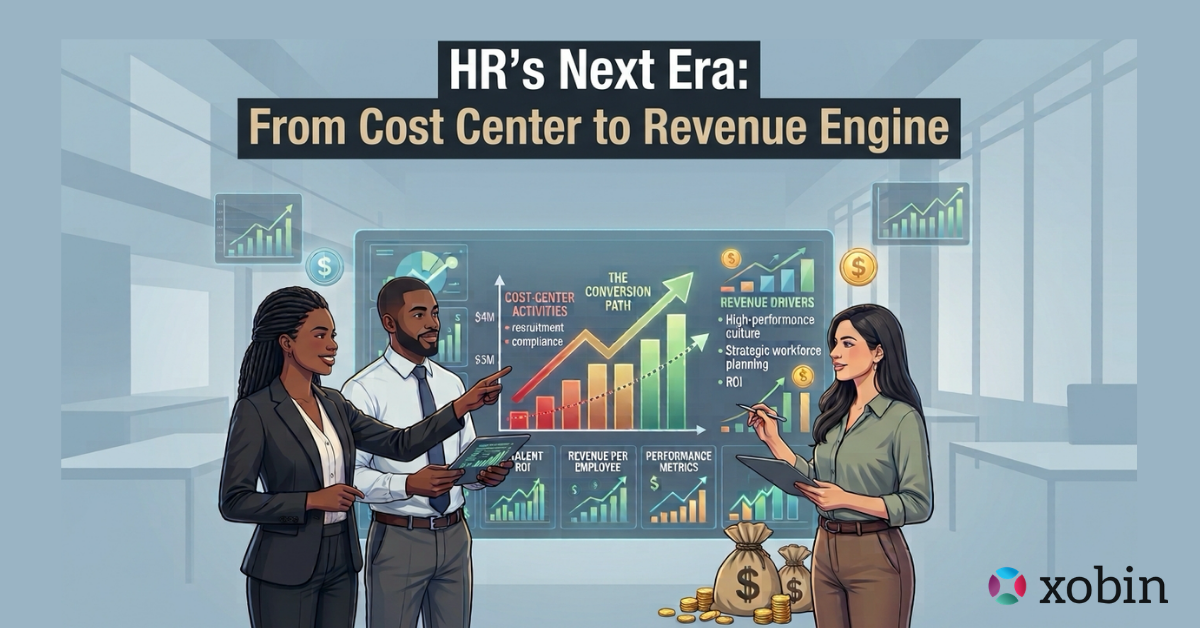
Every few years, a function inside a company gets reinvented. Not because the job description changes, but because someone finally measures it against the right outcome. Finance moved from bookkeeping to strategic capital allocation. Marketing moved from brand awareness to pipeline and revenue attribution. HR is at that same inflection point right now, and most companies haven’t noticed yet.
Table of Contents
Here’s the one-line version of the shift: HR moves revenue by changing how fast, and how well, people create business value.
Here’s how that plays out across the employee lifecycle, with the data behind each stage.
TL;DR – Key Takeaways!
- HR is going through the same reinvention finance and marketing already went through: from reporting on the business to actually helping run it.
- Eight everyday HR levers, hiring speed, quality of hire, training, ramp time, upskilling, internal mobility, attrition, and workforce planning, all turn out to be revenue levers once you look at them the right way.
- None of this works on gut feel. It needs real, validated data on who’s actually capable of what.
- The HR teams that bring that data into the room where growth targets get set won’t just have a seat at the table. They’ll help write the agenda.
Why Is HR Suddenly Being Measured Like a Business Unit?
Here’s the shift, in one sentence: HR impacts revenue by improving how quickly and effectively people create business value. Every lever below is a different angle on that same idea.
Put together, they’re the difference between an HR function that reports on the business after the fact and one that helps run it in real time. That’s not a small distinction. It’s the entire rebrand, and it comes with a data problem attached, which is where the products doing this work in practice come in.
The Eight Levers Turning HR Into a Revenue Function
Strip away the jargon, and revenue-focused HR comes down to eight everyday decisions your team is already making. The difference is whether you’re making them with a P&L mindset or a paperwork mindset. Here’s what changes when you do the former.
1. Hire revenue-generating talent faster
Every open seat on your sales floor or engineering team is a quiet tax on next quarter’s numbers. SHRM’s 2025 benchmarking report puts average time-to-fill at around six weeks, and if that seat carries a quota, every one of those weeks has a dollar figure attached, whether anyone’s calculating it or not.
The fix isn’t “hire faster and hope.” It’s removing the friction that has nothing to do with judgment, job descriptions, outreach, screening, scheduling, so recruiters spend their time on the calls that actually matter. An applicant tracking system that pulls all of that into one pipeline keeps requisitions from sitting on a recruiter’s calendar.
2. Chase quality over speed
Here’s an uncomfortable stat: only 20% of organizations formally track quality of hire, per SHRM’s 2025 survey of 2,300+ HR leaders. That gap matters because a bad hire isn’t cheap to unwind. SHRM’s 2025 data puts average cost-per-hire at $5,475 for nonexecutive roles and $35,879 for executive roles, and that’s before you factor in the lost productivity, team disruption, and re-hiring costs a mis-hire triggers on top of it.
The research on why this keeps happening is decades old. Schmidt and Hunter’s meta-analysis of 85 years of hiring data found unstructured interviews predict job performance at a validity of just 0.38, barely better than chance. Structured interviews alone reach 0.51. Pair a structured interview with a validated psychometric assessment, and that number climbs to 0.63, the highest combination in the entire body of research.
3. Make the training budget answer to the sales floor
Skill gaps rarely announce themselves. They show up as missed quotas, slower support resolution, and delivery timelines that keep slipping, long before anyone connects the dots back to training.
The distinction worth holding onto: training tied to ramp time or conversion rate is a lever. Training tied to a completion certificate is a line item. Before you set a training budget, run a skill gap analysis to find out what people are actually missing. It’ll tell you faster than a survey will.
4. Stop confusing “onboarded” with “producing”
These are two different milestones, and treating them as one is where ramp-time math quietly breaks. Shave two weeks off ramp time across a hundred hires and you’ve created real, calculable value. Most companies just never sit down to do the math.
The shortcut is hiring people who fit the role more precisely to begin with, using role-specific skill assessments, then checking early with structured 360-degree reviews that the ramp is actually on track rather than assuming it is.
5. Build the skills you’ll need before you need them
The companies ahead of the curve aren’t reacting to skill gaps. They’re mapping AI, data, and automation capabilities against where the business is headed, then upskilling people who already understand the company rather than hiring cold. Most organizations find out what they’re missing only after a project stalls. That’s the expensive way to learn it.
6. Send your best people at your biggest problems
Internal mobility gets filed under “retention perk,” but that undersells it. Moving a strong performer into a high-impact role grows output without growing headcount. SHRM, citing a LinkedIn study of 32 million profiles, found employees promoted within three years have a 70% chance of staying, and those who made a lateral move have a 62% chance, compared with just 45% for people who never moved internally. The real bottleneck usually isn’t a shortage of talent. It’s not knowing who’s ready, or where they’d do the most good next.
7. Catch attrition while it’s still a whisper
Losing your best engineer or top salesperson is a P&L event, not a headcount footnote. Gallup’s latest State of the Global Workplace report shows global engagement fell to 20% in 2025, its second straight year of decline, and each percentage point lost represents roughly 21 million disengaged employees worldwide. Catching that early means running continuous pulse checks between annual surveys, not waiting for an exit interview to explain what already happened.
8. Bring the data to where growth gets decided
This is the lever that changes everything else. Instead of waiting for leadership to hand down a revenue number, HR walks into the room and says: “Here’s what hitting that number actually requires, in roles, skills, capacity, and investment.” That’s not support work. That’s strategy, spoken in a language of finance and the board already understands. And it only works with real, org-wide data on hand, not numbers pulled together the night before the meeting.
What Actually Separates Traditional HR From Revenue-Focused HR?
This is the biggest shift of all. Traditionally, the board or leadership team decides the growth number, then tells HR after the fact. In the model that’s emerging, HR walks into that room and says: “We want to grow revenue by ₹100 crore. Here’s what that means in roles, skills, capacity, and the hiring or upskilling investment required to get there.” That’s not support work. That’s strategy.
You can see the evolution most clearly in the questions each version of HR asks:
| HR maturity level | The question it asks |
| Traditional HR | How many people did we hire? |
| Modern HR | How quickly did those hires become productive, and what did they produce? |
| Revenue-focused HR | Where should we invest in people to increase revenue per employee? |
That last question is the most powerful repositioning available to HR right now, because it’s the only one a CEO or board actually budgets around.
Why Does This Only Work If the Underlying Data Is Trustworthy?
Every lever above rests on the same unglamorous foundation: knowing, with real evidence, who’s actually capable of what.
- You cannot shorten a 12-month ramp curve if you cannot predict who will ramp up quickly.
- You cannot move high performers into high-impact roles if “high performer” is a manager’s opinion rather than a measured outcome.
- You cannot build a credible skills-gap map on assumption.
- You cannot bring a workforce plan into a boardroom if the underlying numbers will not survive scrutiny.
This is the problem Xobin’s assessment science exists to solve. At Xobin, we ground our evaluations in industrial-organizational psychology and validate them for predictive accuracy. That means the signal HR brings to the table holds up under the same scrutiny as a finance model or a sales forecast. It’s a standard we work to for HR teams across 55+ countries, because the shift from headcount reporting to revenue partnership doesn’t happen on good intentions. It happens on evidence.
The HR teams that make this shift first won’t just earn a seat at the table. They’ll be the ones setting the agenda for what gets discussed at it. The next time growth targets get set in your company, is HR in the room, or hearing about it afterward?
Frequently Asked Questions
How does HR impact company revenue?
HR impacts revenue by controlling how fast and how well people create business value, through hiring speed, quality of hire, time-to-productivity, and internal mobility. Get any of these wrong and the cost shows up directly on the P&L, not just in HR’s budget.
What is revenue-focused HR?
It’s an approach where HR ties its metrics, like time-to-hire and internal mobility rate, directly to business outcomes like pipeline and retention. It doesn’t stop at reporting on headcount.
Why is internal mobility considered a revenue lever?
Moving high performers into high-impact roles grows output without growing headcount, and it keeps people around longer in the process. LinkedIn’s Economic Graph found employees who move internally are significantly more likely to stay at least a year longer than those who don’t.
What does a bad hire actually cost a company?
It varies by role and seniority. But once you count recruiting, ramp time, and lost productivity, replacing an employee typically runs 50% to 200% of their annual salary, according to Gallup.
Do external hires perform better than internal promotions?
No, generally the opposite. Wharton research found external hires get lower performance ratings in their first two years. They also get paid 18-20% more, and are more likely to leave or be let go than people promoted from within.
Why does quality of hire matter more than speed of hire?
Because a fast bad hire costs more than a slow good one. Most companies don’t even track it, only 20% measure quality of hire at all, per SHRM, so they have no real signal on whether their hiring process works.