

Psychometric assessment tools measure cognitive ability, personality traits, and behavioral tendencies to help employers evaluate candidates before a hiring decision is made. According to Korn Ferry’s 2026 Talent Acquisition Trends report, based on a survey of more than 1,670 external talent leaders plus 230 internal experts, 84% of talent acquisition leaders plan to use AI in their hiring process in 2026.
Xobin, SHL, Hogan Assessments, Predictive Index, Criteria Corp, and Mercer | Mettl are among the established psychometric assessment companies, and each is built around a different hiring problem rather than a single “best” answer.
Table of Contents
TL;DR – Key Takeaways
- Each psychometric assessment tools fits a different use case: Xobin for combined technical and psychometric screening, SHL for the deepest validation documentation, Hogan for personality-led leadership assessment, Predictive Index for a fast candidate experience, Criteria Corp for lower-cost cognitive testing, and Mercer | Mettl for customized enterprise testing.
- We scored all six platforms on the same five-criteria rubric, shown in full below, using only public documentation.
- Pricing varies by assessment type, hiring volume, contract structure, region, and implementation requirements. Treat any published starting price as directional and request a full quote.
- For recruitment, prioritize published validity evidence, appropriate norm groups, ATS integration, candidate completion time, and assessment security over brand recognition alone.
- “Assessment tool” and “assessment provider” are not always the same purchase. Some vendors sell self-serve software; others sell software bundled with consulting, custom test development, or managed delivery.
How Did We Evaluate and Rank These Psychometric Assessment Tools?
We rated each platform from 1 to 5 across five criteria using the same scoring framework for every vendor. The scores reflect the strength of publicly documented evidence and capabilities, not an absolute judgment of product quality. A higher score means we found stronger or more complete public documentation against that criterion.
Important: This is not a universal ranking of the six companies. It is a comparison of how strongly each provider’s capabilities and assessment evidence are publicly documented against a consistent five-factor rubric. A higher score indicates stronger publicly available evidence or documented capabilities against our criteria, not that the platform is objectively better for every organization.
The Rubric
| Criterion | What we looked for | Scoring (5 → 1) |
| Assessment evidence | Validity, reliability, accreditation, research documentation | 5: Extensive published/independent evidence 4: Strong evidence, minor gaps 3: Some specific reliability/validity data 2: General claims, limited detail 1: No meaningful public evidence |
| Assessment breadth | Range of psychometric, cognitive, technical, specialty tests | 5: Cognitive + personality + technical + specialty 4: Three major categories 3: Two major categories 2: Limited range 1: Single instrument type |
| Recruitment workflow | ATS integrations, hiring workflow capabilities | 5: Multiple named ATS integrations 4: Strong workflow, some integrations named 3: Workflow documented, few integrations named 2: Basic workflow info only 1: No workflow info published |
| Candidate experience | Completion time, delivery format, friction | 5: Strongest completion-time/delivery in comparison 4: Short, low-friction 3: Moderate time or limited evidence 2: Longer or unclear experience 1: No completion-time info published |
| Commercial transparency | Public pricing, clarity of commercial model | 5: Public price list/calculator 4: Clear model, some public pricing 3: Model disclosed, no price list 2: Limited pricing info 1: Commercial model undisclosed |
The final score is the simple sum of the five criteria, with each criterion carrying equal weight. Because commercial transparency and assessment evidence measure different things, buyers should also review the individual scores rather than relying only on the overall ranking.
The Scorecard
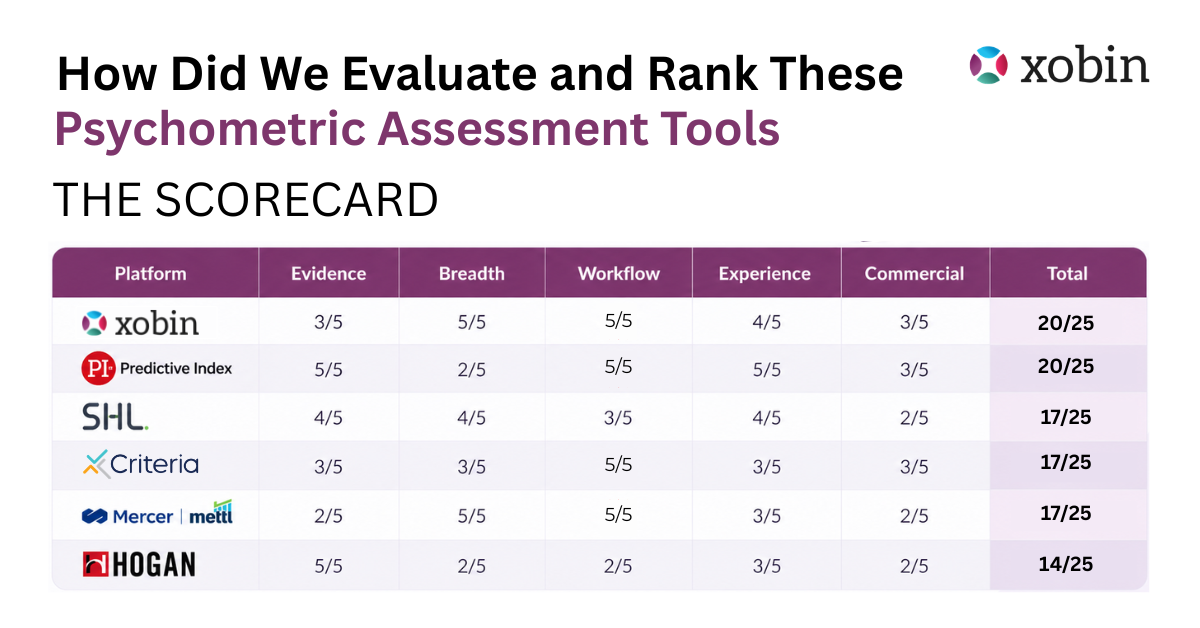
What’s behind each score:
Xobin (20)
- Evidence 3: Xobin describes its psychometric assessments as having undergone reliability and validity testing. While detailed coefficients or external accreditation are not currently published, we position Xobin in the moderate-evidence category based on the level of publicly available supporting documentation.
- Breadth 5: seven documented psychometric categories plus a separate coding library.
- Workflow 5: named 15+ integration partners including Greenhouse, Lever, BambooHR, SmartRecruiters, Workable, JazzHR, Zoho Recruit, and Ashby.
- Experience 4: completion time varies by test type: 15–45 minutes for job-skill tests, and 40–90 minutes for leadership-level situational-judgment psychometric tests; Xobin does not publish a single figure for psychometric assessments overall.
- Commercial 3: subscription model, demo-gated, no public price list.
Predictive Index (20)
- Evidence 5: Predictive Index publicly reports more than 400 criterion-related validity studies and references EFPA test-review certification for its core assessment instruments.(PI).
- Breadth 2: only two core instruments (PIBA and PICA).
- Workflow 5: a native Greenhouse integration plus 20+ additional named ATS integrations including BambooHR, Lever, SAP SuccessFactors, and Oracle Taleo via partners Joynd and Flexspring (Predictive Index).
- Experience 5: a 12-minute timed cognitive test plus a short untimed behavioral survey.
- Commercial 3: tiered subscription referenced in marketing, no public price list.
SHL (17)
- Evidence 4: SHL’s technical documentation and independent assessment literature provide evidence of reliability and validity research, although we did not find a specific published study count on SHL’s own site comparable to the figures reported by Predictive Index and Hogan. Under our rubric, this supports a strong but not highest evidence score.
- Breadth 4: cognitive, personality, and situational judgment all documented (SHL).
- Workflow 3: delivered via TalentCentral, configured per enterprise contract.
- Experience 4: Verify G+ is adaptive with partial scoring, 36 minutes.
- Commercial 2: Primarily enterprise-oriented commercial model, no public pricing.
Criteria Corp (17)
- Evidence 3: Criteria’s own materials report correlations of .55–.8 with other established cognitive aptitude tests and describe a standardization sample of 985 individuals across more than 50 companies, but we did not locate a published internal-consistency coefficient (e.g., Cronbach’s alpha) or third-party accreditation on Criteria Corp’s public site to support a higher evidence score. (Criteria Corp).
- Breadth 3: CCAT, EPP, and named specialty tests such as SalesAP.
- Workflow 5: Criteria’s own integrations page names Greenhouse, Lever, Fountain, and iCIMS among its partners
- Experience 3: CCAT is a 15-minute, 50-item timed assessment; its fixed time limit may make completion experience different from shorter or adaptive assessments.
- Commercial 3: subscription model, demo-gated, no public price list.
Mercer | Mettl (17)
- Evidence 2: Mercer | Mettl describes its assessments as research-backed, but the public materials we reviewed did not provide the specific reliability coefficients, validity coefficients, sample sizes, or study counts needed for a higher evidence score (Mercer | Mettl).
- Breadth 5: 200+ assessments across 800+ skills and 25+ industries.
- Workflow 5: Mercer | Mettl’s own partners page names Greenhouse, iCIMS, Keka, and Skillate among its ATS and LMS integrations.
- Experience 3: no standard completion time published, varies by battery.
- Commercial 2: enterprise-contract only, no public pricing.
Hogan Assessments (14)
- Evidence 5, Hogan’s published materials report more than 250 cumulative criterion-related validation studies and reference external review of its assessment instruments (Hogan via GMAC).
- Breadth 2, the core suite (HPI, HDS, MVPI) is personality-only; cognitive coverage (HBRI) is a separate product.
- Workflow 2, we found no named ATS integrations; delivery instead requires Basic Certification plus Level B qualification for some instruments (Performance Programs).
- Experience 3, three untimed instruments running 45 to 60 minutes combined.
- Commercial 2, certification- and contract-gated, no public pricing.
The ranking reflects publicly available vendor documentation and research available as of September 2026. Where third-party sources are used for pricing or comparison information, those estimates should be treated as directional rather than as universal vendor prices.
We treat pricing as directional, not definitive
Psychometric assessment pricing can change substantially based on candidate volume, assessment type, contract length, geographic market, implementation services, and customization.
Rather than presenting a single figure as the “true” cost of a platform, buyers should request an all-in quote covering licenses, assessments, integrations, validation support, implementation, administration, and any required certification.
Third-party pricing articles can help establish a rough range, but they should not replace a current vendor quote.
We disclose our own conflict of interest
This article is published by Xobin, and Xobin is one of the platforms compared. We’ve applied the same five criteria to Xobin as to every competitor listed. The comparison also identifies areas where other vendors may be a better fit. Where information about Xobin comes from Xobin’s own company data rather than an independent source, it should be understood in that context.
Author and review information
The content is reviewed by Mark Smith, Ph.D., an Organizational psychologist and Assessment expert. Last fact-checked September 2026. Because assessment catalogs, integrations, and commercial models change over time, pricing and feature information should be confirmed with each provider before making a purchasing decision.
What Are Psychometric Assessment Tools?
Psychometric assessment tools are standardized tests that measure how a candidate thinks, behaves, and responds under set conditions. They convert candidate responses into scores that can be interpreted against appropriate benchmarks or norm groups.
They measure cognitive ability, personality, and behavioral traits.
Most platforms combine two or three test types in one workflow:
- Cognitive ability test (numerical, verbal, logical and abstract reasoning)
- Personality assessments (often built on the Five-Factor Model) characteristics such as conscientiousness, emotional stability, openness, and other personality dimensions.
- Situational judgment tests (how candidates are likely to respond to workplace situations)
- Behavioral assessments: (work preferences, behavioral tendencies, and role-related patterns)
- Emotional intelligence assessments (areas such as interpersonal awareness and emotional regulation)
Selection research going back decades shows combining multiple valid predictors improves prediction accuracy over any single method (Schmidt and Hunter, 1998).
They differ from skills tests in what they evaluate.
A skills test evaluates whether a candidate can perform a specific task, such as writing code, using a spreadsheet function, or applying a technical concept.
A psychometric test evaluates characteristics such as cognitive ability, personality, behavioral tendencies, or judgment.
Many hiring teams use both. A technical skills assessment can establish whether someone can perform the work, while a relevant psychometric assessment can provide additional information about how they may approach decisions, problems, or workplace situations.
What Are the Best Psychometric Testing Tools?
Here’s a comparison of the platforms recruiters use most for pre-employment psychometric testing. The right choice depends on the roles being assessed, hiring volume, required evidence, candidate population, workflow, and budget.
| Tool / Company | Best For | Test Types | Pricing Model |
| Xobin | Combined technical and behavioral screening | Cognitive aptitude, personality inventory (Big Five, DISC), emotional intelligence, situational judgment, coding | Subscription, volume-based |
| SHL | Enterprise programs needing deep validation | Cognitive (Verify, adaptive IRT), personality, situational judgment | Enterprise contract |
| Hogan Assessments | Leadership and personality-focused assessment | Personality (HPI, HDS, MVPI); business reasoning (HBRI) sold separately | Certification / assessment-based |
| Predictive Index | Fast, low-friction behavioral and cognitive screening | Behavioral (PIBA), cognitive (PICA) | Tiered subscription |
| Criteria Corp | Cost-conscious cognitive and personality testing | Cognitive (CCAT), personality (EPP) | Subscription / volume-based |
| Mercer | Mettl | Customized enterprise assessment programs | Cognitive, personality, coding, custom batteries | Enterprise contract |
Commercial models and available assessments can vary by region, contract, product package, and use case. Confirm current details directly with each provider.
1. Xobin combines technical and psychometric screening in one platform
Xobin offers psychometric assessments covering personality, cognitive aptitude, emotional intelligence, situational judgment, logical reasoning, leadership ability, and culture fit. The assessment library includes frameworks such as the Big Five (OCEAN), DISC, HEXACO (including honesty-humility), Dark Triad, cognitive preference types, and emotional intelligence. Teams can also combine psychometric assessments with coding, technical, and other pre-employment tests within the same hiring workflow. Xobin reports typical completion times of 15 to 45 minutes, depending on the assessment depth.
Best for: organizations that need a broad range of personality, behavioral, cognitive, technical, and situational-judgment assessments in one workflow, especially high-volume hiring teams that also need reporting, proctoring, multilingual support, and flexible assessment delivery.
Limitations:
- Fewer independently published, peer-reviewed validity studies are publicly available for Xobin than for long-established providers such as SHL and Hogan. This is why Xobin receives 3/5 on public-evidence criterion.
- Organizations looking specifically for leadership assessment and a long-established certification ecosystem may find Hogan more suitable.
Start a free Xobin psychometric assessment trial → Book a personalized demo!
2. SHL stands out for validation depth and enterprise assessment programs
SHL’s Verify G+ test measures numerical, deductive, and inductive reasoning across 30 items in 36 minutes, using computer-adaptive delivery, and is documented on SHL’s own product pages as suitable for all job levels (SHL, 2026). SHL delivers assessments through its TalentCentral platform. Independent assessment literature describes SHL’s technical manuals as documenting reliability coefficients and factor structures across industries, though we did not locate a specific published study count comparable to Hogan’s or Predictive Index’s on SHL’s own site, which is why SHL scores a 4 rather than a 5 on our evidence criterion.
Best for: large organizations running structured, multi-market assessment programs, and buyers who weigh published technical documentation heavily.
Limitations:
- Enterprise implementations can involve more procurement, configuration, validation, and support requirements than a lightweight self-serve assessment platform.
- Total cost can increase when organizations require additional implementation, customization, validation, or consulting services.
3. Hogan Assessments is well suited to leadership and personality assessment
Hogan’s core suite, the Hogan Personality Inventory (HPI), Hogan Development Survey (HDS), and Motives, Values, Preferences Inventory (MVPI), is primarily personality-focused. Cognitive assessment is available separately through the Hogan Business Reasoning Inventory (HBRI), a roughly 35-minute, 24-item measure. Using any Hogan personality instrument requires Basic Certification, and the HPI, MVPI, and HBRI additionally require Level B qualification, typically a relevant psychology degree.
Best for: leadership selection and development programs already staffed by certified practitioners.
Limitations:
- Cognitive assessment is available separately through HBRI rather than being part of the core HPI, HDS, and MVPI personality suite.
- Certification and qualification requirements can add cost and lead time for organizations that need to administer Hogan instruments internally.
4. Predictive Index offers a fast candidate experience
Predictive Index’s two core instruments are the PI Behavioral Assessment (PIBA), an untimed adjective checklist, and the PI Cognitive Assessment (PICA), a timed, 12-minute, 50-question test. PI’s own materials describe the Behavioral Assessment as backed by more than 400 criterion-related validity studies and certified under the European Federation of Psychologists’ Associations (EFPA) test review model, with the Cognitive Assessment carrying the same certification (Predictive Index, 2020).
Best for: mid-market teams that want a short, low-friction assessment pair and don’t need a broad test library.
Limitations:
- Its assessment breadth is narrower than platforms that combine psychometric testing with coding, broader skills testing, and assessment security features.
- Less suited to highly regulated, high-stakes enterprise hiring where deeper validation documentation is required
5. Criteria Corp focuses on accessible cognitive and personality testing
Criteria’s CCAT is a timed, 15-minute, 50-item cognitive aptitude test. Criteria’s own technical brief reports a Cronbach’s alpha reliability coefficient of 0.86 based on a sample of 97,929 test-takers, and separately reports norms built from 985 individuals across more than 50 companies (Criteria Corp, 2026). In one published case study covering 179 employees at a single digital media company, sales reps who passed both the CCAT and the EPP personality test generated roughly seven times the annual bookings of reps who passed neither; this is a single company’s local validation study, not a general benchmark (Criteria Corp, 2026).
Best for: teams that want cognitive and personality testing with a relatively straightforward assessment workflow.
Limitations:
- The publicly available research documentation we located is narrower than the documentation available for SHL or Hogan. Organizations using assessments in regulated or legally sensitive hiring contexts should request assessment-specific validation and adverse-impact documentation.
- CCAT uses a fixed 15-minute, 50-item format, so organizations should evaluate whether that testing format suits their candidate population.
6. Mercer | Mettl emphasizes customization and enterprise delivery
Mercer | Mettl describes itself as an all-in-one assessment platform used by more than 6,000 organizations across 100 countries, with a library of more than 200 ready-to-use assessments spanning over 800 skills across 25-plus industries (Mercer | Mettl, 2026). Assessments are developed in-house by Mercer’s industrial-organizational psychologists and data scientists.
Best for: organizations that need custom test creation, proctoring, and managed delivery alongside psychometric testing.
Limitations:
- Its enterprise-oriented commercial model may be less suitable for smaller teams or lower-volume hiring.
- Managed and customized delivery may require more setup than a lightweight self-serve assessment platform.
Psychometric Assessment Tools Compared by Use Case
Instead of asking which platform is universally “best,” compare the tools against the hiring problem you need to solve.
| Hiring Need | Platforms to Consider | Why |
| Technical + psychometric screening | Xobin, Mercer | Mettl | Combines technical and behavioral/psychometric assessment capabilities |
| Enterprise assessment programs | SHL, Xobin and Mercer | Mettl | Strong fit for structured and customized enterprise programs |
| Leadership assessment | Hogan and Xobin | Strong focus on personality, leadership behavior, and derailment |
| Behavioral + cognitive assessment | Predictive Index | Combines behavioral and cognitive assessment |
| Cognitive + personality testing | Xobin and Criteria Corp | Combines cognitive aptitude and personality assessment capabilities |
| High-volume recruitment | Xobin, Criteria Corp, Predictive Index | Designed for scalable assessment workflows |
| Highly customized testing | Mercer | Mettl, SHL and Xobin | Better suited to complex enterprise requirements |
These are use-case recommendations rather than universal rankings. The right choice depends on the specific role, assessment purpose, candidate population, and evidence available for the assessment being used.
Who Are the Top Psychometric Assessment Providers?
“Provider” and “tool” often get used interchangeably, but the terms can point to two different buying decisions.
Some providers offer software; others offer managed testing services.
A self-serve platform such as Xobin, Criteria Corp, or Predictive Index generally gives recruiting teams direct access to build, send, administer, and score assessments.
Enterprise-oriented providers such as Mercer | Mettl and other assessment organizations may combine software with custom assessment development, consulting, validation, proctoring, or managed delivery, aimed at organizations that want a managed service rather than an in-house workflow.
When comparing psychometric assessment providers, determine whether you need:
- Assessment software only
- Pre-built psychometric tests
- Custom assessment development
- Validation support
- Assessment consulting
- Managed testing
- Proctoring and security
- ATS integration
- Reporting and analytics
If your team is comparing “psychometric assessment providers,” it’s worth clarifying up front which model you actually need.
What Should Recruitment Teams Prioritize?
When hiring teams evaluate psychometric tools, they should focus on a few criteria that matter most for recruitment.
Completion time affects who finishes the assessment
A psychometric assessment can be scientifically strong but still create problems if it is difficult to access, takes too long, or does not fit the recruiter’s existing workflow.
Look for:
- Reasonable assessment completion time.
- Mobile and accessibility considerations where relevant.
- Direct ATS or recruitment workflow integration.
- Automated candidate invitations and reminders.
- Clear candidate instructions.
- Simple recruiter reporting.
- Appropriate assessment security.
Longer assessments can increase candidate friction and may affect completion rates, particularly in high-volume hiring. Recruiters should therefore evaluate assessment length alongside the importance of the information being measured. Recruiters should confirm the specific ATS integrations available for their chosen vendor and plan before implementation.
Validated, bias-audited assessments matter more for regulated hiring
Hiring assessments should measure characteristics that are relevant to the job and should be supported by appropriate validity and reliability evidence.
Cognitive ability has a substantial research base in personnel selection. However, the relevant evidence depends on the specific assessment, criterion, population, and validation design. Avoid treating a single validity coefficient as a universal prediction of job performance. The strongest evidence is assessment-specific. Ask for documentation showing which assessment was validated, against which job criterion, for which population, and under what study design. A vendor’s overall research reputation should not be treated as evidence that every assessment in its catalog has the same level of validity support.
How Do You Choose a Psychometric Assessment Tool?
- Define what you are measuring: cognitive ability, personality, behavioral fit, or a combination.
- Confirm the vendor publishes validity and adverse-impact data, not just marketing claims.
- Check candidate completion time against the published figures above.
- Confirm ATS integration before signing, not after.
- Get an all-in cost estimate that includes validation support and admin time, not just the license fee.
- Run a small pilot with your own candidate pool before a full rollout.
Finding the Right Fit for Your Hiring Needs
Choosing a psychometric assessment tool comes down to matching the platform to your hiring volume, assessment requirements, candidate population, workflow, and evidentiary needs. Under our fixed rubric, Xobin has the highest overall score because of its combination of assessment breadth and recruitment workflow capabilities. Predictive Index and Hogan receive the strongest scores on publicly documented assessment evidence. These scores do not mean one platform is objectively better for every organization. If validity evidence is your primary buying criterion, review the Evidence score independently rather than relying on the total score. Use the scorecard and use-case table as a starting point, then verify current pricing, integrations, assessment availability, and technical documentation directly with each provider.
Frequently Asked Questions
How long does a typical psychometric assessment take to complete?
Most single psychometric tests run 15 to 30 minutes, although full batteries combining cognitive, personality, and situational judgment components can take 45 to 90 minutes. Longer assessments can create additional candidate friction, so recruiters should compare the expected completion time with the amount of information the assessment provides.
Can candidates cheat on online psychometric tests?
Unproctored online assessments can create opportunities for candidates to receive outside assistance. Vendors address assessment security differently, using measures such as remote or AI-based proctoring, randomized questions, browser controls, or other monitoring mechanisms. Buyers should confirm which controls are included in the specific assessment package they purchase.
Do psychometric tests measure IQ?
Cognitive ability assessments are designed to measure aspects of general mental ability, such as reasoning, problem solving, and information processing. They are related to the constructs measured by traditional intelligence tests, but a workplace cognitive assessment should not automatically be treated as an IQ test.
What is considered a good score on a psychometric test?
There’s no universal passing score. Results are typically reported as percentiles against a norm group for the specific role or industry, so a “good” score means performing above the benchmark your employer has set for that position, not a fixed number.
Are psychometric assessments used for promotions and leadership development, not just hiring?
Yes. Psychometric assessments can also be used in contexts such as leadership development, succession planning, internal mobility, and promotion decisions. However, the appropriate assessment and interpretation should depend on the purpose of the decision and the evidence supporting its use in that context.