

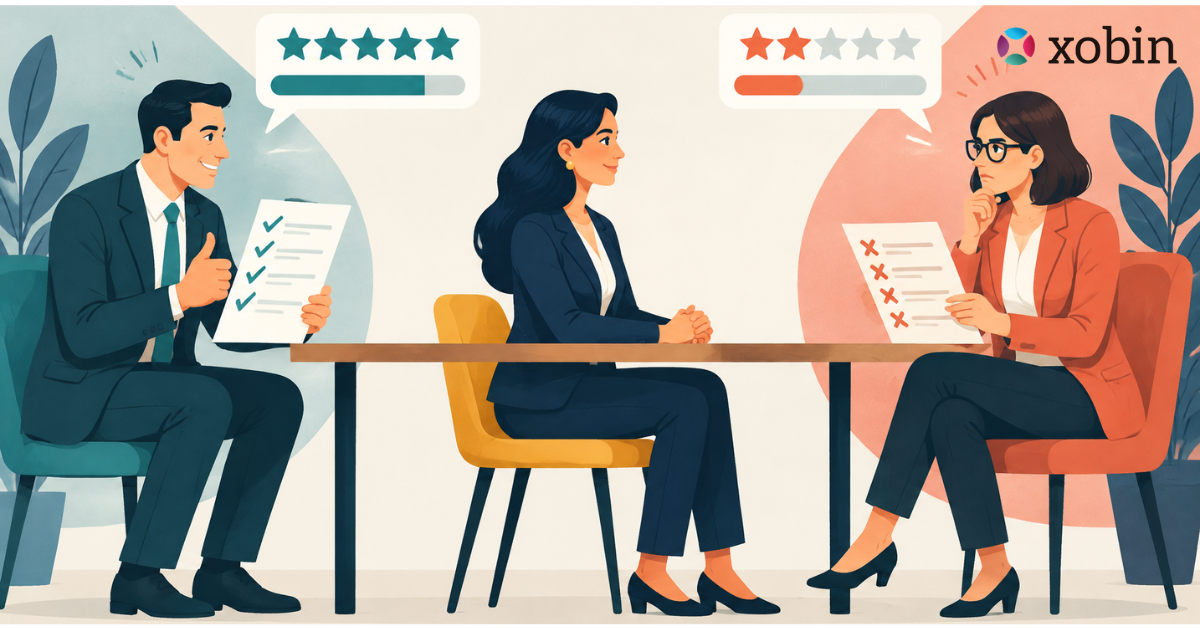
Interview scores swing between interviewers when each person asks different questions, uses their own idea of what a “4” means and fills in the score from memory later. The candidate isn’t the variable. The process is. Give every candidate the same questions, write down what weak, average and strong answers sound like, and have interviewers score on their own before the debrief.
Table of Contents
Most hiring teams have seen this. Two interviewers meet the same candidate on the same day. One writes “strong hire, 4 out of 5.” The other gives a 2 and adds “not sure she’s ready.”
Then the debrief turns into a negotiation. Whoever argues hardest usually wins.
It’s tempting to blame one interviewer for being too tough or too soft. But if it keeps happening across roles, the problem isn’t the people. It’s the setup they’re working in, and it’s the main reason teams move to a structured interview format.
TL;DR – Key Takeaways
- Big gaps between interviewers usually point to the interview design, not the candidate.
- Different questions, undefined rating scales and scoring from memory are the usual causes.
- More structure means more agreement between interviewers.
- Written examples of weak, average and strong answers give everyone the same yardstick.
- Scoring independently before the debrief stops the loudest voice from deciding.
Why do interview scores vary so much between interviewers?
Partly because of who’s doing the scoring. Mostly because of how the interview is set up.
People use the scale differently
Some interviewers rarely give anything below a 4. Others treat a 3 as high praise. Neither is wrong. They’re just reading the scale differently.
Then there are the habits psychologists have names for. The halo effect, where one great answer lifts every other rating. The contrast effect, where a decent candidate looks brilliant after a weak one and ordinary after a strong one. Central tendency, where someone scores almost everyone a 3 because committing feels risky. And similarity, where interviewers warm to people who remind them of themselves, is one of the most common forms of unconscious bias in hiring.
None of this makes someone a bad interviewer. These are normal human tendencies. A loose interview just gives them a lot of room.
The interview isn’t really the same interview
This is the bigger problem, and it’s the one you can fix. One interviewer asks about a past project. Another runs a hypothetical. A third chats about culture. Then they compare scores as if they’d measured the same thing.
Rating scales make it worse. “Rate communication from 1 to 5” means something different to everyone holding the pen. And when scores get filled in the next morning, the overall impression has usually replaced what the candidate actually said.
The debrief can tip it the rest of the way. If people talk before they commit to a score, the most senior or most confident person sets the tone and everyone else drifts toward them.
Structure is what changes it
The research here is consistent. A meta-analysis by Huffcutt, Culbertson and Weyhrauch, summarized in a 2017 review of interviewer rating research, put reliability between separate interviewers at about .40 for low-structure interviews. For highly structured ones, it was .61. Highly structured panel interviews reached around .78.
The U.S. Office of Personnel Management says the same in its guidance on structured interviews: more structure means higher validity, better rater reliability and agreement, and less adverse impact.
If you’re working out which method fits which stage, our comparison of psychometric testing and structured interviews explains where each one helps.
How can you tell if your interviewers are drifting?
Most teams feel it in debriefs but never check. You can, with data you already have.
Pull six months of interview scores and group them by interviewer. Look at three things for each person: their average score, how spread out their scores are and how often they recommend moving a candidate forward. A simplified example (the numbers are illustrative, not benchmarks):
| Interviewer | Average score (1 to 5) | Spread of scores | Recommends advancing |
| Interviewer A | 4.1 | Narrow | Most candidates |
| Interviewer B | 2.4 | Narrow | Very few |
| Interviewer C | 3.0 | Very narrow | About half, almost all scored 3 |
| Interviewer D | 3.2 | Wide | About half |
A is generous. B is tough. C plays it safe in the middle. D is the only one clearly separating strong candidates from weak ones. If A and B interview for the same role, a candidate’s result may depend more on the calendar than on their answers.
There’s a quicker check too. Record one interview, with the candidate’s consent. Have four or five interviewers score it on their own, then compare. If the scores run from 2 to 5 on the same answers, you don’t need statistics to see the problem.
How do you make interview scores consistent?
Use the same questions for everyone
Build a short set of questions from the role’s must-have skills and ask them of every candidate at that stage. Plan the follow-ups too. This alone removes the biggest source of drift.
Write down what each score sounds like
A behaviorally anchored rating scale spells out what a weak, average and strong answer looks like for each question. For a customer success role, with the question “Tell me about a time a client was unhappy with something you couldn’t fix,” it might look like this:
| Score | What the answer sounds like |
| 1 | Blames the client or another team. No clear action taken. |
| 3 | Describes listening to the client and escalating, but the follow-through is vague. |
| 5 | Explains the client’s real concern, what they did within their control, how they set expectations and what changed afterwards. |
Writing anchors for a role’s core questions isn’t a big job. Once they exist, two interviewers hearing the same story are comparing it to the same picture instead of their own.
Score first, discuss second
Ask interviewers to score each answer during the interview or within the hour, and to submit before anyone talks. Then start the debrief from the written scores. A gap becomes a question (“what did you hear that I missed?”) instead of a position to defend.
Calibrate regularly
Once a month or so, play one recorded answer. Everyone scores it alone. Reveal the scores together and talk through the differences using the anchors. The aim is for your toughest and most generous scorers to settle on a shared standard without anyone being singled out.
Let a structured AI interview take the first round
High-volume roles are where consistency breaks down most, because that’s where the most interviewers are involved. A structured AI interview asks every candidate the same questions and applies the same rubric every time. Controlled AI interviews keep the question set fixed, and our explainer on how AI interviewing works for recruiters covers the trade-offs. The AI scores the evidence. Your team still makes the call, and later rounds start from a consistent baseline.
Want every candidate scored against the same yardstick?
Xobin’s structured AI interviews ask role-specific questions in a fixed format and score answers against a defined rubric, so your first round doesn’t depend on who’s free that day. Book a 30-minute personalized demo and see a scored interview for one of your roles.
Which interview questions cause the most scoring drift?
Some questions almost guarantee disagreement, because there’s no clear picture of what a good answer looks like. These are the usual suspects, with a better alternative for each:
| Common question | Why scores drift | Ask this instead |
| “Tell me about yourself.” | There’s no right answer, so each interviewer scores their own impression | “Walk me through a project from last year that’s closest to this role.” |
| “Are you a team player?” | Everyone says yes, so scores reflect how convincing the yes sounded | “Tell me about a time you disagreed with a teammate. What happened?” |
| “What’s your biggest weakness?” | Rehearsed answers, scored on polish | “What’s a skill you’ve had to work hard to improve? How did you do it?” |
| “Would you fit in here?” | “Fit” means something different to every interviewer | Score against named values or behaviors the team has written down |
| Brainteasers | Scores depend on whether the candidate has seen the puzzle before | A short problem taken from the actual job |
You don’t need to ban open questions. Just make sure every scored question has an anchor behind it. If a question can’t be anchored, it probably shouldn’t carry a score.
Score every candidate the same way, from the first round
Xobin’s structured AI interviews, role-specific skills tests and scored reports give your hiring team one consistent baseline for every candidate, before human interviewers add their judgment. Book your 30-minute personalized demo and we’ll show you a structured, scored interview built around one of your open roles.
Frequently asked questions
Is it normal for interviewers to disagree about a candidate?
Some disagreement is healthy, especially when interviewers assess different skills. The warning sign is a big gap on the same evidence, like two people scoring the same answer very differently. That usually points to unclear questions or undefined scores.
How many interviewers should each candidate score?
More than one, scoring on their own. Combining several independent ratings smooths out individual leniency or severity. Adding interviewers without shared questions and anchors mostly adds noise, though.
Should we average interview scores or discuss them?
Both, in that order. Collect independent scores first, look at the average and the spread, then discuss the answers behind any big gaps before deciding.
Can AI make interview scoring fairer?
AI can make scoring more consistent because it applies the same rubric to every answer. It still needs regular checks for bias, and a person should make the final hiring decision.