Imagine having the power to predict a candidate’s potential before they even step foot in the door. Psychometric tests can do this for you! These scientifically-backed tools provide deeper insights into a candidate’s cognitive abilities, personality, and potential, helping you make more informed, unbiased hiring decisions. But how can you ensure you’re using them effectively to make the best hiring decisions? In this blog, we’ll explore how you can use psychometric assessment test effectively in recruitment to transform your hiring process and find top talent. Let’s dive in!
TL;DR – Key Takeaways
- Psychometric assessment tests measure cognitive abilities, personality traits, emotional intelligence, and behavioral tendencies to provide insights into candidates’ suitability for a role.
- Define the skills and traits essential for the role, then choose assessments that match those requirements.
- Select research-backed tests with strong validity and reliability, ensuring they measure relevant attributes and produce consistent results over time.
- Integrate assessments into appropriate recruitment stages, using results alongside interviews, past experience, and other evaluation methods rather than as the sole hiring criterion.
- Explain why assessments are included, reassure candidates that results are not the only deciding factor, and provide feedback when possible.
The Science Behind Psychometric Assessment test
Psychometric Assessment Tests are scientifically designed tools that measure various attributes such as cognitive abilities, personality traits, emotional intelligence, and behavioral tendencies. These assessments provide insight into a candidate’s potential fit for a role, their ability to perform under pressure, and their compatibility with your company culture.
The underlying science behind psychometric tests is rooted in psychology and psychometrics. It is the study of psychological measurement. By using established statistical models, psychometric assessment tests are able to offer objective and consistent measures of a candidate’s skills, personality, and cognitive capabilities. This contrasts with traditional hiring methods, which can often be influenced by unconscious bias or subjective judgment.
Two key concepts that every recruiter should understand when considering a psychometric assessment test are validity and reliability.
- Validity refers to how well the test measures what it’s supposed to measure. For example, if a test is designed to assess problem-solving skills, it should only measure those skills and not general intelligence or irrelevant traits. It ensures the results are meaningful and relevant to the role you’re hiring for.
- Reliability, on the other hand, relates to how consistent the test results are over time. A reliable Psychometric Assessment Test will produce the same results if taken multiple times by the same individual, ensuring that your hiring decisions are based on stable data, not one-off anomalies.
Psychometric assessment tests with high validity and reliability provide a more accurate, consistent, and fair means of evaluating candidates than traditional resume screening or unstructured interviews.
How to Use Psychometric Assessment Tests Effectively?
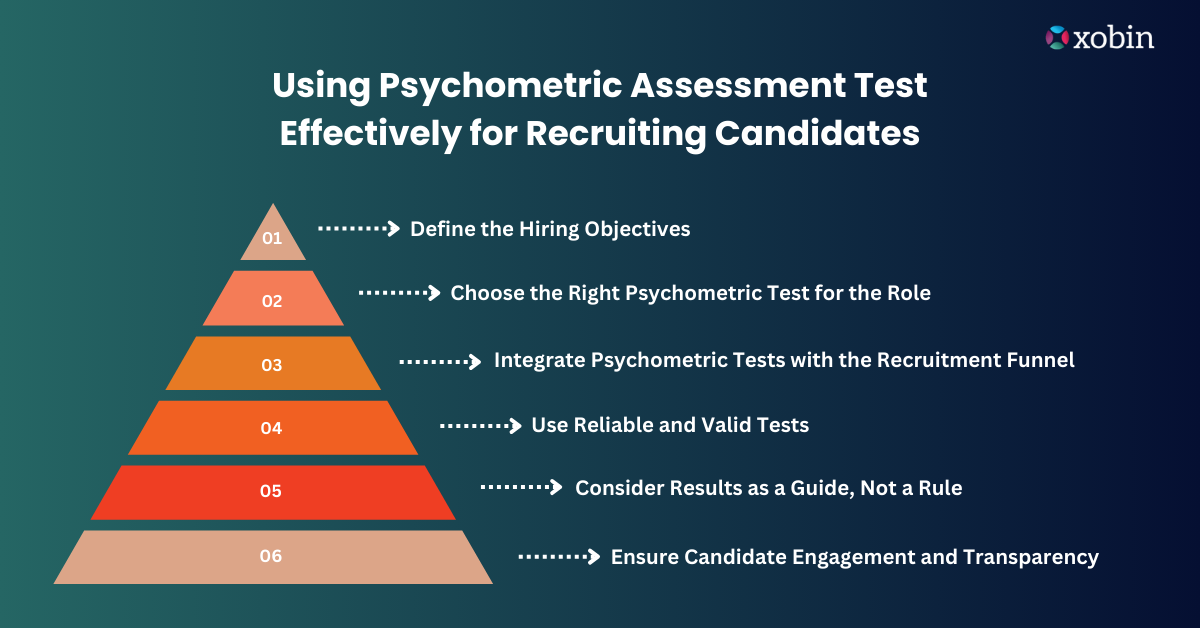
To get the most out of psychometric assessment test, it’s important to use them strategically and effectively. Here’s a step-by-step guide on how to implement these tests in your recruitment process:
1. Define the Hiring Objectives
Before implementing psychometric assessment tests, recruiters must determine what skills and traits are essential for the role. Ask yourself:
- Explain why the test is part of the hiring process.
- Assure them it’s not the only deciding factor.
- Provide feedback if possible.
2. Choose the Right psychometric assessment test for the Role
There are many different types of psychometric assessment tests, including those that measure cognitive abilities, personality traits, and emotional intelligence. It’s important to select the right test based on the requirements of the role. Different tests serve different purposes. Here are some common types:
- Aptitude Tests: Evaluate logical reasoning and problem-solving skills.
- Personality Tests: Assess workplace behavior and cultural fit.
- Cognitive Ability Tests: Measure memory, attention to detail, and analytical thinking.
- Situational Judgment Tests (SJT): Present real-world scenarios to assess decision-making skills.
For example, for a sales role, a test assessing emotional intelligence and persuasion skills would be useful, while for a technical role, cognitive ability and problem-solving skills are more relevant.
3. Integrate Testing with the Recruitment Funnel
A psychometric assessment test should be part of your overall recruitment funnel. Rather than using them as a one-time tool, consider integrating them at multiple stages of the process to get a fuller picture of each candidate. Psychometric assessments should be integrated at the right stage of recruitment. Most recruiters use them:
- Before interviews – Filter out unsuitable candidates early on to shortlist top candidates.
- After first-round screening – Use test results to frame better interview questions to refine selections further.
- Before final hiring decisions – To confirm cultural and skill fit.
4. Use Reliable and Valid Tests
Not all psychometric assessment tests are scientifically valid. Using a trusted psychometric test provider ensures credibility and better hiring results. Choose tests that are:
- Backed by research
- Used by top recruiters
- Proven for predictive accuracy.
5. Use Results as a Guide, Not a Rule
Psychometric assessment tests are valuable tools, but they shouldn’t be the sole determining factor in your hiring decisions. Use the results as part of a broader assessment that includes interviews, past experiences, and other evaluation methods. The goal is to combine multiple data points to get the most accurate picture of a candidate. Once candidates complete the tests, analyze the reports carefully. Look at:
- Overall score compatibility against job role benchmarks.
- Behavioral patterns that align with the role
- Red flags that indicate potential challenges.
6. Ensure Candidate Engagement and Transparency
If a candidate completes a psychometric assessment test, provide feedback if possible. Whether they were successful or not, candidates appreciate understanding how they performed and why certain traits matter for the role. This transparency builds trust and strengthens your employer brand. When candidates feel engaged, they are more likely to complete the assessments sincerely.
- Explain why the test is part of the hiring process.
- Assure them it’s not the only deciding factor.
- Provide feedback if possible.
Get Started with Xobin’s Psychometric Assessment Tests!
Xobin’s psychometric assessment tests help recruiters gain deeper insights into a candidate’s cognitive abilities, personality traits, and behavioral tendencies.
- Identify the key cognitive, behavioral, and leadership traits needed for the role.
- Choose from Cognitive Aptitude, Logical Reasoning, Analytical Skills, or Behavioral Tests based on job requirements.
- Use Personality Inventory to evaluate 100+ personality traits like teamwork, leadership, or emotional intelligence.
- Get detailed reports on candidates’ strengths, weaknesses, and suitability.
- Use test results to shortlist the best candidates.
Take a personalized demo today to experience how Xobin is transforming the future of recruitment!