
A single job post can pull in thousands of applications in a week. Most recruiters still spend those first days reading resumes, chasing replies and juggling calendars, and by the time screening starts, the strongest candidates have often moved on.
AI agents for recruiting are built to close that gap. They don't just suggest the next step. They take it, then hand you a shortlist you can actually act on. This guide explains what these agents are, how they work under the hood, and which five are worth a closer look in 2027.
TL;DR - Key takeaways
- An AI agent for recruiting is software that takes a hiring goal, plans the steps, uses connected tools to carry them out, and checks its own results, with a recruiter approving key decisions.
- The difference from older AI tools is action. A chatbot answers, a copilot suggests, an agent does the work across several steps.
- Most agents run a loop: understand the role, find or receive candidates, screen and interview them, score the evidence, then hand a shortlist to a human.
- Recruiting is where HR uses AI most. SHRM's State of AI in HR 2026 puts it at 27% of organizations, ahead of every other HR function.
- The five AI recruiter agents compared here are Xobin NURA, LinkedIn Hiring Assistant, Workable AI Agents, Eightfold AI Interviewer and Workday Paradox (Olivia). Each is strongest at a different stage of the funnel.
- In the EU, AI used for recruitment and selection counts as high-risk under the AI Act, with obligations now due from 2 December 2027. New York City already requires an annual independent bias audit for automated hiring tools.
What are AI agents for recruiting?
AI agents for recruiting are AI systems that complete multi-step hiring work on their own. You give the agent a goal, such as "shortlist 20 qualified backend engineers for this role." It then plans the steps, uses connected tools like your ATS, calendar and assessment platform to act, reviews its own output, and passes the result to a recruiter for the final call.
That last part matters. A good recruiting agent doesn't replace the hiring decision. It replaces the hours of resume reading, follow-up emails, scheduling back-and-forth and first-round screening calls that sit between a job opening and a useful shortlist.
Adoption is still early but moving fast. Recruiting is already the HR function where AI shows up most: SHRM's State of AI in HR 2026, based on a survey of 1,908 HR professionals, found 27% of organizations use AI in recruiting, ahead of HR technology at 21% and learning and development at 17%. Seven of the top ten AI use cases in HR sit inside recruiting. Agents are the next step on top of that base, and HR professionals already use AI agents for recruiting tasks.
If you're looking for the wider category of AI hiring software, including tools that aren't agents, our guide to the best AI recruiting tools covers that ground. This post stays focused on agents: what makes them different, how they actually work, and which ones are worth a demo.
How is an AI recruiting agent different from ATS automation, chatbots and copilots?
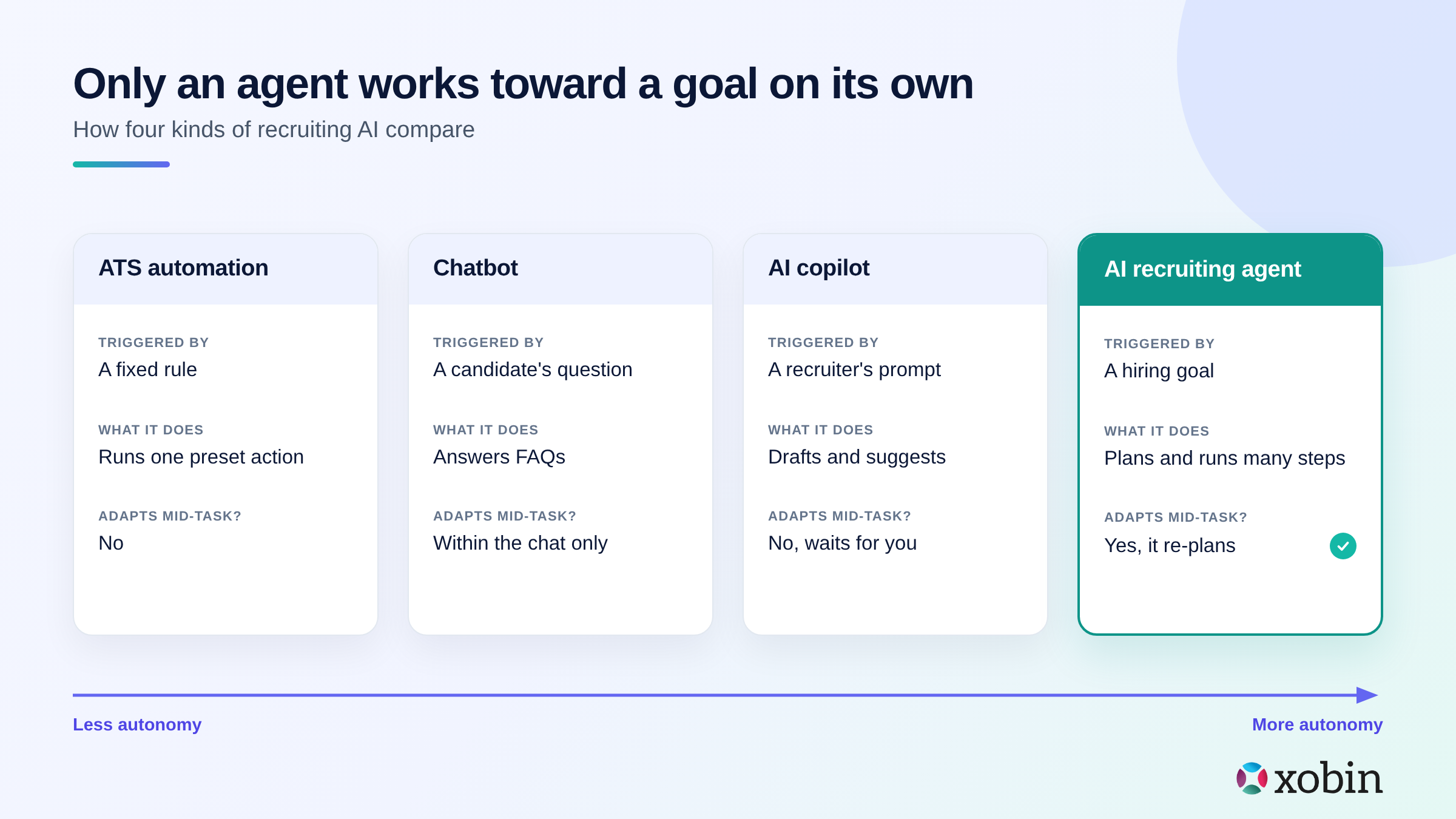
An AI recruiting agent acts toward a goal across many steps and adapts when something changes. Automation follows fixed rules, a chatbot answers questions, and a copilot drafts or suggests while a human does the work.
Most vendors now use the word "agent," so this distinction helps you sort real agents from relabelled features.
| Type | What triggers it | What it does | Adapts mid-task? | Example in hiring |
|---|---|---|---|---|
| ATS automation | A fixed rule ("if status = rejected, send email") | Runs one predefined action | No | Auto-rejection email after a knockout question |
| Recruiting chatbot | A candidate's question | Answers FAQs, collects basic details | Within the conversation only | "What's the salary range?" answered on the careers page |
| AI copilot | A recruiter's prompt | Drafts a job description, summarises a resume, suggests a search string | No, waits for the next prompt | "Write a JD for a senior data analyst" |
| AI recruiting agent | A hiring goal | Plans and runs several steps: sources, screens, interviews, scores, schedules | Yes, re-plans based on results and recruiter feedback | "Find and screen 20 qualified analysts, book the top 8 with the hiring manager" |
A quick test during demos: ask the vendor what happens when the first batch of candidates is weak. A copilot waits for you to search again. An agent should widen or adjust the search on its own, tell you what it changed, and keep going.
It's also fair to say that most agents sold today are semi-autonomous. They run the routine steps independently and stop at defined checkpoints for human approval. For hiring, that's a feature. It keeps people accountable for decisions that affect someone's livelihood.
How do AI recruiting agents work?
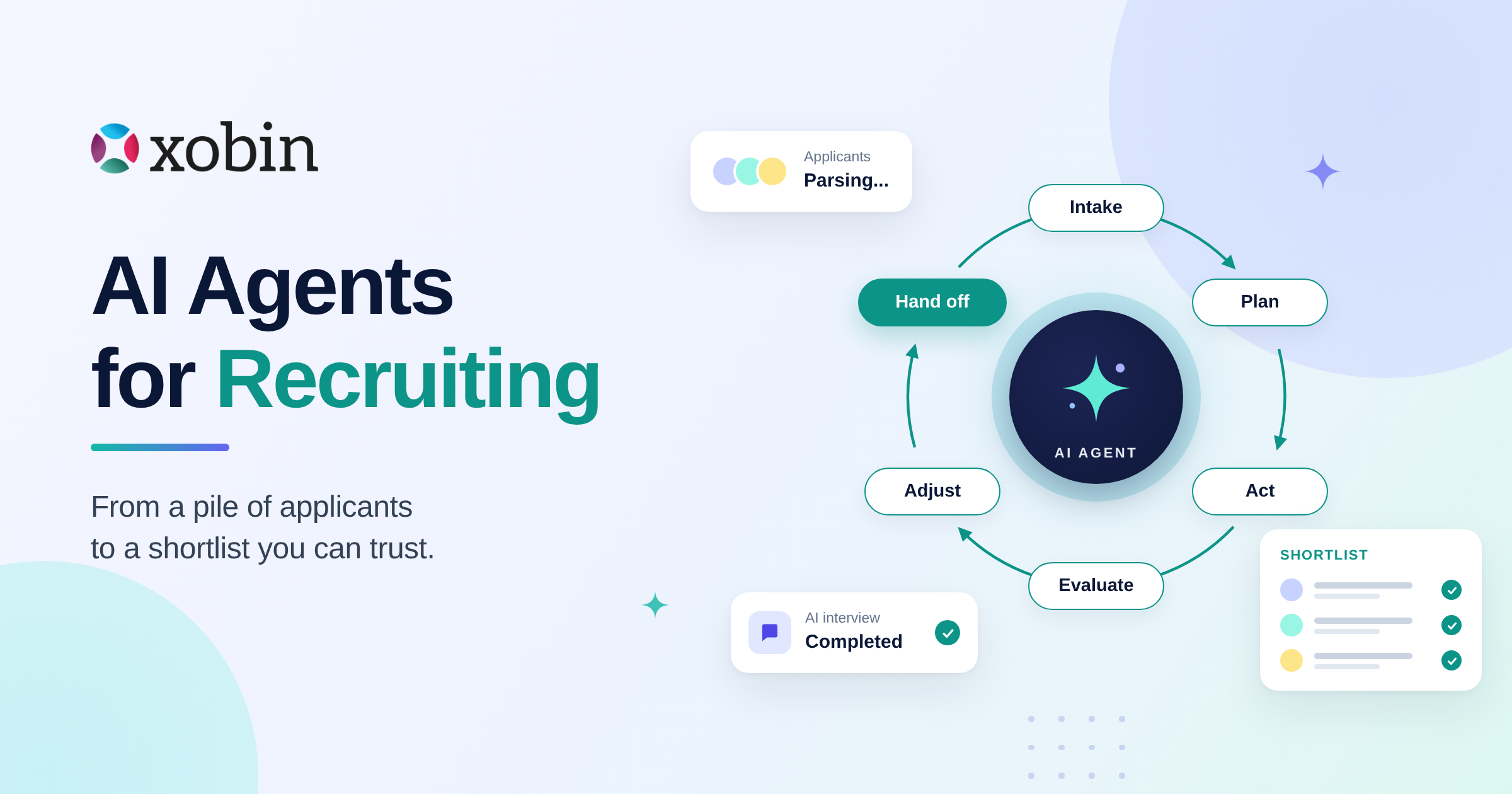
AI recruiting agents work in a loop: they take in the hiring goal, plan the steps, act through connected tools, check the results against the role's criteria, and hand qualified candidates to a recruiter. Recruiter feedback then flows back in and sharpens the next round.
Six parts sit inside every recruiting agent
- A goal and its criteria. The job requirements, must-have skills, location, budget and deadline. Strong agents ask intake questions when this is vague instead of guessing.
- Data and context. Resumes, ATS records, past applicants, talent pools and the job description. The quality of this data sets the ceiling on everything else.
- A reasoning model. Usually a large language model that breaks the goal into tasks and decides what to do next.
- Tools it's allowed to use. Search, email and SMS, calendars, assessment libraries, AI interviews, the ATS itself. An agent without tool access is just a chatbot.
- Memory. What the recruiter liked and rejected last time, which messages got replies, how this hiring manager scores candidates.
- Guardrails and checkpoints. Rules on what the agent may do alone and where it must stop for a human, plus an audit trail of every action and score.
The loop, step by step
- Intake. The recruiter shares the role. The agent turns notes or a JD into structured criteria and confirms them.
- Plan. It decides where candidates will come from (inbound applicants, an internal pool, external search) and what evidence it needs for each.
- Act. It parses resumes, sends outreach, invites candidates to an assessment or AI interview, and answers their questions.
- Evaluate. It scores each candidate against the criteria and explains the score with evidence: which skills were shown, where answers were weak.
- Adjust. If the pool is thin or scores cluster too low, it changes the plan. It might widen the search or re-contact candidates who skipped a question.
- Hand off. Qualified candidates go to the recruiter with a summary, and interviews get booked on the hiring manager's calendar. The human decides who moves forward.
Weak results send the agent back to planning, and recruiter feedback on each shortlist feeds the next intake.
What this looks like on a real requisition
Picture a retail bank hiring 40 customer service associates, with 3,000 applications arriving in a week. Without an agent, a team of recruiters reads resumes for days and starts phone screens a week later, by which time the best applicants have accepted other offers.
With an agent, parsing starts as each application lands. Every candidate who clears the basics gets an invite to a short AI interview and a communication test that same day, at whatever hour suits them. The agent scores each response against the same rubric, chases the ones who dropped off halfway, and sends recruiters a ranked shortlist with the evidence behind each score. Recruiters spend their time on the final conversations and the offer, which is where human judgment counts most.
The principle Xobin follows is simple: AI structures the evidence and flags what needs attention, and the hiring team makes the decision.
What can AI recruiting agents do across the hiring funnel?
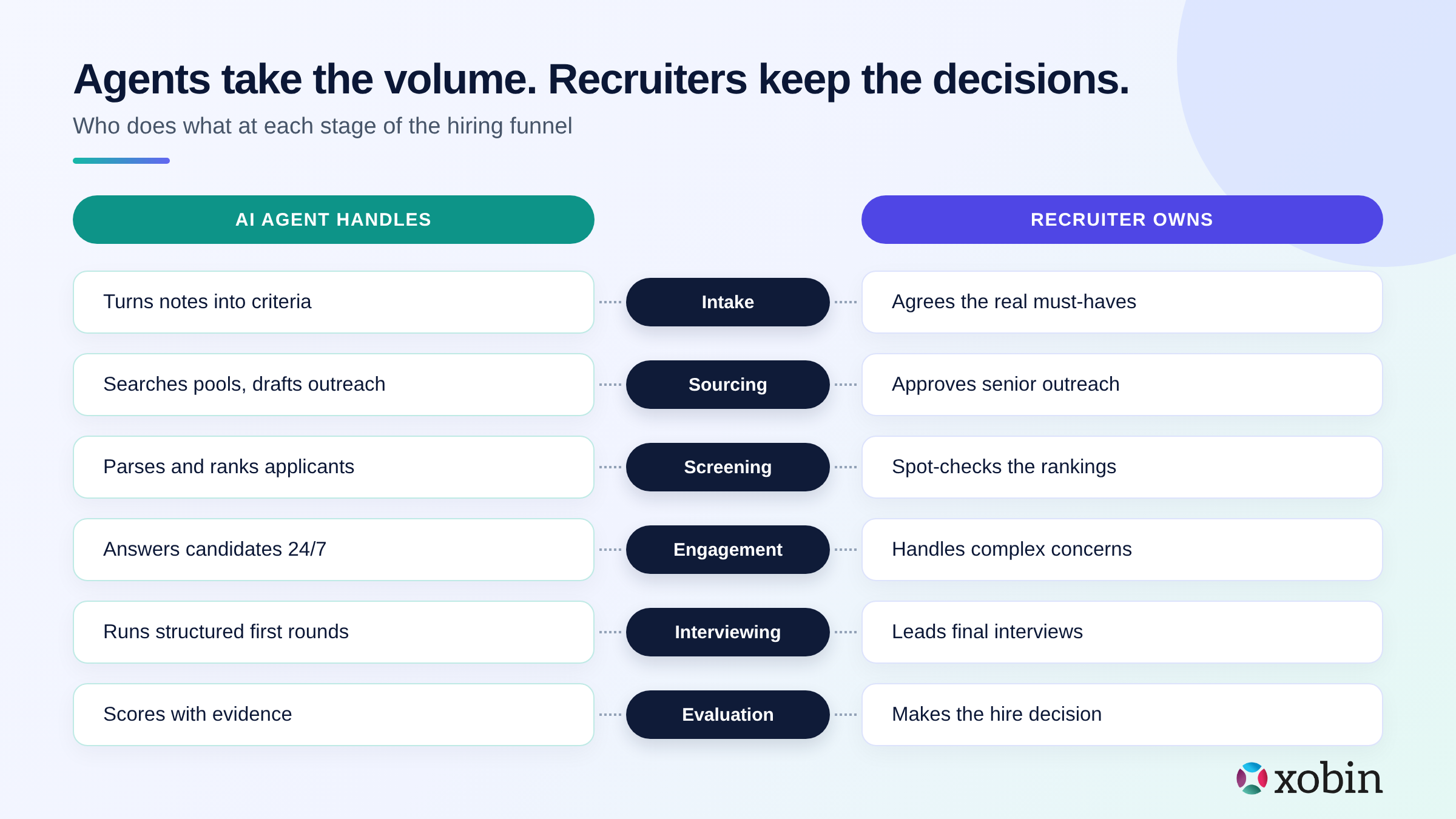
AI recruiting agents can handle sourcing, resume screening, candidate outreach, scheduling, first-round interviews, skills evaluation and candidate Q&A. Final selection, offers and relationship-heavy conversations stay with recruiters and hiring managers.
| Funnel stage | What the agent does | What the recruiter still owns |
|---|---|---|
| Intake | Turns rough notes into structured criteria, asks clarifying questions | Agreeing the real must-haves with the hiring manager |
| Sourcing | Searches talent pools and past applicants, drafts personalised outreach | Approving who gets contacted for senior or sensitive roles |
| Screening | Parses resumes and ranks applicants against the criteria | Spot-checking rankings and overriding where context is missing |
| Engagement | Answers candidate questions 24/7, chases incomplete applications | Handling candidates with complex questions or concerns |
| Interviewing | Runs structured first-round AI interviews and skills tests | Final interviews and culture conversations |
| Evaluation | Scores answers with evidence, flags integrity issues | The hire or no-hire decision |
| Scheduling | Books interviews across calendars and handles reschedules | Nothing, in most cases |
| Reporting | Tracks drop-off, time-in-stage and source quality | Acting on what the numbers show |
The biggest gains usually come from the middle of the funnel. Screening and first-round interviews are where volume piles up and where speed decides whether a strong candidate is still available. That's also where an agent tied to validated assessments earns its keep, because a ranking is only as good as the evidence behind it. A score based on how a candidate actually solved a problem in a skills assessment or answered in a structured AI interview holds up far better than one based on keywords in a resume.
What are the top 5 AI agents for recruiting in 2027?
The top AI agents for recruiting are Xobin NURA, LinkedIn Hiring Assistant, Workable AI Agents, Eightfold AI Interviewer and Workday Paradox (Olivia). NURA covers the early funnel end to end, LinkedIn leads on sourcing, Workable suits SMBs on its ATS, Eightfold suits large enterprises, and Paradox leads on high-volume candidate conversations.
We picked tools that run multi-step work on their own rather than single features with an "agent" label, that are commercially available, and whose capabilities are publicly documented. Xobin NURA is our own product. We've held it to the same standard as the others and listed its limits too.
| Agent | Strongest stage | Best for | How it's sold |
|---|---|---|---|
| Xobin NURA | Screening to qualified handoff (parse, outreach, AI interview, evaluation) | Enterprises, staffing firms and campus hiring with high volume across tech and non-tech roles | Custom, via demo |
| LinkedIn Hiring Assistant | Sourcing and outreach | Teams that source heavily on LinkedIn | Add-on to LinkedIn Recruiter |
| Workable AI Agents | Job brief to screening and candidate chat | SMBs and mid-market teams already on Workable | Paid add-on, credit-based |
| Eightfold AI Interviewer | Structured AI interviewing at enterprise scale | Large and regulated enterprises | Enterprise quote |
| Workday Paradox (Olivia) | Candidate conversations and scheduling | Frontline and hourly hiring at high volume | Enterprise quote |
Xobin NURA
NURA is Xobin's AI recruiting agent. One agent parses resumes, reaches out to candidates, screens them, runs the AI interview, evaluates each answer, schedules qualified candidates with recruiters and updates the ATS.
Xobin launched NURA on 14 July 2026 for enterprise recruitment. What sets it apart is that the agent sits on top of a full assessment platform, so it judges what candidates can actually do instead of ranking resume text. NURA's candidate scorecard rates technical skills, communication, problem solving, adaptability and behaviour, plus an overall score.
- How it works: NURA works on eight stages: parse resumes, outreach, screen, interview, evaluate, schedule, hire and grow. The last two stages reflect that Xobin covers talent management after the hire, not only recruiting.
- Interviews that adapt: questions shift with the conversation, follow-ups are context-aware, and every answer is analysed as it's given.
- Recruiter handoff: the recruiter starts where NURA finishes. Their inbox shows each candidate's progress (resume parsed, interview completed, evaluation done, interview scheduled) and opens to a full profile with the score and a Qualified status.
- Scale and coverage: Xobin reports NURA parses 1 million resumes in about 10 minutes, covers 9,000+ job roles, works in 20+ languages, and each AI interview takes 5 to 10 minutes.
- Control: teams configure role-specific interviews and evaluation frameworks, so every candidate is measured against the same criteria.
- Trust: GDPR compliant, ISO 27001 certified, SOC 2 and CSA STAR.
- Best for: enterprises, staffing firms, GCCs and campus programmes hiring for technical, business, customer-facing and leadership roles.
- Limits: its depth is in the early funnel, from application to qualified handoff, so offer negotiation stays with your team. It also launched more recently than LinkedIn's, Eightfold's and Paradox's agents, so it has a shorter public track record.
LinkedIn Hiring Assistant
Hiring Assistant is LinkedIn's AI agent for recruiters. It runs intake, searches LinkedIn for matching candidates, evaluates applicants, drafts outreach and prescreens interested candidates by voice or text.
Its edge is data. The agent draws on LinkedIn's member network and combines it with applicant data from your ATS. LinkedIn's own July 2026 figures say recruiters view 83% fewer profiles to find qualified matches and reach interview-quality candidates 33% faster.
- What it does: intake questions and sourcing strategy, dozens of searches per role, applicant evaluation, personalised messages, prescreening and interview scheduling.
- Control: you choose which projects it works on, it only performs tasks you request, and you can give feedback at each step.
- Languages: English, French, German, Dutch, Spanish, Portuguese and Italian.
- Best for: corporate and agency recruiters who already live in LinkedIn Recruiter.
- Limits: it's an add-on to LinkedIn Recruiter, ATS integration varies by partner, and candidates who aren't active on LinkedIn are harder for it to reach. It doesn't replace a validated skills test.
Workable AI Agents
Workable offers four AI agents (Job Brief, Sourcing, Screening and Engagement) that work together inside its ATS to create job briefs, source passive candidates, score applicants and follow up with them.
Workable made the agents generally available in September 2026. The Screening Agent scores each applicant against an ideal candidate profile across 14 dimensions. When an application is missing information, the Engagement Agent opens a chat with the candidate, collects answers and re-scores them.
- Transparency: each candidate record shows the agent's status and planned next steps, and recruiters can see what the agent asked and why it gave each score.
- Pricing: credit-based. Every plan includes 3,000 free AI credits; screening costs 1 credit per candidate, sourcing 2 and a completed candidate chat 10.
- Extras: a Workable MCP Server connects the agents to AI assistants like Claude and ChatGPT at no extra cost.
- Best for: small and mid-sized teams that already use Workable as their ATS.
- Limits: the agents live inside Workable, so they're only an option if you're on its ATS. Its screening scores applicants against a candidate profile, so check how it handles hands-on skills testing for technical roles.
Eightfold AI Interviewer
Eightfold AI Interviewer is an agentic interviewer that conducts structured candidate interviews, asks role-relevant follow-up questions and gives human interviewers consistent insights to review.
Eightfold built it on its talent intelligence platform and keeps extending its scope. Its 360 Interview capability combines screening, role fit, coding, case study and language evaluation into a single 60-minute session. In November 2026 Eightfold also announced AI Recruiting Teammate, a goal-driven agent for the full workflow, which is in preview, with testing among a small group of customers planned for late November.
- Trust: SOC 2, ISO 27001 and ISO 42001 certifications, FedRAMP Moderate authorization.
- Integrations: agentic interview intelligence is embedded in Oracle Recruiting Cloud.
- Best for: large and public-sector employers that need enterprise governance.
- Limits: priced and implemented at enterprise level, which can be heavy for smaller teams. The broader end-to-end agent isn't generally available yet.
Workday Paradox (Olivia)
Paradox's Olivia is a conversational candidate experience agent. It answers candidate questions instantly, screens applicants, lets them self-schedule interviews and supports them around the clock over text, chat and messaging apps.
Workday completed its acquisition of Paradox in October 2025, and it's now sold as the Candidate Experience Agent within Workday's recruiting suite. Olivia is known for frontline hiring, where speed of response decides whether an hourly applicant shows up at all.
- What it does: conversational application, screening questions, interview scheduling and rescheduling, reminders and FAQs.
- Reach: SMS and WhatsApp messaging, with support for 100+ languages.
- Best for: retail, hospitality, logistics and healthcare employers hiring hourly staff at volume.
- Limits: its strength is conversation and scheduling, not deep skills or technical evaluation. Its roadmap now follows Workday, which suits Workday customers more than others.
How do you choose the right AI recruiting agent?
Choose an AI recruiting agent by starting with your bottleneck, then checking what evidence it scores candidates on, where it stops for human approval, how it fits your ATS, and whether the vendor can show bias testing and security certifications.
Feature lists all look alike after the third demo. These questions separate the agents that will hold up in production:
- Where does your hiring actually stall? If you can't find candidates, look at sourcing agents. If you drown in applicants, look at screening and interviewing agents. If candidates go quiet, look at conversational agents.
- What evidence sits behind each score? Ask to see a scored candidate. Can the agent point to the answer, test result or skill that drove the rank? Resume keywords alone are weak evidence.
- Where are the human checkpoints? You should be able to set which actions run alone (scheduling) and which need approval (rejections, senior-role outreach).
- Does it work with your stack? Check native integrations with your ATS, calendar and messaging tools, and whether data syncs both ways.
- Can it handle your volume and roles? A tool tuned for software engineers may struggle with nurses or store managers, and the reverse.
- How does it protect test integrity? For AI interviews and assessments, ask about proctoring, identity checks and detection of AI-assisted answers.
- What's the bias and compliance story? Ask for bias audit results, adverse impact monitoring and how candidates are notified that AI is involved.
- Is security verified? Look for SOC 2, ISO 27001 and GDPR compliance at minimum, and ISO 42001 if you want an AI-specific management standard.
- How is it priced? Per seat, per credit or per hire changes the maths a lot at high volume. Model a busy month before you sign.
What are the risks of AI agents in recruiting, and where should humans stay in the loop?
The main risks are biased scoring, decisions nobody can explain, candidate distrust and non-compliance with AI hiring laws. Keeping humans responsible for final decisions, auditing outcomes regularly and telling candidates when AI is used addresses most of them.
An agent that acts on its own can also make mistakes on its own, and at scale. A flawed rule applied to 10,000 applicants is a much bigger problem than one recruiter's bad afternoon.
The rules are already here
- European Union. The AI Act classes AI used for recruitment and candidate selection as high-risk. That brings duties around risk management, data quality, transparency and human oversight. The Digital Omnibus on AI, which entered into force on 27 July 2026, moved the deadline for these obligations to 2 December 2027. It's a delay, not an exemption.
- New York City. Local Law 144 bars employers from using an automated employment decision tool unless it has had an independent bias audit within the past year. Employers must publish a summary of the results and notify candidates before the tool is used. The employer, not the vendor, carries responsibility for compliance.
Five safeguards worth putting in place
- Keep a named person accountable for every hire and rejection decision.
- Require the agent to log its actions and explain every score in plain language.
- Review pass rates by gender, age band and other protected groups at least quarterly.
- Tell candidates when AI is part of the process and offer a route to a human or an alternative assessment.
- Re-check the agent's criteria whenever the role, market or job description changes.
Xobin publishes its research on validation, proctoring and AI bias for this reason. Buyers should expect the same openness from any vendor whose agent scores people.
The bottom line
An AI recruiting agent is worth adopting when it removes a real bottleneck and scores people on evidence you'd be comfortable defending. Pick the stage where hiring stalls, shortlist agents that are strong there, and judge them on transparency and control as much as speed.
If screening and first-round interviews are where your team loses time, see how NURA works on your own roles in a 30-minute demo.


