


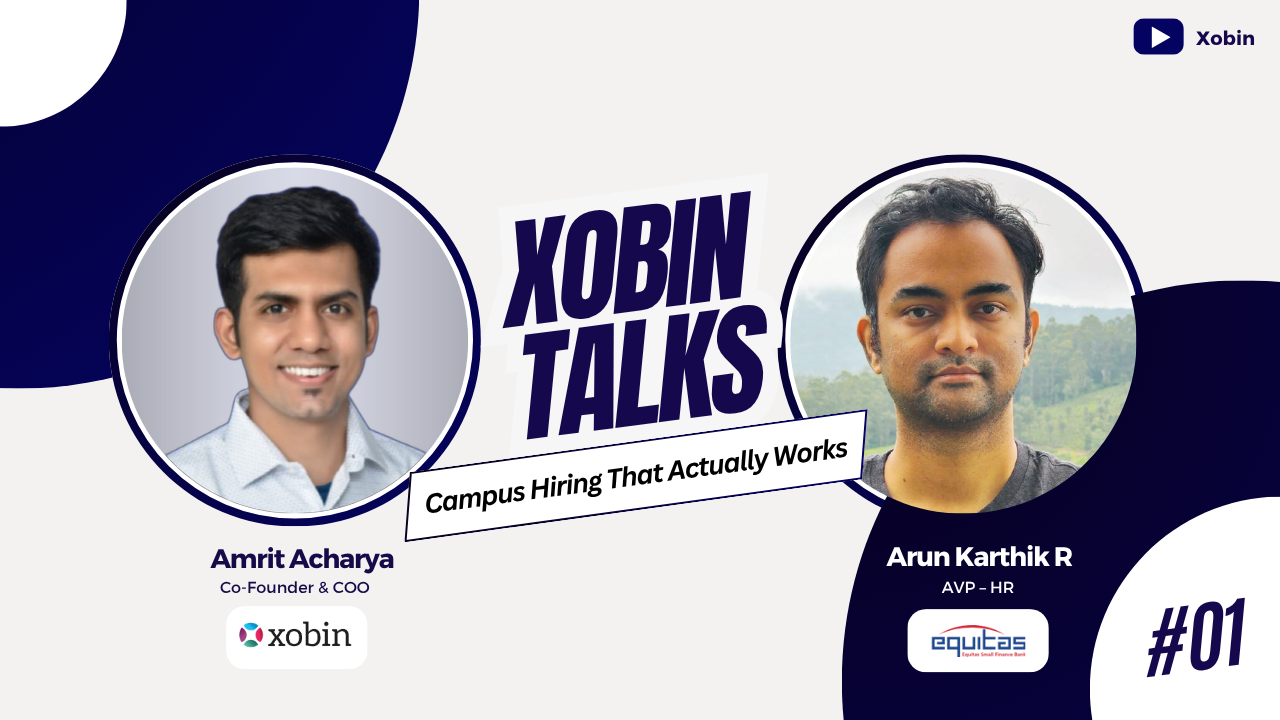
| GUEST PROFILE Arun Karthik, AVP – HR at Equitas Small Finance Bank Connect: LinkedIn |
This episode was hosted by Amrit Acharya, COO of Xobin.
Table of Contents
TL;DR – Key Takeaways
- Only 51% of Indian graduates are considered job-ready due to gaps in vocational and practical training (Economic Survey, 2024). Choosing the right campuses is not optional. It determines your hiring ROI from day one.
- Campus hiring is never a one-person job. Team size should scale directly with hiring volume: 10-15 hires need one strong manager; 500+ hires need a dedicated multi-function team.
- A realistic joining rate in campus hiring is 75-80%. If your drop-off rate is running at 40%, you likely have a pre-joining engagement gap, not a sourcing problem.
- Efficiency alone will not move the needle anymore. Freshers in 2025 expect a personalized experience from offer to onboarding, not just a slot in a recruitment pipeline.
- Campus hiring should be treated as a long-term relationship with institutions, not a one-shot transaction. The companies that return every year consistently win better talent.
Campus recruitment has a short-termism problem.
A company decides it needs young talent. It identifies a few colleges, runs a drive, fills its headcount, and moves on. If the experience is underwhelming or the joining rate disappoints, many never go back. The cycle restarts from scratch the next time a headcount gap opens up.
Arun Karthik has seen this pattern from both sides. As a Computer Science graduate who went through campus placements himself, and then as an AVP HR at Equitas Small Finance Bank managing campus hiring for a scaled BFSI organization, he brings an unusually complete perspective to a process that most companies underestimate.
In this episode #1 of Xobin Talks, host Amrit Acharya, COO of Xobin, sat down with Arun to unpack the full lifecycle of campus hiring: how to build a college list, how to structure your team, what metrics actually matter, where the drop-off problem really starts, and how much has genuinely changed in recent years.
How Should a Company Build Its Target List of Colleges?
The right college list is never generic. It is built around your specific role requirements and hiring volume. According to Deloitte’s Campus Workforce Trends Report 2025, campus hiring budgets in India increased 15% in FY25, yet organizations are simultaneously getting more selective about which institutions they visit (Deloitte India, 2025). Spending more while targeting more precisely is the new playbook.
Arun’s approach to this starts with a distinction most HR teams skip: established companies already have tiered campus lists built over years of data. They know which Tier 1, Tier 2 and Tier 3 institutions consistently produce the profiles they need. Companies doing campus hiring for the first time do not have that data, and they should not pretend to.
His practical framework works in two directions simultaneously. First, define the role clearly. A generic relationship banking role can be filled through a broader institutional net. A specialized credit or analytics role requires a more targeted academic profile, which narrows your college list considerably. Second, match the list to your volume. If you need 15 hires, trying to manage 40 campus relationships will exhaust your team without improving your outcomes. If you need 400 to 500 hires, a two or three institution shortlist will not get you there.
The list is a living document. Every cohort that joins should be tracked against their source institution. Over time, that performance data tells you which campuses to move up in priority and which ones to phase out – a discipline that separates systematic campus hiring programs from ad hoc drives.
Arun draws on direct experience managing campus programs at both ICICI Bank and Equitas Small Finance Bank – two institutions with very different hiring volumes and candidate profiles, giving him a grounded view of what works across different organizational contexts.
How Should a Company Structure Its Campus Hiring Team?
Team size should scale directly with hiring volume. Trying to run a large campus program with one person is the most common reason companies fail at it. In India, campus recruitment accounts for 60% or more of entry-level IT and BFSI hiring (Hyring Research, 2025). That kind of volume requires dedicated infrastructure, not borrowed bandwidth.
Arun is clear that the team structure question has no single answer, but the scaling logic is consistent.
For a company hiring 10 to 15 people from campus, a capable hiring manager handling the process end-to-end is perfectly reasonable. The volume is manageable and the coordination overhead is low.
For a mid-sized organization targeting 40 to 50 campus hires, a two or three person team becomes necessary. One person cannot simultaneously manage college relationships, coordinate interview panels, handle offer logistics and drive pre-joining engagement without something breaking.
For large organizations running quarterly drives at scale – the IT companies hiring 3,000 to 4,000 freshers per quarter – a dedicated campus team covering outreach, online skills assessments, interviewing, coordination and onboarding becomes the only viable model. At that scale, campus hiring is not a seasonal HR activity. It is a year-round business function.
The underlying principle: build your team for the volume you are actually targeting, not for the volume you wish you could afford. An undersized team running an oversized program produces poor candidate experience, strained college relationships and joining rates that disappoint everyone.
What Has Actually Changed in Campus Hiring Over the Last Five Years?
The biggest shift is that efficiency is no longer enough. Freshers in 2025 expect a personalized experience, and companies that deliver only processes are losing candidates to those that deliver relationships. Deloitte’s 2025 Campus Workforce Trends Report found a 24% increase in pre-placement offers and conversions across degree programmes in FY25, driven largely by organizations that invested in early engagement rather than late-stage volume drives (Deloitte India, 2025).
Arun puts the five-year shift in precise terms. Organizations have always been built around efficiency. Processes, systems and hiring pipelines are designed to produce consistent outcomes at scale. Five years ago, efficiency was enough. Select 100 people effectively, get 100 people to join. Done.
Today, that model is broken. The difference is that candidates now expect personalization from the very first touchpoint. They compare experiences across multiple companies simultaneously. The placement committee at a college is not just monitoring offer numbers. They are watching how each company treats their students throughout the process.
Arun’s experience at Equitas includes sending personalized letters to selected candidates, running cultural induction programs before candidates physically join, and investing in pre-joining touchpoints that make a fresher feel chosen rather than processed. These are not luxury activities for large employers. They are table stakes for any organization that wants a joining rate above 75%.
The volume hiring and personalized experience tension is the defining challenge of campus hiring right now. It does not resolve easily. But the companies solving it are building campus programs that compound in value year over year.
Should Companies Hire for Attitude or Hire for Skills?
Neither end of the spectrum works universally. The right answer depends entirely on your organization’s internal capability to train and retain. Only 51% of Indian graduates are considered job-ready due to gaps in vocational and practical training (Economic Survey, 2024). That single statistic forces every campus hiring team to confront this question seriously.
Arun does not dodge the debate. His answer is contextual and honest.
If your organization has been operating for 15 to 20 years with mature L&D systems, well-defined competency frameworks and clear career pathways, hiring for attitude and training for skills is not just viable. It is financially smart. You can absorb the longer ramp-up time because you have the infrastructure to make it work.
If you are in a technical industry where the base investment for training is higher – as in technology companies – the calculus shifts. The cost and time to build foundational skills from scratch is steeper, which pushes the decision toward hiring for a stronger base of existing capability.
The critical variable that Arun adds, and that most hiring frameworks ignore, is what comes after the offer. Hiring for attitude only works if you can demonstrate to that candidate within the first two to three years that the organization has a credible plan for their career. A 30-year career map shown to a fresher during induction sounds impressive. It does not retain talent. What retains talent is a concrete plan for the next two to three years, active upskilling within the first three weeks, and visible evidence that the organization is genuinely invested in their growth – not just their output.
What Are the Real Pain Points in Virtual and Hybrid Campus Hiring?
The biggest challenge of virtual campus drives is that candidates can attend multiple company processes simultaneously – and top talent always flows to the highest bidder. Fresher attrition runs at 20-30% within the first two years even after joining, and a significant portion of that starts before the candidate ever arrives (TheHireHub.ai, 2026). The drop-off problem begins at the moment of offer, not after onboarding.
Arun is direct about this dynamic. In physical campus hiring, a student sitting in a recruitment hall is physically committed to that process for the day. In virtual hiring, that same student can have five browser tabs open across five company processes at once. The competition for their attention, and ultimately their commitment, is immediate and invisible to the recruiter.
His observation on salary as a driver is equally honest. Talent flows to the highest offer. That is not a mindset problem or a loyalty failure. It is rational behavior from a candidate who has multiple options simultaneously visible. The companies that win in this environment are not necessarily the ones paying the most. They are the ones creating a strong enough experience across the process that salary becomes one factor among several rather than the only deciding variable.
The practical response to this challenge is not to outbid every competitor. It is to make your process, your communication and your pre-joining engagement so strong that a candidate who receives a higher offer from elsewhere still has a reason to choose you.
What Metrics Should a Company Track for Campus Hiring?
Start with three: joining rate, cohort performance and drop-off rate. Everything else is secondary until you have consistent data on these fundamentals. Tracking ROI per college by monitoring hiring outcomes and offering acceptance rates over multiple cycles is the standard practice among India’s best campus hiring programs (Taggd Research, 2025).
Arun’s guidance here is calibrated for companies at different stages of campus hiring maturity.
For a first-time program, the instinct to build sophisticated tracking dashboards is understandable but premature. If your basic systems for tracking offer status and joining confirmation are not yet reliable, adding complexity makes outcomes harder to see, not easier. Start with the joining rate per institution. That single number tells you more about the quality of your process and your campus relationships than any other metric.
Over time, add drop-off rate tracking by institution. If candidates from one college consistently decline offers at higher rates, something in your process or your positioning at that campus needs to change.
The third and most underused metric is cohort performance. Track how freshers from each institution perform in their first 6 to 12 months. That data is what tells you whether your college tiering system reflects actual talent output, and it gives you an evidence base for adjusting your list year over year.
On the question of what a realistic joining rate looks like, Arun’s benchmark is 75 to 80%. A rate below that consistently suggests a pre-joining engagement gap. The period between offer and joining is where most campus programs go silent – and where most drop-offs happen.
What Are the Best Practices for Onboarding Campus Hires?
Onboarding that is built purely for efficiency fails freshers in 2025. The pre-joining period is where most organizations lose candidates they have already won. Organizations that maintain structured pre-joining communication, share learning resources early and involve future managers before day one see significantly lower drop-off rates (Asanify Research, 2026).
Arun’s view on onboarding reflects a shift that many organizations have not yet made. Processes designed for operational efficiency are not the same as processes designed for human experience. A checklist-driven induction that gets a fresher system access and an ID card on day one is efficient. It is not memorable. It does not create the kind of first impression that makes a 22-year-old tell their peers at other companies that they made the right choice.
The specific practices that work: automated query-handling for the most common pre-joining questions, personalized communication in the period between offer and joining, cultural exposure before the formal first day, and a visible human presence in the process rather than purely bot-driven touchpoints. Freshers in 2025 can immediately tell the difference between a company that is genuinely invested in their arrival and one that is managing them at arm’s length until they show up.
Employer brand on LinkedIn and Glassdoor matters here too, but Arun adds a nuance most companies miss. You will never know with certainty who is writing those reviews or what specific experience prompted them. What you can control is the intent behind every touchpoint you create. If the intent is genuinely to give the candidate a good experience, that tends to show up – in ratings, in joining rates and in the conversations freshers have with their peers who are still deciding where to join.
🎧 Watch the Full Episode
Xobin Talks Episode #1 with Arun Karthik, AVP HR, Equitas Small Finance Bank | Hosted by Amrit Acharya, COO, Xobin
▶ Play Episode #1 of Xobin Talks
Enjoyed this episode of Xobin Talks? Like, share, and join the Xobin HR community for more such insights of industry leaders.
About Arun Karthik
Arun Karthik is AVP HR at Equitas Small Finance Bank, where he leads campus hiring, employer branding and talent management. His career spans over five years in HR across BFSI, with prior experience at ICICI Bank. His background in Computer Science Engineering followed by an MBA in HR gives him a distinctive lens on the intersection of technology and people strategy – particularly relevant as campus hiring becomes more data-driven and digitally mediated. Outside of HR, Arun is an avid chess player.
Connect with Arun on LinkedIn | Company: Equitas Small Finance Bank
Want more insights like this? Explore all Xobin Talks episodes!
Frequently Asked Questions
How should a company build its target list of colleges for campus hiring?
Start with your role requirements and volume. Generalist roles can draw from a broader institutional net; specialized roles need a more targeted academic profile. Match the size of your college list to your hiring volume – trying to maintain 40 relationships when you need 15 hires will exhaust your team. Track cohort performance by institution over time and adjust your tiering based on actual outcomes, not assumptions.
How large should a campus hiring team be?
Scale your team to your volume. For 10-15 hires, one strong hiring manager can handle the process end-to-end. For 40-50 hires, a two or three person team is needed. For large organizations hiring hundreds of freshers per quarter, a dedicated full-function team covering outreach, assessments, interviews, logistics and onboarding becomes essential. Undersizing the team for the volume you are targeting is the most common reason campus programs underperform.
What is a realistic offer joining rate in campus hiring?
A healthy joining rate is 75 to 80%. If your drop-off rate is running near 40%, the problem is typically pre-joining engagement, not sourcing. The period between offer acceptance and day one is where most companies go silent – and where most drop-offs happen. Structured pre-joining communication, personalized touchpoints and early cultural exposure are the most reliable ways to close the gap.
Should companies hire freshers for attitude or for skills?
It depends on your internal capability to train. Organizations with mature L&D systems, competency frameworks and clear career pathways can hire for attitude and build skills over 12-18 months. Technical industries with higher training investment costs tend to need a stronger existing skill base. In either case, what retains freshers is not the hiring philosophy. It is a credible 2-3 year career plan, active upskilling in the first month, and visible organizational investment in their growth.
What metrics should a first-time campus hiring program track?
Start with three: joining rate, drop-off rate per institution and cohort performance at 6-12 months. Once your basic tracking is reliable, add metrics like offer-to-acceptance time and cost per hire. Cohort performance data is the most underused metric in campus hiring. It is what tells you whether your college tiering is actually producing the talent quality you believe it is.
What has changed most in campus hiring over the last five years?
The biggest shift is the expectation of personalization. Five years ago, running an efficient process that selected the right number of candidates was enough. Today, freshers expect to feel individually chosen, not just processed. Candidates attending virtual drives simultaneously compare experiences across multiple companies in real time. The organizations winning campus hiring in 2025 are investing in relationship quality from the moment of first contact, not just at the point of offer.
Why do companies fail at campus hiring when they try it for the first time?
Three reasons consistently appear: they treat it as a one-time transaction rather than a long-term relationship with institutions, they underestimate the program relative to their volume target, and they go silent between offer and joining. Campus hiring compounds in value over multiple years. The first cycle is always the hardest. The companies that persist past year two and build genuine relationships with placement officers and faculty consistently outperform those that restart from scratch each cycle.
How important is employer branding for campus hiring success?
It is increasingly important, but the most impactful employer brand work happens in the process itself, not just on LinkedIn or Glassdoor. Freshers talk to each other. A candidate who had a smooth, personal and respectful experience at your campus drive will share that with peers still deciding where to apply. That word-of-mouth, especially in the same campus cohort, shapes perception faster than any social media post. Build your brand through the quality of your process first.