


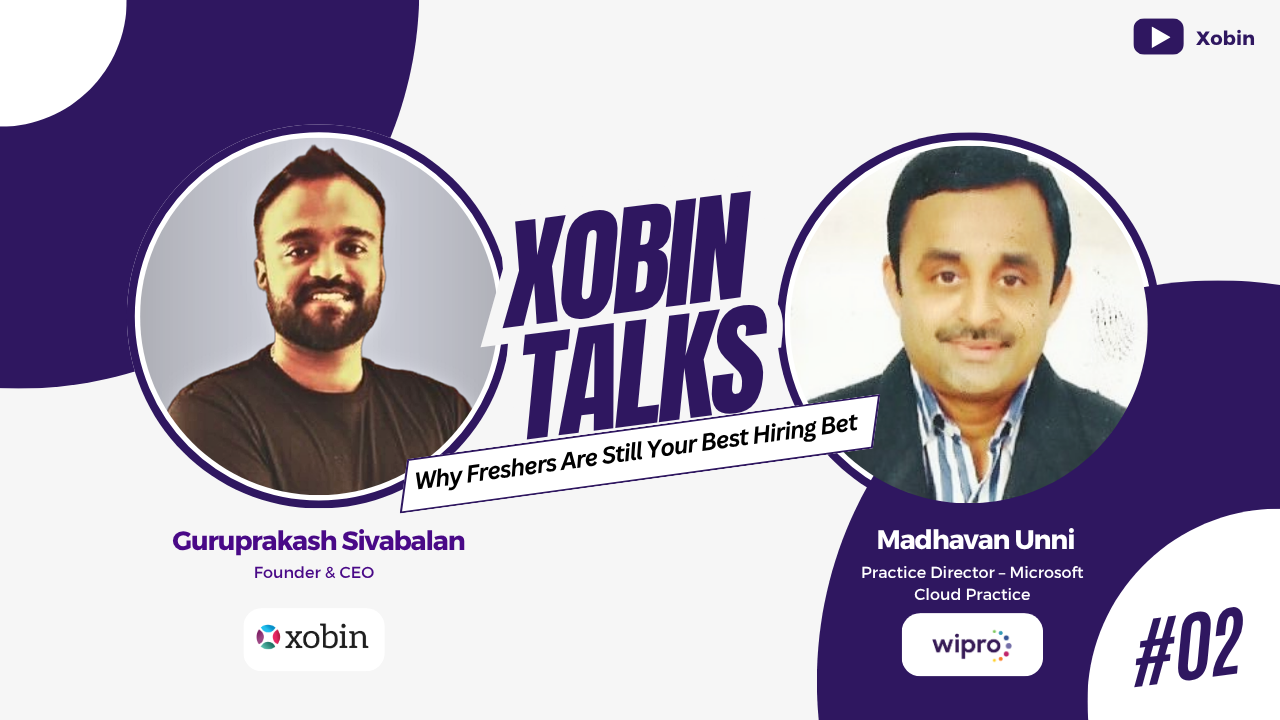
| GUEST PROFILE Madhavan Unni, Practice Director – Microsoft Cloud Practice at Wipro Technologies. Connect: LinkedIn |
Table of Contents
TLDR – Key Takeaways
- India’s overall graduate employability fell to 42.6% in 2024, down from 44.3% in 2023 (Mercer Mettl India Graduate Skill Index, 2025). The industry-academia gap is widening, not closing, making deliberate fresher hiring strategy more important than ever.
- 70% of Indian employers still intend to hire freshers in the second half of 2025 (TeamLease EdTech Career Outlook, 2025). Demand for fresh talent has not disappeared. The way organizations access it has changed.
- Large IT companies like Wipro have moved campus engagement to the pre-final year, using simulator environments to bridge the gap between academic learning and workplace readiness before graduation.
- Freshers hired through internship-to-full-time pipelines show a 44% five-year retention rate, significantly higher than those hired through final-year campus drives (CollegeSimplified, 2026).
- For large campus drives, releasing 2X the number of offers you actually need is standard practice. The realistic conversion rate from offer to joining in campus hiring is approximately 50%.
The question most HR teams ask about freshers is the wrong one.
They ask: is hiring freshers worth the training investment given how quickly they leave?
The more useful question, the one Madhavan Unni has been answering across 15 to 20 years of campus hiring at Wipro, is: what do freshers bring that experienced hires simply cannot? And once you understand the answer to that question properly, the hiring and retention strategy that follows it becomes much clearer.
In this episode #2 of Xobin Talks, host Guruprakash Sivabalan, Founder and CEO of Xobin, sat down with Madhavan to explore how fresher hiring is evolving, why the industry-academia gap is the central challenge, and what the most sophisticated organizations are doing to solve it before graduation rather than after.
Why Do Organizations Still Need to Hire Freshers at Scale?
Freshers bring three things that experienced hires cannot replicate: an unfiltered perspective on problems, faster adaptability to new environments, and the capacity to be shaped around your organization’s specific needs. With 70% of Indian employers still intending to hire freshers in the second half of 2025, demand for entry-level talent has not disappeared (TeamLease EdTech, 2025). The organizations winning this market are those that understand precisely what they are hiring for.
Madhavan frames the fresher value proposition around three distinct advantages that organizations regularly undervalue.
The first is the unfiltered perspective. Experienced professionals develop mental models over years of practice. Those models are efficient and usually correct. They are also occasionally limiting. A fresher looking at the same problem has not yet been conditioned to see it one particular way. The hackathons and ideathons that have proliferated over the last five years consistently draw fresh graduates as participants – and consistently produce ideas that senior practitioners would not have generated, precisely because of that absence of conditioning.
The second is adaptability. The most important attribute of a fresher, in Madhavan’s assessment, is not their academic record or their technical knowledge. It is their capacity to be put somewhere challenging and to learn their way through it. The passion to develop skill and expertise is higher in freshers than at almost any other career stage. That is a resource, and organizations that treat it as such build talent pipelines that compound in value over years.
The third is moldability. Freshers enter with technical foundations but without deeply ingrained professional habits. That means you are not overwriting an existing approach. You are building one. For organizations with strong cultures, clear career frameworks and good onboarding, that is a significant advantage over lateral hiring.
Madhavan’s framing of freshers as “fresh clay” reorients the conversation from risk management (will they stay long enough?) to strategic shaping (what can we build?). That reframe has direct implications for how organizations structure their training investment.
What Is the Real Problem with the Industry-Academia Gap?
The gap between what colleges teach and what organizations need is not just a curriculum problem. It is a communication problem, and colleges need to own their part of it. India’s overall graduate employability fell to 42.6% in 2024, down from 44.3% in 2023, with non-technical skills like communication, creativity and leadership showing the sharpest declines (Mercer Mettl India Graduate Skill Index, 2025). That number is not improving on its own.
Madhavan makes a distinction that most HR conversations skip. The industry-academia gap has two distinct causes that require different solutions.
The first is curriculum misalignment, where colleges teach skills that are outdated or disconnected from what companies actually need in new hires. This is the cause that gets the most attention and it is real.
The second cause is expectation misalignment, and it is equally important. When a student arrives at a campus drive without understanding what the recruiting company actually does, what its market position is, what the role involves, or what a career there looks like – that student cannot make an informed decision. And uninformed decisions produce higher attrition, lower engagement and poorer cultural fit on both sides.
Madhavan’s position is that this second cause is the college’s responsibility to fix. Before a company arrives on campus, students should already know the company’s business, its approximate market share, what a new hire can realistically expect in their first year, and what a career trajectory at that organization looks like over three to five years. Transparency and clarity from the institution is the first and most overlooked step in setting expectations that hold up after the offer is accepted.
The other dimension of the gap is assessment methodology. Categorizing students based purely on their academic marks and using that as the primary filter for recruitment is a practice that consistently produces wrong outcomes. The correlation between academic performance and professional performance is weaker than most hiring processes assume. Many average scorers are exceptional workers. Many high scorers struggle with the ambiguity, pace and interpersonal demands of real work. A skills-based assessment approach, rather than a marks-based shortlisting approach, produces significantly better hiring outcomes at scale.
How Are Large IT Companies Moving Campus Engagement Earlier?
The most sophisticated campus hiring programs now start in the pre-final year of graduation, not the final semester. The organizations doing this are closing the skill gap before it becomes a training cost. Leading recruiters are engaging with students from their second and third year, running pre-placement assessments, internship pipelines and skills challenges well before final year begins (iamneo, 2025). This is not a marginal practice anymore. It is the new standard for large IT organizations.
Madhavan describes a model that Wipro and similar large IT organizations have moved toward: assess students in their pre-final year, extend job offers while they are still completing their degree, and use the intervening period to expose them to the company’s actual work environment through simulator programs.
The simulator model works as follows. Students who accept offers are given access to the company’s systems, real project environments and UI simulations during their final year. They are not yet employees. But by the time they graduate and arrive on their first day, they have already operated inside the company’s workflows. The ramp-up time is shorter. The culture shock is smaller. The transition from campus to corporate is genuinely bridged rather than just verbally described during induction.
This model also introduces an incentive structure. Organizations using this approach offer velocity-based incentives to freshers who perform well during the pre-joining simulation period, creating early recognition systems that signal to new hires that performance is seen and rewarded from the very start of the relationship.
The business case is straightforward. Interns hired through this kind of extended pipeline show a 44% five-year retention rate, significantly higher than those hired through final-year campus drives (CollegeSimplified, 2026). The investment in pre-final year engagement pays back in reduced attrition, faster productivity and stronger cultural alignment on day one.
What Is the Right Offer-to-Joining Ratio for Large Campus Drives?
For large campus hiring programs, releasing 2X the number of offers you need is standard practice – not a sign of poor planning. No-show rates for campus interviews and drives can reach 30-40% (TheHireHub.ai, 2026). Building that reality into your planning model is the difference between programs that consistently hit their headcount targets and programs that scramble every cycle.
Madhavan’s guidance on this comes from direct experience managing offer planning at scale. The reasons behind the gap between offers extended and candidates who actually join are not unusual or alarming. Some candidates decline for personal reasons. Others have chosen higher education over employment. Some find the adjustment to professional life more difficult than expected. The reasons are varied and many are entirely reasonable.
The practical implication is that offer planning should treat the 50% conversion rate as a baseline assumption rather than as a worst case. For campus recruitment, the standard is 2X offers for the headcount you actually need. For lateral hiring, where competition is more direct and candidates have more immediate alternatives, the multiple moves to 3X.
This is not a counsel of low expectations. It is a counsel of accurate ones. Campus hiring that plans for 100 joiners and extends 110 offers is a program that will miss its target every year. Hiring through campus that plans for 100 joiners and extends 200 offers, with strong pre-joining engagement to push that conversion rate above 50%, is a program that consistently delivers.
The other lever on conversion rate, the one that Madhavan consistently returns to, is the quality of the candidate experience between offer and joining. That period is the most neglected stretch in most campus hiring programs and the most consequential for whether an accepted offer converts to an actual joiner.
How Should Organizations Think About Fresher Retention in a World of Short Tenures?
Long tenures at single organizations are no longer the norm for early-career professionals, and building a retention strategy around trying to change that is less productive than building one around making the first two to three years genuinely valuable. The average tenure of a fresher at their first organization has shortened significantly over the past decade. Fresher attrition of 20-30% within the first two years is now considered normal across industries in India (TheHireHub.ai, 2026).
Madhavan’s perspective on this is grounded rather than nostalgic. The earlier model, where professionals spent 10 years at a single organization and built their career there, reflected a different set of employment conditions, information availability and career option density. Today’s freshers have better visibility into what alternatives exist, faster access to comparison information and a stronger orientation toward learning and challenge over stability.
The shift has produced a new primary driver of fresher tenure decisions: freshers stay where they are being challenged and leave where they have plateaued. A company offering steady growth but limited challenge will consistently lose its best new hires to organizations offering steeper learning curves at lower stability. That is not a loyalty failure. It is a rational response to information.
The practical implication for retention strategy is to focus investment on the first two to three years rather than on long-term incentive schemes that vest over five to seven years. A fresher who experiences visible growth, meaningful challenge and genuine recognition in their first 24 months has a concrete reason to stay that a distant equity vesting schedule cannot match. Pair that with a clear plan for the next stage of their career inside the organization, and retention rates improve materially.
The future of work adds another layer here: the hybrid model is now accepted by both employers and employees as the baseline expectation for knowledge work. Organizations that build career development and culture around hybrid participation, rather than treating it as a concession to be minimized, will consistently outperform in early-career retention.
🎧 Watch the Full Episode
Xobin Talks – Episode 2 | Madhavan Unni, Practice Director, Microsoft Cloud Practice, Wipro Technologies | Hosted by Guruprakash Sivabalan, Founder and CEO, Xobin
▶ Play Episode on Xobin Talks
About Madhavan Unni
Madhavan Unni is Practice Director for the Microsoft Cloud Practice at Wipro Technologies, one of India’s largest IT services organizations. With 15 to 20 years of experience in campus and fresher hiring, he has been a practitioner and architect of large-scale early career hiring programs across the IT sector. His perspective on the industry-academia gap, pre-final year engagement models and simulator-based onboarding reflects years of direct experimentation and refinement at Wipro’s scale. He brings both strategic and operational depth to one of campus recruitment’s most persistent challenges: turning newly minted graduates into productive, engaged professionals faster than the competition.
Connect with Madhavan: LinkedIn | Company: Wipro Technologies
Want more insights like this? Explore all Xobin Talks episodes
Frequently Asked Questions
Why should companies still prioritize hiring freshers despite shorter average tenures?
Freshers bring unfiltered problem-solving perspectives, high adaptability and the capacity to be shaped around your culture. With 70% of Indian employers intending to hire freshers in HY2 2025, demand reflects this recognized value.
What is a realistic offer-to-joining conversion rate for campus hiring?
Approximately 50%. Release 2X the offers you need for your actual headcount target. For lateral hiring the standard rises to 3X. Build this into your planning model rather than treating it as a worst case.
What is the industry-academia gap and whose responsibility is it to fix?
Both sides own it. Colleges must fix expectation misalignment by preparing students with company context before drives begin. Companies must address curriculum misalignment through closer academic partnerships.
What is the pre-final year hiring model and why are large IT companies using it?
Assess students in year three, extend offers while they complete their degree, then expose them to real workflows via simulator programs. Internship-to-hire pipelines using this model show a 44% five-year retention rate.
Should companies filter campus candidates primarily by academic marks?
No. The correlation between academic performance and professional performance is weaker than most frameworks assume. Skills-based assessment covering problem-solving, communication and adaptability consistently produces better outcomes.
How should organizations think about fresher retention given shorter average tenures?
Focus investment in the first two to three years. Freshers stay where they are challenged. A credible near-term career plan and active upskilling in month one are more effective than distant vesting schemes.
Why is a third-party recruitment partner useful for large-scale fresher hiring?
Large-scale fresher hiring in a compressed window is operationally intense. A trusted partner manages outreach, assessment and logistics at the quality and pace internal teams alone often cannot sustain.
How has the shift to hybrid work changed fresher recruitment and retention?
Hybrid work is the expected baseline for freshers entering the workforce today. Organizations that build career development and culture around hybrid participation outperform those treating it as a concession. The risk for freshers is isolation and slower cultural absorption. Structured touchpoints, mentorship and deliberate in-person investment in the first 90 days substantially reduce that risk.