
In 2025, the job market is expected to be even more competitive than ever. Hence, organizations must create a recruitment strategy that attracts the best talent and retains them. As a result, building an effective hiring strategy requires a comprehensive approach that takes into account several factors, including company goals, target audience, available resources, and current market conditions. Leveraging tools like pre-employment testing can help businesses streamline hiring and identify the right candidates efficiently.
TL;DR – Key Takeaways
- Define measurable hiring goals aligned with business objectives, including required roles, candidate skills and experience, hiring volume, and recruitment timelines.
- Understand your target audience, create candidate personas, and develop an employer brand that showcases your company culture and values.
- Use multiple recruitment channels and employee referrals, while leveraging AI and automation to streamline resume screening, interview scheduling, and follow-up emails.
- Prioritize diversity, equity, and inclusion, offer competitive compensation and benefits, and create a positive candidate experience through transparency, timely feedback, and respect.
- Track channel effectiveness and recruitment metrics, including time-to-hire, cost-per-hire, and applicant-to-hire ratio, to evaluate your strategy and identify improvements.
Steps to Build an Effective Recruitment Strategy
Define your hiring goals
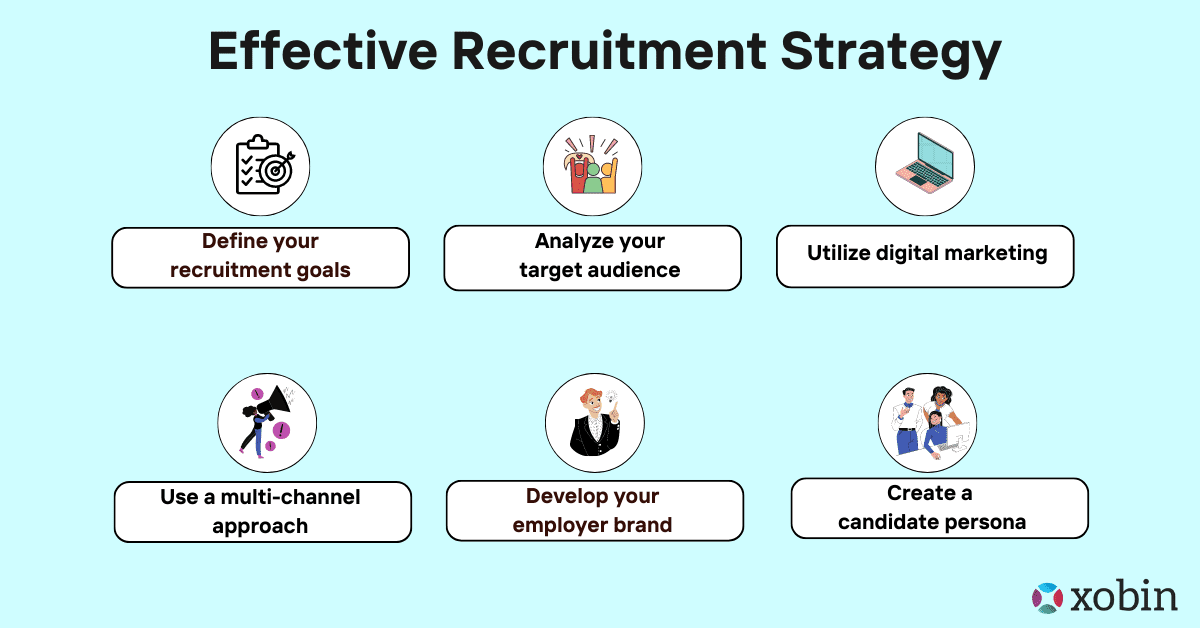
Before building your recruitment strategy, it is essential to define your recruitment goals. Begin by identifying what positions you need to fill and what skills and experience you require from candidates. What are you looking for in a candidate? What are your recruitment targets? Understanding these goals will help you tailor your hiring strategy accordingly. Determine the number of employees you need to recruit and what time frame you have to complete the hiring process. Set specific and measurable goals that align with your overall business objectives.

Analyze your target audience
Once you’ve defined your recruitment goals, it’s essential to understand your target audience. This includes identifying the type of candidates you need to attract, their demographics, their preferred communication channels, and what motivates them to apply for a job. This information will help you tailor your recruitment messaging and outreach to attract the best talent.
Utilize digital marketing
In 2025, social media will continue to be a powerful tool for recruitment. Organizations can leverage social media platforms such as LinkedIn, Twitter, and Facebook to promote their job openings, engage with potential candidates, and build brand awareness.
Use a multi-channel approach
Use a variety of channels to reach your target audience, including job boards, social media, email, referrals, and networking events. Therefore, use data and analytics to track which channels are most effective and adjust your hiring strategy accordingly.
Develop your employer brand
Your employer brand is how candidates perceive your company as an employer. It’s important to establish a positive employer brand to attract and retain top talent. Make sure your recruitment messaging aligns with your brand values, and that your website and social media profiles showcase your company culture and values.
Create a Candidate Persona
A candidate persona is a fictional representation of your ideal candidate. It should include information about their demographics, education, experience, and motivations. Use this information to tailor your recruitment messaging and outreach to attract candidates that fit your persona.

Leverage AI and Automation
Artificial Intelligence (AI) and Automation technologies can help streamline the recruitment process, making it more efficient and effective. Hence, these technologies can automate mundane recruitment tasks. Tasks such as, screening resumes, scheduling interviews and sending follow-up emails, allowing recruiters to focus on more strategic tasks.
Implement a referral program
Employee referrals remain one of the most effective ways to find quality candidates. Implementing an employee referral program can incentivize your employees to refer qualified candidates, increasing your chances of finding the right fit for the job.
Prioritize Diversity, Equity, and Inclusion (DEI)
In 2023, it is crucial to prioritize diversity, equity, and inclusion (DEI) in your hiring strategy. Organizations must actively seek out diverse candidates and create an inclusive work environment to attract and retain talent from all backgrounds. Prioritizing DEI in your recruitment strategy will not only make your organization more attractive to candidates but will also create a more innovative and productive workforce.
Offer Competitive Compensation and Benefits
In a competitive job market, offering competitive compensation and benefits is essential. Candidates are more likely to accept job offers from organizations that offer a competitive salary and benefits package. Additionally, offering unique benefits such as flexible work arrangements as well as professional development opportunities can help your organization stand out from the competition.
Create a Positive Candidate Experience
The candidate experience is a critical component of any recruitment strategy. So, the candidates who have a positive experience during the hiring process are more likely to accept a job offer. Also they will remain engaged with the organization. Creating a positive candidate experience can be as simple as being transparent about the recruitment process, providing timely feedback, and treating candidates with respect and empathy.
Finally, it is essential to measure and analyze your recruitment metrics to evaluate the effectiveness of your hiring strategy. Metrics such as time-to-hire, cost-per-hire, and applicant-to-hire ratio can provide valuable insights into your recruitment process and help you identify areas for improvement.
Conclusion
In conclusion, building an effective recruitment strategy in 2023 requires a holistic approach that incorporates digital marketing, AI and automation, employee referrals, DEI, competitive compensation and benefits, positive candidate experience, and data-driven analysis. Organizations that prioritize these elements in their recruitment strategy are more likely to attract and retain top talent and achieve their hiring goals.