
Posting a job description and waiting used to work. It doesn’t anymore.
Today, 95% of employers forecast growth in 2026, yet nearly three-quarters report difficulty filling the roles that growth requires (Randstad Workmonitor, 2026). That gap isn’t a sourcing problem. It’s a marketing problem. The companies winning the talent race aren’t necessarily offering the biggest salaries. They’re the ones that show up consistently, tell a compelling story, and build trust with candidates long before a job opens up. That’s recruitment marketing in practice.
This guide breaks down what recruitment marketing actually is, how it differs from traditional recruiting, and what a working strategy looks like from top of the funnel to hire. Whether you’re a CHRO rethinking your employer brand, a talent acquisition lead trying to reduce cost-per-hire, or a founder competing for engineers against companies three times your size, this is your starting point.
TL;DR – Key Takeaways!
- Recruitment marketing helps organizations build relationships with potential candidates early, using marketing techniques to create interest in future career opportunities.
- It differs from traditional recruiting in one key way: it’s always-on, not triggered by a job opening.
- A strong employer brand helps you hire more efficiently by lowering recruitment costs, increasing offer acceptance rates, and reducing the time it takes to fill vacancies.
- The recruitment marketing funnel has four stages: Awareness, Consideration, Application, and Nurture. Each stage calls for the right message through the right channel.
- AI pre-screening and talent CRM tools allow small hiring teams to build meaningful candidate relationships and manage high-volume recruitment without stretching recruiter capacity.
- At the end of the day, great hires matter more than a crowded applicant pipeline. That’s why quality-of-hire is the metric that counts.
- Consistency matters more than budget. Companies that show up regularly with authentic content outperform those running occasional high-spend campaigns.
What Is Recruitment Marketing?
Recruitment marketing is the practice of applying marketing strategies to talent acquisition. Instead of waiting for candidates to apply, it positions your company as an employer of choice and builds relationships with potential hires before any vacancy exists. Think of it as demand generation, but the product is your workplace. The goal isn’t just more applicants. It’s better-fit candidates who already understand your culture, believe in your mission, and are pre-sold on the opportunity.
A sourced (outbound) candidate is 5x more likely to be hired than someone who found you through a job board (Gem, 2025). That one number shows why investing in your employer brand ahead of time delivers results that simply posting jobs when you need hires can’t match.
Recruitment Marketing vs. Traditional Recruiting
The distinction matters. Traditional recruiting is reactive: a role opens, you post it, you screen applicants, you hire. Recruitment marketing is proactive: you build an audience of interested talent continuously, so when a role opens, you’re not starting from zero.
| Dimension | Traditional Recruiting | Recruitment Marketing |
| Timing | Triggered by vacancy | Always-on |
| Candidate source | Inbound applications | Nurtured pipeline + inbound |
| Primary goal | Fill the open role | Build employer brand + pipeline |
| Key metric | Time-to-fill | Candidate NPS, pipeline quality |
| Who leads | Recruiter | TA + Marketing collaboration |
| Cost structure | High per-hire (ad spend) | Lower long-term cost-per-hire |
What Makes Recruitment Marketing a Must-Have in 2026?
The labor market has tightened in a specific way. By February 2026, there were 1.1 unemployed workers per job opening, up from 0.6 in Feb 2023 (U.S. Bureau of Labor Statistics JOLTS data, 2026). More candidates exist on paper. However, finding skilled professionals who can contribute from day one is still challenging, especially in fields like engineering, healthcare, and mid-to-senior leadership.
Here’s the thing: candidates are not passive observers anymore. 83% of job seekers research reviews and ratings before they decide where to apply, and 87% say a company’s reputation directly influenced their decision to accept their current role (JobScore, 2026). Your hiring brand is being evaluated before any recruiter picks up the phone.
The Cost of Ignoring Employer Brand
Poor employer branding has a direct financial cost. Organizations with weak employer brands pay 10% higher salaries to attract the same talent (Harvard Business Review). The average cost-per-hire in the U.S. is $5,475 for non-executive roles and $35,879 for executive positions (SHRM 2025 Benchmarking Report, 2025). Companies with strong brands reduce that by 50%.
Not ideal, if you’re burning budget on job ads that could be redirected to brand-building content that compounds over time.
The Passive Candidate Opportunity
Roughly 70% to 75% of the workforce qualifies as passive, meaning they’re not actively job hunting but would consider the right opportunity (LinkedIn Talent Solution). These candidates won’t see your job board post. They need to encounter your employer brand on social media, through employee stories, or via content that surfaces organically. Recruitment marketing is the only strategy designed to reach them.
How Does the Recruitment Marketing Funnel Work?
The recruitment marketing funnel follows a candidate’s journey, starting with employer awareness and progressing through consideration, interest, application, and finally, hiring.
Each stage demands a different message, a different channel, and a different measure of success. Most companies invest heavily at the bottom of the funnel (job ads, screening calls) and almost nothing at the top. That’s backwards.
Companies using data-optimized funnels achieve 37% higher offer acceptance rates and 24% faster time-to-hire compared to those relying on ad-hoc processes (Recruiting Benchmarks Report, 2025). The funnel isn’t just a framework. It’s a competitive advantage.
Stage 1: Awareness
At this stage, your goal is visibility. Candidates don’t know you, or they know you only by name. Content marketing, social media, and employee reviews on platforms like Glassdoor, LinkedIn, and Indeed, along with thought leadership, all help shape your employer brand. 62% of job seekers look up a company on social media to assess its reputation before applying (Content Stadium, 2022). If your social presence is thin or outdated, you’re losing candidates at the first touchpoint.
Stage 2: Consideration
Candidates know who you are. Now they’re weighing you against other employers. This is where your careers site, employee testimonials, benefits content, and culture storytelling do the heavy lifting. 76% of candidates want to know about company culture and values before accepting an offer (Harvard Business Review via DSMN8). If that information is buried or generic, the consideration stage is where you lose qualified talent silently.
Stage 3: Interest and Application
The candidate is ready to engage. Frictionless apply flows matter more than most teams realize. Research consistently shows that application processes taking more than 10 minutes see significant drop-off. CareerPlug’s analysis of 10 million+ applications found that only 6% of job views convert to applications at all (Pin.com, 2026). Fixing conversion rate at this stage has an outsized impact on pipeline volume.
Stage 4: Nurture and Hire
Most applicants won’t be hired on the first interaction. And many strong candidates aren’t ready to apply today. A talent CRM with automated nurture sequences keeps warm leads engaged, so when the right role opens, you have a warm pipeline instead of a cold one. 44% of sourced hires in 2024 were candidates rediscovered within an existing database (Gem, 2025). Your old candidates are an underused asset.
 Pro Tip Map each funnel stage to a content type and a metric. Awareness = LinkedIn post reach + careers page traffic. Consideration = time-on-site + email open rates. Interest = application conversion rate. Nurture = pipeline response rate. Without stage-level measurement, you won’t know where you’re leaking qualified talent.
What Are the Core Channels in a Recruitment Marketing Strategy?
No single channel wins the talent acquisition game. Effective recruitment marketing uses a portfolio approach, weighting channels based on the candidate personas you’re trying to reach and the roles you’re most frequently hiring.
Employer Review Platforms
Glassdoor, LinkedIn, and Indeed are where candidates form opinions about your company. 70% of Glassdoor users say they’re more likely to apply when an employer actively engages on the platform (Vouch, 2026). Employers who improved their Glassdoor rating by at least 0.5 points saw 20% more job clicks and 16% more apply starts on average (JobScore, 2026). Worth the investment in reputation management.
Social Media and Content
98% of in-house recruitment and employer brand teams now use social media (Content Stadium via Vouch, 2026). But volume isn’t the goal. Format matters. On LinkedIn, video posts generate approximately 1.4x more engagement than text-based content (The Australian via Vouch, 2026). Employee-generated content and behind-the-scenes culture posts consistently outperform polished corporate messaging because candidates can tell the difference.
1 in 10 hires today comes directly from content, engagement, or direct interaction between a recruiter and candidate on social media (Clutch via Aspiration Marketing, 2025). That percentage is growing.
Careers Site
Your careers site is the center of gravity for every campaign you run. Social media drives traffic. Job boards drive applications. But both point back here. A careers site that clearly communicates culture, role expectations, growth opportunities, and authentic employee stories converts significantly better than a basic job listings page. It’s not a static brochure. It’s an active recruitment channel.
Email and Talent CRM
Talent CRM nurture sequences are the underdog of recruitment marketing. Candidates who’ve expressed interest but aren’t ready to apply, silver-medal candidates from past hiring rounds, and referral network contacts can all be kept warm through periodic, relevant communication. When a role opens, a warm email to a 200-person talent pool is faster and cheaper than a paid job board campaign.
Pro Tip Segment your talent CRM by role type, skill, and engagement level. A generic “we’re hiring” blast underperforms a personalized message that references a candidate’s specific skills or prior conversation by a wide margin.How Do You Build a Recruitment Marketing Strategy From Scratch?
Start with your employer value proposition (EVP). Before you create content or run campaigns, you need a clear, honest answer to the question: “Why would a great candidate choose us over any other option?” When organizations build their EVP around genuine employee feedback, they create a message that resonates more deeply and remains relevant longer than polished corporate copy.
Here’s a practical sequence that works for most talent teams.
Step 1: Define Your Candidate Personas
Who are you trying to hire in the next 12 months? Not just job titles. What do they care about? Where do they spend time online? What frustrates them about their current employer? The clearer your candidate persona, the sharper your messaging becomes. And sharp messaging is what makes your employer brand visible in a noisy market.
Step 2: Audit Your Current Brand Presence
Before you build, understand what already exists. Check your Glassdoor and LinkedIn profiles, your careers site, and your social channels. Read your own reviews. Ask recent hires what they saw and heard about you during their job search. You may find strong foundations you’re not amplifying, or you may find inconsistencies that are actively hurting your pipeline quality.
Step 3: Set Measurable Goals
Clear goals drive better results. Instead of aiming for a “better employer brand,” set measurable targets, such as increasing careers page traffic by 30% in Q3. Then, align your recruitment marketing efforts with your hiring goals, whether that’s filling open roles faster, lowering cost-per-hire, or improving offer acceptance rates.
Step 4: Activate Content Consistently
Consistency beats perfection. A LinkedIn post three times a week outperforms a perfectly produced campaign that runs once a quarter. Employee spotlights, day-in-the-life videos, culture content, leadership perspectives, and transparent job postings (including salary ranges) all build cumulative brand equity. Posting and going quiet is worse than never posting, because candidates notice.
Step 5: Measure, Adjust, Repeat
Recruitment marketing is iterative. Track metrics at every funnel stage. Identify where drop-off happens. Adjust messaging, channel mix, or content format accordingly. Companies that use data-driven recruiting approaches are twice as likely to improve hiring efficiency and candidate experience (LinkedIn Global Recruiting Trends via The Recruitability, 2025).
Pro Tip Don’t wait for perfect data before you start. Set a baseline in month one, review in month three, and adjust quarterly. Early imperfect measurement beats late perfect measurement every time.How Does Technology Make Recruitment Marketing More Effective?
Technology has moved from an optional layer to the backbone of effective recruitment marketing. Over 87% of companies now use AI somewhere in their recruiting process, up from 26% in 2024, though only 44% have fully implemented it (MSH, 2026). The adoption curve is steep because the use cases are genuinely broad.
AI-driven candidate matching, automated sourcing, video interviewing platforms, CRM-based nurture sequences, programmatic job advertising, and employer brand analytics tools are now accessible to teams of all sizes. And over half of U.S. employers are actively integrating AI into their hiring process to personalize outreach at scale, a figure that jumped from just 19% in 2024 (Universum Global, 2025).
Where Technology Adds the Most Value
The highest-ROI applications of recruitment tech in 2026 tend to cluster in three areas:
Pre-screening and assessment
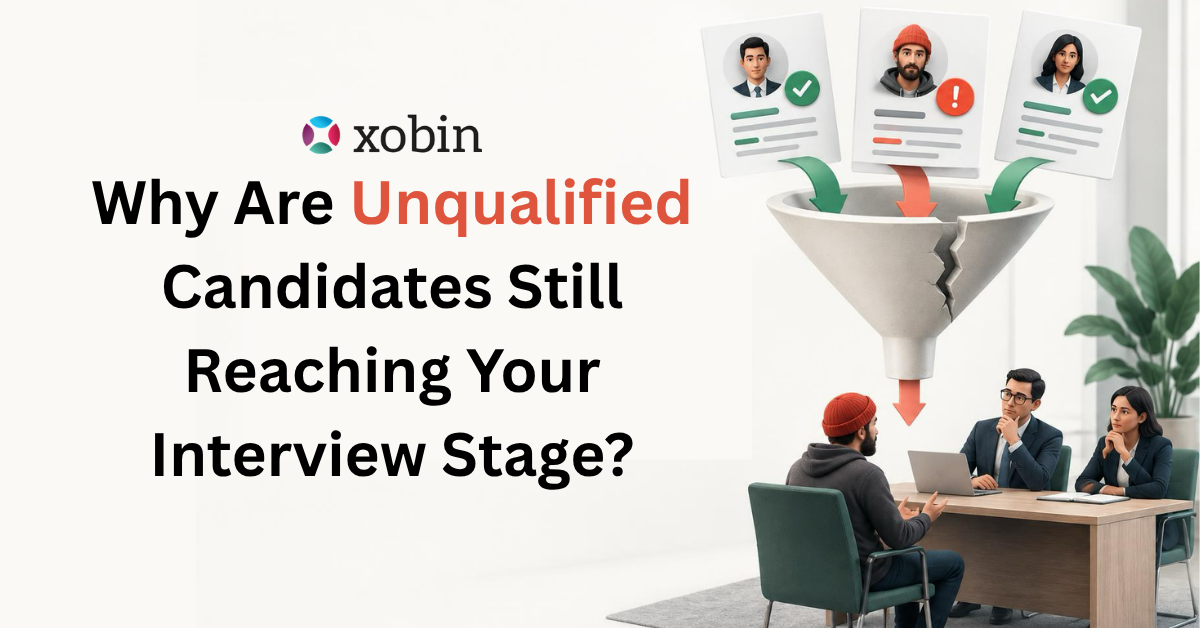
High-volume roles consume enormous recruiter bandwidth if every application is manually reviewed. AI-powered pre-screening and structured skills assessments filter the funnel faster and more consistently, reducing recruiter hours spent on candidates who aren’t qualified.
For example, teams using structured AI Interviews at this stage, the approach Xobin uses with its pre-screening product, typically reduce time-to-shortlist significantly compared to manual CV review, particularly for technical and sales-heavy roles where skill validation matters more than resume formatting.
Candidate engagement automation
CRM sequences that trigger based on candidate behavior (viewed a job, downloaded content, attended an event) allow small teams to maintain warm touchpoints with large talent pools without manual effort.
Analytics and attribution
Understanding which channels produce your highest-quality hires, not just your most applications, is the difference between efficient spending and a wasted budget. Recruitment analytics platforms make this possible.
How Do You Measure Recruitment Marketing ROI?
ROI in recruitment marketing is measurable. But you have to choose the right metrics and measure them consistently over time. The common mistake is tracking only activity metrics (posts published, applications received) instead of outcome metrics (quality-of-hire, offer acceptance rate, cost-per-hire by channel).
The average U.S. cost-per-hire sits at $4,700 for standard roles, reaching $28,000 for senior positions (Vouch, 2025). Companies with strong employer brands reduce that figure by 50%. That’s not a soft benefit. At any significant hiring volume, it’s a material business outcome.
Cost-per-hire by channel
Don’t just calculate overall cost per hire. Track hiring costs by source (LinkedIn, referrals, job boards, organic applications, and your careers page) to see where your budget delivers the best results.
Time-to-fill
The 2025 benchmark for most roles sits between 36 and 42 days, with high-demand tech and healthcare roles running longer (The Recruitability, 2025). Referral hires are notably faster, closing 55% quicker than candidates from traditional sourcing (MSH, 2026).
Offer acceptance rate
The current benchmark sits at 65 to 70% (The Recruitability, 2025). A rate below that signals either a compensation gap or a candidate experience problem. Both are fixable with data.
Careers site conversion rate
What percentage of visitors submit an application? The industry average is around 6% of job views (Pin.com, 2026). Improvements here have a direct multiplier effect on total application volume without increasing ad spend.
Quality-of-hire
Performance ratings, retention at 12 months, and hiring manager satisfaction scores at 90 days. Because a low cost-per-hire that produces poor retention is not a win. The challenge most teams face here is that quality-of-hire is hard to measure without a structured framework.
Benchmarking candidates against role-specific skill templates before the hire, the way tools like Xobin X360 approach it, gives you a baseline that makes post-hire quality comparison actually meaningful rather than purely anecdotal.
What Are the Biggest Recruitment Marketing Mistakes to Avoid?
Most recruitment marketing failures trace back to a handful of predictable mistakes. Knowing them in advance saves you budget, time, and pipeline quality.
Mistaking activity for strategy
Regular LinkedIn posts mean little if you don’t know who you’re targeting or what action you want candidates to take. It’s not marketing. Strategy means knowing exactly who you’re trying to reach, what you want them to believe about your company, and how you’ll move them from awareness to application.
Ignoring the candidate experience
60% of candidates report having a poor candidate experience, and 72% of those candidates share it online (X0PA AI via x0pa.com, 2026). Your employer brand is defined not just by what you publish but by how candidates feel when they interact with your hiring process. Slow responses, generic rejections, and disorganized interview processes undermine everything you’ve built.
Treating the employer brand as a one-time project
A careers site refresh or an “employer brand campaign” that runs for one quarter and then stops won’t produce compounding results. Brand equity builds through consistency. The companies seeing the highest ROI from recruitment marketing treat it as an ongoing function, not a project.
Prioritizing quantity over quality in the funnel
More applicants is not always better. Gem’s analysis of 140 million applications found that organizations using funnel-based metrics reduced cost-per-hire by 19% while increasing candidate satisfaction scores by 28% (Recruiterflow, 2025). The goal is a cleaner funnel, not a bigger one.
Pro Tip Run a quarterly candidate experience audit. Survey rejected candidates, screen-failed applicants, and recent hires separately. Each group will surface a different category of friction. Act on what you find.Ready to Turn Your Recruitment Marketing Into Measurable Hires?
Building a strong employer brand and a structured hiring funnel takes strategy. But knowing which candidates are actually worth your recruiter’s time, that’s where most teams lose ground. Xobin helps you pre-screen at scale, assess role-specific skills, and benchmark candidate quality before you ever extend an offer. Less guesswork. Faster shortlists. Better hires.
Book a personalized demo and see how Xobin fits into your hiring funnel.
Frequently Asked Questions
What does recruitment marketing mean, and why is it important?
Recruitment marketing is how companies attract and engage candidates before a job is posted. The reason this is important is that highly qualified candidates, particularly passive talent, aren’t checking job boards every day. You need to reach them where they already are, build trust in your brand over time, and make sure they think of you first when they’re ready to move.
How do I start recruitment marketing with a small team or limited budget?
Start with two things: an honest careers page that reflects your actual culture, and a consistent presence on one social channel where your target candidates spend time. You don’t need a full campaign. Regular, authentic content from real employees outperforms polished corporate posts almost every time. Start small and stay consistent.
How is recruitment marketing different from recruiting?
Recruiting fills open roles. Recruitment marketing builds the pipeline that makes recruiting faster and cheaper. Recruiting is what happens when a seat is empty. It is what happens in the months before that, so you’re not scrambling when it is.
How does employer branding affect the quality of candidates you attract?
When your employer brand clearly communicates culture, growth, and values, candidates self-select more accurately. The ones who apply already align with what you offer. That means fewer mismatched hires, higher offer acceptance rates, and better retention after the hire.
What is a talent pipeline and how does recruitment marketing help build one?
A talent pipeline is a pool of pre-engaged candidates you can reach out to when a role opens. Recruitment marketing builds it by consistently attracting and nurturing people who’ve shown interest in your company through content, events, social media, and email, even when you’re not actively hiring.
What role does AI play in recruitment marketing in 2026?
AI is being used at two key points: pre-screening candidates at scale so recruiters focus only on qualified applicants, and personalizing outreach so candidates receive messages relevant to their background. The shift is from spray-and-pray job ads to targeted, data-informed engagement across the full hiring funnel.