

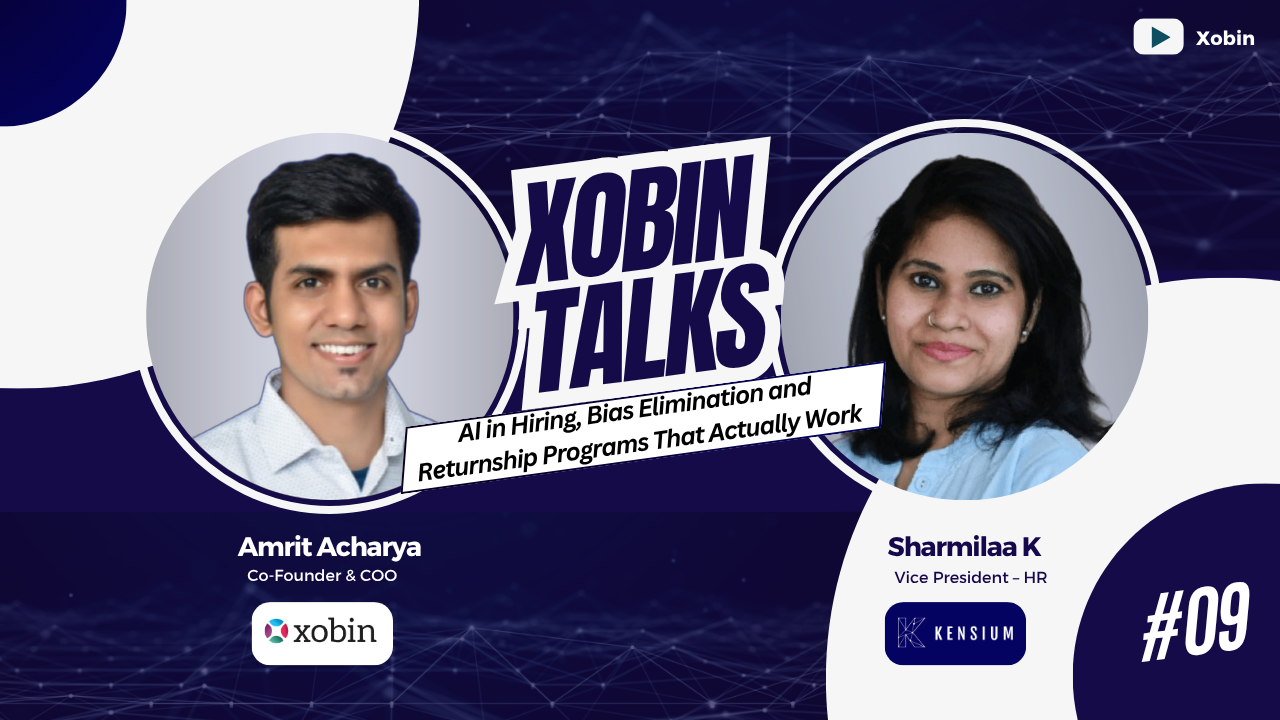
This episode was hosted by Amrit Acharya, Co-Founder and COO of Xobin.
Table of Contents
TL;DR – Key Takeaways
- India’s female Work Participation Rate has doubled from 22% in 2017-18 to 40.3% in 2023-24, but career-break bias still blocks skilled women from returning (CII Report, 2025). Structured returnship programs are the fix, not a mandate.
- Blind screening at Kensium eliminated gender and compensation bias across all hiring. When managers saw profiles without names, gender or salary history, they picked significantly more women candidates.
- AI does not eliminate bias entirely. It reduces specific, measurable biases like those on gender, pedigree and compensation, while human judgment remains essential for culture fit and team dynamics.
- Automated assessment tools saved Kensium entire days of paper-based testing. As a result, recruiters now focus only on the top 15% of applicants, staying energized and free from decision fatigue throughout the hiring process.
- Company culture develops through everyday interactions, not occasional events. The individuals employees engage with daily shape the culture far more than any onboarding presentation.
AI in HR is being discussed everywhere. Bias in hiring is being discussed everywhere. Returnship programs are gaining traction in India. But most conversations stay at the level of policy.
With 18 years of HR experience spanning BPOs, multinational enterprises, and technology services firms, Sharmilaa K has consistently driven impactful hiring initiatives. As the co-founder of the Kensium Women’s Network, she also introduced blind screening, AI-assisted video interviews, and a structured returnship program across a technology and services company operating in five countries.
In Episode #9 of Xobin Talks, Amrit Acharya sat down with Sharmilaa to discuss the strategy, challenges, pilot initiatives, stakeholder responses, and measurable outcomes behind these transformative HR practices.
What Does the Future of HR Look Like in a World of AI?
From Support Function to Business Partner
Sharmilaa’s view on AI in HR is grounded in her experience of watching HR evolve from a support function to a core business partner. The shift accelerated through the pandemic. Organizations suddenly had to balance employee well-being, mental health, remote collaboration, and workplace culture all at once, making the growing complexity of HR impossible to ignore.
Now, AI represents the next major turning point, although not in the alarming way many people assume.
Augmented Intelligence, Not Artificial Replacement
Sharmilaa draws the same distinction Xobin makes with its customers. The word in AI is not “artificial” but “augmented.” The intelligence in AI-assisted hiring is not replacing the human decision. It is improving the data available to the human making it.
AI tools in recruitment surface patterns that recruiters cannot hold in their heads across 200 campus interviews in a day. They reduce a particular type of bias that often appears when recruiters see a candidate’s name, college reputation, or previous salary before evaluating actual skills. However, these tools do not make hiring decisions on their own. The final decision still rests with the hiring manager, who benefits from more accurate and structured insights during the process.
The HR professionals who will thrive are those who learn to use AI well. Those who treat it as a threat will be replaced not by AI but by peers who adopted it.
How Did AI Transform Campus Hiring at Kensium?
The Pre-AI Problem: Decision Fatigue at Scale
Campus hiring before AI implementation was a logistical and human endurance challenge. Teams traveled across multiple universities. They administered paper-based tests. Someone sat correcting those tests by hand. By the end of a full drive day, recruiters had spoken to dozens of candidates and were making decisions in a state of cognitive exhaustion.
Decision fatigue in recruitment is not a minor problem. Research on judicial decisions, hiring panels and clinical assessments consistently shows that humans make more conservative, less accurate decisions as cognitive load accumulates over a working day. Kensium was building this bias into their campus process by design, without realizing it.
The First Step: Automated Assessment
The first AI intervention was modest. Kensium automated the test administration and scoring process. The change was immediate and measurable.
A process that once took an entire day was reduced to just 15 minutes. As a result, recruiters could access results in real time and move faster through the hiring process. Instead of reviewing every applicant, they focused only on the top 15% of scorers during interviews. Consequently, recruiters arrived better prepared, more focused, and less exhausted. At the same time, interview quality improved because candidates had already proven their basic skills before reaching the final stage.
The Second Step: AI-Assisted Video Interviews
Once the assessment automation proved its value, Kensium went further. For certain roles, particularly leadership and campus positions, they implemented AI-assisted video interviews. The tool evaluates word choice, reasoning patterns and behavioral signals against a pre-built candidate persona.
That persona was not arbitrary. Before deploying the tool, Kensium interviewed high-performing employees across roles, mapped the traits common to their success and loaded those criteria into the system. The AI now screens for those traits, not just for articulate delivery or confident presentation.
The output is a personality map for each candidate. Recruiters review this profile along with their own evaluation to determine role suitability and cultural alignment. The AI does not make the hire. It gives the recruiter a second layer of structured signal to validate or challenge their intuition.
How Do You Manage Bias in AI Hiring Tools?
AI Reduces Some Biases While Human Oversight Catches Others
The most common concern about AI in hiring is that it may reflect the biases of the people who build it. Sharmilaa acknowledges this concern seriously. Since humans develop AI tools, some level of historical bias can exist in the training data. Therefore, this concern is completely valid and should never be overlooked.
But the relevant comparison is not between AI and a perfect process. It is between AI and what actually happens in unassisted human hiring.
What Blind Screening Proved at Kensium
Before deploying AI, Kensium ran a controlled experiment with blind screening. They removed candidate names, gender indicators and current compensation from profiles before presenting them to hiring managers.
The result was clear. Significantly more women candidates were selected at the shortlisting stage when managers evaluated competence without the demographic overlay. The bias was not malicious. It was unconscious. Managers were unconsciously discounting women candidates of a certain age or life stage, assuming without evidence that they might leave for caregiving reasons.
Removing the name and gender from a profile forced managers to evaluate the profile on its merits. The women who came through that filter were then interviewed on equal footing. The unconscious bias had been interrupted before it could operate.
Extending Blind Screening Principles to AI
Kensium took the learnings from blind screening and applied them to how they configure and monitor their AI tools. Compensation history is not fed into screening criteria. Demographic data is excluded from early-stage scoring. The AI is evaluated on output distribution, not just individual scores. If the tool starts producing results that skew consistently in any demographic direction, that pattern is investigated.
The practical fix when bias appears is at the human end, not the AI end. Managers are trained to push back on their instincts. HR spokes rotate so that the same person is not always doing the same team’s one on one. Accountability for the pattern of decisions sits with the HR leader, not with the tool.
How Do You Build a Returnship Program That Actually Works?
The Problem: Skilled Women Locked Out of the Workforce
India’s Female Work Participation Rate has doubled from 22% in 2017-18 to 40.3% in 2023-24. But career-break bias remains a structural barrier (CII Report, 2025). Women who take breaks for caregiving are viewed as high-risk hires. The skills are still there. The organizational fit is still assessable. What is missing is a structured pathway back in.
This was the gap Kensium’s returnship program was designed to close.
Starting With the Kensium Women’s Network
The program began not with a policy but with a network. Sharmilaa and a senior executive co-founded the Kensium Women’s Network with specific goals: increase female representation in every department, build a pipeline of women in leadership, and create a formal pathway for career returners.
The initial women’s population at Kensium was 15. Within one year of the network and the returnship program operating together, they hired 36 additional women. That is more than a doubling of the female headcount in twelve months.
The Program Architecture
The returnship program is structured around the core insight that the principles of most professional roles do not expire during a career break. What someone needs when returning is not retraining from scratch. It is a re-entry ramp.
Kensium’s ramp has three components. The first is cohort-based flexibility.
- Women with shorter breaks of under two years follow a standard re-entry track.
- Women with career breaks of two to five years or more are grouped separately and receive extended onboarding and additional support.
- Women who need technology upskilling are connected to partner institutes, with payment arrangements built into the compensation structure.
The second component is phased hours. Returners begin with three to four hours per day and increase gradually over three to six months to full-time. This was the most contentious element with managers. The pushback was predictable: What can someone achieve in four hours?
Sharmilaa’s response was a pilot. One department. A small group of returners, each paired with a mentor who was already invested in the network’s goals. The pilot produced results fast enough to demonstrate the model’s viability. The organization’s internal returners, women who had taken caregiving breaks while at Kensium, became the first cohort. Their shorter learning curve and existing cultural knowledge made the case concrete and measurable.
Building Allies Before Building Policy
The structural lesson Sharmilaa shares is about sequencing. The program did not begin with a policy announcement. It began with allies. Leadership was brought in first. Then mid-managers. Each conversation was not about the moral case for diversity but about the business case for retaining trained talent, reducing recruitment costs and accessing a pool of experienced professionals who are consistently underserved.
Internal Returners as Brand Ambassadors
A further multiplier: women who returned to Kensium became the program’s most effective recruiters. When someone on a career break in a WhatsApp group or return-to-work network asks for recommendations, the person who speaks loudest is the one who already came back and found it worked. Internal returners drove referrals that external marketing could not replicate.
How Do You Balance Culture Fit with Culture Add?
The Team Heat Map
Kensium uses a team heat map to evaluate where each team sits across five leadership and culture dimensions. Every quarter, HR conducts structured one-on-ones with team members. The responses are aggregated, themed and fed back to department heads.
When a new hire is being considered for a team, their AI-generated personality map is compared against the team heat map. The question is not only whether this person fits the current team. It is whether this person fills a gap on the team.
When a Team Needs Disruption
A sales team that is predominantly male, aggressive and outward-facing may need someone who brings assertiveness in a different style or who introduces process thinking into a relationship-heavy dynamic. Introducing that one person does not break the team. It often sharpens it.
- Sharmilaa’s framework for this decision is explicit.
- Does this candidate complement the team?
- Integrate easily?
- Or disrupt productively?
Depending on whether the team is complacent, high-performing but missing innovation, or genuinely cohesive and scaling, the right answer differs. The team heat map makes that judgment more informed and less instinctive.
Frequency of Team Assessments
Kensium runs heat maps quarterly but does not treat them as standalone events. The quarterly one-on-one data feeds a rolling picture of team health over years. A team that scored low on motivation in Q2 of one year and high in Q1 of the next has a story worth understanding. That longitudinal view is what separates genuine culture monitoring from checkbox compliance.
How Do You Build Culture in a Hybrid and Remote Organization?
Kensium’s Blended Approach
Kensium operates across five countries with employees in remote locations in India, the US, Poland, Canada and other markets. The policy varies by role and location. Support functions are encouraged to come in more frequently. Trainees work in offices because observational learning cannot be fully replicated remotely. Everyone else operates on a hybrid model where flexibility is the default and in-person is structured around collaboration needs.
Onboarding as Culture Foundation
For employees who may never visit a Kensium office, the onboarding experience carries disproportionate weight. Kensium’s 15-day HR onboarding includes a mandatory 30-minute session with every member of the leadership team.
Each leader shares their personal story, explains how their function contributes to the company’s mission and embeds one or two of Kensium’s core values into the conversation. This is not a slide deck about values. It is a set of personal conversations about why specific people chose to build here and what they believe. New employees hear 10 to 12 of these conversations in their first two weeks. The effect of compounds.
Culture Is Made by People, Not Programs
The most important observation Sharmilaa makes about culture is structural. Culture lives in the daily behavior of whoever is interacting with employees most regularly. The manager who jumps in on a difficult project without being asked. The colleague who stays late to help debug a problem. The leader who volunteers at a school on foundation day rather than throwing a party.
Kensium’s foundation day is called Kensium Cares Day. The company shuts down commercial operations for the day. Employees, including their families, volunteer for a cause the organization has chosen. In Hyderabad, 150 people rebuilt a school’s library and IT lab together. The day communicates more about what the organization values than any policy document.
🎧 Watch the Full Episode
Xobin Talks – Episode 9 | Sharmilaa K, VP-HR, Kensium | Hosted by Amrit Acharya, Co-Founder and COO, Xobin.
▶ Play Episode #9 of Xobin Talks
About Sharmilaa K.
Sharmilaa K. serves as the Vice President of HR at Kensium, a technology and commerce solutions company with operations in five countries. She brings 18 years of HR experience across BPO operations, learning and development, employee engagement, and talent acquisition. Over the years, she has worked with large MNCs, mid-sized organizations, and growing startups. In recognition of her contributions, she received the 40 Under 40 HR Award and earned a place among the top 100 HR managers.
Also, she co-founded the Kensium Women’s Network, a diversity-focused initiative that led to 36 additional women hires within a single year. She also helped launch a structured returnship program, which enabled experienced professionals to rejoin the workforce after taking multi-year career breaks.
Connect with Sharmilaa: LinkedIn | Company: Kensium
Want more from Xobin Talks? Explore all Xobin Talks episodes.
Frequently Asked Questions
What is augmented intelligence in HR and how is it different from AI replacing jobs?
Augmented intelligence uses AI to give HR professionals better data for their decisions, not to replace those decisions. The tool flags patterns, screens at scale and surfaces signals. A human evaluates the output, adds cultural context and makes the final call. The job changes shape. It does not disappear.
How did blind screening change hiring outcomes at Kensium?
Removing names, gender and salary history from candidate profiles before manager review significantly increased the selection rate of women candidates. Managers evaluated competence without demographic overlay. The unconscious bias that had been filtering out qualified women was interrupted at the source.
What does a structured returnship program actually look like in practice?
Kensium’s program places returners in cohorts based on break length. Shorter breaks follow a standard three to six month ramp with phased hours starting at three to four hours per day. Longer breaks include extended onboarding, mentorship and access to technology upskilling through partner institutes.
How do you get manager buy-in for a returnship program when they are skeptical?
Run a pilot in one department with supportive managers before rolling out company-wide. Let the results speak. Kensium started with internal returners who already knew the culture. Their faster ramp demonstrated the program’s viability to skeptical managers better than any policy argument could.
How should HR teams handle bias in AI hiring tools?
Monitor the output distribution of the tool regularly. If results skew in any demographic direction, investigate the configuration. Exclude compensation history and demographic data from scoring criteria. Combine AI output with blind screening and human review. The tool is one input, not the decision.
How often should companies run team culture assessments?
Quarterly one-on-ones feeding a rolling heat map are Kensium’s approach. The value is not in each quarterly snapshot but in the longitudinal view that shows how team health evolves over one to two years. Rotate the HR professional conducting the one-on-ones to remove relationship bias from the data.
How do you build culture in a remote-first organization?
Onboarding carries disproportionate weight when employees never visit an office. Kensium’s 15-day HR onboarding includes 30 minutes with every leadership team member. Weekly manager check-ins focus on how employees are feeling, not project updates. Team-building events run globally across all five countries simultaneously.
What is the difference between culture fit and culture add in hiring?
Culture fit means a candidate shares existing team values and working style. “Culture add” means the candidate brings something the team currently lacks. Both are useful. The team heat map helps identify what the team actually needs at a given stage, rather than defaulting to fit because it feels safer.