


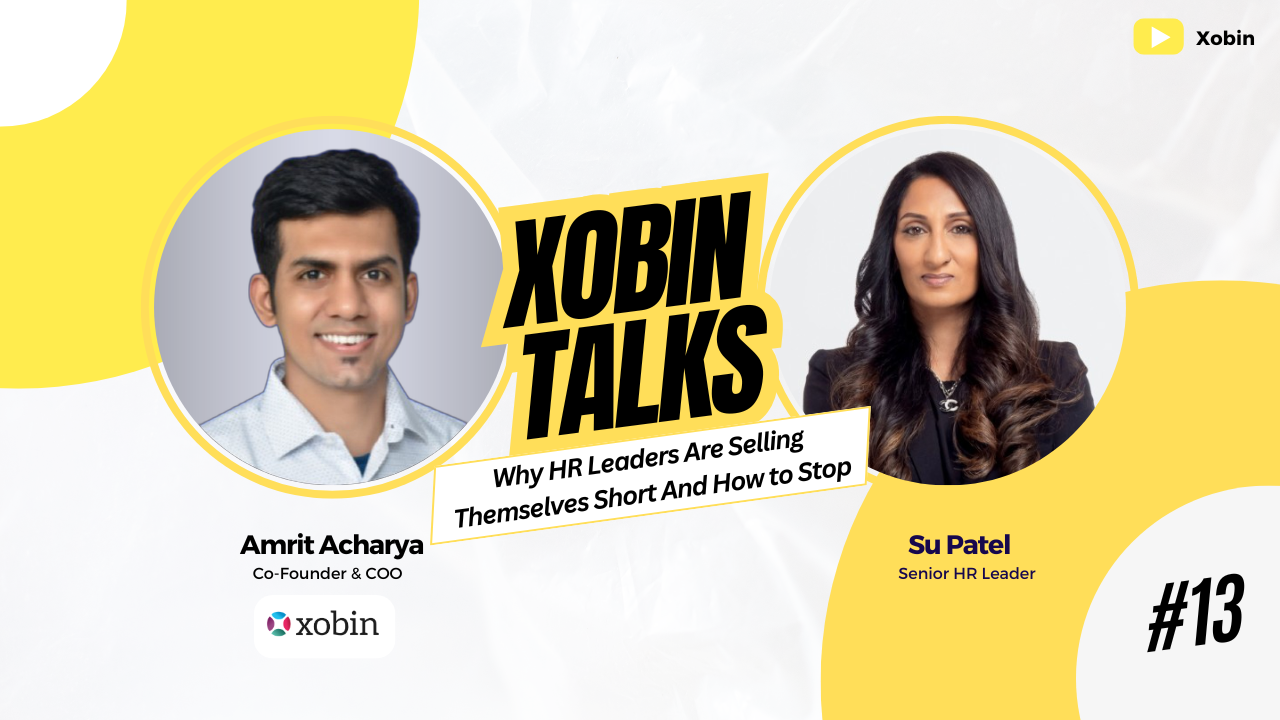
| GUEST PROFILE Su Patel, Founder and Director, HR Training and Consultancy Limited, Coach and Mentor for HR Leaders Connect: LinkedIn |
This episode was hosted by Amrit Acharya, Co-Founder and COO of Xobin.
Table of Contents
TL;DR – Key Takeaways!
- Only 5% of CHROs ever become CEO, and 42% move to lower-level HR positions after the C-suite (Josh Bersin Company, 2025). The glass ceiling is real, but a large part of it is self-imposed.
- HR professionals are stuck in reactive mode: onboarding, exit interviews, performance reviews. The ones who break through are radically proactive, out on the floor, knowing their people, preventing problems before they need fixing.
- The number one reason HR leaders do not go for bigger roles is not lack of skills. It is low self-worth, imposter syndrome, and a belief that business leadership belongs to someone else.
- Commercial awareness is the missing link for most HR professionals. If you cannot speak to profit, sales, and the balance sheet, you will always be seen as a support function, not a business leader.
- AI and technology will free up HR from paperwork and processes. That is not a threat. It is an invitation to do human work, developing people, building relationships, and being a genuine voice in the organization.
Su Patel started her career as a cashier at Tesco at 18 years old. She did not plan to go into HR and had no strategy, only a natural instinct for people that she followed all the way from a checkout till to senior operations manager, then into HR, and then into building her own coaching practice.
Since then, she has dedicated her career to helping HR professionals break free from the challenges holding them back. Many find themselves constantly reacting to problems, working in roles that don’t reflect their true potential, or believing that leadership opportunities are meant for someone else. Through her coaching, she helps them shift that mindset and move forward with confidence.
In Episode #13 of Xobin Talks, Amrit Acharya, Co-Founder and COO of Xobin, sits down with her to explore the tough questions that many HR professionals often avoid asking themselves. Along the way, the conversation uncovers fresh perspectives, practical insights, and honest reflections on the challenges shaping today’s workplace.
“How Did You End Up in HR? I Don’t Think You Planned It.”
Su: “It was really simple. I started as a cashier at Tesco at 18 and I had no plan, no idea what I wanted to do. And then a supervisor role came up, and I thought, I’m going to go for that because I like working with people. I got the job. And my manager started to see that I had a real natural way of inspiring people. I got promoted to line manager, then to senior operations manager.”
Then one day, a group director walked up to her and asked what she wanted to do next.
Su: “I said I really want to go into personnel.” “Personnel” is what HR was called at the time. And he said, “Okay, cool.” The following Monday I was placed in an HR role with no training, no education, nothing. I went from a trading manager to an HR manager overnight.”
She has no regrets at all.
Su: “My first job was at a retail store in East London during Ramadan. Since many of my coworkers were Muslim and the local community was incredibly diverse, I had the chance to experience different cultures and traditions firsthand. And I noticed that we served lunch between 12 and 2, but the fast breaks at four or four thirty. And I thought, why is there no food available for these people to break their fast? So I spoke to the restaurant manager and said, “Can we make sure there is food available for our Muslim employees?” And it was so well received. Already I was starting to understand. “What can we do to make the workplace truly fantastic?”
That story, Amrit points out, is also the opening example of her book.
“If Someone Asked You to Describe HR Today, Would Your Answer Really Be Positive?”
Amrit shares what he hears when he asks leaders about their HR function: process-driven, rule-bound, invisible until there is a problem. HR only becomes relevant at onboarding, at exit interviews, and at performance reviews.
Su: “Here’s the thing. HR professionals are frequently stuck in the middle of nowhere. On one hand, they’re paid by the organization to deal with problems. On the other hand, every HR professional who went into that role actually wants to help people. So they’re stuck, are they there for the business or are they there for the employee?”
The answer, for Su, is to escape the trap of reactivity entirely.
Su: “One of the things I really stress in my book is that in order to keep your work from becoming overly reactive, you need to create opportunities to prevent problems. Onboarding, exiting, and performance reviews are all very reactive activities. The real question is, how can we be more proactive in our approach? Beyond that, what can we do to build an employee experience that truly stands out? And as we move forward, how do we help people develop their skills, improve retention, and equip managers with a deeper understanding of the individuals they lead?”
To make it more relatable, she talked about how this worked in her own store.
Su: “I never sat at my desk. I was always out there on the shop floor with people. What are you up to? What’s going on with you? Tell me what you’re dealing with. We had 300 employees, and I knew pretty much what was going on, who had a dog, who had grandchildren, and the first names of everybody. That’s how much I wanted to be in the world of my people. And that’s what created me to be effective in my role.”
The Core vs. the Corner
Su: “I’ve always thought that HR ought to be an essential part of a company. Instead, it should be right at the heart of the business. When HR is truly involved, it becomes the force that holds everything together. In many ways, it’s the foundation that supports the company, not just the department people turn to when something goes wrong.”
“I Have Conversations With 25 HR Leaders Every Week. Surprisingly, Very Few See a Future as CEO.”
Amrit raises the data he keeps running into: the CFO is always in line to become CEO, and the COO is in line but rarely, almost never, to be the CHRO. Is HR selling itself short?
Su: “One hundred percent. Many HR professionals, even at the head of the HR level, have a really big gap in how they perceive themselves. They don’t have that level of self-worth. They’re often coming from a place of low confidence and low self-esteem. They’ve been in organizations where they haven’t felt valued. And also, they don’t see themselves as someone who can earn a CEO level of salary or take on that job or lead that many people.”
The data backs this up. Only 5% of CHROs ever become CEO, and 42% move to lower-level HR roles after leaving the C-suite (Josh Bersin Company, 2025). Just 3 out of 10 CHROs have experience in business roles. Even so, the expectations of the position are changing, and a solid understanding of business is now more important than ever.
Amrit adds a framing he hears often in his part of the world.
Amrit: “There’s a saying here that goes, ‘You’re never going to become a general if you haven’t served in the infantry.’ And I think this gets into the heads of HR folks; they feel that because they haven’t done something operational, they don’t have the right to be that general.”
Su: “It all boils down to mindset. Many people don’t believe they can become a CEO, even when they have the right skills and experience. At the same time, they fear success, worry about feeling like an imposter, or hesitate because they’re afraid of failure. In most cases, the challenge isn’t their qualifications; it’s the way they see themselves.”
“So How Do You Actually Break Through? What Do You Tell Your Clients?”
Amrit plays the role of an HR professional in their first or second job, two levels below where they want to be. Su has just become their coach; what happens next?
Su: “Having a clear idea of what you want is the first step. Not settling for what you have. Most HR people are just settling, and they don’t think they can have more because they don’t feel not good enough, because of imposter syndrome, or because they feel they don’t have the skills. But it’s got nothing to do with skills. It’s about knowing what you want and then working towards that.”
She takes them through an exercise.
Su: “Get a blank piece of paper. If there were no restrictions in your life, no money constraints, no mindset limitations, and no people holding you back, what would you love to do? Where do you want to be in three years? In five years? You might not know exactly, and it might change halfway along. But at least you have a plan of where you’re going. Every single person needs a career plan.”
Who Do You Need to Be?
Su: “Then the next question is: who do you need to be to achieve that goal? Nine times out of ten they won’t be who they need to be right now. Right now they’re feeling not very confident, feeling challenged, feeling like a victim in the organization. But what does it really take to succeed in the role? They need to grow as leaders, take greater ownership of their work, and develop a stronger understanding of the business side of things. More importantly, they must be ready to make a bigger impact and contribute beyond their day-to-day responsibilities.”
She is direct on that last point.
Su: “Many HR professionals don’t always have a clear understanding of how the business is performing. For example, how many of them regularly track sales figures, understand profit margins, or review the company’s balance sheet? In many cases, they don’t. Instead, they tend to focus solely on HR activities and overlook the broader business picture. And I’m not going to lie, I really struggled with numbers in the beginning myself. But it’s about leaning in and learning because of that CEO question; that is exactly why they’re not in line for that role.”
The Mirror of Your Role Model
Su: “If you want to become an HR Director, start showing up like one. HR Directors understand the business, build strong networks, and stay connected with the right people. More importantly, they know their value and aren’t afraid to own it. So you’ve got to create that identity within yourself. The identity of the person you want to aspire to become.”
Korn Ferry Found That HR Leaders Rarely Move Into Business Roles. Could That Be Limiting Their Impact?
Amrit raises research showing that when HR leaders are asked if they want to take a business role, most say no; they prefer to stay within HR. Su’s read on why this is happening is frank.
Su: “A lot of it comes from not believing they have the skills. Or they look at their boss doing the business role really badly, and they don’t want that job. But I think the biggest thing is they haven’t got a mentor. They haven’t got someone in their life who is doing the job they aspire to and can show them it’s possible.”
She emphasizes the importance of having the right people around you.
Su: “You become the average of the five people you hang around with. So who are you speaking to? Who are you learning from? HR professionals are not good at asking for help; they feel like if they do, they’ll be seen as weak. In reality, though, they will develop if they surround themselves with people who are more advanced than they are. That is what will grow them.”
Vulnerability as a Leadership Tool
Su: “I don’t hesitate to be vulnerable with others because I believe honesty opens the door to meaningful support. When I share my challenges, people can better understand how to help. And actually, vulnerability creates trust between people. People want to help you when you are open about where you are and what you need. But you’ve got to be available to receive that help, not just ask for it.”
“Is AI Coming for HR Jobs? Because That’s What My Clients Keep Asking.”
Amrit shares what he hears from young HR professionals every week: is ChatGPT going to take my job?
Su: “Here’s what I would say. If you are not continually learning and adapting, your job could be on the line. They say if you’re not learning, you’re dying. So it’s up to us to hold onto the role. It’s up to us to show the organization that our role is so much more than what technology can do.”
But she goes further; she is not threatened by AI at all. She sees it as a gift.
Su: “If I’m outside talking to people, interacting with human beings, what’s that got to do with technology? Nothing.” “I don’t need to worry about it. Actually, that’s fantastic since it will free up more time for me to interact with people. HR needs to get away from the processes, the trackers, the spreadsheets, and the policies and actually go and interact more with the human beings in the organization.”
She echoes what Amrit says to his own clients.
Amrit: “We keep telling people: AI is not artificial intelligence in this context; it is augmented intelligence. It is meant to support a person in HR, not replace them. You can never take the human out of human resources.”
Su: “A hundred percent. And I’m actually loving ChatGPT because it frees me up; it takes less time to do the paperwork, the policy writing, and the processes. I’ve got more time to develop and grow people, to train people, to step up in my human role. Which is what it is. It’s human resources. That means you’ve got to be more human.”
“How Is the Role of the CHRO Changing for the Future?”
Su: “For me, it’s all about developing the HR brand. HR has had such a negative reputation people call them ‘human remains,’ there’s a lot of negativity about HR not being supportive. But I think there’s real potential for building a much more positive brand.”
She describes the role as she sees it evolving.
Su: “The role will undoubtedly become influential in the future. A visionary role. Someone who is out there really building the HR brand to be so valuable and so needed within any organization. Not the person you go to when you’re in trouble, but the person who is the glue, the foundation, the one who is helping the head of finance, the head of sales, and the head of operations actually be better leaders themselves.”
The data supports the direction she is describing. CHROs today spend 80% of their time with the most senior stakeholders on the most sensitive issues, C-suite succession, future of work strategy, and organizational transformation (Russell Reynolds, 2025). The role is no longer a support function; it is a boardroom seat.
Su: “HR is no longer just a function that works behind closed doors. Today, it plays a central role in the organization, influencing strategy, strengthening culture, and contributing directly to business success. And if they’re in the middle, then you’ve got sales, operations, finance, and everybody around them, but HR is leading the way and is almost like the glue or the foundation of the organization.”
“One Last Thing. You’ve Been Through Real Personal Difficulty. What Did That Teach You?”
Su concludes with a statement that goes beyond the professional. In 2016, she separated from her husband, lost her job, and had to sell her house, all within three months.
Su: “It was a really tough, tough period for me. But I realized that when you’re at the bottom, there’s only one way to go, which is up. Everything I’m sharing with you now are all the things I implemented for myself. I created a vision board, found a mentor, and joined supportive communities. Along the way, I kept growing and becoming the person I am today.”
She ends with something she says she wishes someone had told her in corporate life.
Su: “One thing I didn’t realize when I was in corporate is that you cannot rely on one income stream. They don’t teach you this at school. They don’t teach you this in your job. But when you feel the fear of losing your job, that is when you become a victim to the boss who doesn’t treat you well. You become a victim to toxic environments because you don’t have another option. So life is about creating options for yourself so that you’re not stuck. Create more freedom.”
🎧 Watch the Full Episode
Xobin Talks – Episode 13 | Su Patel, Founder, HR Training and Consultancy | Hosted by Amrit Acharya, Co-Founder and COO, Xobin
▶ Play Episode #13 of Xobin Talks
About Su Patel
Su Patel is the Founder and Director of HR Training and Consultancy Limited and the author of Putting Humans Back into HR. She started her career as a cashier at Tesco in 1988 at age 18 and worked her way through supervisory, line management, and senior operations roles before moving into HR with no formal training, only the people instinct she had always had.
She spent decades in HR across large organizations before building her coaching practice, where she now works with HR professionals across all career levels to break through the mindset barriers holding them back. Her coaching combines career planning, confidence building, commercial awareness development, and practical leadership skills.
Want more from Xobin Talks? Read all our Xobin Talk episodes!
Frequently Asked Questions
Why do so few HR leaders become CEO?
Only 5% of CHROs ever become CEOs (Josh Bersin Company, 2025), and the primary barrier is not skills or experience; it is mindset. Most HR leaders do not see themselves as business leaders, lack commercial awareness, and have not built the cross-functional relationships and visibility that CEO succession requires.
What is the biggest mindset shift HR leaders need to make?
Moving from reactive to proactive: most HR professionals are stuck responding to problems – onboarding, exits, performance reviews. The ones who advance are out in the organization before problems arise, building relationships, understanding the business, and creating value that is visible to leadership.
How does Su coach HR professionals through the glass ceiling?
She starts with goal clarity: what do you actually want, with no restrictions? Then she asks who you need to be to get there, because most HR professionals are not yet being that version of themselves. The work builds a commercially aware, networked, confident, and visible identity before the role arrives.
What is the role of commercial awareness in HR career growth?
It is the single biggest differentiator between HR professionals who stay in support roles and those who make it to the business table. Knowing the sales figures, the profit margins, and the balance sheet, this is what signals to leadership that you are thinking like a business leader, not just an HR practitioner.
What is the role of commercial awareness in HR career growth?
It is the single biggest differentiator between HR professionals who stay in support roles and those who make it to the business table. Knowing the sales figures, the profit margins, and the balance sheet, this is what signals to leadership that you are thinking like a business leader, not just an HR practitioner.
Should HR leaders be worried about AI taking their jobs?
Only if they are not adapting, AI removes the administrative burden of paperwork, policy writing, and process management, freeing HR to do what technology cannot: build relationships, develop people, and act as a genuine human presence in the organization. The threat is not AI. The threat is staying in the spreadsheet when the invitation is to step onto the floor.
How important is mentorship for HR career growth?
Critical. HR professionals are not good at asking for help; they fear being seen as weak. But surrounding yourself with people who are already where you want to be is the fastest path to getting there. If you are the most senior person in your network, you are in the wrong network.
What does the future CHRO role look like?
An influencer and visionary at the core of the organization, not at the corner. CHROs today spend 80% of their time with the most senior stakeholders on strategic issues like C-suite succession and organizational transformation (Russell Reynolds, 2025). The future CHRO is a boardroom presence, a business partner, and a culture builder, not a policy administrator.
What is Su’s advice on financial independence and career freedom?
Build multiple income streams while you still have a job. When the fear of losing your income is your primary motivator, you will tolerate bad management and toxic environments because you feel you have no option. Options are freedom. Creating those options proactively through investing, side businesses, or other income sources means you never have to stay somewhere that does not serve you.