


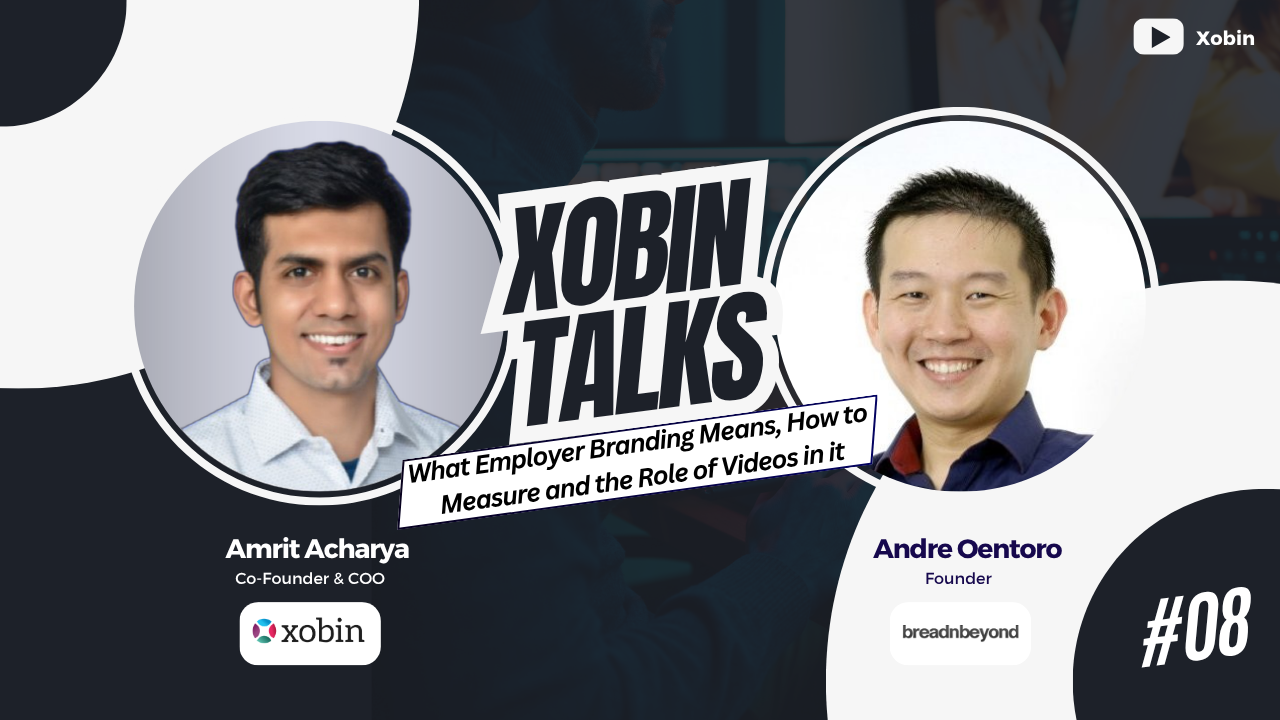
| GUEST PROFILE Andre Oentoro, Founder of BreadnBeyond, Founded in 2008. Connect: LinkedIn |
This episode was hosted by Amrit Acharya, Co-Founder and COO of Xobin.
Table of Contents
TL;DR – Key Takeaways!
- 75% of candidates research an employer’s brand before applying – before salary, before title, and before job description (LinkedIn, cited by Randstad). Employer branding is not nice to have. It is a pre-filter that shapes who applies.
- Strong employer branding reduces cost-per-hire by up to 50% and decreases turnover by 28% (LinkedIn, Workplace Insight). The ROI case is established. The execution gap is the problem.
- Employer branding is done by design, not by coincidence. Every training video, onboarding asset and LinkedIn post is either reinforcing or undermining the brand you are trying to build.
- Videos for employer branding must be a consistent campaign over time. A single video does not build a brand. A year of consistent, on-brand content does.
- Employer branding budget should sit between 10% and 40% of the hiring budget, depending on industry and competitive intensity. The range is wide because context determines necessity.
Most companies say they care about employer branding. But they have no idea what they are measuring, how much to spend on it or how to tell whether it is working.
Andre Oentoro has spent 15 years helping companies close that gap. He founded BreadnBeyond in 2008 as a graphic design agency, evolved it into an animation and video branding firm, and has spent the better part of a decade producing employer branding campaigns, onboarding videos and recruitment content for companies that want their culture to land with the right people.
In this episode #8 of Xobin Talks, host Amrit Acharya, Co-Founder and COO of Xobin, sits down with Andre to define employer branding properly, establish the metrics that matter, explore where video fits in, set realistic budget expectations and understand what the future of employer marketing looks like.
What Is Employer Branding, Really?
The Definition
Employer branding is the work of creating and promoting a company’s identity and reputation as a place to work.
Andre’s framing is broader than most. The employer is not always a company. It can be an individual professional, a university research department or a solo founder hiring their first employee. The brand is whatever potential employees, current employees and the wider public perceive about what it is like to work with you.
That perception is active whether you manage it or not. Companies that think they do not have an employer brand simply have an unmanaged one.
Why Identity Is the Hard Part
Defining company identity is where most employer branding efforts stall. It is easy to say “we are innovative” or “we have a great culture.” It is much harder to make those claims concrete enough that they are believable and consistent across every touchpoint a candidate encounters.
Andre points to Google and Apple as examples of companies that have solved this. When someone is offered a job at Google, they rarely hesitate. Not because Google pays the most, but because the culture is clearly enough defined that candidates already know whether they belong there before they walk in the door. That clarity is not accidental. It is the product of years of deliberate, consistent employer branding.
What Metrics Should HR Use to Measure Employer Branding?
Employee Satisfaction
The first metric Andre identifies is employee satisfaction. This is measurable through surveys, 360-degree feedback and pulse checks. Satisfaction levels show what the culture is really like, which is the best indicator of your employer brand’s future.
A company can publish all the right content about its culture. But if the people inside are not satisfied, that gap will surface in Glassdoor reviews, in referral behavior and in attrition data. Satisfaction is the foundation.
Employee Retention
Retention is the second metric. If employees are consistently leaving within two to three years, that is a signal of misalignment between what the company promises and what it delivers.
The data on this is well established. Companies with strong employer brands reduce turnover by 28% (LinkedIn, Workplace Insight). That reduction is not the result of better pay alone. It is the result of candidates self-selecting based on accurate expectations and of existing employees feeling pride in where they work.
Volume and Quality of Candidates
The third metric is the applicant pipeline: both volume and quality. If the number of applicants for open roles is declining while the industry is stable, something is wrong with the employer brand, not the market.
Andre is careful about this. External factors such as economic conditions, industry trends, and competitor sign-on bonuses can affect application volume. But when the broader environment is stable and applications are still falling, the employer brand is the variable to examine.
Quality matters as much as volume. A strong employer brand attracts candidates who are pre-aligned to the company’s culture and values. 72% of recruiting leaders say employer branding has a significant impact on hiring outcomes (Apollo Technical, 2025). The highest-leverage impact is not just getting more applicants. It is getting applicants who are already a good fit before the first interview.
How Does Video Fit Into Employer Branding?
More Than a Hiring Video
The instinctive use of video in employer branding is the recruitment video, which is a polished, two-minute clip showing happy employees and a nice office. Andre’s framing goes much further.
Video serves employer branding across the entire employee lifecycle. Recruitment videos attract candidates. Onboarding videos introduce new hires to the culture. Training videos communicate how the company operates and what it values. Every one of these assets is either reinforcing or contradicting the brand the company claims to have.
Social media posts featuring video content drive 48% more engagement from candidates compared to text alone (Market.biz, 2026). That reach advantage makes video the highest-leverage format in employer branding. But the content of the video matters more than the format itself.
Brand Consistency Across Every Asset
Andre makes a point that most companies miss. If a company positions itself as fun, every video it produces must communicate that. Not just the recruitment video. The training video on compliance. The onboarding video for new hires. The LinkedIn post from the HR team.
Consistency does not happen by default. It is designed. Color palette, tone of voice, character design, and pacing all of these elements signal brand identity to viewers whether or not the company intended them to.
One Video Is Not a Campaign
The second point Andre emphasizes is continuity. A single employer branding video does not build a brand. But a consistent campaign over a year or more does.
This is where most employer branding video efforts fail. A company invests in one strong video, posts it, sees initial traction, and then moves on. Six months later, the brand signal has faded. The companies that build genuine employer brand recognition through video are running continuous content on LinkedIn, in onboarding, and in internal communications that all point in the same direction.
What Should the Employer Branding Budget Be?
10% to 40% of the Hiring Budget
Andre’s answer is intentionally a range: 10% to 40% of the hiring budget, depending on context.
The lower end is appropriate for companies in stable industries with moderate competition for talent and a reasonably healthy employer brand. The upper end applies to companies in industries with high natural turnover, declining interest from candidates, or a significant brand deficit that needs active repair.
Why This Range Is Defensible
Strong employer branding reduces cost-per-hire by up to 50% (LinkedIn, cited by Apollo Technical). If a company is spending a substantial budget on job ads, agency fees and recruiter time every year, investing 20-30% of that in employer branding to reduce those downstream costs is a straightforward business case.
The challenge is making that case to leadership. HR is frequently positioned as a cost function. Employer branding is often the line item that gets cut first when budgets tighten.
Andre’s framing for making the case: employer branding is not a marketing expense. It is a hiring efficiency investment. Every rupee spent on building the brand is a rupee that reduces what needs to be spent on filling roles that the brand should be making easier to fill.
How Should Employer Branding Differ Across Channels?
The Strong Link Between Recruitment and Marketing
Andre’s most conceptually useful observation in this episode is that recruitment and marketing are mirror images of each other. Marketing is how a company reaches potential customers. Employer branding is how it reaches potential employees. The coin is the company itself. The two sides face in different directions but come from the same material.
That framing has a practical implication: channel selection in employer branding should follow the same logic as channel selection in marketing. You fish in the right pond. For some talent profiles, that is LinkedIn. For others, it is Glassdoor, GitHub, college campus communities or niche industry forums.
Platform-Specific vs. Consistent Content
The question of whether content should differ by platform is one Andre answers contextually. The brand identity stays consistent. The format, tone and length adapt to what each platform rewards.
A long-form culture story works on LinkedIn. A 15-second behind-the-scenes clip works on short-form platforms. A detailed careers page narrative works for a candidate doing deep research before applying. The same underlying truth about the company’s culture is communicated differently depending on where the candidate is in their decision-making process.
Good Culture Self-Propagates
Andre ends with a principle that all of the tactical discussion above depends on. Good culture attracts more good culture. When the right employees are in the building, they create the conditions that attract more people like them. Employer branding accelerates that process. But it cannot substitute for the underlying reality.
No employer branding campaign can survive on false promises for long. Candidates who join because of misleading information often leave within a year. As a result, their Glassdoor reviews can damage the value of the original campaign investment. In employer branding, authenticity is more than an ethical responsibility, it is also a business necessity.
🎧 Watch the Full Episode
Xobin Talks – Episode 7 | Andre Oentoro, Founder, BreadnBeyond | Hosted by Amrit Acharya, Co-Founder and COO, Xobin
▶ Play Episode #8 of Xobin Talks
About Andre Oentoro
Andre Oentoro is the founder of BreadnBeyond, an animation and video branding agency based in Indonesia. He founded the company in 2008, originally as a graphic design firm, before pivoting to video production in 2009 and evolving into a full animation agency by 2012. BreadnBeyond specializes in employer branding campaigns, onboarding and training videos and recruitment content for companies across Southeast Asia and globally.
Andre’s background is in architecture, giving him a designer’s perspective on visual identity and brand consistency that informs how his agency approaches every branding brief.
Connect with Andre: LinkedIn | Company: BreadnBeyond
Want more of such insights from Xobin Talks? Explore our Xobin Talks episodes.
Frequently Asked Questions
What is employer branding and why does it matter?
Employer branding is the process of building and promoting a company’s reputation as a great workplace. It plays a key role in hiring because nearly 75% of job seekers research a company’s employer brand before submitting an application. Moreover, a strong employer brand can lower hiring costs by as much as 50% while also reducing employee turnover by 28%.
What metrics should HR use to track employer branding success?
Three key metrics matter most: employee satisfaction scores from surveys and 360-degree feedback, employee retention rates tracked over rolling 12 to 24-month periods, and the volume and quality of the applicant pipeline. In many cases, a drop in application quality becomes the first clear sign of an employer brand issue.
How much should a company spend on employer branding?
Between 10% and 40% of the hiring budget, depending on industry and competitive context. Companies in high-turnover industries or those with a visible brand deficit should lean toward the higher end. Strong employer branding reduces downstream hiring costs enough to make the investment self-funding over time.
How does video help employer branding?
Video drives 48% more candidate engagement than text on social media. But the impact comes from consistency, not one-off production. Every video, from recruitment to onboarding to training, should reflect the same brand identity. A single video does not build a brand. A sustained campaign does.
Should employer branding content differ by social media channel?
The brand identity stays consistent. The format, tone, and length adapt to each platform. LinkedIn rewards longer-form culture stories. Short-form platforms reward quick, authentic clips. A careers page supports deeper research. The underlying truth about the company’s culture should be the same everywhere.
How long does it take for employer branding to show results?
Initial improvements in application volume and candidate quality can appear within 6-12 months. Larger gains in retention and cost-per-hire typically take sustained brand consistency over multiple hiring cycles to materialize. Employer branding is a compounding investment, not a quarterly campaign.
Can a company build employer branding without a big budget?
Yes, but not without authenticity and consistency. Employee advocacy, LinkedIn presence, transparent culture content and responsive review management are high-impact, lower-cost tactics. The risk in under-investing is that a poor brand costs more in downstream recruitment and attrition than a modest branding program would have.
What is the relationship between employer branding and company culture?
Inseparable. Employer branding communicates culture externally. When the message does not match internal reality, the gap shows in reviews and early attrition. Good culture is the foundation. Employer branding amplifies what is already there.