
A hiring manager at a Fortune 500 company recently told us something that made the room go quiet.
Table of Contents
“We had a candidate score 94% on our coding assessment. The recording looked completely clean. No tab switches, face on camera the whole time, no audio flags. We flew him out for the onsite.”
He paused, then said the part that should scare every talent leader reading this:
“On day one of the onsite, he could not write a for-loop on a whiteboard. He had clearly used AI tools or an off-screen helper during the remote test. Our proctoring tool had no idea.”
This is the dirty secret of remote hiring in 2026. Most companies are not screening for integrity.
They are hoping.
TL;DR – Key Takeaways!
- Xobin’s AI Trust Score was validated on 442,000+ candidates from 171 countries.
- The score is bimodal: it cleanly separates compliant from high-risk candidates instead of smearing them into a grey middle.
- It is geographically neutral across every continent tested.
- It stays consistent across strict and light proctoring setups alike.
- It correlates with actual test performance, confirming it measures real behaviour, not noise.
The Uncomfortable Number Nobody Wants to Publish
Industry reports quietly estimate that somewhere between 30% and 60% of remote technical assessments involve some form of integrity violation. Tab switching. Second devices. A friend in the next room. AI tools running silently in the background.
Ask five recruiters and you will get five different guesses. Nobody knows the real number, because nobody has measured it at scale.
We decided to stop guessing.
We ran an integrity analysis across 442,000+ candidates from 171 countries, covering every test configuration our platform supports. The results were not what our own product team expected. One finding in particular (we will get to it in a minute) changed how we think about trust in hiring entirely.
| Did You Know? The candidate cheating rate on unproctored online tests is roughly 3x higher than on proctored ones, according to independent HR research published in late 2025. And yet, more than 40% of companies running remote hiring still use little to no active proctoring, citing “candidate experience” concerns. |
What a Bad Hire Actually Costs You (It’s Worse Than You Think)
The U.S. Department of Labor pegs the cost of a single bad hire at around 30% of that employee’s first-year salary. For a $120,000 engineer, that is $36,000 gone. For a senior role, six figures evaporate.
But the salary waste is an easy number. Here is what rarely makes it into the ROI deck:
- Downstream team velocity. A misfired senior hire drags team output for an average of 6 to 9 months before anyone admits the problem.
- Interview loop tax. Your best engineers spent 8 to 12 hours interviewing the person. That time is unrecoverable.
- Legal exposure. If a candidate misrepresents credentials or identity during assessment, and your audit trail cannot prove how they were screened, you carry the liability.
- Reputation damage. One cheating scandal on Glassdoor, Reddit, or Blind, and your candidate pipeline shrinks for a quarter.
And this is the one that really hurts: every cheater who slips through displaces a legitimate candidate who would have done the job well. The cost of integrity failure is not just the bad hire you made. It is the good hire you missed.
| ✅ Pro Tip Before you do anything else, audit your last 50 rejected-after-hire cases. How many came from remote assessments with weak or no proctoring? If the answer is more than 2, you do not have a hiring problem. You have an integrity problem wearing a hiring problem’s clothes. |
Why Traditional Proctoring is Mostly Theatre
Most “AI proctoring” on the market today does three things: tracks eye movement, flags tab switches, and records the webcam. That’s it.
Here is the problem. A determined cheater in 2026 is not switching tabs.
- They have a second laptop open, angled away from the camera.
- They have a phone mirroring ChatGPT on a desk out of frame.
- They have a friend on mute feeding answers through a wireless earbud the webcam cannot see.
Traditional proctoring catches the clumsy ones. It misses the sophisticated ones entirely. And sophistication is increasing fast.
What you actually need is something different. Not a camera. A signal.
A measurable, data-backed score that tells you, in one number, how much you can trust the result sitting on your dashboard. That is what an Integrity Score does. And that is what we set out to validate.
If your team is running remote hiring at any serious volume, you already suspect your current proctoring is leaking. The question is how much.
See Xobin's AI Trust Score in action on a live demo. It takes 20 minutes. No slides.
Book A DemoWe Tested Our Integrity Score on 442,000 Candidates. Here is What We Found.
Xobin’s AI Trust Score (our name for the Integrity Scoring model built into the platform) produces a number from 0 to 10 for each test run on our platform. The score is derived from behavioural signals captured during the assessment: gaze patterns, tab activity, unauthorised device detection, audio anomalies, multi-person detection, and about a dozen other data streams.
The validation study was run to answer one question: when this score says “high risk,” is it actually right?
Here are the four findings that matter.

Finding 1: The score produces a clean behavioural split
This was the finding that changed our product team’s thinking. When we plotted the Integrity Score distribution across all 442,000 candidates, we did not get a bell curve. We got two peaks.
A massive spike at 10 (completely compliant candidates). A sharp spike at 0 (candidates flagged on multiple serious integrity violations). With the vast majority of candidates concentrated at these two extremes, the distribution reveals a clear behavioural divide rather than a gradual spectrum.

This shape (statisticians call it bimodal) is exactly what a reliable trust signal should produce. The model is not hedging. It is not smearing everyone into an ambiguous grey zone. It is saying, with confidence, there are two populations in your candidate pool, and it can tell them apart.
If you have ever looked at a proctoring report that flagged 80% of your candidates “for review,” you know how useless a non-committal score is. Ours commits.
Finding 2: Geographic neutrality (this matters more than you think)
One of the biggest hidden problems in AI-based hiring tools is regional bias. For example, an algorithm trained mainly on North American data may rate candidates from Southeast Asia or Africa lower, even when their honesty and integrity are not an issue.
For a global assessment system, fairness across regions is essential. Analysis across continents shows remarkably consistent score distributions, with no evidence of systemic regional skew.
This consistency indicates that the Integrity Score is:
- Behaviour-driven, not geography-driven
- Stable across diverse testing environments
- Free from regional bias

Candidate distribution varies significantly across continents. To ensure fair comparison, we focus on median and quartile-based distribution metrics rather than raw counts. Despite uneven regional representation, the integrity score distribution remains broadly consistent, reinforcing the model’s generalizability.
For any company hiring globally (and in 2026, that is most of them) this is not a nice-to-have. It is the difference between a defensible hiring process and a lawsuit waiting to happen.
Finding 3: The score works whether proctoring is strict or light
Most integrity tools break the moment you relax proctoring settings. Turn off the lockdown browser, and the score becomes meaningless.
Ours did not. Across all three proctoring levels we support, the median Integrity Score stayed in a consistent band. The signal driving the score is the candidate’s actual behaviour, not the intensity of monitoring.
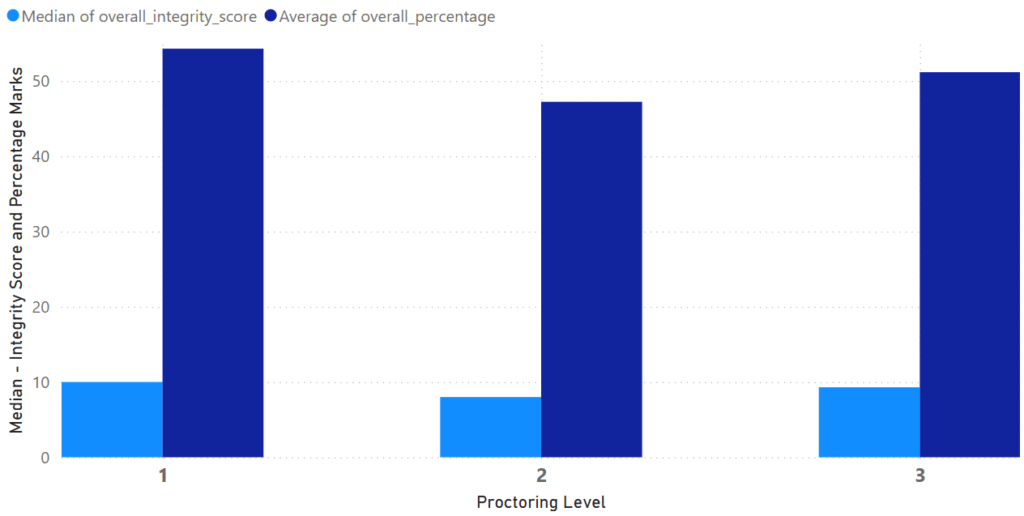
Why this matters: not every role justifies a locked-down assessment. A senior architect take-home needs a different proctoring footprint than a high-stakes compliance certification. The same trust signal has to apply to both. Ours does.
After just three findings, you already have deeper integrity insights than most hiring tools share all year. And then comes the one result that confirms everything.
Talk to Xobin about running your own validation on your last 1,000 candidates. We will show you exactly what you are missing.
Book A DemoFinding 4: High-integrity candidates perform better (and this proves the score is real)
The Integrity Score was never designed to predict test performance. It measures trust, not skill. But here is what the data showed when we crossed the two:

Candidates in the High Integrity band scored measurably better on the actual assessments than those in the Low band. Medium sat in between, cleanly.
Think about what this means. If our integrity model were measuring noise (random signals that did not correspond to real behaviour) we would expect zero correlation with performance. Instead, we found a clean, monotonic relationship.
Translation: the candidates our score flags as high-risk are the same candidates who were probably getting help using AI tools, or misrepresenting their abilities. They were never going to do the job well. Our score catches them before your interview loop wastes 10 hours on them.
The Hard Truth About Your Current Process
If you are still relying on webcam recordings and tab-switch flags to evaluate remote candidate integrity, you are running a 2018 solution against a 2026 problem.
The candidates have evolved. The AI tools they use have evolved. The sophistication of coordinated cheating rings (yes, those are a real thing now) have evolved. Your proctoring probably has not.
Most talent leaders we talk to know this, on some level. They just have not had the data to act on it. Now you do.
| ✅ Pro Tip Ask your current assessment vendor one question: “Can you show me a validated distribution of your integrity score across a dataset larger than 100,000 candidates?” Watch how fast the conversation changes. Most cannot. We published ours. |
What This Means for How You Hire From Here
The results above are not just a product validation for us. They are a roadmap for every company still running remote assessments without a trust layer. You now have three options:
- Option A: Do nothing. Keep running the same process. Keep hoping. Accept that somewhere between 1 in 3 and 1 in 2 of your remote assessment scores are being inflated by people who should not be hired.
- Option B: Add more proctoring theatre. Tighter lockdown browsers. More webcam recordings. Longer test times. Candidates will hate it, your completion rates will drop, and the sophisticated cheaters will walk right past it anyway.
- Option C: Move to a validated trust signal. An Integrity Score that has been tested at scale, proven free of regional bias, works across proctoring levels, and correlates with real outcomes. Then use that score as a trust layer on top of everything else you do.
Option C is what we built. The data above is why we think you should consider it seriously.
This is not a feature pitch. It is a category shift. Remote hiring without a validated integrity signal is going to look, five years from now, the way hiring without background checks looks today. Obvious. Negligent. Expensive.
You read a 7-minute blog on this because you already know your current process has gaps. The next step is seeing exactly where they are in your pipeline.
Book a call with Xobin today and we will run your next 100 assessments through the AI Trust Score and show you what you have been missing. No commitment, no deck, just your data.
| About the Research The analysis and findings in this blog are based on an independent validation study conducted by Poornima Gayathri S. Using Xobin’s candidate dataset of 442,000+ assessments across 171 countries, she independently validated the AI Trust Score as a reliable behavioural signal in remote hiring. |
Frequently Asked Questions
What is an Integrity Score in online assessments?
An Integrity Score is a number (typically on a 0 to 10 scale) generated by an AI model that analyses a candidate’s behaviour during a remote assessment. It captures signals like gaze patterns, tab activity, unauthorised devices, audio anomalies, and multi-person detection, then produces a single trust metric that indicates how confident a recruiter can be in the validity of that candidate’s test result. Xobin’s AI Trust Score is an example of this, validated on over 442,000 candidates.
How accurate is AI-based integrity scoring?
Accuracy depends on three things: the quality of the behavioural signals captured, the size and diversity of the training data, and whether the model has been validated against real outcomes. Xobin’s AI Trust Score was validated across 442,000+ candidates from 171 countries. The validation study found a clean bimodal score distribution (two distinct behavioural populations), geographic neutrality across continents, consistent performance across proctoring levels, and a strong correlation between integrity and actual test performance.
Is AI proctoring biased against certain regions or demographics?
It can be, and many tools in the market are. Models trained primarily on Western datasets frequently under-score candidates from other regions for reasons unrelated to actual integrity. Xobin’s validation explicitly tested for this, and found that score distributions remained consistent across all continents represented in the 171-country dataset. Asking vendors for published, large-scale validation data is the single best way to screen out biased tools.
Can candidates game an Integrity Score?
Difficult, and increasingly so. Because the score is derived from over a dozen independent behavioural streams (not just one signal like tab switching), gaming it would require a candidate to simultaneously fool gaze tracking, audio analysis, device detection, multi-person detection, and several other layers at once. Traditional proctoring can be defeated by a second device. A behavioural trust score like Xobin’s is significantly harder to circumvent.
Does integrity scoring predict job performance?
Not directly, and it is not supposed to. An Integrity Score measures trust in the assessment, not the candidate’s skill. However, Xobin’s validation study found that high-integrity candidates consistently scored better on the assessments themselves. The interpretation: candidates flagged as low-integrity were likely getting outside help, using AI tools, or misrepresenting their capabilities, and would not have performed as strongly without that assistance. The score does not predict performance, but it does tell you whether the performance you are seeing is real.