The hiring fraud your ATS will never catch and what it’s costing you right now.
You just made an offer. The candidate cleared your online assessment, scored in the top 5%, gave clean responses, and hit a fast completion time. They join. Two weeks in, they can’t do the basics.
You’re not alone. And it’s not bad luck.
There’s a growing, organized ecosystem of proxy test-takers operating in plain sight, and most hiring teams have no idea they’re being targeted.
TL;DR – Key Takeaways
- 30–50% of candidates cheat in unproctored online assessments for entry-level roles (HackerEarth, 2025).
- Proxy test-takers are people hired to sit assessments on behalf of candidates and are the fastest-growing form of remote hiring fraud.
- Common methods include remote desktop sharing, credential handoffs, impersonation services, and WhatsApp answer rings.
- A single bad hire from cheating during online assessment costs companies up to 30% of that employee’s first-year salary (U.S. Department of Labor).
- 74% of employers admit they’ve made at least one wrong hiring decision (CareerBuilder)
- AI proctoring software with live candidate ID verification is the most effective layer of defense.
- Xobin AI proctoring detects and prevents every cheating ways, from impersonation to screen sharing, in real time
The Uncomfortable Truth About Online Assessments
Here’s something most assessment vendors won’t tell you:
If your test can be taken at home, unsupervised, it can be cheated on.
Not occasionally. Not rarely. At scale.
Research from HackerEarth (2025) found that 30–50% of candidates cheat in online assessments for entry-level roles, with even 10% of senior candidates reportedly caught doing the same. To make matters worse, a separate study revealed that 80% of job candidates lie in some capacity during the hiring process, ranging from embellishing resumes to full-on online assessment cheating (Bryq). That’s not an edge case. That’s structural.
Proxy test-takers are third parties who physically or remotely complete an assessment on behalf of a candidate. The problem itself isn’t new. What has changed, however, is how frighteningly sophisticated the infrastructure around it has become.
Consider what’s out there: Telegram groups with thousands of members offering proxy services, LinkedIn profiles of self-described “assessment specialists,” Discord servers where candidates compare notes on specific company tests, and Fiverr-style gig marketplaces where anyone can hire someone to score in the 90th percentile on their behalf, for as little as ₹500.
Your current hiring process probably can’t detect any of it. This is exactly where most companies struggle with hiring fraud detection.
What Proxy Test-Taking Actually Looks Like
Most hiring managers picture proxy cheating in remote hiring as something clumsy: a friend at the same desk or someone forwarding screenshots to WhatsApp.
The reality is far more organized. Here’s how it actually works:
Remote Desktop Sharing
A candidate opens a video call and shares their screen, and a “helper” guides them through every question in real time. In some cases, the helper takes over entirely while the candidate watches something in another tab. This is one of the most widespread forms of remote hiring fraud, and it goes completely undetected by standard platforms.
Account Credential Sharing
Candidates hand over login credentials to professional proxy test-takers, who complete assessments on their behalf. These operators often work from IP addresses that won’t trigger location flags, making the fraud invisible on the surface.
Impersonation Services
Entire businesses exist specifically for this purpose. A proxy registers using the candidate’s email and personal details, completes the full assessment, and sends results back. There are no shared screens or detectable anomalies. Classic remote hiring fraud that standard platforms simply weren’t built to catch.
WhatsApp Answer Rings
For aptitude and knowledge-based tests, candidates use methods of cheating in online assessments such as screenshot questions and broadcast them to group chats. Answers come back within seconds, and the candidate inputs them without breaking a sweat.
AI-Assisted Cheating
This is where the problem accelerates. According to a 2025 study, 83% of candidates said they would use AI assistance if they believed detection was unlikely, and 14% have already admitted to using generative AI tools like ChatGPT during live assessments (HackerRank). Even more alarming, CodeSignal’s February 2026 data shows cheating on technical assessments doubled in a single year, jumping from 16% to 35%.
The question, then, isn’t whether this is happening to your company.
The question is, how many times has it already happened without you knowing?
The Real Cost Nobody Talks About
Let’s put a number on it.
You hired someone who used a proxy test-taker to game your assessment. Here’s what that actually costs:
- Onboarding cost: ₹50,000–₹200,000 per hire depending on role
- Lost productivity during the performance gap: 3 to 6 months of subpar output
- Team morale impact: High performers get frustrated carrying dead weight.
- Rehiring cost: You go through the entire recruitment process again, including job ads, screenings, interviews, assessments, and negotiations.
- Opportunity cost: The genuinely qualified candidate you rejected because the proxy cheat scored higher
The numbers from global research are sobering. The U.S. Department of Labor puts a bad hire’s cost at a minimum of 30% of that employee’s first-year salary and up to 50% for managerial roles. A CareerBuilder survey found 74% of employers have hired the wrong person, with an average reported loss of $14,900 per bad hire. Gallup’s 2025 data puts the macro picture in sharp focus: disengaged employees cost the global economy an estimated $8.9 trillion annually in lost productivity.
For a mid-level tech role, a single bad hire driven by assessment cheating can cost upward of ₹10–15 lakhs once everything is added up.
Now multiply that by the number of hires you make in a year.
This isn’t a minor inconvenience. It’s a structural leak in your hiring pipeline, and assessment integrity is the plug most companies still haven’t installed.
Why Your Current Process Is Blind to It
Most recruitment teams rely on three filters: resume screening, interviews, and assessments. The working assumption is that if a candidate clears all three, they’re legitimate.
But here’s the critical flaw: interviews test performance under observation. Assessments, more often than not, don’t.
When a candidate walks into your interview room, using a proxy test-taker is impossible. When your assessment link goes out at 6 PM on a Tuesday with a 48-hour completion window, though, you’ve essentially handed them an open-book exam with no one watching.
Standard assessment platforms track time-on-question and flag “abnormally fast” completions. The problem is that professional proxy test-takers are well aware of this. They study typical completion times, pace themselves accordingly, and operate entirely within “normal” parameters.
In other words, they’re not just cheating. They’re cheating strategically.
Research from Talogy (2025) shows that 65% of hiring managers are now concerned about candidates using generative AI to cheat on recruitment assessments. Despite this, the vast majority of companies continue to rely on unproctored, unsupervised assessments as a primary screening filter.
Your Applicant Tracking System sees a pass. Your recruiter sees a good score. Your hiring manager sees a promising candidate. Nobody, at any stage, sees the fraud. And without a proper hiring fraud detection system in place, that’s unlikely to change.
The Warning Signs Most Recruiters Miss
How to detect proxy test-taking in hiring isn’t about catching someone red-handed in the act. It’s about learning to read patterns. Here are the clearest signals:
Score-to-interview disconnect
A candidate scores in the 85th percentile on your online technical aptitude test but then struggles to explain basic concepts in a follow-up call. That gap is the single biggest behavioral signal that proxy test-takers were involved with, and it almost never has another explanation.
Unusually consistent completion times
Proxy services train their operators to finish within “normal” windows. So if you’re seeing a large cohort from the same job board completing assessments in eerily similar timeframes, that’s worth investigating as a potential sign of proxy cheating in remote hiring.
IP and device anomalies
A candidate based in Pune completing an assessment from an IP registered in Bengaluru at 2 AM is a signal, not proof, but a signal worth acting on. It becomes especially concerning when candidate identity verification wasn’t enforced at login.
Perfect scores on hard questions, mistakes on easy ones
This pattern is one of the clearest examples of how companies catch fake assessment scores. Genuine cognitive ability tests don’t work this way. When someone aces advanced reasoning but drops points on basic arithmetic, something is off.
Resume-to-score mismatch
A fresh graduate with no relevant experience scoring above senior professionals on a domain-specific test deserves a second look before any offer moves forward.
Seeing one of these signals doesn’t confirm fraud. Seeing three or four in the same candidate profile, however, is a conversation you need to have and a system you need to put in place to prevent assessment fraud in recruitment going forward.
What Assessment-First Companies Are Doing Differently
The companies successfully working to prevent assessment fraud in recruitment aren’t simply using harder tests. They’re rebuilding how the entire verification process works.
AI proctoring software
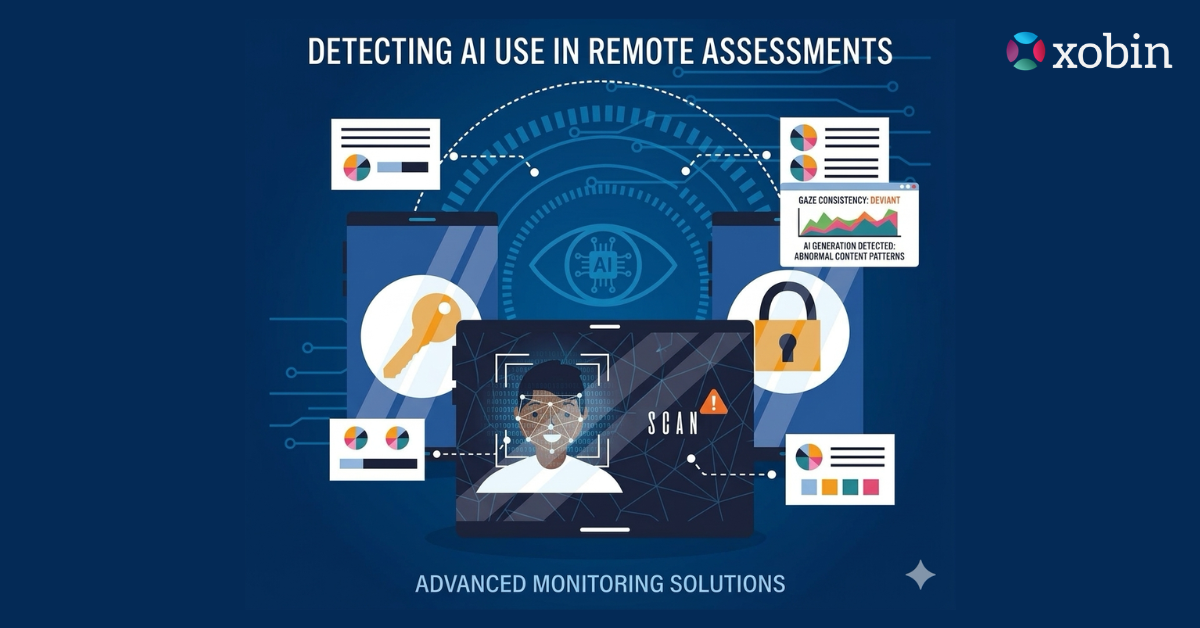
It goes far beyond passive recording. It actively analyzes behavior, flags unusual eye movement patterns, detects multiple faces in frame, monitors tab-switching, and cross-references typing patterns against baseline data. This is AI proctoring software doing what recording alone never could. Worth noting: AI-based proctoring tools now demonstrate a 95% accuracy rate in detecting suspicious behavior during online exams (PMaps, 2024).
Candidate ID verification
Candidate ID verification at the start of every session means a live face match against a government-issued ID before the first question even loads. Not an honor policy. Not a checkbox the candidate ticks themselves. Real candidate identification verification that confirms the person sitting the test is actually the person who applied.
Randomized question banks with adaptive difficulty
It ensures no two candidates see the same assessment. As a result, candidates cheating on online assessments through screenshot-sharing rings find their advantage completely eliminated.
Post-assessment validation layers
It takes the form of short follow-up interviews that mirror assessment content. These are designed specifically to surface the score-to-ability gaps that proxy test-takers always leave behind, because no matter how good the proxy is, they can’t prepare the real candidate for a live conversation about what they supposedly just completed.
Behavioral analytics across the entire session
It shifts the focus from the score itself to how that score was reached: time per question, correction patterns, pause durations, and the overall fingerprint of real thinking versus a scripted relay.
Taken together, these layers represent the difference between assessments that measure and assessments that verify. That’s why assessment integrity has become non-negotiable for serious hiring teams.
The Bigger Picture: What This Means for Your Hiring Quality
Here’s the uncomfortable math. If proxy cheating in remote hiring is happening in even 5–10% of your assessments, a meaningful portion of your hiring decisions are being made on corrupted data.
You believe you’re selecting top performers. In reality, you’re selecting top performers alongside the most organized cheaters.
The downstream consequences are significant. A study by Leadership IQ found that 46% of newly hired employees fail within 18 months, while only 19% achieve genuine success. Not all of that is assessment fraud, but a significant share traces back to decisions made on data that was never real in the first place.
Over time, this quietly degrades your entire talent pipeline. Teams underperform. Managers blame culture or onboarding. Nobody ever traces it back to online test cheating at the top of the funnel, which is exactly why it keeps happening.
Meanwhile, the candidates who played by the rules, the ones who actually had the skills, lost out to someone who paid ₹1,000 on Telegram.
That’s not just a hiring problem. That’s a fairness problem. And it compounds silently, hire after hire.
Xobin Closes the Gap!
Xobin AI Proctoring detects every cheating method and prevents it, not as a marketing claim but as a technical reality built into every assessment session.
Xobin’s advanced AI-proctoring features are designed specifically around the proxy test-taker problem. What separates it from passive recording tools is the depth of verification layered across every session.
Every assessment includes:
- Live face detection that confirms the right person is taking the test, not just that someone is logged in
- AI proctoring software monitoring that flags eye movement anomalies, multiple faces, tab switches, and background activity in real time
- Randomized, role-specific question banks that eliminate the value of question-sharing rings entirely
- Score integrity reports that attach a confidence rating to every result, so you know not just the score but also how much to trust it
- Automated follow-up question suggestions so interviewers can probe precisely the areas where behavioral anomalies were detected
The result is straightforward. You don’t just get scores. You get verified scores.
Hiring fraud detection stops being something you deal with reactively after a bad hire surfaces. Instead, it becomes proactive, embedded into every step of the assessment pipeline. And you stop making ₹10-lakh mistakes based on proctored assessments that were never actually proctored at all.
Before You Send Your Next Assessment Link
Ask yourself one question: if a candidate wanted to use a proxy test-taker on this assessment, how hard would it actually be?
If the answer is “not very,” you already know what to do next.
See how Xobin prevents proxy test-taking. Book a personalized demo today!
People Also Ask
Q1. How common is proxy test-taking in online hiring assessments?
Research indicates 30–50% of candidates cheat in unproctored online assessments for entry-level roles. Cheating on technical assessments doubled from 16% to 35% in a single year, according to CodeSignal (2026). Proxy test-taking, where a third party completes the assessment entirely, is among the fastest-growing methods.
Q2. How can companies detect if a candidate used a proxy test-taker?
Key red flags include a sharp score-to-interview skill gap, IP or device anomalies, inconsistent performance patterns such as acing hard questions while failing easy ones, and suspiciously uniform completion times across a candidate cohort. AI proctoring software with behavioral analytics can flag these signals in real time.
Q3. What is the best way to prevent proxy cheating in remote hiring?
The most effective approach combines live candidate ID verification before the test begins, AI-powered behavioral monitoring throughout, randomized question banks, and post-assessment follow-up interviews to validate scores. Platforms like Xobin bundle all of these into a single proctored assessment workflow.
Q4. Does AI proctoring really work against proxy test-takers?
Yes. Modern AI proctoring software goes well beyond simple recording. It detects multiple faces in frame, flags abnormal eye movement, monitors tab-switching, and cross-references typing patterns against baseline data. Studies show AI-based proctoring tools achieve a 95% accuracy rate in detecting suspicious behavior during online exams.
Q5. How much does a bad hire from assessment fraud actually cost?
The U.S. Department of Labor estimates a bad hire costs at minimum 30% of that employee’s first-year salary and up to 50% for managerial roles. When onboarding, lost productivity, team disruption, and rehiring costs are factored in, a single fraudulent mid-level hire can run Rs. 10–15 lakhs or more for Indian companies.