It’s 9 AM on a Tuesday and you posted the job last Friday.
You open your inbox and see 340 applications waiting for review. Meanwhile, your hiring manager messages you before 9 a.m. asking, “Have you found any strong candidates yet?” On top of that, you’re juggling three other open positions. To make things even more challenging, your afternoon is packed with interviews for a role that may no longer have final approval.
When hiring pressure kicks in, you move fast. You scan resumes, spot familiar names, notice the right keywords, and shortlist candidates in seconds.
Here’s what nobody told you when you built that shortlist.
Not every big-name company on a resume is real. Sometimes, AI simply copies keywords from your job post and builds a polished resume around them. In less than a minute, it can actually construct a compelling nine-year career narrative.
You didn’t hire a candidate. You hired a document. And the document lied.
This isn’t an uncommon edge situation or a warning from a specialized industry forum. A 2025 Software Finder survey of 874 HR professionals found that 72% of recruiters have already encountered AI-generated applications, including fabricated portfolios, invented references, and resumes written entirely by machine.
The fraud isn’t coming. It was in your last shortlist.
TL;DR — Key Takeaways!
- In less than 60 seconds, AI can create a flawlessly plausible fake resume, and your present hiring procedure most likely won’t be able to identify it. Here’s what’s happening, how bad it already is, and what the smartest HR teams are doing about it.
- 72% of recruiters have already seen AI-generated fake applications and most couldn’t tell the difference (Software Finder, 2025).
- Only 19% of hiring managers are confident their process would catch a fraudulent candidate, meaning 81% are hiring blind (Checkr, 2025).
- By 2028, 1 in 4 applicant profiles will be fraudulent, according to Gartner. It’s already a crisis.
The Resume is Broken as We Know it
There’s a dirty secret spreading quietly across the recruitment industry. The resume, the document your entire hiring funnel depends on, can now be fabricated from scratch in under a minute. Not roughly. Not passably. Convincingly.
Tools like ChatGPT, Claude, and dozens of specialized “AI resume builders” can now generate a complete professional resume tailored to a specific job description, loaded with industry-appropriate vocabulary, realistic-sounding metrics, and a believable career trajectory. A candidate with zero experience in data engineering can produce a resume that looks like 7 years of it.
According to a 2025 Software Finder survey of 874 HR professionals, 72% of recruiters reported encountering AI-generated applications, from resumes written by machines to AI-generated portfolios (51% of cases) and fabricated references (42%). This isn’t an occasional edge case. It’s a systemic flood. And it’s not just AI making this worse. Resumes have been an unreliable hiring signal for far longer than most recruiters realize.
And here’s what makes it genuinely terrifying: your ATS is not designed to catch it.
ATS systems were built to parse and rank. They were never built to verify. When an AI writes a resume using the precise keywords from a job description, it doesn’t just pass the ATS. It scores well.
What Exactly Can AI Fabricate, and How Convincingly?
Let’s be specific, because vague warnings don’t prepare you for the actual problem.
A candidate with basic AI literacy can now generate, in under 60 seconds:
- A complete career history that covers job roles, companies worked for, employment timelines, and reporting lines, all arranged in a way that shows natural and believable professional growth.
- Quantified achievements like “Reduced customer churn by 34%” or “Managed a $2.3M budget.” Numbers that feel specific enough to be real but are impossible to verify without a direct call.
- Skills sections precisely mirrored your job description’s exact language.
- Cover letters that thoughtfully mention your company’s latest updates, reflect its mission, and align with the language and values that shape its culture.
- LinkedIn profiles that match the resume, complete with AI-generated connections and endorsements.
In the 2025 Checkr survey of 3,000 hiring managers, 62% said job seekers are now better at faking their qualifications and experience on resumes with AI than HR teams are at detecting those deceptions. Only 13% disagreed.
Let that land for a second. The people doing the deceiving are winning.
Did You Know? Between September and November 2025, cybersecurity firm Huntress found that 23.2% of their own applicants were flagged as fraud risks after implementing AI-detection tools, suggesting nearly 1 in 4 applications involved AI-generated or falsified resume submissions. (Huntress, 2026)
This isn’t a future risk. Companies actively using detection tools are discovering the fraud that was previously invisible to them.
Why Traditional Screening Simply Cannot Keep Up
The fundamental issue that no one wants to discuss publicly is that hiring teams will eventually fail.
Recruiters are measured on speed-to-fill. Hiring managers want qualified candidates fast. Nobody’s KPI is “fraud detection rate.” In fact, recruiters are already losing an estimated 850 hours a year just to irrelevant applications, before fake resumes even enter the picture. So when a polished resume hits your inbox in a market where you’re desperate to fill a role, the psychological pressure is to move forward, not to investigate.
And that pressure is exactly what fraudsters are counting on. The more stretched your team is, the more AI-generated applications slip through unchecked.
Nine in ten HR workers reported a surge in low-effort, AI-generated applications flooding their pipelines in 2025 (Staffing Hub, 2026). But “low-effort” is an antiquated term for this problem. The new version is high-effort AI fraud: sophisticated, targeted, personalized fake profiles designed to pass every stage of your funnel.
A 2025 survey of 3,000 hiring managers found that only 19% were extremely confident their current process would catch a fraudulent applicant (Checkr, 2025). This indicates that 81% of hiring teams are operating in the dark.
The consequences are real:
- Wasted recruiter hours screening candidates who don’t exist
- Onboarded employees who can’t perform the role they claimed
- Security risks from bad actors who deliberately misrepresented their identity
- Legal exposure when background check gaps allow fraud to slip through
According to Gartner’s widely cited projection, by 2028 one in four candidate profiles worldwide will be fake, driven entirely by AI tools that make professional identity fabrication cheap, fast, and scalable.
We’re not heading toward that number. We’re already accelerating past it.
What a Convincing Fake Resume Really Looks Like
Understanding the structure of AI-generated fraud is the first step to catching it. Here’s what sophisticated fake resumes tend to look like and why they’re so hard to spot.
They Pass ATS Perfectly
AI tools are now trained on what ATS systems look for. They don’t just add keywords. They place them in the right density, in the right sections, with the right formatting. A human gaming an ATS gets it partially right. An AI gets it exactly right.
Their Metrics Are Specific But Untraceable
“Increased pipeline velocity by 27%” sounds precise and credible. It’s also completely unverifiable. Authentic resumes tend to have context around numbers. AI-generated ones drop precision metrics without the surrounding story because the story doesn’t exist.
The Timeline Is Always Suspiciously Clean
Real careers have gaps, pivots, and messy transitions. AI-generated resumes tend to produce unnervingly clean progressions: logical promotions, no unexplained gaps, and no awkward role changes. Life is messier than that.
The Skills Section Mirrors Your Job Post
If a resume’s skills section reads like a copy-paste of your requirements, that’s not a coincidence. That’s the exact prompt the candidate used.
 Pro Tip for Recruiters During the initial screening call, ask, “Walk me through exactly how you approached [a specific task from their stated experience].” AI-generated resumes lack recollection. Within ninety seconds, candidates who depend on them will stall, generalize, or contradict themselves. Authentic experience produces instinctive, specific answers.
The “instinctive response” test is one of the most effective low-cost anti-fraud screening tactics available to any recruiter today.
What the Data Says About Where This Is Heading
The trend lines are unambiguous. In 2024, AI-assisted applications were a concern. By 2026, they will become a crisis. By 2027, they’re the default assumption for high-volume roles.
A 2025 survey of 3,000 hiring managers found 59% had already suspected a candidate of using AI to misrepresent themselves (Checkr, 2025). On top of that, 71% of HR professionals reported encountering misleading or false candidate information in a separate Equifax survey of 254 HR executives.
These aren’t fringe cases. These are the majority of your applicants.
According to Gartner’s 2025 workforce prediction, one in four candidate profiles globally will be fake by 2028, enabled by AI tools that fabricate professional identities at scale and at near-zero cost. This represents a structural failure in resume-based hiring, not a temporary anomaly.
So What’s the Actual Fix? (Hint: It’s Not “Better Resume Screening”)
When the Resume Wins and Your Business Loses
Picture this. Last quarter, a mid-sized SaaS company hired a senior data analyst. Impressive resume. Cleared every screening call. Gave sharp answers in the panel interview. Joined the team on a Monday.
By Wednesday, his manager knew something was wrong.
He couldn’t write a basic SQL query. The dashboard he had created at his last company? He’d never seen the tool before. The “7 years of experience”? Assembled in 45 minutes by an AI that had never touched a dataset in its life.
That company lost 6 weeks of onboarding time, a recruiter’s credibility, and a team’s trust, all because a resume looked exactly like what they needed.
This is not a hypothetical. Versions of this story are happening inside your pipeline right now. You just don’t have the tools to see it yet.
It’s not the fraud you catch that should worry you. It’s the fraud that’s already past your front door, sitting in a Slack channel, on a payroll, with access to your systems.
Most hiring teams rely on a mix of recruiter expertise, screening conversations, and LinkedIn verification to evaluate candidates. Even so, a well-crafted AI-generated profile can look surprisingly authentic. As a result, when recruiters are juggling multiple vacancies and every day of delay impacts the business, spotting the difference becomes much more difficult.
The only reliable signal is demonstrated skill. Not described skill. Not claimed skill. Demonstrated skill. Resume-based hiring was already broken before AI arrived. Now it’s a liability.
The Four-Layer Answer to Fake Resume Fraud
The smartest recruiting teams have stopped trusting documents and started building verification pipelines where each layer targets a specific fraud vector.
Layer 1: Assess what candidates can actually do.
Xobin’s largest test library of skills assessments goes well beyond multiple choice. Candidates face coding challenges, video responses, and open-ended questions, all scored consistently by AI. A fabricated resume claims skills. A timed coding challenge exposes whether those skills actually exist.
Layer 2: Interview every candidate, not just your shortlist.
Xobin’s Agentic AI Interviews conduct dynamic, role-specific conversations with intelligent follow-ups and instant scoring, running 24/7 without recruiter involvement. Every single candidate gets a real L1/L2 screening. Nobody slips through because your team was too stretched to reach them.
Layer 3: Make sure the person taking the test is the person you’re hiring.
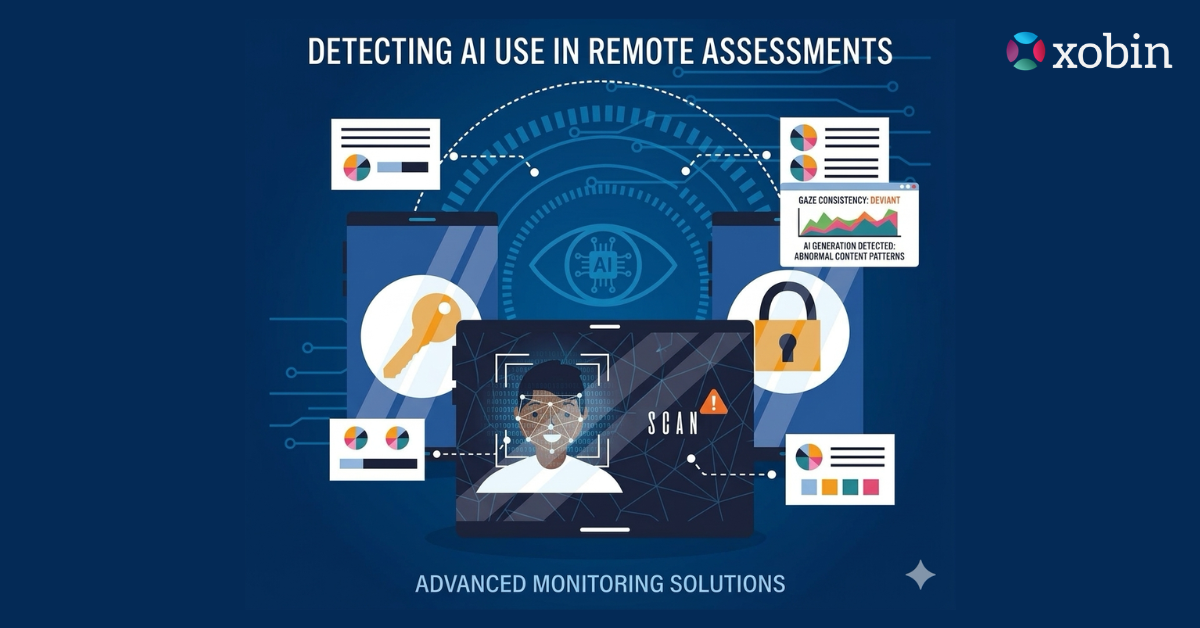
Xobin’s multi-layered proctoring monitors eye gaze, webcam feeds, browser activity, audio, unauthorized devices, and multiple user presences in real time. Every assessment generates a trust score and an audit-ready report. So when a result lands on your desk, you know it’s genuine.
Layer 4: Let the data tell you who actually fits the role.
After parsing a resume, Xobin’s ATS cross-references it against the job description and assessment results to generate a fitment score, a quantified match between candidate and role. It normalizes job titles, maps skills to industry-standard taxonomies, flags employment gaps, and surfaces AI-generated interview questions tailored to each candidate. A fraudster can fake a resume. They cannot fake a fitment score that combines their claimed experience with their actual test performance.
According to a 2025 ResumeGenius report, 74% of hiring managers have now seen AI-generated content in applications, and the teams adapting fastest are the ones adding objective evaluation layers before human review begins.
Want to see exactly how this pipeline runs end to end? Here’s a step-by-step breakdown of how Xobin’s automated candidate screening works.
AI created the fraud problem. The answer is AI that’s specifically built to end it.
Stop Screening Documents. Start Testing People.
AI didn’t just give candidates a better spell-checker. It gave them a fabrication engine. And while most of your competitors are still arguing about whether to “allow AI on resumes,” the smartest hiring teams have already accepted the new reality and built around it.
The resume is not dead. But trusting it blindly, the way most hiring funnels still do, is now actively dangerous.
The good news is the same technology that made fraud cheap to commit has also made it possible to catch at scale. A four-layer verification pipeline, assessments, AI interviews, proctoring, and a fitment score that ties it all together turn your hiring funnel from a vulnerability into a competitive advantage.
A document is not evidence of capability. A test is. And now, you have no excuse not to run one.
If your hiring process is still resume-first, you’re not just at risk of hiring fraud. You’re making a promise to your organization that you can no longer keep.
Book a personalized demo to know how Xobin helps companies verify candidate skills before the final interview. Replace resume guesswork with objective talent data.
Explore Assessments →
3,400 skills-based assessments | 2,500 role-based assessments
Frequently Asked Questions
Can AI really generate a completely fake resume that looks legitimate?
Yes, and it takes under 60 seconds. Modern AI tools can produce role-specific resumes with plausible work history, quantified achievements, and ATS-optimized formatting. A 2025 Software Finder survey found 72% of recruiters had already encountered AI-generated applications, including fabricated portfolios in 51% of cases.
How common is AI resume fraud in 2025 and 2026?
Extremely common. In a 2025 survey of 3,000 hiring managers, 59% suspected a candidate of using AI to misrepresent themselves (Checkr). Gartner projects 25% of all candidate profiles globally will be fake by 2028, a trend already well underway.
What’s the difference between “AI-assisted” and “AI-fabricated” resumes?
“AI-assisted” means a real candidate used AI to improve language or format, which is generally accepted. “AI-fabricated” means credentials, experience, and skills that don’t exist were invented wholesale by AI. The latter is fraud and, increasingly, a legal liability for hiring teams who onboard such candidates.
How can recruiters detect AI-generated fake resumes?
Behavioral signals during screening calls are often more reliable than resume analysis. Ask for specific, process-level answers to experience-based questions. AI-fabricated candidates stall or overgeneralize. The most reliable solution is pre-employment skill assessment that verifies capability independently of the resume.