

If you’re still screening candidates primarily through resumes and gut-feel interviews, you’re working with a broken tool. A January 2025 survey found that 44% of job applicants admitted to being dishonest during the hiring process, and 24% lied on their resume alone (Resume Builder, 2025). That’s not a minor inconvenience, that is a systemic failure point in traditional hiring.
Online assessments exist to fix that failure. They give recruiters, TA teams, and L&D leaders objective, data-backed signals about a candidate’s actual skills before a single interview is scheduled.
This guide covers everything talent professionals need to know about what online assessments are, the types that matter most, how the process works end-to-end, the measurable benefits, and the key use cases across the talent lifecycle.
Table of Contents
TL;DR – Key Takeaways!
- Nearly 75% of employers have made at least one bad hire, costing an average of $17,000 per mistake (CareerBuilder, 2024). Online assessments directly reduce that risk.
- 78% of HR professionals say pre-employment assessments have improved the quality of their organization’s hires (SHRM, 2024).
- Skills-based hiring has reached 81% adoption among employers globally, and assessments are the engine that makes it work (MSH, 2026).
- The average cost per hire is now $5,475 (SHRM, 2025). A structured assessment process can help reduce these hiring costs significantly.
- Only 15% of hiring leaders feel fully confident in their decisions at the time of hire (SmartRecruiters, 2024). Better data fixes that.
What Is an Online Assessment?
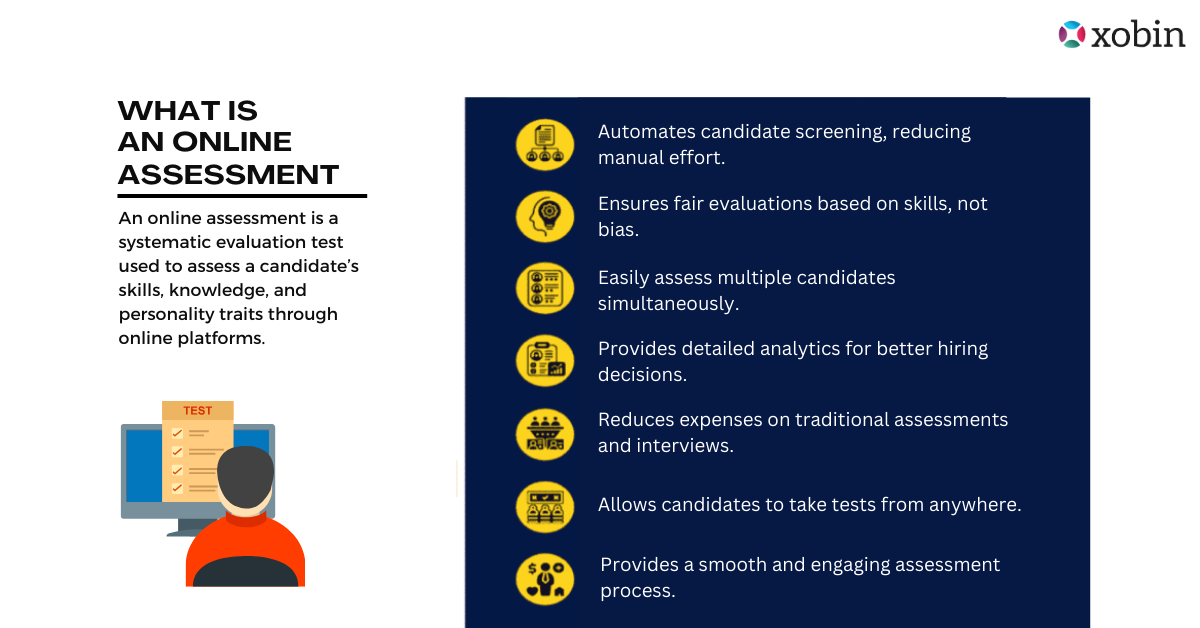
Online assessments (sometimes called pre-employment tests, skills tests, or talent assessments) are structured, technology-driven evaluations that measure a candidate’s skills, cognitive ability, personality, and job-specific competencies via an online platform. They replace the guesswork of unstructured interviews and resume screening with standardized, comparable data.
Here’s what’s changed. With generative AI tools widely available, a polished resume now takes minutes to produce. Candidates can craft keyword-perfect applications without possessing the underlying skills. This is precisely why 56% of employers still cite “not enough qualified candidates” as their biggest recruitment challenge, even when application volumes are at record highs (Breezy HR via SSR, 2025). The resume has become a weaker signal, not a stronger one. Online assessments counteract that directly.
Modern online assessment platforms offer real-time analytics, automated scoring, AI-powered proctoring, and customizable test formats, making them practical at any hiring scale, from a 5-person startup to a 50,000-employee enterprise.
Types of Online Assessments Recruiters Actually Use

Not all assessments serve the same purpose. Therefore, it is important to understand which type of assessment fits a specific hiring or training need. Here is a simple explanation of the assessment types commonly used by TA and L&D teams, along with practical examples to help you choose the right test for different job roles.
1. Skill-Based Assessments
Skill-based assessments measure a candidate’s proficiency in specific job-related competencies, the things they’ll actually do on the job. Skills-based hiring has reached 81% adoption globally (MSH, 2026), and these tests are the core mechanism behind that shift.
They validate resume claims objectively. A candidate who lists “advanced Excel skills” either demonstrates them or doesn’t. This way, employers no longer need to rely only on what candidates say.
Common examples:
2. Cognitive Ability Tests
Cognitive ability tests measure problem-solving speed, logical reasoning, numerical aptitude, and critical thinking. They’re particularly useful for roles that require quick decision-making under pressure, think analyst, operations, or leadership-track positions.
According to research from the Society for Industrial-Organizational Psychology, cognitive ability tests are among the strongest predictors of job performance across role types.
Common examples:
3. Technical and IT Assessments
Technical assessments go beyond coding. They cover networking, cybersecurity, cloud infrastructure, DevOps practices, and database management. With 72% of organizations struggling to find candidates with advanced technical skills (HRLineup, 2025), these tests help TA teams cut through inflated technical claims quickly.
Common examples:
4. Personality Assessments
Personality assessments evaluate behavioral traits, emotional tendencies, and communication style. They help answer the question most interviews fail to answer well: will this person actually fit how this team works?
These tests don’t predict raw performance on their own, but they’re powerful indicators of culture add, long-term retention fit, and leadership potential.
Common examples:
5. Coding Assessments
Coding assessments put candidates in a live coding environment where they write, debug, and optimize real code. AI-driven evaluation scores accuracy, efficiency, and execution speed instantly. For engineering TA teams, this replaces the first technical phone screen entirely.
Common examples:
6. Psychometric Assessments
Psychometric assessments combine cognitive ability, personality, and behavioral data into a holistic candidate profile. They use scientifically proven psychological methods to predict job success and leadership abilities with greater accuracy. Because of this, they offer valuable insights that traditional interviews often struggle to evaluate consistently.
Common examples:
- Situational Judgment Test (SJT)
- Emotional Intelligence Test
- Attention Span Test
- Behavioral Assessment Test
7. Language Proficiency Tests
For customer-facing or global roles, language proficiency isn’t just nice to have. It’s a job requirement. Xobin’s Communication Checker assesses speaking fluency, writing accuracy, reading comprehension, and grammar precision in a structured, automated format.
Common examples:
- English Proficiency Test
- Communication Test
- French / Spanish / German Proficiency Tests
- IELTS-equivalent assessments
8. Video-Based Assessments
Video-based assessments let candidates respond to pre-recorded questions via video submission. AI analysis evaluates confidence, speech clarity, and communication structure. For high-volume roles, recruiters can review only flagged candidates rather than watching every single video, cutting screening time dramatically.
Common examples:
- Pre-recorded Video Interview
- Facial Expression and Confidence Evaluation
- Speech Clarity and Pronunciation Test
- Cultural Fit and Team Compatibility Assessment
9. Game-Based Assessments
Game-based assessments use interactive challenges to evaluate cognitive ability, decision-making, and adaptability in a more engaging format. Gamified testing modules have been shown to significantly increase candidate engagement compared to traditional tests, which is particularly valuable for early-career and campus hiring pipelines where dropout rates tend to be high.
Common examples:
- Cognitive Ability Game
- Problem-Solving Challenge
- Strategy and Critical Thinking Simulation
- Decision-Making Scenario
How Does Online Assessment Work? A 7-Step Process

Here’s how the process runs end-to-end on a modern assessment platform.
Step 1: Define Job Requirements and Select the Right Test
Before anything else, recruiters and hiring managers align on what “good” actually looks like in this role. That means mapping out the technical skills, soft skills, cognitive requirements, and behavioral traits needed to succeed. Only then can you select the right combination of assessments.
Custom tests can be built from scratch or drawn from a pre-built library of thousands of validated tests. Getting this step right is what separates meaningful data from noise.
Step 2: Test Configuration and Customization
Modern platforms let recruiters tailor every element of the assessment, including time limits per section, question format (multiple-choice, coding, video, or case study), difficulty level by role seniority, and AI-powered proctoring settings. White-labeling options mean candidates see your brand, not a third-party tool. That matters for candidate experience.
Step 3: Inviting Candidates to Take the Assessment
Assessments are shared via email link, ATS integration, or career portal. Candidates can take the test from any device, at any time, which is a meaningful advantage for global and remote hiring. Clear instructions are provided upfront, including time limits, structure, and proctoring rules.
Step 4: Real-Time Test Execution and AI Proctoring
Once a candidate begins, the platform monitors the session continuously. AI proctoring watches for eye movement patterns, verifies identity via facial recognition, detects tab-switching and screen activity, and flags external audio. This level of monitoring is why remote assessment integrity has become a real competitive differentiator, because not all proctoring is created equal.
Step 5: Automated Evaluation and Scoring
Results score instantly. Multiple-choice answers are evaluated for correctness. Coding tests are scored on accuracy, efficiency, and execution. Video responses are analyzed by AI for communication signals. No manual grading and No unconscious favoritism in the scoring stage.
Step 6: Generating Detailed Reports and Insights
Recruiters receive structured reports showing overall scores, section-level strengths and weaknesses, time-per-question data, and comparative ranking across all candidates. This is where online assessments shift the recruiter’s role from screener to decision-maker.
Step 7: Moving the Best Candidates to the Next Stage
Armed with objective data, recruiters can automatically advance top performers, send standardized feedback to those who don’t qualify, and invite shortlisted candidates directly to structured interviews. The process compresses what used to take days into hours.
Why Recruiters Are Moving to Online Assessments: 7 Measurable Benefits
1. Assessments Cut Screening Time Dramatically
Recruiters spend a disproportionate share of their week on tasks that don’t require human judgment. According to GoodTime’s 2025 Hiring Insights Report, 35% of recruiter time is consumed by scheduling alone (SSR, 2025). Add resume screening and phone screens on top of that, and most TA professionals spend the majority of their week before they ever talk to a genuinely qualified candidate.
Online assessments automate the initial filter. Instead of a 30-minute screening call with every applicant, only candidates who pass a validated assessment move forward. In practice, that means reviewing the top 10-15% of applicants rather than 100%, which compounds into real time savings across every open role.
From what we’ve seen across TA teams using structured pre-hire assessments, the reduction in first-round interview volume alone tends to free up 6 to 8 recruiter hours per open role.
2. Assessments Reduce Hiring Bias
Unconscious bias is one of the most persistent and expensive problems in talent acquisition. It shapes resume screening, phone screen impressions, and even structured interview scoring. Online assessments don’t replace human judgment, but they precede it with objective data.
When candidates are evaluated on demonstrated skills first, the conversation that follows is anchored to evidence rather than first impressions. Research shows that 72% of organizations now use structured approaches specifically to reduce hiring bias (SSR, 2026). Assessments are the structured layer that makes that work.
3. Assessments Improve Quality of Hire
According to SHRM’s own research, 78% of HR professionals say that using pre-employment assessments has improved the quality of their organization’s hires (SHRM, 2024). That’s not a marginal gain. For a team filling 50+ roles a year, consistently higher quality hires compounds into a meaningful business advantage.
Worth noting too: organizations that adopt skills-based hiring report that 91% see improved retention and 90% see improved diversity compared to when they used traditional hiring methods (TestGorilla, 2024). Those are outcomes driven by better upfront evaluation, not luck.
4. Assessments Improve the Candidate Experience
A slow, opaque hiring process drives candidates out. Around 47% of candidates report that poor communication led them to withdraw from a process entirely (High5Test, 2025). Online assessments, when done well, create a cleaner and more transparent experience.
Candidates know what they’re being evaluated on, can complete the assessment on their own schedule, and receive faster feedback. That signals organizational competence, and that matters to the people you most want to hire.
5. Assessments Reduce Cost Per Hire
The average cost per hire is now $5,475 for non-executive roles (SHRM, 2025), and a bad hire at $60,000 annual salary can cost $17,000 or more in direct losses alone (CareerBuilder, 2024). According to SHRM’s research, employers typically need to spend the equivalent of six to nine months of an employee’s salary to find and train a replacement after a bad hire. For a $60,000 role, that’s $30,000 to $45,000 in replacement costs alone.
When you factor in avoided agency fees, reduced time-to-fill from more accurate shortlisting, and lower first-year turnover, the ROI of a structured assessment process adds up quickly.
6. Assessments Enable Global and Remote Hiring
Over 70% of employers now intend to expand their global workforce (SSR, 2026). Online assessments make that operationally possible. Candidates anywhere in the world can complete validated, proctored evaluations without physical presence. Evaluation standards stay consistent regardless of location, time zone, or candidate volume.
That’s not a minor operational convenience. It’s what makes global talent acquisition scalable.
7. Assessments Give Recruiters Data-Driven Decision Tools
Only 15% of hiring leaders feel fully confident in their hiring decisions at the time of hire (SmartRecruiters, 2024). That’s a striking number. It means the vast majority of hiring decisions are being made on incomplete information.
Assessment data changes that equation. Skill scores, cognitive benchmarks, and behavioral profiles give recruiters an evidence base to bring into hiring manager conversations. Decisions shift from “I have a good feeling about this candidate” to “here’s how this candidate performed relative to the benchmark for this role.”
Key Use Cases: Where Online Assessments Fit Across the Talent Lifecycle
Online assessments aren’t only a pre-hire screening tool. Here’s how TA teams, L&D professionals, and people leaders use them across the full talent lifecycle.
1. Pre-Employment Testing: Screening at Scale
The most common use case. Assessments filter large candidate pools to a qualified shortlist before any human time is invested. A marketing team can test analytical reasoning and content writing skills before scheduling a single interview. An engineering team can run coding assessments that replace the first technical screen entirely.
This use case drives most of the ROI in reduced time-to-hire and lower cost-per-hire.
- Evaluate job-specific skills before the interview stage
- Measure cognitive ability and problem-solving
- Assess cultural and behavioral fit via psychometric tools
- Remove bias from early-stage screening
2. Campus and Early-Talent Recruitment
High-volume campus hiring without assessments means reviewing thousands of applications with little signal beyond GPA and extracurriculars. Assessments give campus recruiters objective data on potential, covering cognitive ability, aptitude, and role-specific skills, at a scale that human review simply can’t match.
58% of fresh graduates are still searching for their first role post-graduation (NACE, 2024), which creates intense competition and makes skills differentiation essential. Assessments help you find the candidates who’ll actually perform, not just the ones with the smoothest applications.
3. Internal Training and L&D: Skills Gap Identification
L&D teams use assessments to identify skill gaps in existing employees before designing training programs. This prevents the common mistake of building development initiatives around assumed needs rather than measured ones.
For example, a financial services firm can test relationship managers on risk management and compliance knowledge. Results reveal who needs foundational training, who needs advanced modules, and who’s already at competency, so training resources go where they’ll actually move the needle.
4. Workforce Upskilling and Reskilling
As industries shift and job requirements change, many organizations find it’s more cost-effective to reskill existing employees than to hire externally. Around 59% of workers want to develop new skills for career growth but don’t know where to start (LHH/Adecco, 2024). Assessments answer that question at scale.
They identify which employees can transition into new roles and which training interventions will be most effective, giving L&D leaders data to build credible business cases for upskilling investment.
5. Remote Hiring and Global Talent Acquisition
With remote work now a standard expectation, assessments are the infrastructure that makes remote hiring trustworthy. AI proctoring ensures that remote evaluations have the same integrity as in-person ones. Standardized test formats mean candidate data is comparable regardless of where someone completed the assessment.
For global TA teams, this removes one of the key practical barriers to international hiring at scale.
6. Promotions and Internal Leadership Assessment
Companies increasingly use assessments to make internal promotion decisions more objective. Who’s actually ready for a management role? Which team members have the decision-making and strategic thinking skills for a director position?
Assessments help organizations answer those questions with data rather than tenure or visibility. It means promotions are based on merit, not internal politics, which is a meaningful signal to high performers watching how advancement decisions get made.
Start Assessing Smarter!
Every unfilled role costs an organization roughly $500 per day in lost productivity. Every bad hire costs an average of $17,000. And 60% of companies reported longer time-to-hire in 2024, without a plan to change that, the same pattern repeats.
Online assessments are the structural fix. They give TA teams objective data at the top of the funnel, reduce recruiter time spent on unqualified candidates, and improve the quality of every hiring decision downstream.
Xobin’s online talent assessment platform includes 3,400+ skill-based assessments and 2,500+ job-role-based tests, built for recruiters who want to make every hire count. Book a personalized demo and see what your hiring process looks like with real data behind every decision.
Frequently Asked Questions
Are online assessments legally defensible for hiring decisions?
Yes, when assessments are scientifically validated and job-relevant. Validity ensures the test accurately predicts job performance, and reliability ensures consistent results over time. Compliant assessment platforms document both. Always verify that any assessment you use has published validity evidence before deploying it in a hiring process.
How long should an online assessment take?
It depends on the role and assessment type. Most pre-employment assessments run 20 to 45 minutes. Longer assessments risk drop-off, particularly for passive candidates. A good rule of thumb is to use the shortest assessment that gives you an actionable signal for the specific role, not the most comprehensive one available.
Can candidates cheat on online assessments?
Modern AI-proctored assessments make this very difficult. Webcam monitoring, facial recognition, eye-tracking, screen activity monitoring, and audio detection all work simultaneously. While no system is 100% foolproof, a well-configured AI proctoring environment creates significant deterrents and catches most attempts.
Do online assessments hurt the candidate experience?
Done well, they improve it. Candidates want transparency about what they’re being evaluated on. They’d rather complete a 30-minute assessment than sit through a poorly run phone screen. The key is briefing candidates clearly beforehand, keeping assessment length proportionate to the role, and providing timely feedback.
What’s the difference between a psychometric test and a skills assessment?
Skills assessments measure what a candidate can do, focusing on demonstrated competencies. Psychometric tests measure how a candidate thinks and behaves, covering cognitive ability, personality, and behavioral tendencies. Best-practice hiring uses both: skills tests to verify capability and psychometric tests to assess potential and fit.