


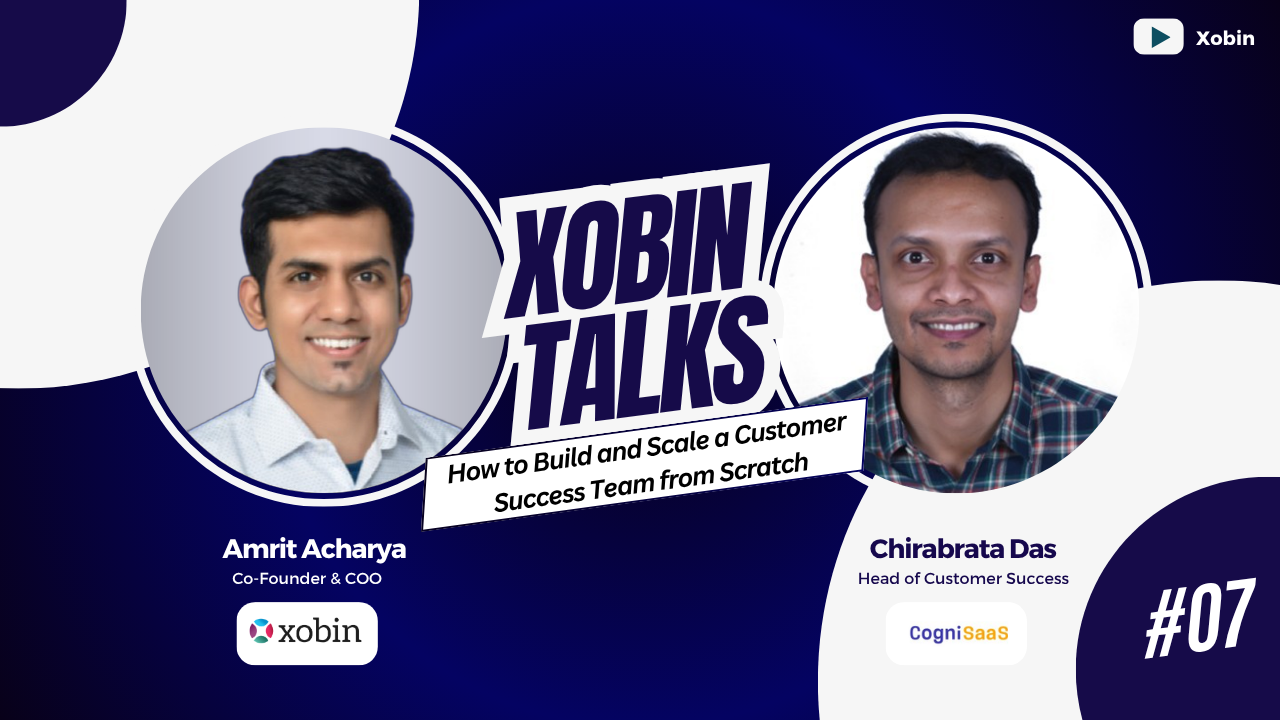
This episode was hosted by Amrit Acharya, Co-Founder and COO of Xobin.
Table of Contents
TL;DR – Key Takeaways
- Companies with great retention grow 1.5-3x faster than peers. NRR is the north star metric every CS function should anchor to from day one (Dock, 2023).
- Retention is the right first KPI for a new CS function. Do not push CS to behave like sales before it has matured. The results cycle in customer success is longer, but the compounding effect once it kicks in is significant.
- When hiring CSMs, knowing their own numbers is non-negotiable. A candidate who cannot state their current ARR, churn rate or upsell contribution in an interview has not been operating as a CS professional.
- CSM transitions are one of the highest churn-risk moments in the customer lifecycle. A two- to three-week overlap, shared calls and warm introductions to every key stakeholder are the minimum viable handover.
- US and Southeast Asian customers require fundamentally different relationship styles. The US rewards preparedness and directness. Southeast Asia rewards local language, personal warmth and relationship-first trust building.
Most companies create a customer success function too late and measure it the wrong way.
- They bring in a CS hire when churn is already hurting.
- They hand them 50 accounts with no process and no tooling.
- Then they set sales-style targets against a function that does not produce results on a sales timeline.
Chirabrata Das chose a different path. He joined Whatfix as the seventh employee in 2015, at a time when customer success was still not clearly defined in India. From there, he built the CS function from the ground up. As a result, he managed operations across four time zones while growing the portfolio from 30 SMB accounts to a complex, enterprise-level customer base as Whatfix moved toward unicorn status. Later, he led customer success at Yellow.ai and Unboxed. Eventually, he joined CogniSaaS.
In this episode #7 of the Xobin Talks customer success series, host Amrit Acharya, Co-Founder and COO of Xobin, goes deep with Chirabrata on what it actually takes to build a customer success function that compounds over time.
How Did You Make the Transition from Banking to Customer Success?
From Innovation Banking to SaaS
Chirabrata’s entry point into customer success was unusual. He joined a private bank’s Innovation Banking division, a team tasked with identifying emerging technologies that could be adopted inside the bank. The role involved attending events, evaluating products and running small internal pilots with direct CEO visibility.
That experience shaped how he thinks about CS. He was already doing the core work of a customer success professional, understanding a product deeply, mapping it to an organization’s specific needs, managing internal stakeholders and measuring outcomes before he ever held the CS title.
The Follow-Up That Changed Everything
When Whatfix posted a job description for a customer success role in 2015, Chirabrata applied and heard nothing. Rather than moving on, he emailed both founders directly to ask whether he was still in consideration.
The founders had been consumed by a funding round and had not reviewed any applications. His follow-up moved him to the top of the list and his point to anyone job hunting today: Very few candidates follow up when applying without a referral. That low-effort step consistently separates candidates who get interviews from those who do not.
What Did Building CS from Scratch at Whatfix Actually Look Like?
The First Year: Volume Without Process
Chirabrata’s brief on day one was straightforward: here are 30 accounts; introduce yourself and understand how they are using the platform. By year-end that number had grown to 50. He lost nearly 20 of them.
The reason was simple: there had been no ongoing interaction with those customers at any level. They had purchased the product and been largely left alone. His first job was not strategy. It was making sure customers could actually use what they had bought.
The Shift from Support to Consulting
That foundational phase, making sure the product worked for the customer, is where most early-stage CS functions stall. Chirabrata describes the transition to a more consultative stance as gradual and deliberate.
Once a customer was reliably using the product, he would ask what else they were struggling with and how the platform might help. That question opened conversations about adjacent problems. Those conversations created referrals to other teams. Referrals created expansion. The support-first phase was not a failure mode. It was a prerequisite.
Scaling the Team
When the portfolio grew beyond what one person could handle across four time zones, Chirabrata raised his hand and said he could not continue without support. A senior strategic hire came in above him.
That hire brought something Chirabrata acknowledges he could not have provided alone: the discipline to stop doing and start building. As the hands-on person, he had not made time for process design. The senior hire handled strategy. Chirabrata handled implementation. The first structural decision they made together was customer tiering. Not every customer could receive the same level of attention. Defining what each tier would receive, and communicating that to the sales team before a deal closed, set expectations that held across the customer lifecycle.
What Do You Look for When Hiring CS Professionals?
Hiring Individual Contributors
Chirabrata’s primary evaluation criterion for customer success hires is how well the candidate knows what they are currently doing. Not what they have done on paper. What they understand, today, about the accounts they own.
Three signals matter most in a customer success interview.
Active Listening
The first is active listening. Not appearing to listen, actually waiting until someone has finished speaking before responding. In Indian professional culture specifically, Chirabrata observes that cutting someone off when you have a relevant point is common and rarely noticed. And, in customer success, it is a liability. A CSM who cannot hold space for a customer to finish a thought will miss critical information.
Knowing Their Numbers
The second is knowing their own numbers. This is the most common failure point Chirabrata sees in candidates with two to four years of experience. He asks, “What is the total ARR in your current book?” What was your upsell contribution last quarter? What was your churn rate? Most candidates cannot answer.
These are not proprietary figures. They are the operating metrics a CSM is responsible for daily. Arriving at an interview without them signals that the candidate has not been operating as a CS professional, regardless of what their title says.
Learnability
For fresh candidates, the third signal is learnability over existing knowledge. CS in India was built largely by people reading what was working in the US and adapting it. That intellectual curiosity and willingness to learn from ground experience are stronger predictors of CS performance than any credential.
Hiring CS Managers and Team Leads
For manager-level hires, Chirabrata uses scenario-based evaluation rather than competency questions.
Churn Scenario
The first scenario: a customer has decided to churn. Walk me through what you would do, and do not offer a discount. He is looking for whether the candidate’s instinct is to first understand why. Pricing, perceived value gap, competitor offer, internal stakeholder change. Getting to the real reason before proposing a solution is the skill that separates consultative CS leaders from reactive ones.
Letting Someone Go
The second scenario is more difficult: have you ever had to let someone go from your team, and how did you handle it? This question evaluates whether the candidate can deliver difficult news clearly and with dignity, a core skill for anyone who will manage people and hard conversations with customers.
Willingness to Get Hands Dirty
The final criterion for manager-level hires is whether they will do the work when their team cannot. A CS manager who waits for their team to return before moving an account forward is a bottleneck. The best CS leaders Chirabrata has worked with drop into IC mode the moment the situation requires it.
How Do CS KPIs and Targets Change as a Company Matures?
Start with the why.
Before defining any KPI, Chirabrata asks founders one question: why does this company need a CS function right now? The answer determines the metrics.
A company that needs CS to fix post-sales chaos needs different metrics than one that wants CS to drive expansion revenue. A company where churn is already a board-level concern needs different targets than one building CS proactively.
Retention as the North Star
His recommendation for early-stage CS functions is to anchor on retention first. Not upsells. Not expansion. Retention.
Companies with strong retention grow 1.5-3x faster than those that churn their base and replace it with new logos (Dock, 2023). NRR, net revenue retention, is the metric that best captures retention health because it accounts for both churn and expansion in a single number. High-growth SaaS companies typically target NRR of 120% or above (k38 Consulting, 2026).
CS Is Not Sales
The most common mistake founders make is treating the CS function as a growth function from day one, expecting it to behave like a sales team on a quarterly cycle.
The CS results cycle is longer. The trust required to generate natural upsells and cross-sells takes months to build. Pushing CS toward sales behavior before that trust is established destroys the relational foundation that makes expansion possible in the first place.
Chirabrata’s prescription: let retention mature first. Once natural upsells start appearing, allow CS to own those leads. Then consider bringing in a dedicated account manager for strategic accounts where growth potential is high and the hunting mindset of a salesperson would add more value than the nurturing mindset of a CSM. Structure the incentives so both roles benefit from the outcome.
How Do You Handle CS Handovers When a CSM Leaves or an Account Upgrades?
Why Handovers Are a High-Churn Risk
A CSM change is one of the highest-risk moments in the customer lifecycle. When the person an account has been talking to for 18 months leaves, the relationship effectively resets. The probability of churn or contraction increases significantly because the new CSM has to rebuild trust that already existed before they arrived.
This is a problem the industry underserves in written guidance, in Chirabrata’s view. Documentation helps, but it does not solve the human dimension of the problem.
The Two to Three Week Overlap Model
His practical framework: the outgoing and incoming CSM should share every customer call for a minimum of two to three weeks before the handover is complete.
This is not a shadow arrangement. Both people are on the call. The outgoing CSM makes introductions. The incoming CSM asks questions. Customers see a person who knows them bringing in the new person, which is qualitatively different from receiving an email saying their CSM has changed.
Key Stakeholder Warm Introductions
Before the outgoing CSM exits, they must personally introduce the incoming CSM to every key stakeholder at the account. Not just the primary point of contact. Every person who matters to the deal.
If a face-to-face meeting is possible, prioritize it. If not, a video call is the minimum. An email introduction is not sufficient for a relationship that has commercial value.
Documenting the Org Map
The handover documentation should include a clear org map of the customer’s decision-making structure.
- Who holds the budget?
- Who is the product champion?
- Who is the skeptic?
- Who has the authority to renew?
- Who has the authority to cancel?
That context is in the outgoing CSM’s head. Getting it into a shared document before they leave is the difference between a smooth transition and a new CSM navigating months of rediscovery on an account with an active renewal clock.
How Does Customer Success Work Differently Across Geographies?
US Customers
US customers, particularly in enterprise, value preparation above almost everything else.
- They come to meetings with an agenda.
- They expect you to come prepared with data.
- They give direct feedback and expect direct responses.
The maturity of the US SaaS market means these customers have worked with CS teams before. They know what a good CSM looks like. Walking into a QBR unprepared is visible and damaging in a way it might not be in markets where the relationship carries more weight than the meeting.
Southeast Asia
Southeast Asia is more culturally proximate to India than to the US. Customers prefer WhatsApp messages and phone calls over formal meetings. They are less likely to tell you directly when something is wrong. They respond to warmth and personal relationships in a way that formal process-orientation does not achieve.
The practical implication Chirabrata draws from his time at Yellow.ai: hire locally. Having one person in the relevant country who speaks the language and understands the cultural norms is not a nice-to-have. It is the difference between customers who engage and customers who go quiet.
Middle East
The Middle East operates almost entirely through local partners. End customers prefer face-to-face interactions as the primary mode of building trust. A SaaS company based in India or the US will rarely build direct customer relationships in this region without a local partner who can front-end the relationship.
The CS model for Middle East markets is partner success: enabling local partners to carry the customer success function and managing them as your primary customers rather than managing end accounts directly.
How Do You Get Case Studies from Enterprise Customers?
Own the Process Within CS
Case study acquisition fails most often when it is handed off too early. Marketing wants the story. Legal gets involved. The customer’s communications team has its own approval process. By the time the document comes back, the momentum is gone.
Chirabrata’s approach: the CS person owns the case study process. Not marketing. The CS person knows which contacts will move the request forward, which data points will resonate and what format will get approved internally.
Raw Data to Marketing, Then Back for Approval
The process that worked at Whatfix: extract the raw data points from the customer in unpolished form and hand them to marketing to structure. Marketing adds the narrative, the language, and the visual format. The structured draft goes back to the customer for review and sign-off.
This separates the data gathering from the editorial work, which removes the bottleneck that happens when you ask a customer to produce a case study themselves.
Build the Legal Clause Into the Contract
The lesson learned the hard way: add a clause to the contract that requires the customer to provide case study data and a testimonial within a defined period after implementation. Most larger customers will strike or modify it. But having it in the contract establishes the expectation at the point of sale, before legal teams at the customer’s become the obstacle.
🎧 Watch the Full Episode
Xobin Talks – Episode 7 | Chirabrata Das, Head of Customer Success, CogniSaaS | Hosted by Amrit Acharya, Co-Founder and COO, Xobin
▶ Play Episode #7 of Xobin Talks
Also, explore earlier episodes on CS Fundamentals with Anu Dudhat and CS Metrics with Pratibha Wadhwani.
About Chirabrata Das
Chirabrata Das is Head of Customer Success at CogniSaaS, a project and customer onboarding platform built for enterprise SaaS companies. He is one of India’s earliest customer success practitioners, having joined Whatfix as the seventh employee in 2015 when CS as a defined function barely existed in the Indian SaaS market.
He built the CS function at Whatfix from the ground up before moving to Yellow.ai and Unboxed, where he led CS for Southeast Asian markets. His eight-plus years of experience span enterprise CS across the US, Southeast Asia and the Middle East, with a track record of building CS teams, designing processes and setting the KPI frameworks that early-stage companies use to mature their post-sales function.
Connect with Chirabrata: LinkedIn | Company: CogniSaaS
Want more series like this? Explore all Xobin Talks episodes.
Frequently Asked Questions
What is the most important KPI for a new customer success function?
Retention. Do not push CS to behave like sales before it has matured. NRR is the north star. Companies with strong retention grow 1.5-3x faster than those that churn and replace. Let the retention foundation mature before layering in expansion targets.
How do you know if a CS hire truly understands their current role?
Ask them their numbers. What is the total ARR in your book? What was your upsell contribution last quarter? What was your churn rate? Candidates who cannot answer are not operating as CS professionals regardless of title.
What does a good CSM transition look like when a team member leaves?
Two to three weeks of shared calls between the outgoing and incoming CSM. Personal warm introductions to every key stakeholder. A documented org map of the account’s decision-making structure. A face-to-face or video introduction before the handover is complete.
When should a startup expect CS to drive upsell and expansion revenue?
Only after the retention foundation is solid and natural cross-sells are already occurring. Forcing CS into a sales motion before that trust is built damages the relationship that makes expansion possible. Let it emerge. Then structure incentives to reward it.
What is the most common mistake when interviewing CS candidates?
Not asking them their numbers. Candidates with two to four years of experience routinely cannot state their current ARR, churn rate or upsell contribution. These are baseline operating metrics for any CS professional. If they cannot answer, treat that as a strong signal.
How do US and Southeast Asian customers differ in how they work with CSMs?
US customers reward preparation and directness. They come structured and expect the same. Southeast Asian customers prefer WhatsApp, phone calls and personal warmth over formal cadences. They are less likely to tell you directly when something is wrong, which makes local language and relationship investment essential.
Why does the Middle East require a different CS model entirely?
Middle Eastern customers build trust through face-to-face interaction and expect local presence. A partner success model, where you manage local partners who front-end customer relationships, is more effective than trying to build direct CS relationships remotely.
How do you get enterprise customers to participate in case studies?
Own the process inside CS, not marketing. Extract raw data from the customer, hand it to marketing for structure, and return the draft to the customer for approval. Add a case study clause to the contract at signing to establish the expectation before legal teams become the obstacle.