


Hiring has never moved faster or cost more when it goes wrong. The average time-to-hire has climbed to 44 days (HiringThing, 2025), while 72% of employers globally report struggling to find qualified candidates (Recruiters Lineup, 2025). Automation is no longer optional; it’s the difference between filling roles in days versus weeks.
Table of Contents
Yet with dozens of platforms claiming to “transform hiring,” picking the right one is genuinely hard. This guide cuts through the noise. Whether you’re an HR manager at a growing startup, a talent leader at a global enterprise, or a staffing agency managing high-volume pipelines, you’ll find an honest assessment of which recruitment automation tools actually deliver and who each one is built for.
TL;DR – Key Takeaways!
- AI-powered screening tools can reduce time-to-hire by up to 75%, yet only 6% of employers successfully shortened their hiring cycles in 2024 (GoodTime, 2025) indicating most teams still haven’t found the right automation fit.
- Skills-based hiring now drives 81% of companies’ evaluation strategies, up from 56% in 2022 (SSR, 2026) making assessment-first platforms increasingly critical.
- The right recruitment automation tool depends heavily on your hiring stage: assessment-heavy (Xobin), conversation-heavy (Paradox/Olivia), or process-heavy (Greenhouse, iCIMS).
What Is Recruitment Automation and Why Does It Matter in 2026?
Recruitment automation refers to software that handles repetitive, rule-based hiring tasks resume screening, interview scheduling, candidate communications, assessments so recruiting teams can focus on judgment-intensive work like candidate relationships and final decisions.
The business case is clear. According to a 2025 SHRM study, companies that automate at least 60% of their recruiting administrative tasks see 28% lower cost-per-hire and 19% higher candidate satisfaction scores. Automation saves recruiters an estimated 14 hours per week (Recruiters Lineup, 2025). And skills assessments alone improve quality-of-hire by 36%.
But not every platform automates the same thing. There are three broad categories to understand before evaluating any tool:
- Workflow accelerates: ATS platforms, sourcing CRMs, and scheduling tools that speed up specific tasks. Examples: Greenhouse, iCIMS, Workable.
- Conversational agents: Tools that handle candidate interaction end-to-end via chat or voice. Example: Paradox (Olivia).
- Assessment and evaluation platforms: Systems that test, score, and evaluate candidates across skills, behavior, and cognitive ability. Example: Xobin and HireVue.
Most hiring teams need more than one. But knowing which category solves your biggest bottleneck is the starting point.
The Best Recruiting Automation Softwares
| Platform | Best For | Key Strength |
| Xobin | Startups, SMBs, enterprises, and staffing agencies | All-in-one assessment, video interviews, coding evaluation, and ATS in a single platform |
| Greenhouse | Mid-market to enterprise tech companies | Structured hiring with scorecards, DEI tooling, and 1,000+ integrations |
| Paradox (Olivia) | High-volume hourly hiring in retail, hospitality, logistics | Conversational AI that screens, schedules, and engages candidates 24/7 |
| Zimyo | SMBs and enterprises that want recruitment, onboarding, and core HR unified | Agentic AI (ZIM) that automates hiring-to-onboarding workflows inside a full HRMS suite |
| TestTrick | Hiring teams and agencies screening candidates at scale | Combines skills testing, coding challenges, and one-way video interviews in a single automated workflow |
| HireVue | Large enterprises with 1,000+ candidates per cycle | AI-powered video interviewing and game-based cognitive assessments at scale |
| iCIMS Talent Cloud | Global enterprises with complex compliance requirements | Configurable workflows, multi-country hiring, and deep HRIS integration |
| Workable | SMBs and fast-growing teams (25–300 people) | All-in-one ATS with sourcing database and transparent pricing |
| Lever (LeverTRM) | Growth-stage companies hiring proactively | ATS + CRM hybrid for building long-term candidate relationships |
| Eightfold AI | Fortune 500 companies focused on internal mobility | Deep learning talent intelligence that maps skills across the entire workforce |
1. Xobin
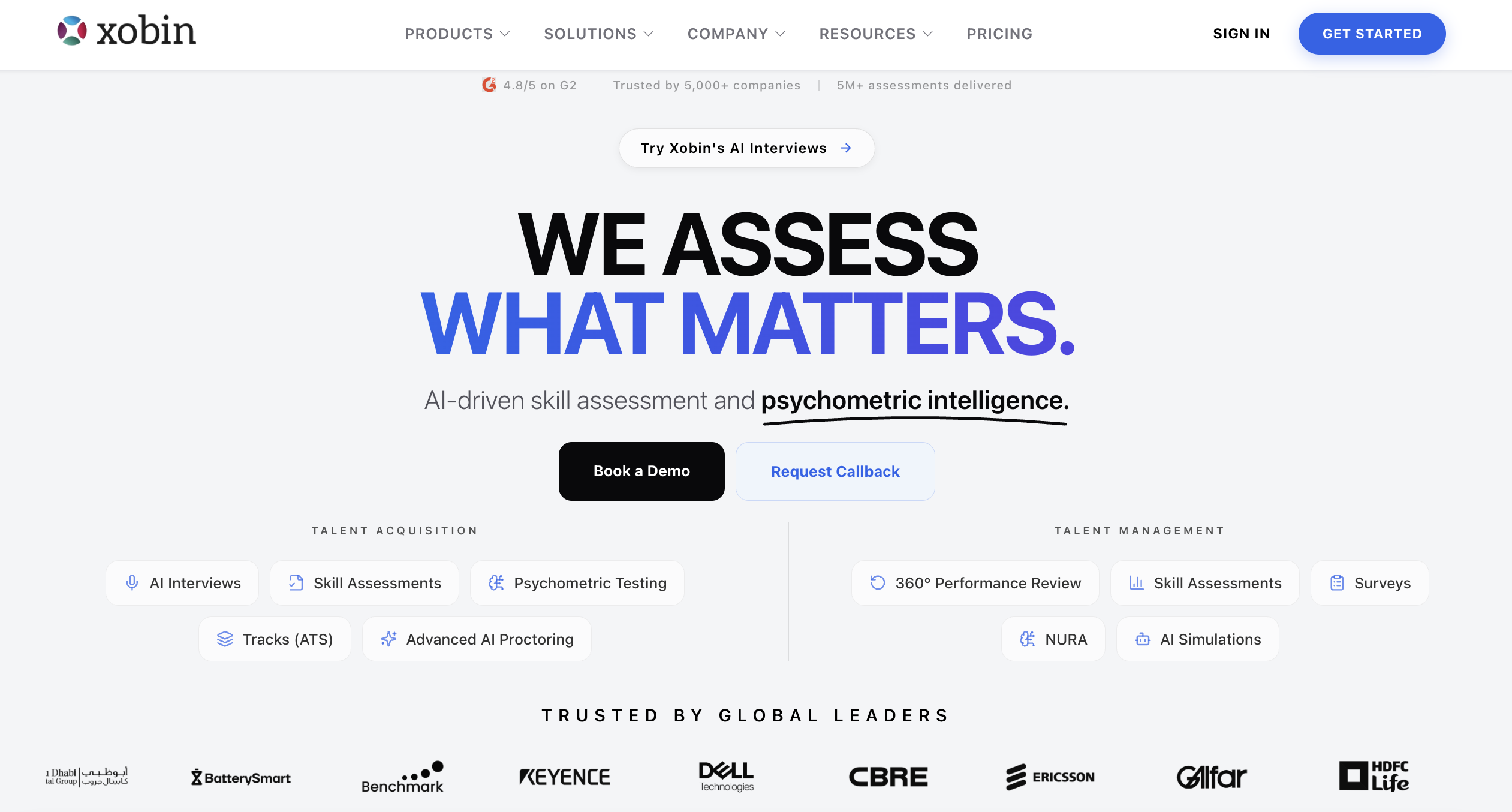
Best for: Startups, SMBs, enterprises, and staffing agencies that want skill testing, video interviews, behavioral assessments, coding evaluations, and ATS in a single, secure platform.
Xobin is an AI-powered talent acquisition platform that automates the most time-intensive stages of recruitment resume screening, skills evaluation, coding rounds, video interviews, and candidate shortlisting through a single connected platform. Drop a job description into the AI Copilot and it auto-builds a role-matched assessment; once candidates complete it, AI Evaluate scores open-ended answers, flags anomalies, and surfaces ranked shortlists without a recruiter reviewing individual responses.
What separates Xobin from point solutions is how far that automation extends. Agentic AI conducts L1/L2 technical interviews autonomously around the clock, while trigger-based workflows handle scheduling reminders, candidate communications, and offer-stage nudges compressing hiring cycles that typically span weeks into days. With 5,000+ customers across 60+ countries, including 10+ Fortune 500 companies, it serves teams from 25-person startups to 10,000-employee enterprises through the same platform.
Core features of Xobin
- 3,400+ skills and 2,500+ role-specific skill assessments and 1,80,000+ validated questions across tech, finance, sales, and operations.
- Agentic AI Interviews that conduct L1/L2 technical interviews autonomously, 24/7, with integrated code editors.
- Advanced Coding Simulator supporting 50+ languages with real-time test case execution and code quality scoring.
- AI-based resume parsing with a candidate-to-JD fitment score, powered by NLP.
- Multi-layer AI proctoring including EyeGazer gaze tracking, audio analysis, and unauthorized device detection.
- White-label option for staffing agencies and reseller partners to deliver fully branded assessment experiences.
- SOC2 Type 1 & 2, ISO 27001, GDPR, and CSA STAR certified; dedicated data centers across the EU, UK, USA, Middle East, and India.
- 50+ native integrations and open APIs for seamless connection with ATS, HRMS, and LMS systems.
Limitations to know: Xobin’s breadth means it’s more than most teams need for simple job-board-and-schedule workflows. Organizations that only need a basic ATS without assessments will find the platform over-featured for their use case.
Best fit verdict: For organizations committed to skills-first hiring across roles from junior to senior with assessment, video, coding, and ATS needs under one roof Xobin covers more of the evaluation funnel than any single-category tool.
2. Greenhouse
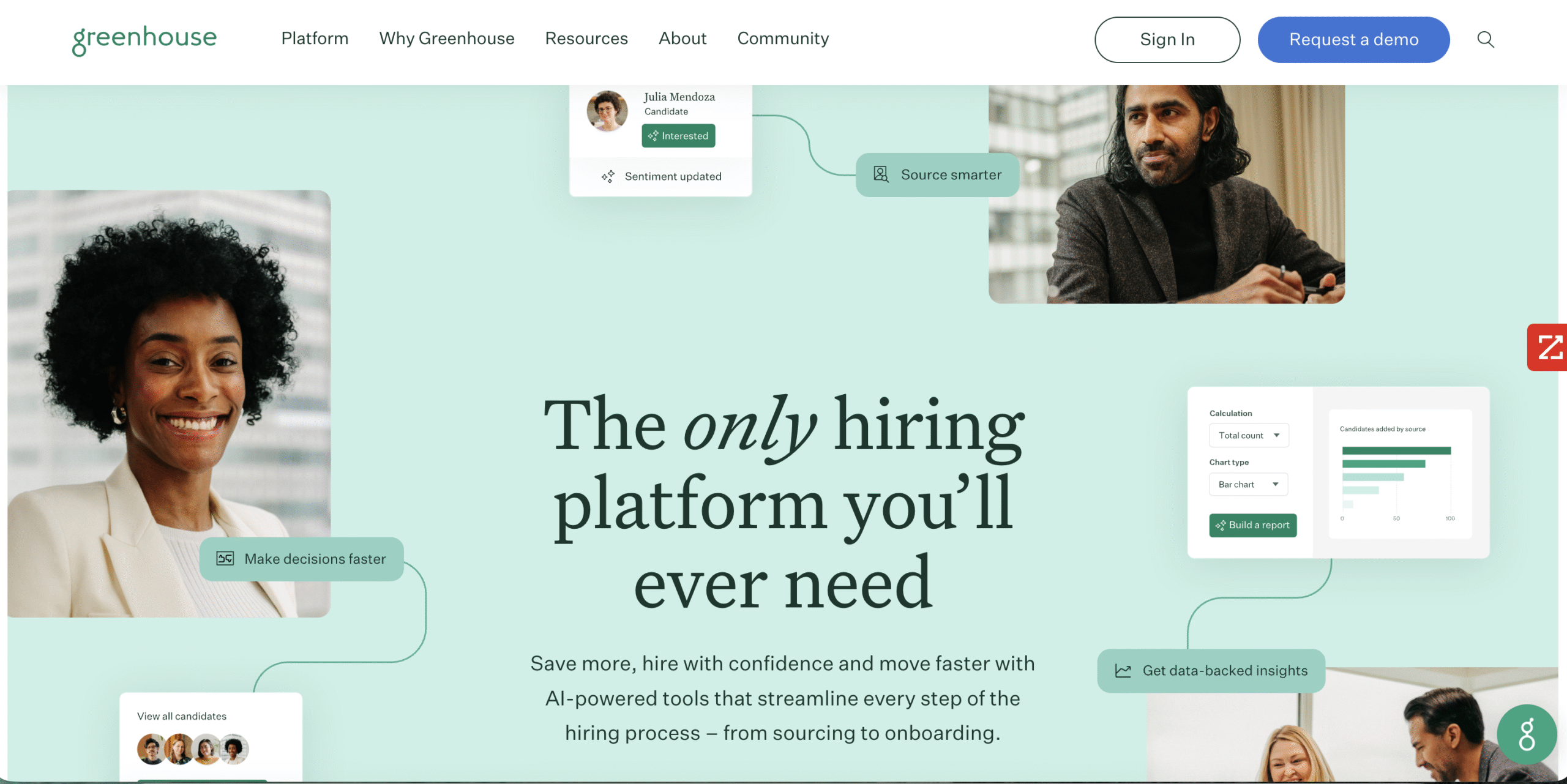
Best for: Mid-market to enterprise companies (especially tech) that prioritize consistent, bias-reduced, compliance-ready hiring workflows.
Greenhouse has built its reputation on one clear philosophy: structured hiring. The platform’s scorecard system where every interviewer rates candidates on the same dimensions, using the same format, for each role creates documented, legally defensible hiring records that large organizations and regulated industries depend on.
What separates Greenhouse from most ATS competitors is not its feature count but its methodology. Hiring teams define key role attributes upfront, build interview plans around those attributes, and score candidates against identical criteria across every conversation. The result is richer data and fewer post-hoc rationalizations for hiring decisions.
Core features of Greenhouse
- Customizable structured interview kits with role-specific scorecards.
- 1,000+ pre-built integrations (Slack, LinkedIn, Workday, BambooHR, and nearly every HR tool in use today).
- DEI tooling and bias-detection workflows built into the evaluation process.
- Comprehensive reporting on time-to-hire, source effectiveness, funnel conversion, diversity metrics, and interviewer performance.
- AI-assisted sourcing tools that surface qualified candidates and rank existing applicants with explainable scoring.
- EEOC/OFCCP compliance documentation and audit trail generation.
Limitations to know: Pricing ($6,000–$70,000+/year) and a 3–6 month implementation make it a poor fit for smaller teams. Top-of-funnel sourcing requires additional tools.
According to a Forrester Research 2025 ATS Evaluation, Greenhouse is the top-rated platform for compliance-oriented hiring, making it the gold standard for organizations where hiring decisions must be defensible and documented.
Best fit verdict: If data integrity, DEI outcomes, and structured evaluation are non-negotiable, and you have a dedicated recruiting ops person to manage the platform, Greenhouse delivers.
If your team already runs on Greenhouse and wants to layer in structured skill assessments without leaving the platform, Xobin’s Greenhouse integration connects assessment scores directly into your existing hiring workflow.
3. Paradox (Olivia)
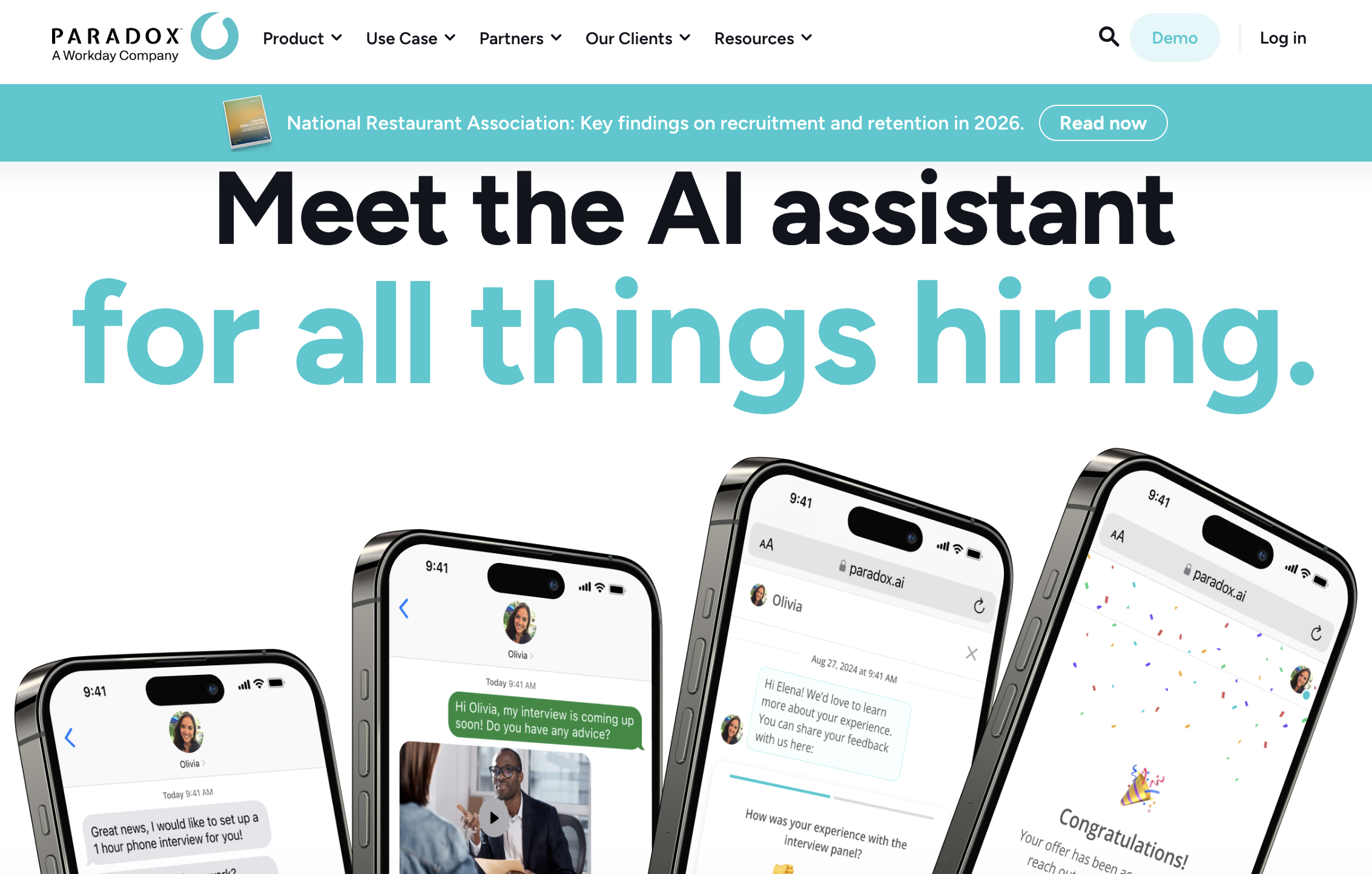
Best for: Retail, hospitality, healthcare, logistics, and any organization running high-volume hourly hiring where speed and candidate experience are the primary constraints.
Paradox, now part of Workday following its October 2025 acquisition, is the category benchmark for conversational AI in recruiting. Its AI assistant named Olivia operates via text, web chat, WhatsApp, and SMS to screen candidates, answer FAQs, schedule interviews, and move applicants through the funnel without recruiter involvement.
The results from enterprise customers are meaningful. McDonald’s cut its hiring time in half after deploying Paradox. Chipotle reduced time-to-hire from 12 days to 4 days. In one documented case, candidate response times dropped from a 7-day turnaround to under 24 hours after Olivia was deployed on the career site (HeroHunt.ai, 2025).
Core features of Paradox (Olivia)
- Olivia chatbot for 24/7 candidate engagement across text, web, and WhatsApp.
- Automated screening, scheduling, and FAQ handling without human intervention.
- Multi-language support for global hiring programs.
- Conversational job applications that guide candidates through the entire process via chat.
- Native integrations with Workday, SAP, UKG, ADP, and iCIMS.
- Event management for career fairs and campus recruiting programs.
Limitations to know: Paradox’s analytics capabilities are less robust than dedicated ATS platforms. When conversations require nuance beyond Olivia’s training, manual override is necessary. As a Workday acquisition, the integration path for non-Workday customers is less certain going forward.
Best fit verdict: For organizations hiring hundreds or thousands of hourly workers, Paradox solves the specific bottleneck of candidate drop-off and recruiter time spent on scheduling. It’s not a replacement for a full ATS, it’s the conversational front end that makes your existing process faster.
4. Zimyo
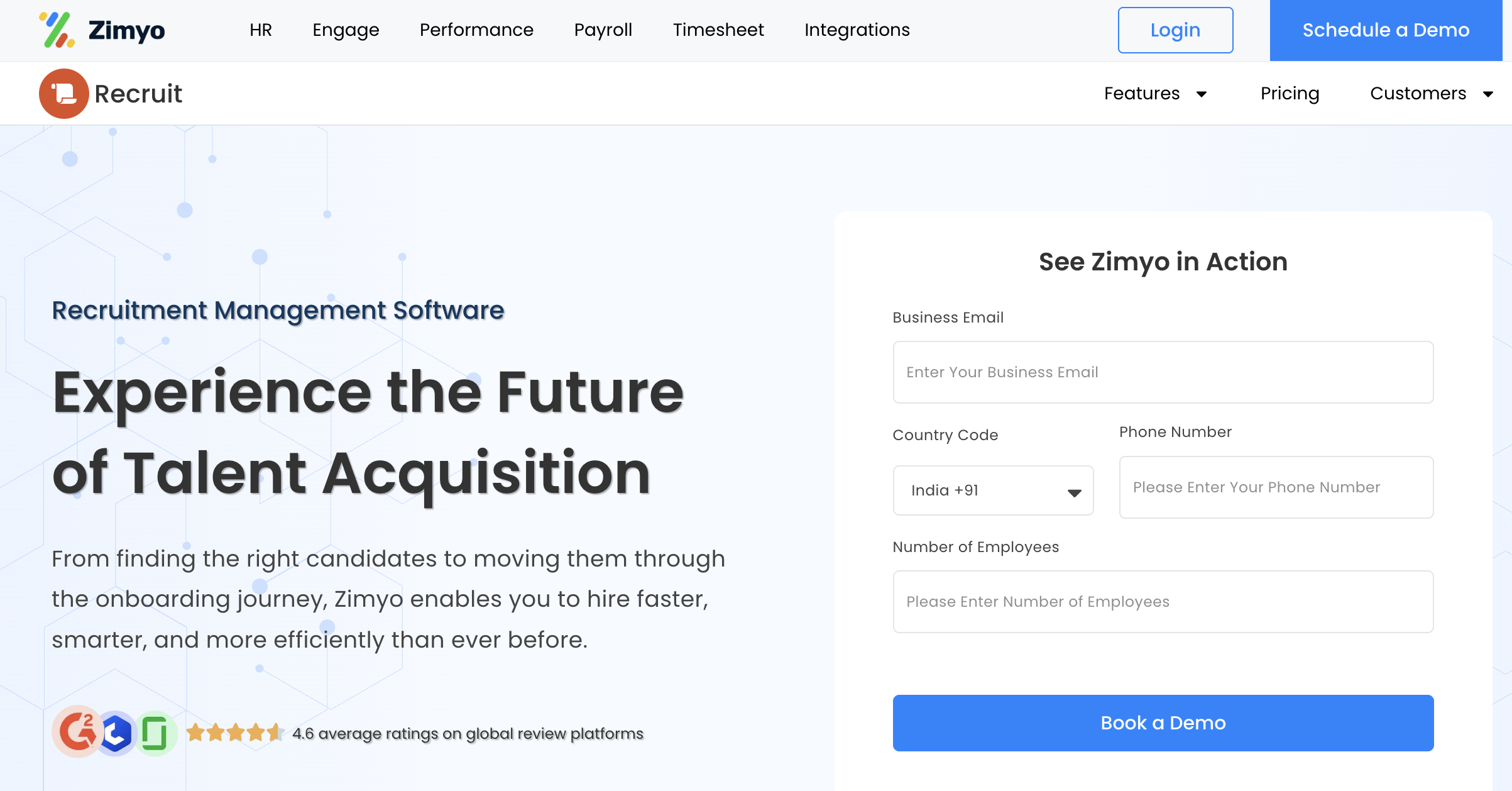
Best for: SMBs and enterprises that want recruitment automation connected to everything that comes after the offer letter – onboarding, payroll, and core HR, without stitching together five different tools.
Zimyo is an AI-powered HR platform that automates the entire hiring journey – from job posting to a fully onboarded, payroll-ready employee, in one system. Its ATS handles the heavy lifting recruiters lose hours to every day: posting roles across multiple job boards in one click, parsing resumes with AI-driven candidate-to-JD match scores, auto-scheduling interviews, and rolling out e-sign-ready offer letters. Recruiters open ranked shortlists, not application piles.
The real differentiator is ZIM, Zimyo’s agentic AI. ZIM doesn’t wait for instructions, it executes. It screens and ranks every applicant, answers candidate queries in real time, and the moment an offer is accepted, kicks off onboarding on its own: document collection, verification, induction, payroll setup, done before HR opens the file. Onboarding cycles that stretch across weeks close in days.
Core features of Zimyo
- 60+ modules, one platform: ATS, onboarding, HRMS, payroll, performance, and LMS with zero data silos.
- ZIM (agentic AI) screens, ranks, and responds to candidates, then auto-triggers onboarding on offer acceptance.
- AI resume parsing delivers ranked, JD-matched shortlists instead of raw applicant piles.
- ISO 27001, SOC 2, and GDPR-aligned security with role-based access and full audit trails.
- One-click multi-board job posting with automated scheduling, scorecards, and e-sign offer letters.
- Seamless hire-to-payroll flow: no re-entry across documentation, verification, induction, and payroll.
- Trusted by 2,500+ organizations, 1M+ employees, 40+ countries, including Bajaj Capital.
Limitations to know: Zimyo’s recruitment module is strongest as part of its unified suite. Teams that only want a standalone ATS with no interest in HR or payroll won’t use most of what the platform offers.
Best fit verdict: For companies that want to stop paying for, and reconciling data across – a separate ATS, onboarding tool, payroll software, and HRMS, Zimyo automates more of the hire-to-payroll journey than any recruitment-only platform.
5. TestTrick
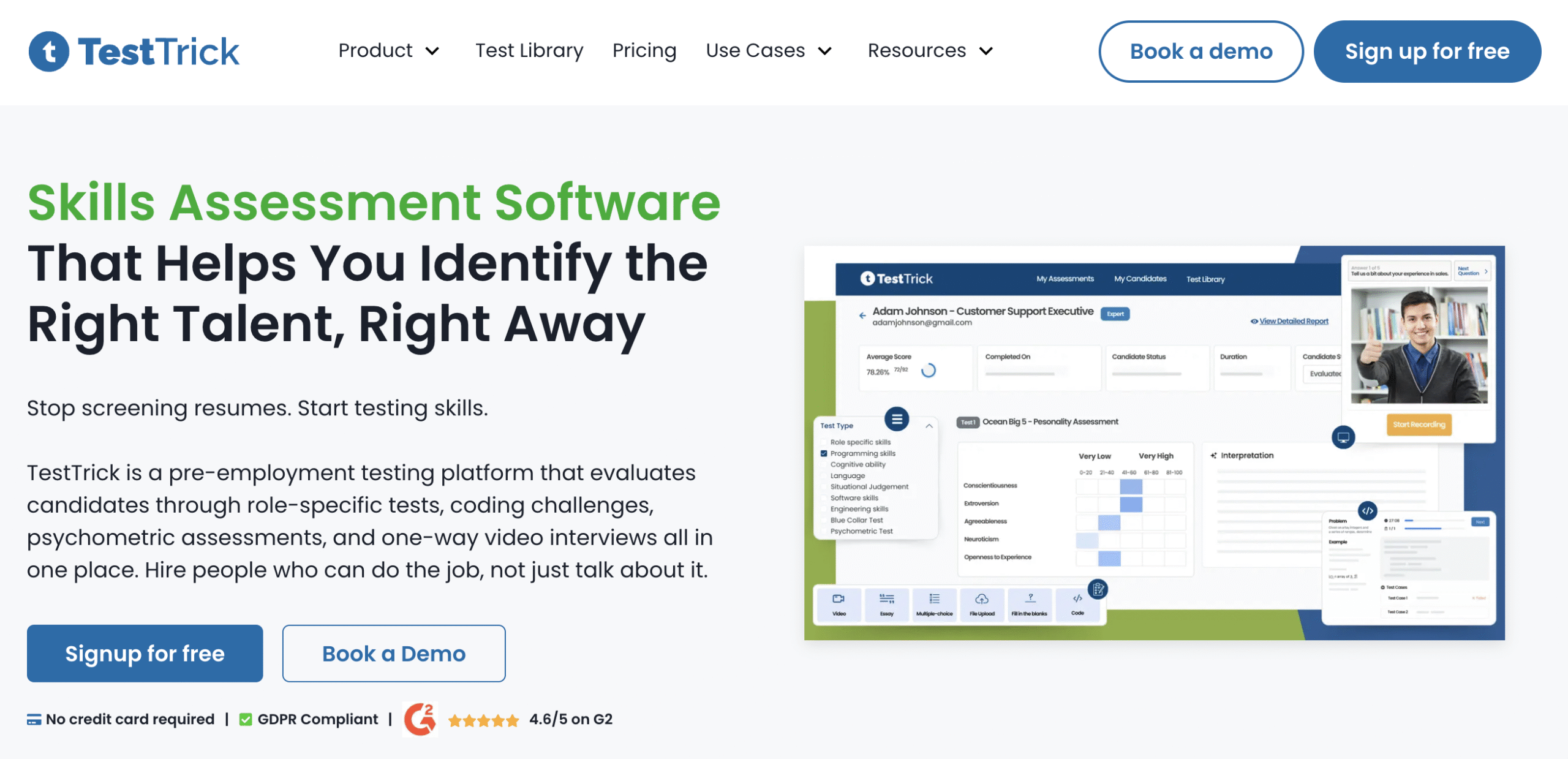
Best for: Hiring teams, recruitment agencies, and growing companies that want to automate candidate screening, skills testing, and one-way video interviews within a single platform.
TestTrick is a skills assessment platform that helps hiring teams move beyond resume-based screening and evaluate candidates through job-relevant assessments. It combines role-specific tests, coding challenges, psychometric assessments, Excel-based tasks, and one-way video interviews in one recruitment workflow.
By automating assessment delivery, scoring, reporting, and candidate shortlisting, TestTrick helps recruiters reduce manual screening and focus their time on candidates who have demonstrated the required skills.
Core Features of TestTrick
- 500+ pre-built, role-specific assessments covering technical, cognitive, soft-skill, and functional competencies
- One-way video interviews for replacing or supplementing early-stage phone screens
- Psychometric and cognitive assessments for evaluating candidate suitability
- Automated grading, candidate reports, and ranked results
- Multi-layer anti-cheating controls, including webcam monitoring, screen monitoring, tab-switch detection, full-screen enforcement, and copy-paste restrictions
- Specialized assessment tools, including coding environments, code playback, SQL questions, and Excel-based assessments
- Custom assessment and question creation
- ATS integrations that help teams transfer assessment data into their recruitment workflows
Limitations to Know: TestTrick uses candidate-based credits, so organizations should choose a plan that matches their expected hiring volume. The platform focuses on pre-employment assessment and candidate screening rather than full-cycle HR management
Best-Fit Verdict: TestTrick is a practical option for recruitment teams that want to replace repetitive manual screening with structured, skills-first assessments, automated reporting, and asynchronous video interviews.
6. HireVue
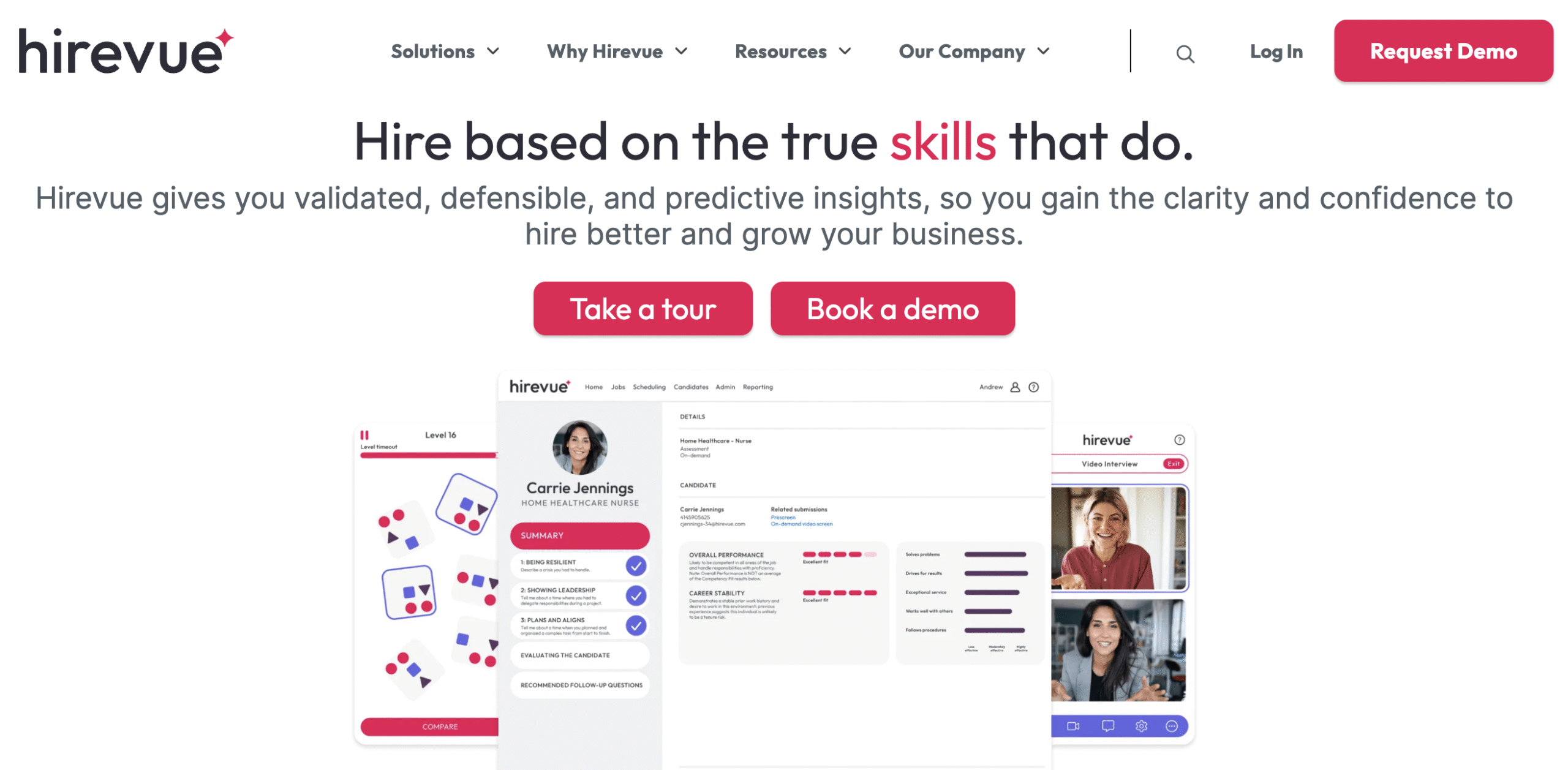
Best for: Large enterprises with high-volume hiring needs (1,000+ candidates per cycle), particularly campus and graduate recruitment where structured evaluation at scale is critical.
HireVue pioneered the one-way video interview candidates record answers to pre-set questions on their schedule, and recruiters review asynchronously with AI-assisted scoring. Today, the platform layers predictive assessment, game-based cognitive challenges, and structured scoring rubrics on top of that video foundation.
Deployed by enterprises including Unilever (where the HireVue-Pymetrics process delivers automated personalized feedback to 100% of applicants), HireVue supports video interviews in 40+ languages and reports up to 60% reduction in initial screening time (HireVue, 2025). Its game-based assessments, interactive challenges measuring problem-solving and attention, developed by I/O psychologists add a layer of cognitive evaluation that pure video platforms can’t replicate.
Core features of HireVue
- Pre-recorded and live video interviewing with AI evaluation.
- Game-based cognitive assessments developed by organizational psychologists.
- Structured scoring rubrics and searchable interview transcripts.
- Interview Insights feature generating AI summaries and interviewer benchmarks.
- Certified integrations with Workday, SAP SuccessFactors, Oracle Taleo, iCIMS, and Greenhouse.
- Scheduling automation and calendar coordination tools.
Limitations to know: Async one-way video creates a less candidate-friendly experience than real-time conversation drop-off rates are typically higher than live formats. G2 ratings sit around 4.1, lower than category leaders. HireVue is a strong complement to an ATS, not a replacement for one.
Best fit verdict: If interviewing consistency and enterprise-scale assessment are the primary constraints, HireVue is one of the most established and validated options in the market.
7. iCIMS Talent Cloud
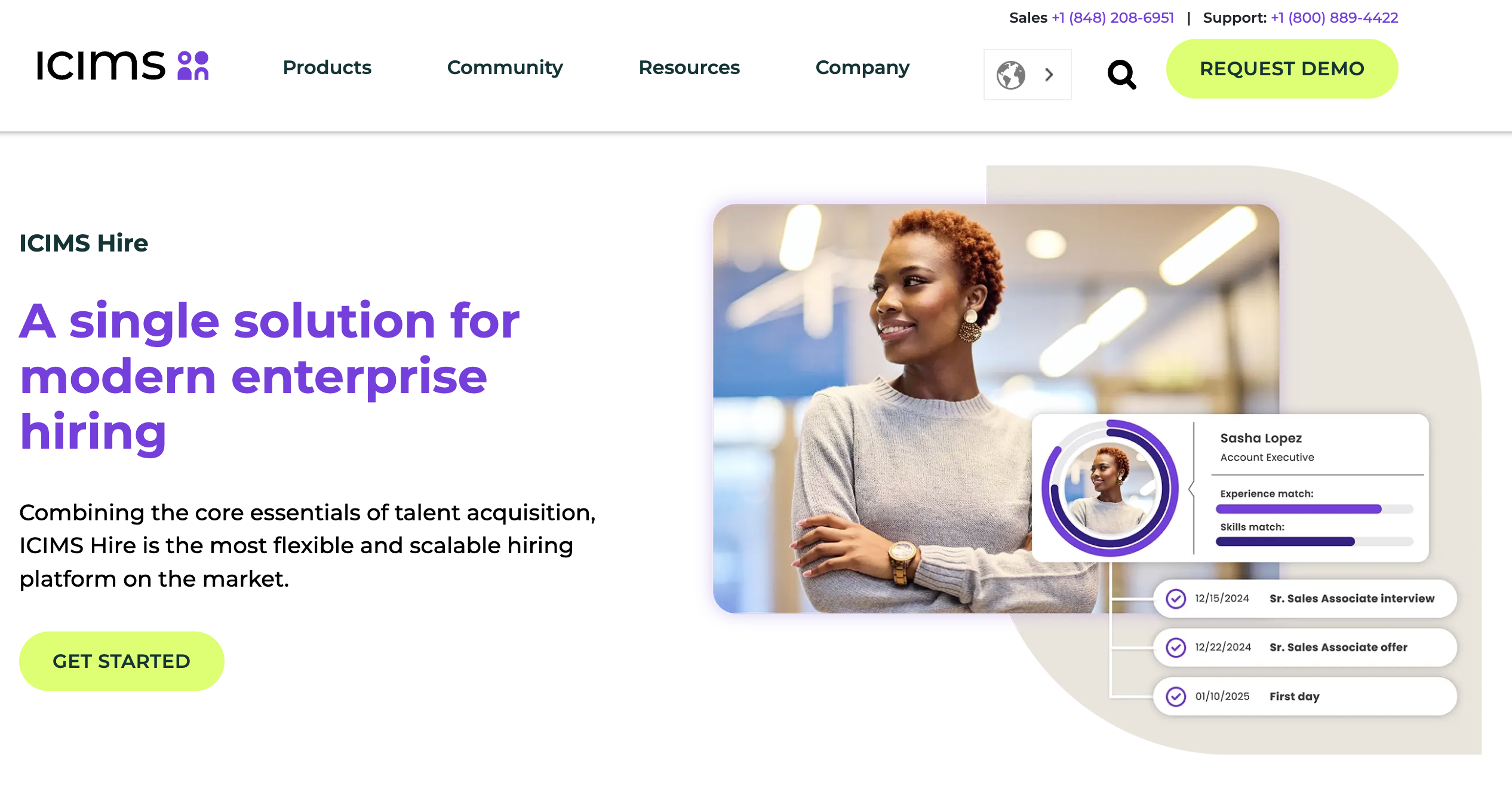
Best for: Global enterprises managing thousands of open roles across multiple geographies, business units, and compliance frameworks.
iCIMS Talent Cloud is a long-standing enterprise ATS with deep penetration among Fortune 500 companies. Its defining advantage over competitors is configurability. When hiring processes vary across teams, roles, and regions and when approval flows, EEOC reporting, and DEI compliance are non-negotiable, iCIMS gives recruiting operations teams room to shape workflows around organizational realities rather than forcing a single process on everyone.
Recent additions via acquisition expand iCIMS’s scope: the Altru and Vocallabs integrations bring video interviewing and AI sourcing capabilities into the platform, while the 2025 acquisition of Apli added multilingual, high-volume screening for Latin American markets.
Core features of iCIMS Talent Cloud
- Customizable hiring workflow setup for job requests, approvals, and automated recruitment stages.
- Advanced career site localization and branding (meets ~88% of typical career site requirements out-of-the-box).
- AI-powered talent matching and GenAI copilot for outreach and DEI metrics.
- Comprehensive EEOC/OFCCP compliance controls and audit trails.
- Multi-country job postings with localization and one-click “easy apply” integrations.
- Advanced Communications Suite covering text, live chat, and AI messaging in one place.
- Automated onboarding including I-9 and e-verify submissions.
Limitations to know: iCIMS implementation is a multi-quarter project. The interface has historically been described as complex, though the “New iCIMS Experience” has improved usability in recent releases. Pricing scales per employee per month ($6–$9 per employee), meaning costs for large organizations run $55K–$140K+ annually.
Best fit verdict: iCIMS earns its place when hiring complexity is high and internal mobility, compliance documentation, and cross-functional coordination are daily operational requirements not edge cases.
8. Workable
Best for: Small and mid-sized businesses that need an ATS, candidate sourcing database, and hiring automation in one platform without the high cost or complexity of enterprise-level tools.
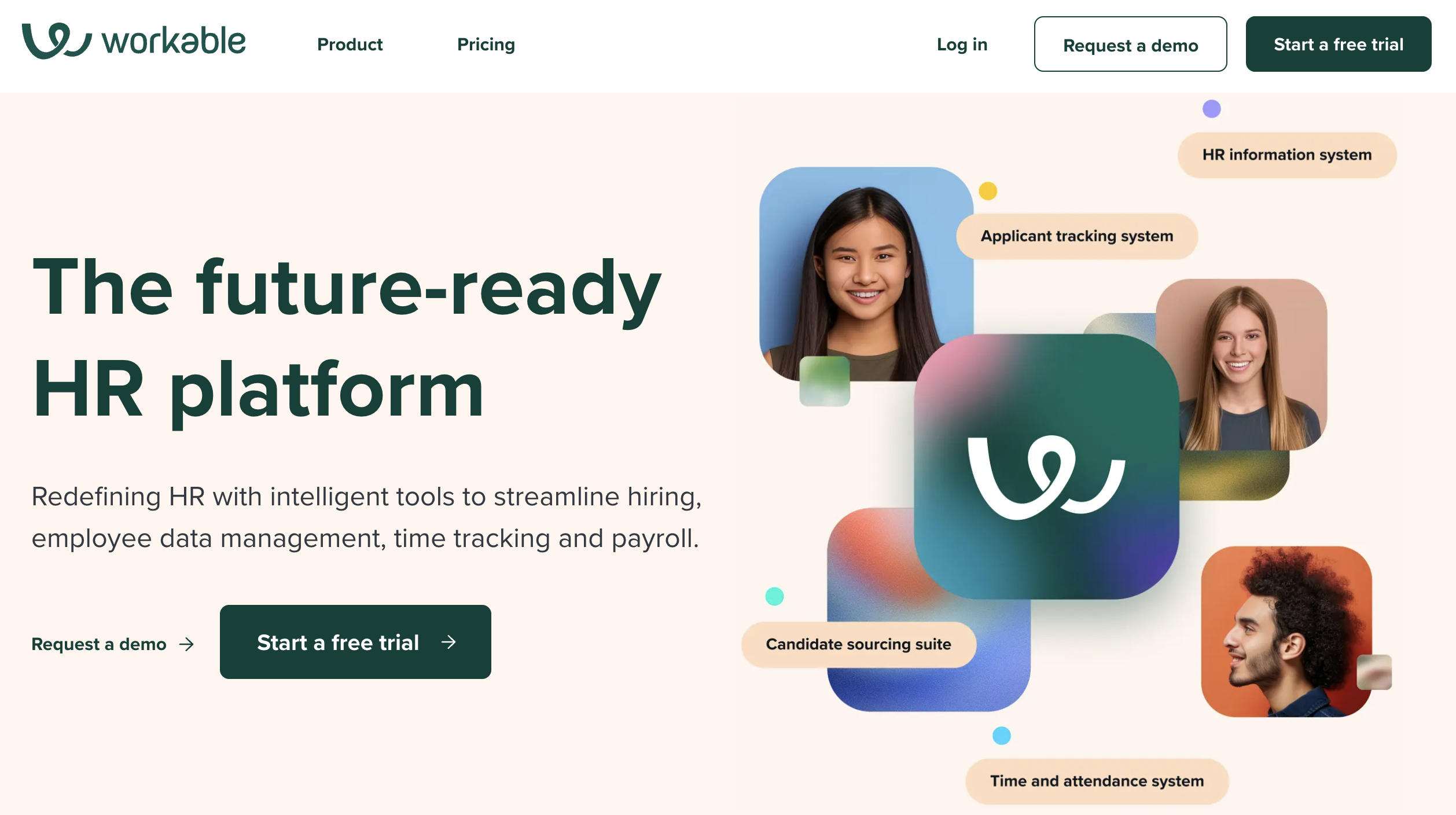
Workable is the fastest-growing ATS for teams that need to get up and running quickly. It combines applicant tracking, candidate sourcing from a 400M+ profile database, AI-assisted screening, and HRIS basics in one platform. Unlike Greenhouse or iCIMS, Workable has transparent pricing Standard starts at $299/month and implementation typically takes one to two weeks.
Its AI-driven approach focuses on improving day-to-day efficiency. It uses AI-based candidate recommendations from the sourcing database, automated screening questions, and ready-to-use interview kits to speed up hiring tasks. As a result, teams can manage the platform easily without needing a separate recruiting operations team.
Core features of Workable
- AI-powered candidate sourcing from 400M+ profile database.
- Automated job posting to 200+ job boards simultaneously.
- Customizable hiring workflows and pipeline stages with role-based access control.
- Built-in video interviewing and texting (additional cost on lower tiers).
- Candidate sourcing tools for building talent pools before roles open.
- Reporting on time-to-hire, source effectiveness, and candidate volume.
- HRIS basics, onboarding workflows, and e-signature support.
Limitations to know: Workable sits in an awkward middle ground more expensive than true SMB tools and less powerful than Greenhouse or Lever for complex enterprise workflows. Texting and video interviewing cost extra on the Standard plan. Headcount-based pricing means costs scale quickly for growing companies.
Best fit verdict: For teams of 25–300 people who want structured, repeatable hiring without the overhead of an enterprise ATS, Workable offers the best balance of capability and ease of use.
For Workable users who need more advanced pre-employment testing than the platform’s built-in screening features, the Xobin x Workable integration offers job-specific assessments and monitored coding tests directly within the workflow, removing the need to switch between different tools.
9. Lever (LeverTRM)
Best for: Growth-stage companies and mid-market teams that hire proactively and want to build candidate relationships over time, not just track applicants through a single cycle.
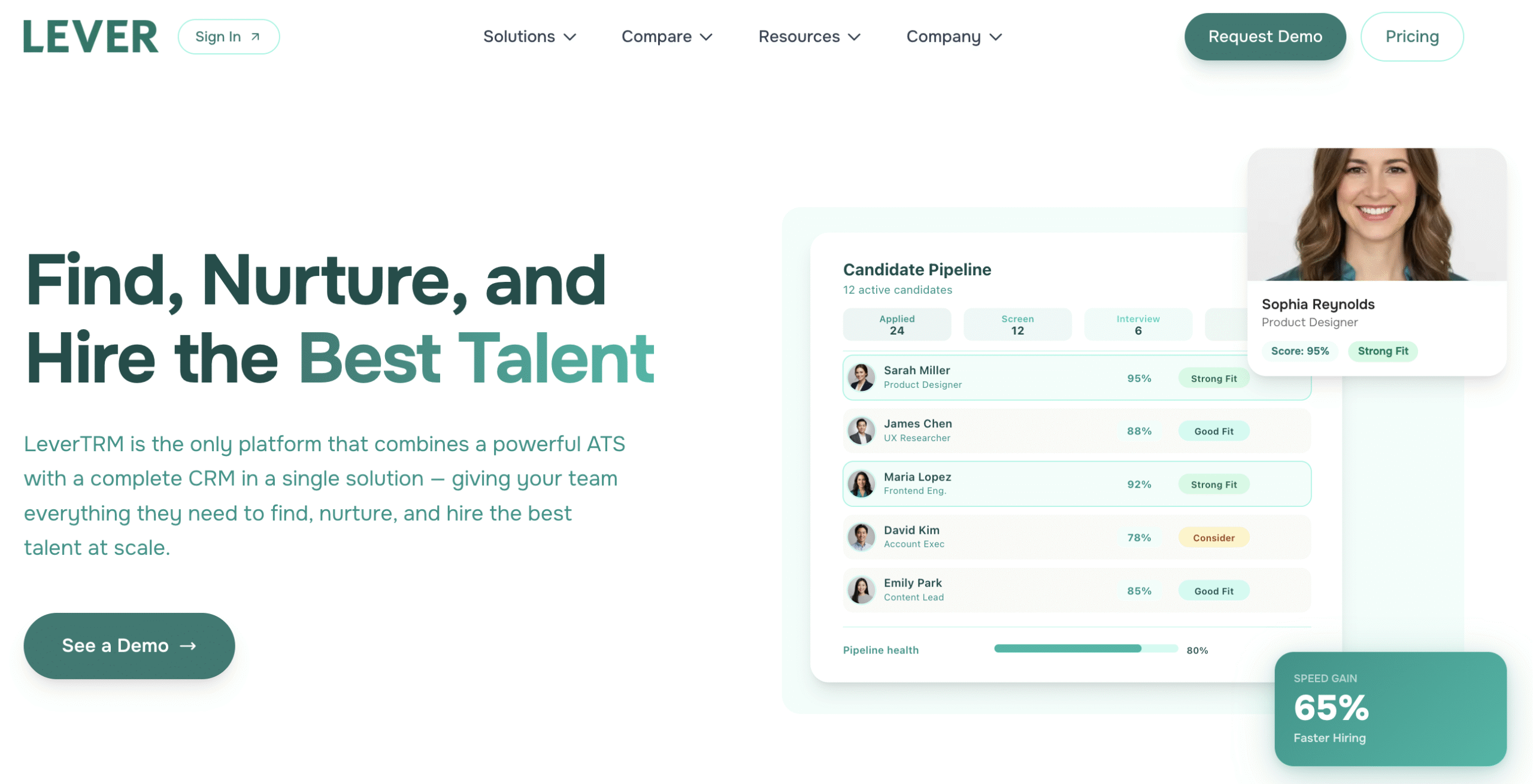
Lever’s defining feature is its fusion of an ATS with a candidate relationship management (CRM) system, which it calls LeverTRM (Talent Relationship Management). Where most ATS platforms treat candidates as pipeline entries, Lever treats them as long-term relationships, enabling automated nurture campaigns, passive candidate outreach, and “silver medalist” resurfacing for future roles.
For fast-growing teams where the same talent pool serves multiple hiring waves, this CRM-first approach can meaningfully reduce sourcing costs and time-to-fill. Lever’s analytics show time-to-hire by source and stage, revealing exactly where the process slows, while its 300+ integrations connect with most existing HR stacks.
Core features of Lever
- Combined ATS + CRM in a single platform (LeverTRM).
- Automated nurture campaigns for passive candidates and talent pipeline management.
- AI-driven suggestions for resurfacing silver-medalist candidates.
- Structured feedback and scorecard collection across interview stages.
- Pipeline health reporting and candidate source analytics.
- API access for custom integrations with internal tools and background check providers.
- Clean, recruiter-friendly UI known for fast adoption across hiring teams.
Limitations to know: Lever may not scale as effectively as Greenhouse for large enterprise hiring operations. Teams managing complex approval workflows and large headcounts often hit limitations as hiring volume grows significantly past 150–200 hires per year. Pricing is custom and not published; enterprise contracts can reach $140,000 annually for large multinational organizations.
Best fit verdict: If your recruiting philosophy is relationship-first and proactive sourcing not reactive applicant processing, Lever’s CRM capabilities make it the most natural fit for growth-stage companies building repeatable talent pipelines.
Teams using Lever for pipeline management can extend candidate evaluation with skill and coding assessments via the Xobin x Lever integration, keeping shortlisting data inside the same system.
10. Eightfold AI
Best for: Fortune 500 companies with large existing workforces that want to optimize internal mobility, predict career paths, and surface hidden talent before looking externally.
Eightfold AI sits in a different category from the platforms above. Its core capability isn’t managing applications, it’s deep talent intelligence. Trained on billions of talent profiles using deep learning, Eightfold maps skills across every employee and candidate in an organization’s ecosystem, then predicts fit, career trajectory, and internal mobility opportunities with a level of insight that goes far beyond traditional keyword-based matching.
By 2025, Eightfold had a valuation of over $2 billion and an expanding Fortune 500 client list (HeroHunt.ai, 2025), built on use cases where organizations discovered that significant portions of their best candidates for open roles already worked inside the company.
Core features of Eightfold AI
- Deep learning-based talent matching across internal and external candidate pools.
- Skills inference engine that maps explicit and implicit skills from resumes, work history, and assessments.
- Internal mobility platform identifying employees ready for adjacent or promotion-track roles.
- Career site personalization showing candidates relevant roles based on their background.
- Workforce planning tools predicting skill gaps 12–24 months ahead.
- DEI analytics and bias-mitigation features across sourcing and matching.
- Integration with major ATS platforms as a talent intelligence layer on top of existing stacks.
Limitations to know: Eightfold is an enterprise investment pricing is custom and implementation requires significant data integration work. Its value compounds with organizational size; smaller teams with limited talent data won’t see the same ROI as large enterprises with thousands of employees.
Best fit verdict: For enterprises where internal mobility, workforce planning, and skills-based talent architecture are strategic priorities, Eightfold provides intelligence that no traditional ATS can replicate.
How to Find the Best Recruitment Automation Platform
Choosing a platform isn’t a feature checklist exercise. Most recruitment automation tools have reached feature parity on the basics. What matters is fit between the platform’s design philosophy and your team’s hiring reality.
Start with your biggest bottleneck
Is it the assessment quality (Xobin)? Candidate drop-off and scheduling speed (Paradox)? Structured evaluation consistency (Greenhouse)? Internal mobility and talent intelligence (Eightfold)? The platform that solves your primary constraint delivers faster ROI than a “full-suite” solution that’s mediocre everywhere.
Consider your hiring volume and team size
Enterprise platforms like iCIMS and Greenhouse handle thousands of hires and require dedicated recruiting ops to manage. Workable and Lever are built for teams that want powerful hiring without a full-time admin. Assessment platforms like Xobin scale from a 25-person startup to a 10,000+ employee enterprise without changing the tool.
Don’t neglect total cost of ownership
License fees are only part of the picture. Add implementation timelines (iCIMS: 2–6 months; Greenhouse: 3–6 months; Workable: 1–2 weeks), per-seat scaling costs, integration work, and ongoing admin overhead. A cheaper license on a complex platform often costs more in practice.
Verify integration compatibility before signing
Integration challenges are often one of the most overlooked expenses when adopting an ATS, and they can push ROI timelines back by several weeks or even months (HackerEarth, 2025). Make sure the platform integrates smoothly with your current HRIS, calendars, communication platforms, and background verification tools.
Run a pilot with real job requirements
Involve your recruiting team; they’re the daily users. A platform that looks polished in a vendor demo but frustrates recruiters in day-to-day use won’t deliver the efficiency gains it promises.
Make a Wise Choice!
Recruitment automation in 2026 isn’t about replacing recruiters, it’s about giving them the tools to make better decisions faster. The recruitment automation systems in this list each solve a distinct problem:
- Xobin for skills-first assessment and candidate evaluation.
- Greenhouse for structured process and compliance.
- Paradox for conversational high-volume hiring.
- HireVue for enterprise video screening.
- iCIMS for complex global enterprises.
- Workable for accessible SMB automation.
- Lever for relationship-driven pipeline building.
- Eightfold for talent intelligence at scale.
The key is matching the platform to the bottleneck. A company drowning in unqualified applicants needs better assessment. A retail chain losing candidates to slow scheduling needs conversational AI. A tech company making inconsistent hiring decisions needs structured evaluation tools.
What doesn’t work: buying a comprehensive enterprise platform for a 30-person team, or adding point solutions across seven different tools when one integrated platform would do the job. Start with the biggest constraint, validate with a pilot, and scale from there.
Frequently Asked Questions
What is the best recruitment automation platform for small businesses?
Workable and Xobin are the strongest options for small businesses. Workable offers transparent pricing starting at $299/month with fast implementation (1–2 weeks) and built-in sourcing. Xobin serves startups from 25 employees upward with structured skill assessments, video interviews, and a full ATS without requiring a dedicated HR operations team to manage the platform.
Can recruitment automation reduce bias in hiring?
It can, but only when implemented thoughtfully. Skills-based assessment platforms that evaluate demonstrated ability rather than resume signals reduce bias structurally. 94% of employers say skills-based hiring better predicts performance than resumes (SSR, 2026). However, AI tools trained on historical hiring data can perpetuate existing biases. Look for platforms with bias audit capabilities, explainable scoring, and DEI monitoring built into evaluation workflows.
What’s the difference between an ATS and a recruitment automation platform?
An ATS (Applicant Tracking System) manages the candidate pipeline from application to offer tracking stages, storing notes, and centralizing data. Recruitment automation platforms go further, adding AI-driven screening, assessment, scheduling, communication, and analytics that reduce manual work throughout the funnel. Most modern platforms blend both: an ATS core with automation and intelligence layered on top.
How is AI changing recruitment automation in 2026?
AI use across HR tasks climbed to 43% in 2026, up from 26% in 2024 (SHRM, via MSH, 2026), reflecting the shift from pilot programs to real workflows. The most meaningful changes are: autonomous AI interviewers conducting L1/L2 screenings without human involvement (Xobin’s Agentic Interviews), multi-agent systems that resolve problems 45% faster than single-agent tools (Joveo, 2026), and predictive analytics that forecast hiring needs before positions open.