
HackerRank has built a great developer community. It’s a useful platform for practising and sharpening coding skills. However, it’s not completely suitable for hiring. If you are looking for an alternative to HackerRank, you are at the right place.
A few years ago, experts would have said that there is no way to predict the behavioral intelligence of a human. In a way it’s true, there is no traditional algorithm to select the right candidate. So, there could be a self-learning intelligent model that can be built for every single job opening.
TL;DR – Key Takeaways
- HackerRank is useful for practising coding skills, but the article questions its hiring suitability and describes skill-based assessments as increasingly ineffective for senior candidates.
- Recruitment decisions often rely on intuition and guesswork, while recruiters have systematic biases that influence how they evaluate candidates.
- Situation-based questions assess candidates’ behavioral traits, and a 90-minute test could score 35 key traits relevant to a particular role.
- The preferred solution is a machine learning model trained on previous recruitment decisions, but requiring at least 100 complete datasets creates challenges for smaller companies.
- Pre-trained models can help recruiters hire senior candidates and make more scientific, efficient decisions, but the author believes these systems cannot replace recruiters.
The bitter truth
The movie “Moneyball” explained how few age-old baseball scouts strongly used their intuition and predictive skills to judge whether a person is a good player or not. In modern recruitment practices, intuition and guesswork play a huge role in the selection of the candidate. The bitter truth is that people have hardwired systematic biases in evaluating candidates. The more experience a recruiter has, the more intuition comes into play.
Traits
While skill-based assessment tests proved to be a good solution for a brief period of time, it is beginning to become ineffective for senior resources. Because any junior resource/student who has an intention to learn fast will crack these tests. Knowledge is available everywhere, so learning a skill that someone else possesses has become very easy.
Therefore, the behaviour of a candidate should be assessed. To break it down further, there are close to 200+ traits that play a crucial role in selecting a candidate. Below are the traits that play a vital role in deciding the candidate’s fit.
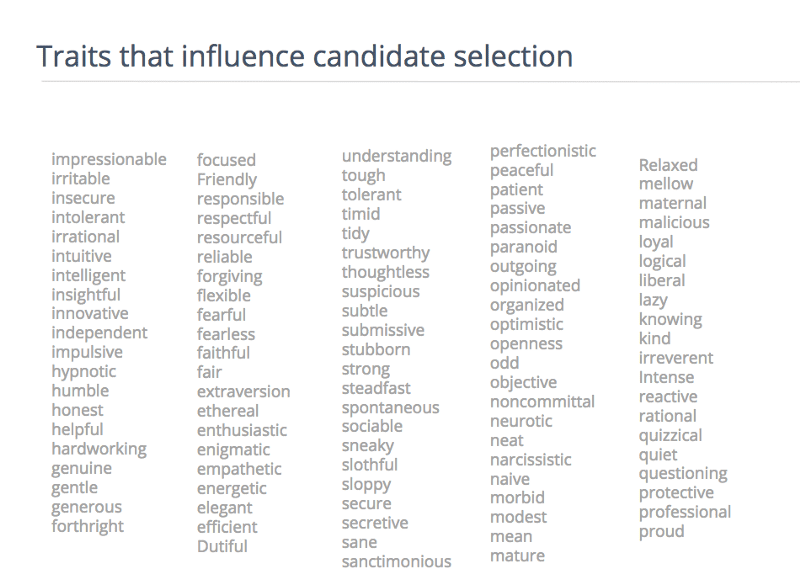
The best possible way to measure these traits is by presenting the candidates with a situation and noticing how they would react. Below is a example of situation-based judgment question.
Question Source: Xobin
The above question checks how a candidate reacts to the given scenario. There is no right or wrong in selecting an option. Know that we are just measuring how the candidate would react to a particular situation. Hence, a group of questions is mapped to these traits to get individual scores for all these traits. A 90-minute test could help us score 35 such key traits that influence the decision of that particular role.
However, it is very tough to have a standard algorithm because every company defines a job role differently. For example, expectations from a “Sales Executive” in Company A could be different from a “Sales Executive” in Company B.
The preferred solution is to build a machine learning model that trains from previous recruitment decisions. It also, helps predict the best suitable candidate for the role at present.
Provided that, this workflow was once used in Xobin. So, it does the job of explaining the concept in layman terms.
Conclusion
Therefore, the catch with this is that it requires at least 100 complete data sets to train the model. While big enterprises don’t have a scarcity of data, smaller companies find generating this data very challenging. So, developers have developed a pre-trained model these days. These models do a pretty decent job of helping hire senior resources that save the recruiters time and get a huge nod from the business heads as well.
Hence, I personally feel that these systems cannot replace recruiters. But, such systems can help them make more scientific decisions in a more efficient way.