
Apple. Facebook. Microsoft. Google. Some of the biggest names in tech trace their roots back to humble beginnings. Yes, many started in garages. But the garage was never the secret. The team was.
Table of Contents
While garages, hustling and bold risks had their role, what we often overlook is the quality of the team. It’s usually the biggest moat when it comes to building great technology.
We first wrote this post in 2016. A decade later, that moat matters even more, for a reason nobody saw coming. Xobin Research tested 683 skill groups against AI tool and agent workflows and found that 72% could be fully or partly delegated to AI under test conditions (Xobin Research, Human vs AI Skills Report 2026). With AI in the loop, one engineer can cover far more ground than in 2016. So can one bad hire. When your whole engineering team fits around one table, every seat counts.
Steve Jobs saw this decades ago. In a 1995 interview, he said the gap between the average and the best in software “is 50 to one. Maybe 100 to one.” (Steve Jobs: The Lost Interview, 1995). His conclusion was simple: go after the very best, because a small team of A players can outrun a big team of average ones.
So, how does one go about tech hiring now? There are still no rules set in stone. Consider this a primer on a few good practices, updated with what’s changed.
TL;DR – Key Takeaways
- Xobin Research found 72% of 683 tested skill groups can be fully or partly delegated to AI. Hire for what AI can’t do well: judgment, business-to-tech translation and collaboration.
- Traditional coding tests fell from 75 to 100% of technical assessment requests in H1 2024 to 25% to under 50% in H1 2026.
- Define the role first. Test real work second. Sell the mission third.
Why does the first tech hire matter so much for a startup?
Your first tech hires matter because each one is a big slice of your company. Replacing a single employee can cost one-half to two times their annual salary, and Gallup calls that a conservative estimate (Gallup, 2019). For a startup, money is the smaller problem. The lost months hurt more.
Remember, 1 person in a team of 10 counts as 10%. In a team of 4, it’s 25%. You don’t want crucial people flaking, and the cost of a bad hire is well documented.
Here’s what’s changed since we first wrote this. AI has widened the gap Jobs talked about. When 72% of tested skill groups can be partly or fully handed to AI (Xobin Research, 2026), the average engineer and the great engineer often produce similar-looking code. The difference shows up in what they choose to build, what they question and what they catch before it ships.
So who are you really hiring? Not a pair of hands. A pair of judgments. That’s harder to spot on a resume, and much more expensive to get wrong.
How do you define a tech role when you’re not technical?
Start with the problem, not the tech stack. Across 35 technical roles reviewed between January and June 2026, translating business requirements into technical solutions ranked among the five most-requested skills, next to AI integration and analytical problem-solving (Xobin Research, 2026). Employers want engineers who get the business.
Knowledge itself is power. Understand what you require. This may be a tad difficult if you’re from a non-technical background. Ask friends and colleagues who know tech interview questions so you better understand the profile you’re looking for. Always consult an expert if you can. It’ll cut your learning curve short.
Avoid reusing old job descriptions. Tailor the job description to your specific needs, and keep in mind that the better detailed it is, the fewer unqualified applications you’ll go through.
Write the role around outcomes
Here’s a simple test we like. Before you list a single language or framework, write down three things this person must ship in their first 90 days. Then ask: which of these could AI draft, and which need human judgment? The second list is your real job description.
A 2026 role brief usually has three layers:
- Core technical skills. The languages and systems they’ll touch every day.
- AI fluency. Can they direct AI tools, check the output and know when not to trust it?
- Business translation. Can they turn a fuzzy customer problem into a clear technical plan?
Stuck on the first draft? Xobin’s free job description templates are a decent starting point. Rewrite them in your own words, though. Candidates can tell a copy-paste job ad from a mile away.
How can startups test technical skills fast and fairly?
Test the work, not the resume, and test it the way the job is done in 2026. Comparing H1 2024 with H1 2026, traditional coding tests fell from 75 to 100% of technical assessment requests on Xobin to 25% to under 50%, while AI-assisted coding tasks rose to 50% to under 75% (Xobin Research, 2026).
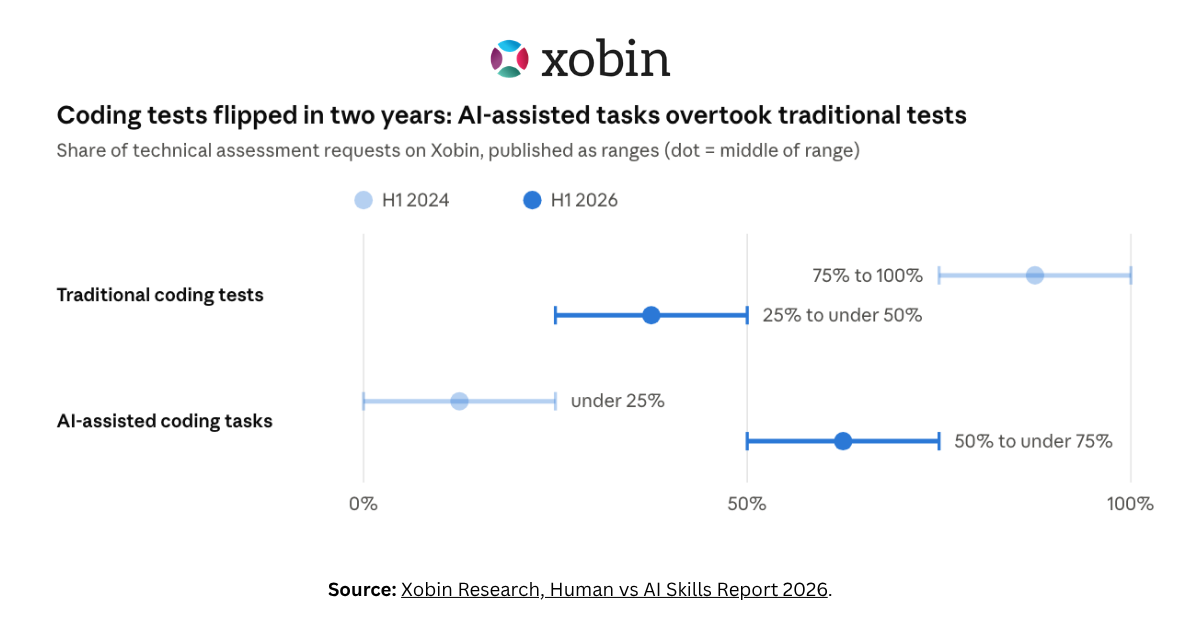
| Technical assessment type | Share of requests, H1 2024 | Share of requests, H1 2026 |
| Traditional coding assessments | 75% to 100% | 25% to under 50% |
| AI-assisted coding tasks (generation, testing, debugging, explanation) | Under 25% | 50% to under 75% |
Source: Xobin Research, Human vs AI Skills Report 2026. Ranges are as published.
That’s a quiet flip in just two years. Hiring teams have stopped asking “Can you write this function from memory?” They’re asking “Can you get a working, correct answer out of AI, and explain why it’s right?”
Why does that matter for a startup? Because your engineers will use AI on day one. A test that bans it measures a job that no longer exists.
Use a short, structured process
Structure beats gut feel. A 2022 revisit of decades of hiring research found structured interviews had the highest mean validity of the selection methods studied, at r = .42 (SIOP, on Sackett et al., 2022). Same questions, same scoring rubric, every candidate.
A lean four-step loop works well for most early-stage teams:
- Short skills test (30 to 45 minutes). Check the basics before anyone spends interview time. Xobin’s coding assessments cover 50+ programming languages with automated test cases.
- AI-allowed work sample. Give a small, real problem from your product. Let them use AI. Then score how they prompt, verify and fix the output.
- Structured interview. Fixed questions tied to the role brief. Controlled AI interviews can run this round on the candidate’s schedule, with the same questions for everyone.
- Team conversation. One hour with the people they’ll actually work with.
Want to see a loop like this in practice? In episode 4 of Xobin Talks, Neha Kothari explains the five-step process she built for AI and ML hiring at SalesCode.ai as it grew from 35 to over 100 people: a skills assessment, a harder coding test, a technical interview, an HR interview and a final decision round.
Keep remote tests honest
Remote hiring is the norm for startups, and so is the worry about cheating. Identity checks, browser controls and AI monitoring through AI proctoring let you trust a score from anywhere. Just be upfront with candidates about what’s monitored and what’s allowed. Respect goes both ways.
Is this person a team player?
Ask yourself this question early, because collaboration is fast becoming the skill employers screen for. Within a fixed set of 24 emerging skill groups, collaboration showed up in 4 groups in 2024 and in 12 to 17 groups in 2026 (Xobin Research, 2026). As AI takes on more solo tasks, the human work that’s left is mostly work with other humans.
Communication and collaboration keep your tech team running at peak capacity. Hiring a brilliant jerk who puts everyone else down and drags team morale with them isn’t a wise decision. It only works in the short term. Code is meant to be shared, so attitude is extremely important.
Engage with them before you decide
Have real conversations with your applicant and establish a connection. Technical skills and profile fit matter, but so do soft skills and commitment. Be transparent and let them know what your deal-breakers are.
Take your time. Do you really see this person contributing to your company? Hire slowly. Brian Chesky reportedly reviewed thousands of applications and interviewed hundreds of people before making Airbnb’s first engineering hire, because he figured the company would one day hold a thousand people just like that person (Paraform). You want committed people who’ll stand strong during turbulent times. They say that when founders start up, it’s like they’re married to each other. That’s true for your early hires as well.
Look for these traits
- Emotional intelligence. Can they read the room and handle pressure? Employers weigh it heavily for leaders: EQ-related criteria average 52% of evaluation weight across 113 leadership scorecard templates from 92 employers (Xobin Research, 2026).
- Patience. Early-stage code changes weekly. So do priorities.
- Ownership. Do they say “we shipped” and “I broke it” with equal ease?
Gut feel is a weak signal for any of these. A short psychometric test or an emotional intelligence assessment gives you something more consistent to talk through in the interview.
How can you hire tech talent for your startup without Big Tech salaries?
You win on autonomy and real problems, not on pay alone. Only about one in four developers say they’re happy in their current job, and “autonomy and trust to manage your own tasks” ranks first among job-satisfaction factors, ahead of competitive pay (Stack Overflow Developer Survey, 2025). That’s a gap a startup can actually fill.
In the heart and mind of every engineer, they look forward to solving complex problems with other great engineers. The chance to work with great tools and keep growing is another plus. So sell your vision, and the benefits of working with you. Truly great companies have a big, hairy, audacious mission that drives them.
What startups can offer that big companies can’t
- Ownership. “You’ll own payments end to end” beats “you’ll join the payments team.”
- Speed. Ideas ship in days, not quarters.
- The best AI tooling. A seat budget for the AI tools they want costs far less than a salary gap, and engineers notice.
- A clear hiring process. Tell candidates every step up front. A fair skills test signals that you hire on ability, not pedigree.
Culture is the invisible hand
A workplace’s culture is its unwritten rules. It’s the invisible hand behind every employee decision. People need to feel safe experimenting and trying new things.
Providing psychological safety and a culture that treats failure as learning can lead to phenomenal results. Google found psychological safety mattered more than anything else in its most effective teams (The New York Times, on Project Aristotle). Employees must feel free to share things without fear of recriminations. For more, watch Astro Teller on the unexpected benefit of celebrating failure.
Where should startups find tech talent in 2026?
Start with your network, then look where others aren’t looking. New grads made up under 6% of startup hires, and startups’ new-grad hiring was down more than 30% from 2019 levels, while demand for experienced engineers kept rising (SignalFire State of Tech Talent Report, 2025). Everyone is fighting over the same senior engineers.
There’s nothing like hiring someone you’ve worked with before or reaching into your own network. To widen your options, try a few of these (among many others):
- Referrals from your current tech team. Usually the fastest, highest-trust channel for your first few hires.
- Meetups, hackathons and open-source communities. They’ll give you good leads. Meeting those leads later for a coffee or a beer should tell you whether they’d suit the role.
- Early-career talent, screened on skills. Read on below.
- Recruiters. Useful for a hard-to-fill senior role, though the fees rarely make sense for a startup’s first few hires.
The overlooked bet: strong juniors, tested properly
Here’s a contrarian take. If big companies have stepped back from new grads, that pool has more strong people in it than it used to, and less competition for them. A junior who is fluent with AI tools, tested on real work and given ownership can grow fast in a startup.
The catch is screening. You can’t judge a new grad on experience they haven’t had yet. That’s where a skills-first process earns its keep. Campus hiring assessments or a short job simulation show you who can actually do the work, no pedigree required.
Building your first tech team? Xobin’s hiring tools for growth-stage startups bring tests, AI interviews and applicant tracking into one place, so a three-person team can run a hiring process that feels like a fifty-person one.
Ready to build your first tech team with confidence? Xobin helps startups test real skills, run structured AI interviews and track every candidate in one place. Book a 30-minute personalized demo and see how it fits your hiring process.
Frequently asked questions
How do I find tech talent for my startup?
Start with people you or your team have worked with, since referrals are fast and come pre-vetted. Then go where engineers spend their time: open-source projects, developer communities, meetups and hackathons. Don’t overlook strong early-career developers. Screened on real work rather than resumes, they can grow quickly with the ownership a startup offers.
How can a startup attract top tech talent without high salaries?
Sell what big companies can’t easily offer: real ownership, hard problems, a short path from idea to shipped product and a say in how things get built. Be specific about what they’ll own in their first 90 days, explain equity openly, and run a fast, respectful hiring process. Candidates judge your culture by how you hire.
How do I hire a developer if I’m not technical?
Start by writing down what this person must deliver in their first 90 days, not a list of technologies. Ask an engineer you trust to turn that into a role brief and sit in on interviews. Then use a practical skills test, so you’re judging what candidates can do rather than how well they talk about it.
How do you assess a software developer’s skills before hiring?
Combine three steps: a short skills test to check the fundamentals, a small work sample based on a real problem from your product, and a structured interview where every candidate gets the same questions and the same scoring rubric. Finish with a conversation with the team they’d join, so both sides can judge the fit.
How much does a bad tech hire cost a startup?
Far more than the salary. You pay for recruiting and onboarding twice, lose months of progress, and add load to an already small team while you fix or redo the work. In an early team, one wrong hire can also set the wrong standard for everyone who joins after them, which is why slow, careful hiring pays off.