



Technical recruitment is more complex today than it was three years ago. More applicants per role, shorter engineering attention spans for interviews, and candidates who’ve memorized every common platform question bank. Recruiting teams that built their process around HackerRank are increasingly running into its edges and looking for alternatives to HackerRank built specifically for modern hiring workflows.
Table of Contents
This guide helps recruiters, HR leaders, and talent acquisition teams compare the best platforms. We evaluated each solution based on the factors that truly impact hiring success, including assessment options, proctoring capabilities, ATS integrations, candidate experience, and suitability for different company sizes.
TL;DR – Key Takeaways
- HackerRank’s main gaps are limited non-technical coverage, outdated question banks candidates have already practiced, and ATS integrations that require manual steps.
- 72% of companies are now moving toward skills-based evaluation over degree requirements (Josh Bersin, 2026 Talent Report), which means assessment platforms need broader test libraries than coding alone.
- HackerRank’s Starter plan costs $1,990/year for 120 attempts – roughly $20 per candidate screened. That adds up fast at volume.
- Its question bank is widely circulated on forums, reducing test reliability and triggering false plagiarism flags.
- According to HackerRank’s own 2025 Developer Skills Report, 66% of developers prefer practical challenges that mirror their actual work over abstract algorithmic problems.
- The 10 platforms below each solve a specific gap HackerRank leaves open – from realistic coding environments to full non-technical assessment coverage.
- No single platform fits every team, the right choice depends on your role mix, company size, and how much workflow automation you need.
When HackerRank Is Actually the Right Tool
Before switching, it’s worth being honest about where HackerRank genuinely works. It’s well-suited for:
- Quant trading firms and algorithmic-focused companies where competitive programming ability is the core job requirement.
- FAANG-style hiring where CS fundamentals, system design depth, and algorithmic optimization are evaluated at every level.
- Fortune 500 companies building engineering teams where abstract problem-solving under pressure is an explicit job signal.
- Organizations building competitive programming or algorithm-specialist teams, where the candidate pool already engages with HackerRank voluntarily.
If your hiring fits that profile, HackerRank is a defensible choice. If it doesn’t and for most recruiting teams it doesn’t – keep reading.
Why Recruiting Teams Are Moving Away from HackerRank
HackerRank started as a developer community, a place for programmers to practice, compete, and sharpen skills. That origin is also the root of its hiring limitations. Most criticism from recruiter reviews on G2 and Capterra focuses on the following recurring issues:
1. The pricing doesn’t scale
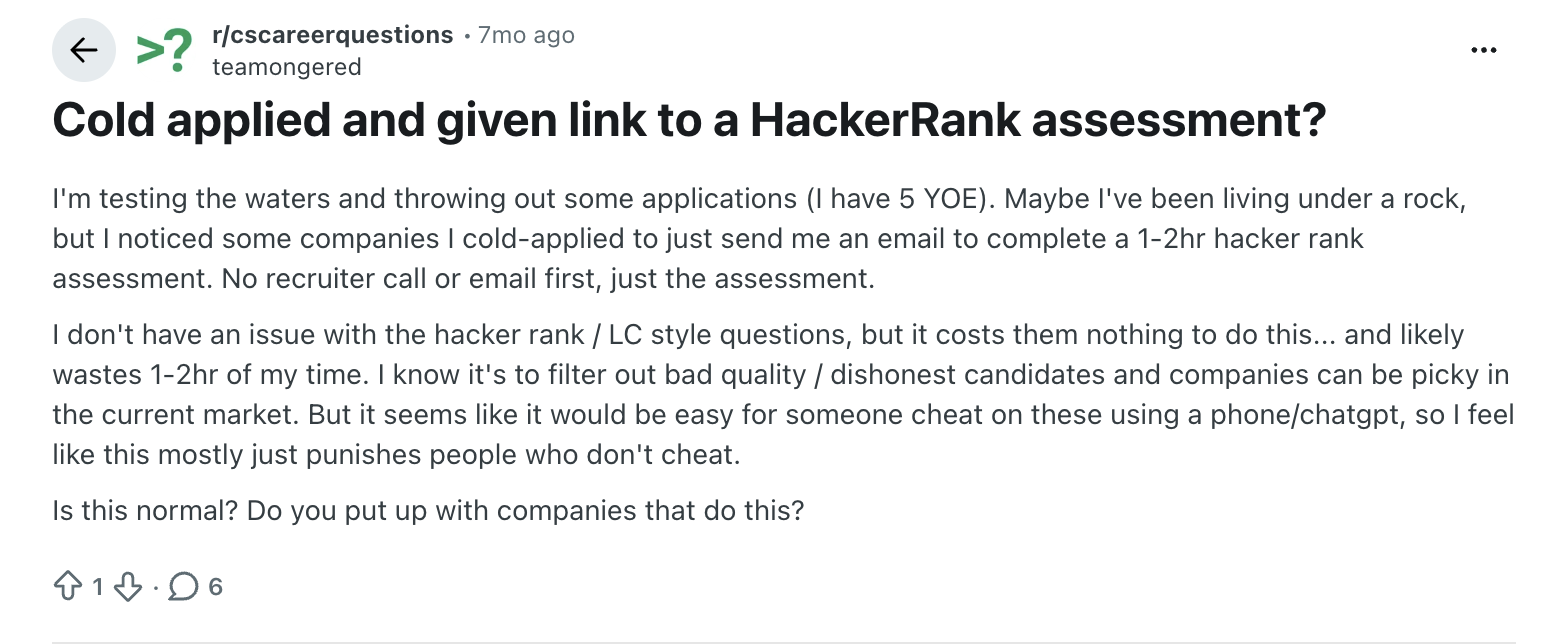
$1,990/year for 120 attempts (Starter) and $4,500/year for 300 attempts (Pro) – roughly $20 per candidate screened, with no credit rollover. White-labeling, flexible question formats, and branded candidate experiences require enterprise tiers. Small teams often have to pay for essential features right from the beginning. For a team screening 500 candidates across a few open roles, the bill hits $10,000 before a single interview.
An engineer on reddit captured the frustration:
2. Question banks candidates already know
HackerRank’s questions circulate on Reddit, Discord, and prep platforms. Candidates who’ve practiced on leaked content pass without having the skills you’re measuring. Worse, because so many candidates have seen the same questions, their code matches widely-shared solutions – triggering false plagiarism flags on legitimate candidates.
HackerRank’s own plagiarism detection documentation warns recruiters not to auto-reject on plagiarism flags because false positives are so common.
One r/cscareerquestions recruiter screening 10 candidates found 7 were definitively cheating. The bypass tools like ShadeCoder, Cluely, AI interview solvers are openly discussed on r/leetcode.
3. Senior engineers disengage
According to the HackerRank 2025 Developer Skills Report, 66% of developers prefer practical challenges that mirror their day-to-day work over abstract algorithmic problems. Engineers doing architecture and system design daily are asked to implement graph traversals under a timer. Many disengage or drop out and they don’t come back. One candidate put it plainly:
“I spent THREE HOURS doing a HackerRank in a state of complete panic and terror… I lost 20 minutes of progress and failed the assessment.”
(Source: r/cscareerquestions, October 2024)
4. Tests don’t reflect how engineers actually work
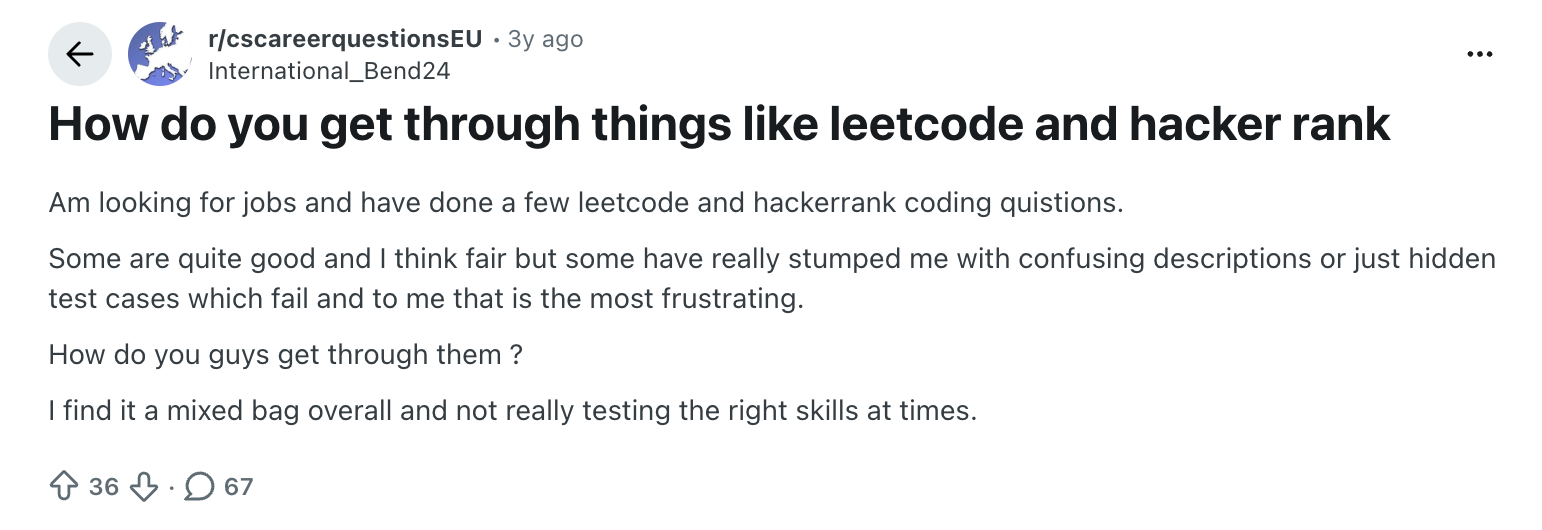
Real development means working inside existing codebases, using libraries, referencing documentation, and debugging collaboratively. HackerRank blocks all of it, no NumPy, no npm, no documentation, no AI tools. Yet according to the HackerRank 2025 Developer Skills Report, 82% of developers now use AI coding assistants daily.
As one engineer noted:
5. No support for non-technical roles
HackerRank offers nothing for finance, sales, operations, HR, or customer success hiring. Most recruiting teams don’t hire only engineers, they end up paying for HackerRank plus a second platform, adding cost and fragmentation to an already stretched process.
6. Workflow gaps with ATS systems
Multiple reviews cite manual CSV exports or clunky syncs when connecting HackerRank results to applicant tracking systems, adding time to a process most teams are trying to speed up.
Should Your Team Keep Using HackerRank or Switch?
Who should move away from HackerRank:
- Small to mid-size companies where $1,990-$4,500/year per plan doesn’t fit the hiring volume
- Teams hiring senior or staff-level engineers where algorithmic tests create false negatives
- Organizations hiring beyond engineering – finance, sales, operations, HR
- Companies where employer brand and candidate experience are active priorities
- Startups that need fast, practical screening without enterprise-tier pricing
Who should stay on HackerRank:
- Large enterprises running high-volume campus recruiting for junior engineering roles
- Quant trading firms and algorithm-specialist teams where competitive programming is the actual job
- FAANG-style technical bars where CS fundamentals and algorithmic depth are explicit requirements
- Organizations with 5+ dedicated technical recruiters and budget for $200-800/recruiter/month
Quick Comparison: HackerRank vs Top 11 Alternatives
| Platform | Why it’s a better alternative to HackerRank | Standout Feature |
| Xobin | Covers technical and non-technical roles in one platform | Agentic AI interviews that run 24/7 without engineering panels |
| Codility | Psychologist-validated assessments with legal audit trail | 76-page Technical Manual with adverse impact data at every cut score |
| CodeSignal | Portable standardized score candidates share across employers | General Coding Framework (GCF) – a credit score for coding ability |
| TestGorilla | Broad test library covering both tech and non-tech hiring | 350+ validated tests across cognitive, technical, and culture-fit |
| TestTrick | Tests coding, Excel, and soft skills, not just code | Coding + video interviews + psychometrics in one flow |
| HackerEarth | Combines assessment tooling with a 7.6M+ developer community | Hackathon and coding event tooling for employer brand building |
| DevSkiller | Tests candidates in real Git repos, not blank code editors | RealLifeTesting – candidates work in actual codebases with real frameworks |
| PMaps | Predicts long-term retention, not just immediate skill | AI Voice Screening for behavioral and cognitive fitment scoring |
| Vervoe | Job-simulation tasks scored automatically by AI | AI-automated candidate ranking across text, video, and audio responses |
| Coderbyte | Fast setup for teams running structured hiring for the first time | 1,000+ challenges with project-based assessments deployable in a day |
| Codeaid | Evaluates code quality and architecture, not just test case results | Built-in AI-generated code detection from day one |
11 Platforms Better Than HackerRank
1. Xobin
Best for: Teams hiring across technical and non-technical roles who want one platform instead of many.
Xobin is an AI-powered talent assessment platform that covers coding assessments, skill tests, psychometric evaluations, video interviews, and agentic AI interviews under one roof. It serves 5,000+ active clients across 60+ countries – from startups to Fortune 500 enterprises – spanning IT, banking, healthcare, manufacturing, and retail.
What Xobin does well
Xobin’s library includes 3,400+ skill assessments and 2,500+ job-role templates, covering both technical and non-technical functions. Coding tests support 50+ languages. Behavioral assessments use validated psychometric models (Big 5, DISC). Communication checks evaluate spoken and written responses in 15 languages. The native ATS module (Tracks) manages candidate pipelines without needing a separate tool. AI proctoring runs multiple layers – eye tracking, screen sharing, browser monitoring, audio analysis, and unauthorized device detection with each candidate receiving a summarized AI Trust Score.
From what we’ve seen, teams switching from HackerRank to Xobin most often cite the non-technical coverage and the reduction in manual steps between assessment and ATS as the two biggest immediate gains.
Compliance: SOC2 Type 1 & 2, ISO 27001, GDPR, CSA STAR. Separate data centers in EU, UK, USA, Middle East, and India.
Limitations: The platform’s breadth can feel overwhelming during initial setup. Pricing requires a demo conversation, there’s no self-serve tier for testing the platform independently.
Not a fit for: Pure algorithm-screening needs, one-off assessments, or individual coding practice.
Free trial: Personalized demo with full feature access. Book a personalized demo here.
Xobin is the only platform on this list that lets a recruiter assess a backend engineer, a finance analyst, and a customer success manager in the same workflow – without a second tool, a CSV export, or a separate vendor contract. With 3,400+ skill assessments spanning technical and non-technical roles, it’s built for the reality that most hiring teams don’t hire only engineers.
2. Codility
Best for: Enterprise engineering teams that need psychologist-validated, legally defensible technical assessments.
Codility has served enterprise technical hiring since 2009. Every assessment is designed by occupational psychologists, validated against an Engineering Skills Model from 30+ international frameworks, and monitored for adverse impact at each cut score.
What Codility does well
Codility’s 1,200+ task library covers real-world simulations, algorithmic challenges, SQL, bug-fixing, and project-based work across 80+ languages. Its AI-specific task library addresses modern engineering roles that work alongside AI tools – an area most platforms haven’t addressed. CodeLive combines IDE, video, and whiteboarding for structured technical interviews. ATS integrations cover 20+ systems including Greenhouse, Workday, SAP SuccessFactors, and Lever. A free Starter plan gives 25 monthly invites with full library access.
Compliance: SOC2, ISO 27001, GDPR, CCPA, WCAG 2.1 AA. No AI is used in automated hiring decisions – a deliberate policy enterprises appreciate.
Limitations: Technical roles only – no soft skills, psychometrics, or non-technical coverage. Pricing is enterprise/custom with no publicly listed tiers – contact sales for a quote, and expect it to reflect enterprise budgets rather than SMB ones.
Not a fit for: Companies hiring outside engineering, or teams with infrequent hiring needs.
Free trial: Starter plan with 25 monthly invites and full task library access.
Codility is the only platform on this list that publishes a 76-page Technical Manual with adverse impact data at every cut score – meaning if a hiring decision is ever challenged legally, there is documented methodology to defend it. For enterprises in regulated industries, that audit trail is often a non-negotiable requirement.
3. CodeSignal
Best for: Companies hiring engineers at scale who want a portable, standardized coding benchmark.
CodeSignal’s General Coding Framework (GCF) produces a standardized score candidates can share across employers, reducing redundant screens and cutting time-to-hire in competitive markets. Enterprise teams use it to compare candidates globally against a common baseline rather than running separate screens.
What CodeSignal does well
The GCF score is the clearest differentiator here – closer to a credit score than a test result: portable, recognized, and already accepted by many engineering teams. The assessment library covers real-world coding challenges across multiple languages, with a clean IDE and reliable proctoring. Role-specific and company-customizable tests go beyond the standard library. Data analytics provide objective comparison across candidates.
Compliance: Enterprise-grade security with ATS and HR system integrations well-developed for mainstream platforms.
Limitations: Technical-only scope. No soft skills, video interviews, or non-technical assessments. Branding and candidate experience customization is limited. Pricing is not publicly listed.
Not a fit for: Organizations hiring beyond engineering, or teams that need holistic behavioral assessment.
Free trial: Available on request via demo.
CodeSignal’s General Coding Framework (GCF) produces a portable, standardized coding score that candidates can share across multiple employers – reducing duplicate screens and cutting time-to-hire in competitive engineering markets.
4. TestGorilla
Best for: SMBs hiring across technical and non-technical roles who want broad coverage and fast setup.
TestGorilla is one of the most widely adopted skills assessment platforms outside of purely engineering-focused companies. Its 350+ validated tests span cognitive ability, technical skills, language proficiency, personality, culture fit, and software knowledge – accessible to recruiters without technical expertise.
What TestGorilla does well
Building and deploying multi-format assessments is straightforward: mix a coding test, a cognitive reasoning check, and a culture fit questionnaire into one candidate-facing session. Automated scoring ranks candidates without manual review. The free plan (5 tests, basic qualifying questions) lets small teams get started before committing. ATS integration and mobile-friendly candidate experience work well for standard hiring workflows.
Compliance: AI-powered proctoring with screen recording, randomized questions, and IP monitoring. Standard data protection practices.
Limitations: Annual contract commitment with limited month-to-month flexibility – multiple verified reviews flag difficulty cancelling after a single hire. The free trial gives limited access to the full assessment library. Support response times have drawn mixed feedback from users.
Not a fit for: Occasional or low-frequency hiring, deep technical assessment depth, or enterprise-grade psychometric rigor.
Free trial: Free plan available (5 tests). Paid plans require annual commitment.
TestGorilla offers 350+ validated tests spanning cognitive ability, technical skills, personality, and culture fit – covering both technical and non-technical roles in one platform. Companies like Revolut have reported 40% reductions in time-to-hire using its structured screening approach.
5. TestTrick
Best for: Hiring teams and agencies that want practical skills testing, one-way video interviews, and built-in proctoring within one platform.
TestTrick is a skills assessment and candidate screening platform built to evaluate job-relevant abilities beyond the resume. It combines role-specific tests, coding challenges, Excel-based assessments, one-way video interviews, and proctoring in a single workflow, covering technical roles as well as finance, sales, marketing, HR, and operations.
What TestTrick does well
Coding challenges run across 15+ languages, covering frameworks, databases, DevOps, and cybersecurity, with automated evaluation and code playback for reviewing a candidate’s problem-solving process. Excel-based tasks work well for finance and administrative screening, while one-way video interviews and cognitive, psychometric, and situational judgment tests round out a fuller read on candidates. Custom assessment building and ATS integrations with Ashby, Manatal, Greenhouse, Lever, and Teamtailor keep it slotting into existing workflows.
Compliance: GDPR compliant, with webcam monitoring, screen monitoring, dual-screen detection, and tab-switch alerts protecting assessment integrity.
Limitations: Assessment volume runs on a credit-based plan, so high-volume hiring may require a larger package. Not built for teams focused purely on competitive programming or algorithm-heavy coding.
Not a fit for: Organizations wanting competitive coding platforms, developer-practice tools, or academic exam management.
Free trial: 7-day free trial, no credit card required. Paid plans scale with candidate assessment volume.
TestTrick combines 500+ role-specific assessments with coding evaluation across 15+ languages, Excel-based testing, and asynchronous video interviews in one workflow. Its reach across both technical and non-technical roles makes it the stronger pick for hiring teams that need to screen finance, sales, and support candidates alongside developers, not just engineers.
6. HackerEarth
Best for: Tech-first companies using hackathons and coding competitions as part of their developer sourcing strategy.
HackerEarth combines technical assessment tooling with a developer community of 7.6 million+ coders across 133 countries. It’s the strongest option on this list for organizations that actively build engineering employer brands through events and not just post job listings and wait.
What HackerEarth does well
The coding challenge library includes 13,000+ problems across 40+ languages. Hackathon tooling is a product strength – branded coding events, live leaderboards, concurrent assessment for thousands of candidates, and post-event recruiter dashboards work reliably. Its AI Interview Agent conducts adaptive technical interviews autonomously, scoring responses and reducing engineering panel time at early stages. ATS and HR software integrations support automated candidate tracking.
Compliance: AI-powered proctoring covers webcam monitoring, plagiarism detection, screen tracking, and browser behavior analysis.
Limitations: Technical hiring only. Non-technical roles, psychometrics, and soft-skill assessments aren’t covered. Candidate experience can feel complex for first-time test-takers, contributing to higher drop-off rates in some hiring contexts.
Not a fit for: Teams hiring primarily for non-technical roles, or smaller companies without a developer community strategy.
Free trial: Available for organizations before purchase.
HackerEarth combines a 13,000+ coding challenge library with a developer community of 7.6 million+ coders across 133 countries. Its hackathon tooling and AI Interview Agent make it the strongest option for tech companies building engineering employer brands through events.
7. DevSkiller
Best for: Engineering teams that want candidates tested in real developer tooling – actual Git repos, real frameworks, live coding environments.
DevSkiller’s flagship methodology is RealLifeTesting™ – candidates work inside actual repositories using real frameworks and familiar tooling, rather than blank code editors with abstract puzzles. It directly addresses the HackerRank criticism that tests don’t reflect how modern developers actually work.
What DevSkiller does well
The platform supports 200+ technologies with 500+ predefined assessments. Candidates work in an IntelliJ-style browser-based environment with Git integration which is closer to a real working day than any algorithm test. A custom assessment builder includes an automatic duration calculator. Customer reviews consistently praise challenge quality and support team responsiveness. ATS integrations cover mainstream systems with 99.95% uptime SLA.
Compliance: GDPR and ISO 27001 certified, covering European hiring requirements.
Limitations: Technical-only tool. Soft skills, video interviews, and non-technical roles are outside its scope. Managing large candidate batches can feel cumbersome. Pricing is custom/enterprise with no publicly listed tiers.
Not a fit for: Companies hiring beyond technical roles, or teams needing a fast self-serve entry point.
Free trial: Yes, available on their site.
DevSkiller’s RealLifeTesting™ methodology tests candidates inside actual Git repositories with real frameworks and tooling – directly addressing the gap between HackerRank’s isolated algorithm format and how engineers actually work. The platform supports 200+ technologies across 500+ predefined assessments.
8. PMaps
Best for: Organizations that need to predict long-term performance and retention, not just evaluate immediate technical output.
PMaps combines cognitive science, behavioral profiling, learning agility evaluation, and AI voice screening into a multidimensional candidate picture. It’s designed for companies that experience high technical attrition and want assessment data that predicts whether someone will stay and grow – not just whether they can pass a test today.
What PMaps does well
PMaps covers cognitive problem-solving, behavioral and learning agility evaluations, communication simulation, and AI-based predictive fitment scoring. Its AI Voice Screening handles early-stage candidate conversations autonomously. Role-based competency benchmarking compares candidates against defined role profiles. Secure remote proctoring covers assessment integrity.
Compliance: Standard enterprise data protection and remote proctoring with fraud monitoring.
Limitations: Not designed for competitive coding environments or high-volume algorithm screening. Initial setup requires competency mapping per role – more upfront investment than plug-and-play tools. Advanced predictive analytics require higher-tier plans.
Not a fit for: Teams that need coding assessment depth, high-volume algorithmic screening, or fast out-of-the-box deployment.
Free trial: 7-day trial access available on request.
PMaps combines cognitive science, behavioral profiling, learning agility evaluation, and AI voice screening to predict long-term job performance – making it the strongest option for organizations where technical attrition is a documented problem.
9. Vervoe
Best for: Teams that want job-simulation assessments combining technical tasks and soft skills, with AI-automated candidate ranking.
Vervoe assesses candidates through task simulation rather than standardized tests. Candidates complete role-relevant tasks – writing an email, debugging a script, analyzing a dataset – scored automatically by AI that ranks the candidate pool without manual review.
What Vervoe does well
The 300+ pre-built assessments span technical, soft-skill, and culture-fit evaluations. The AI builder suggests assessment components by job title and supports text, video, audio, file upload, and MCQ formats in a single candidate experience. Automated AI ranking reduces recruiter workload significantly. Employer branding options – company imagery and messaging inside the assessment experience – are better than most platforms on this list. The 7-day free trial includes unlimited candidate invites with no credit card required.
Compliance: Standard proctoring and data protection. Bias-reducing job simulations are a design priority.
Limitations: Applicant filtering and management are less intuitive than dedicated ATS tools. Proctoring depth is basic compared to enterprise platforms – sufficient for general roles, thin for compliance-sensitive hiring. Lower-tier plans offer less template flexibility.
Not a fit for: Enterprises needing advanced proctoring, pure coding needs, or high-stakes regulated hiring contexts.
Free trial: 7-day free trial, no credit card required.
Vervoe’s 300+ pre-built job-simulation assessments cover technical, soft-skill, and culture-fit evaluation in one candidate experience. Its AI-automated ranking surfaces top candidates without manual review – and its 7-day free trial includes unlimited candidate invites.
10. Coderbyte
Best for: Startups and small engineering teams that need structured technical screening in place quickly, at accessible pricing.
Coderbyte is a practical technical assessment tool for teams setting up formal hiring processes for the first time. It covers coding challenges, project-based assessments, video interview integration, and candidate scoring – the core workflow most small teams need without enterprise complexity.
What Coderbyte does well
Setup is fast – most teams get their first live assessment deployed within a day. The 1,000+ challenge library covers common technical roles. Real-world project-based questions move beyond pure algorithm testing. Video interview integration keeps screening and interviewing inside one platform. Candidate reports give enough data for straightforward hire/no-hire decisions at the pace small teams work.
Compliance: Basic anti-cheating tools including question randomization and basic monitoring. Suitable for standard SMB hiring contexts.
Limitations: Proctoring is lightweight – no eye tracking, audio analysis, or multi-layer detection. Non-technical assessments are limited. ATS integration is weaker than most platforms on this list. Reporting depth can feel thin for teams scaling past 50–100 hires annually.
Not a fit for: Teams hiring beyond technical roles, high-volume or compliance-sensitive hiring, or organizations needing deep ATS integration.
Free trial: Yes, available before purchase.
Coderbyte offers 1,000+ coding challenges, project-based assessments, and video interview integration in one platform – designed for startups and small engineering teams that need structured technical screening deployed within a day, not weeks.
11. Codeaid
Best for: Engineering teams that want the most realistic, long-form code evaluation – including built-in AI-generated code detection.
Codeaid is built around one belief: short, isolated coding puzzles don’t reflect how engineers actually work. Its assessments run inside real Git-based workflows, last up to 10 times longer than industry-standard tests, and evaluate code architecture and style alongside functional correctness.
What Codeaid does well
Candidates check out a real repo, make changes, and submit through familiar developer tooling – a workflow meaningfully closer to actual on-the-job coding than any algorithm screen. Automated scoring evaluates code quality, maintainability, and structure, not just whether test cases pass. AI-generated code detection is built in from day one – flagging AI-assisted submissions alongside traditional plagiarism. The forever-free core tier makes it accessible for small teams on tight budgets.
Compliance: Built-in similarity checker for plagiarism and AI-generated code. Standard data protection.
Limitations: Narrowly scoped to software engineering. No non-technical assessments, video interviews, or meaningful ATS integration. Reporting and candidate management are minimal compared to full-suite platforms.
Not a fit for: Teams hiring beyond software engineering, high-volume screening, or organizations needing ATS integration and broader assessment coverage.
Free trial: Forever-free core tier; 14-day trial on Team and Enterprise plans.
Codeaid’s Git-based assessments run up to 10x longer than industry-standard tests and evaluate code architecture and style alongside functional correctness – with built-in AI-generated code detection that flags AI-assisted submissions from day one.
How to Choose the Right Assessment Platform
| Your situation | Best fit |
| Hiring across technical and non-technical roles | Xobin, TestGorilla, Vervoe |
| Enterprise engineering with legal/bias documentation needs | Codility |
| Standardized benchmarks for competitive engineering markets | CodeSignal |
| Developer community engagement and hackathons | HackerEarth |
| Realistic job-simulation coding tests | DevSkiller |
| Predicting retention and long-term performance | PMaps |
| Startup, first structured hires, fast setup | Coderbyte |
| Deep Git-based code evaluation, AI-submission detection | Codeaid |
| Recruitment agency needing white-labeled assessments | Xobin |
The Bottom Line
HackerRank works for a specific kind of hiring – algorithm-intensive roles, FAANG-style technical bars, companies where competitive programming is the job. For everyone else, the combination of high per-attempt cost, leaked question banks, and a format that 66% of developers say doesn’t reflect their work makes it a poor fit.
The platforms above each solve a different slice of that gap. In our experience, the teams that get the most from switching are those that run a trial on a real open role rather than a test scenario – the candidate drop-off data and completion quality tell you more than any feature checklist.
Frequently Asked Questions
Why is HackerRank so expensive compared to alternatives?
HackerRank’s Starter plan costs $1,990/year for 120 candidate attempts – approximately $20 per screen. Most alternatives on this list offer significantly more attempts at similar or lower entry costs, with several offering free plans or usage-based pricing that scales with actual hiring volume.
What’s the best HackerRank alternative for non-technical roles?
Xobin, TestGorilla, and Vervoe all cover non-technical roles. Xobin adds psychometric and behavioral assessment depth. TestGorilla is faster to deploy for SMBs. Vervoe’s job-simulation format works well for customer-facing and operational roles. HackerRank, Codility, CodeSignal, HackerEarth, DevSkiller, and Codeaid are technical-only platforms.
Which platform offers the most realistic coding tests?
DevSkiller’s RealLifeTesting™ uses actual Git repositories and real developer tooling. Codeaid’s long-duration, Git-based assessments also reflect real workflow. Both go significantly beyond HackerRank’s isolated algorithm format, which 66% of developers say doesn’t match their day-to-day work (HackerRank 2025 Developer Skills Report).
Which platform integrates best with ATS systems?
Xobin (50+ native integrations), Codility (20+ including Workday and SAP SuccessFactors), CodeSignal, TestGorilla, and HackerEarth all offer solid ATS connectivity. Codeaid offers minimal ATS integration at this stage.
How long does switching from HackerRank take?
Standard setups take one to two weeks. Enterprise migrations with custom questions, SSO, and ATS mapping typically take two to four weeks. Platforms with strong onboarding support – Codility, Xobin, DevSkiller – tend to compress that timeline with dedicated account management.
Which platforms support global hiring?
Xobin operates in 60+ countries with data centers in the EU, UK, USA, Middle East, and India, and assessment localization in 15 languages. Codility offers EU and US data hosting with GDPR and CCPA compliance. Both CodeSignal and DevSkiller also support international hiring with appropriate compliance coverage.