

Most hiring teams know they should use psychometric tests. Where they go wrong is treating them as interchangeable, running the same personality test for a data analyst, a sales director, and a customer support hire, then wondering why the results don’t help.
Each type of psychometric test measures something different. Deploying the wrong one for a role is like using a thermometer to measure blood pressure: you get a number, but it doesn’t tell you what you need to know.
This blog maps all the types of psychometric assessment, including every sub-type and role-specific variant available on Xobin’s psychometric testing platform, to specific roles, hiring stages, and what each one actually predicts. The goal isn’t more data. It’s the right data.
Table of Contents
If you’re still working out what a psychometric test actually measures and why it predicts performance in the first place, our complete guide to psychometric testing for recruitment covers that ground. This guide assumes you’re past that question and need to know which specific type to deploy.
TL;DR – Key Takeaway!
- This guide breaks down all 9 psychometric test categories into their sub-types and role-specific variants, mapping each one to the exact Xobin assessment and funnel stage it belongs at.
- Aptitude and cognitive tests anchor early-funnel screening. Personality, motivation, and behavioral tests sit mid-funnel. Role-specific and leadership assessments belong to the late funnel.
- No single test gives a complete picture. The most accurate hiring decisions combine two or three types matched to the role’s specific performance demands.
- Research by Schmidt and Hunter (1998) found that cognitive ability tests are one of the strongest predictors of job performance, with a validity coefficient of 0.51—higher than any other single hiring method.
- Xobin has assessed 4M+ candidates across 5,000+ organizations in 55+ countries. The psychometric assessments are reviewed by Mark Smith, Ph.D., covering all 9 categories with instant auto-graded reports benchmarked against role-specific peer groups.
What Are the Types of Psychometric Tests Recruiters Use for Hiring Best Employees?
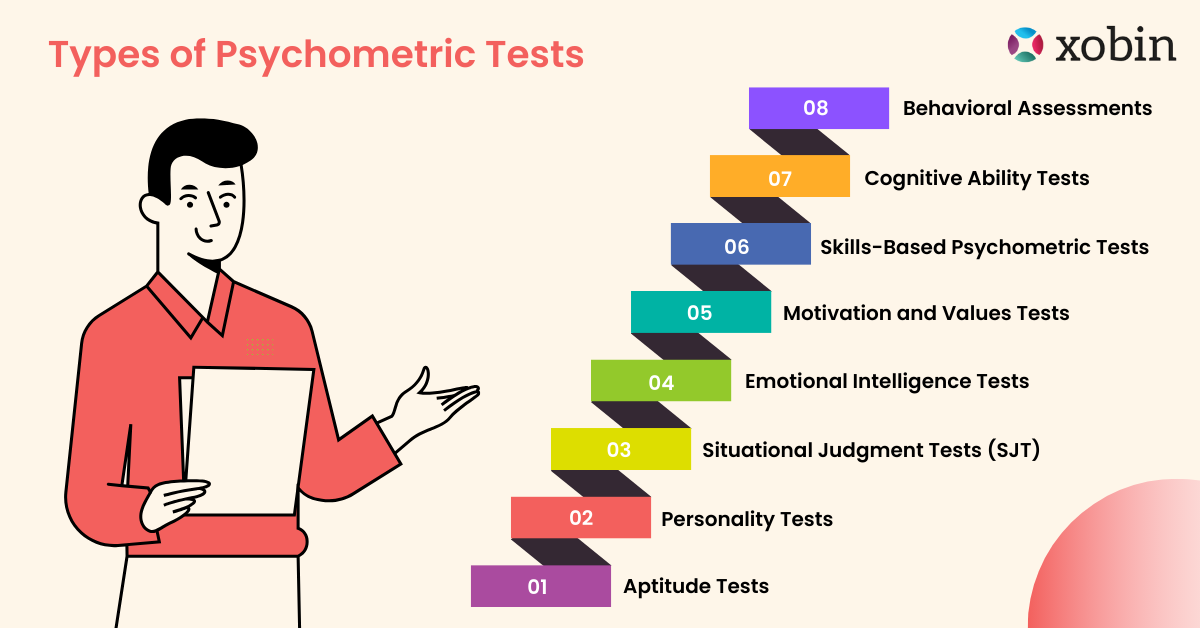
A quick reference before diving in. The table below maps each test category to its primary use case, the funnel stage it belongs at, and the corresponding Xobin assessment.
| Test Category | What It Predicts | Best Funnel Stage | Xobin Assessment |
| Aptitude Tests | Problem-solving, learning speed, domain-specific reasoning | Early screening | Cognitive Aptitude Test Suite |
| Personality Tests | Behavioral tendencies, culture fit, integrity risk | Mid-funnel | NEO-FFI (Big Five), DiSC, HEXACO, Dark Triad, Personality Profiler |
| Cognitive Ability Tests | General mental ability (“g”), adaptability | Early screening | Cognitive Aptitude |
| Emotional Intelligence Tests | Interpersonal effectiveness | Mid to late funnel | Emotional Intelligence (XEAT) |
| Motivation Assessments | Engagement drivers, retention alignment | Mid-funnel | Motivation & Drive Analysis |
| Behavioral & Leadership Assessments | Workplace conduct, leadership readiness | Late funnel / senior roles | Leadership Test, DiSC Leadership Profile |
| Situational Judgment Tests | Real-world decision-making | Mid-funnel | Custom Role-Based SJT |
| Learning Agility and Adaptability Tests | Growth potential, resilience, change readiness | Mid-funnel / promotion decisions | Growth Mindset, Grit, Resilience, Adaptability Tests |
| Role-Specific Psychometric Assessments | Function-specific performance fit | Late funnel | Sales Psychometric (B2B), Sales Psychometric (B2C) |
1. Aptitude Tests
Aptitude tests measure a candidate’s capacity for logical reasoning, analytical thinking, and problem-solving. They don’t test what someone already knows. They test how quickly and accurately someone can process new information and apply it. On Xobin’s platform, this entire category runs through the Cognitive Aptitude Test Suite, which covers ten distinct reasoning sub-types.
Why does aptitude testing use so many sub-types instead of one general score?
Because different roles fail for different reasons. A single composite score hides whether a candidate’s weakness is numerical, spatial, or verbal, and that distinction changes who you should hire for what.
Aptitude Sub-Types Xobin offers
| Sub-Type | What It Measures | Strongest Fit |
| Cognitive Aptitude Test | General problem-solving and learning speed | Most early-funnel roles |
| Numerical Reasoning Test | Working with data, ratios, and financial logic | Finance, analytics, ops |
| Verbal Reasoning Test | Comprehension, language logic | Communication-heavy, support roles |
| Logical Reasoning Test | Pattern recognition, rule-based inference | Technical, engineering roles |
| Abstract Reasoning Test | Recognizing relationships without familiar context | R&D, strategy, design |
| Inductive Reasoning Test | Drawing general rules from specific examples | Data science, research |
| Deductive Reasoning Test | Applying general rules to specific cases | Compliance, legal, QA |
| Spatial Reasoning Test | Mentally manipulating shapes and layouts | Architecture, engineering, design |
| Mechanical Aptitude Test | Understanding physical and mechanical principles | Manufacturing, field technicians |
| Critical Thinking Test | Evaluating arguments and evidence objectively | Leadership, strategy, analyst roles |
| Data Interpretation Test | Reading and reasoning from charts, tables, and datasets | Analytics, BI, finance |
When to Use Aptitude Tests, and When to Skip Them
Use aptitude tests early in the hiring funnel as a volume screener. A 20-minute test before any human review time is invested filters on objective criteria rather than CV polish, and the sub-type breakdown tells you exactly where a candidate’s reasoning strength lies.
Skip them, or scale back to one sub-type, for roles where analytical ability matters less than interpersonal skill, such as community management or welfare roles. Running a full aptitude suite for these positions adds friction without adding useful signals.
A 2024 SHRM Talent Trends report found that 54% of organizations now use pre-employment assessments to gauge applicants’ knowledge, skills, and abilities during hiring, up from earlier years (SHRM, 2024). Trusted by 5,000+ organizations across 55+ countries, Xobin’s aptitude suite is validated across global markets including India, the Middle East, Southeast Asia, and North America.
2. Personality Tests
Personality tests measure enduring behavioral traits that predict how someone will work, communicate, and relate to others. They don’t measure skills or intelligence. They reveal the psychological patterns that drive everyday workplace behavior. Xobin’s personality category includes five distinct frameworks, each suited to a different hiring question.
The 5 Personality Frameworks Xobin Offers
NEO-FFI (The Big Five Personality Test) measures Openness, Conscientiousness, Extraversion, Agreeableness, and Neuroticism. It’s the most empirically validated personality framework in I-O psychology and the most predictive of long-term job performance. Industrial-organizational psychology research consistently ranks Conscientiousness as one of the strongest single-trait predictors of job performance across nearly every occupation studied (APA, Society for Industrial and Organizational Psychology).
DiSC (DiSC Personality Test) segments behavioral style into Dominance, Influence, Steadiness, and Conscientiousness. It’s most useful for understanding communication style, team dynamics, and how a candidate handles conflict. Worth noting: DiSC has weaker criterion-related validity than Big Five for predicting job performance. It’s most valuable as a post-hire development tool rather than a pre-hire selection filter.
HEXACO adds an Honesty-Humility dimension to the Big Five. This makes it particularly valuable for roles involving financial authority, sensitive data, or fiduciary responsibility.
Dark Triad measures Machiavellianism, Narcissism, and Psychopathy. It’s used for risk screening in leadership, compliance, and fiduciary roles, where the cost of a bad hire goes well beyond underperformance.
Personality Profiler is Xobin’s broader, role-agnostic personality snapshot, designed as a faster mid-funnel check when a full Big Five or HEXACO battery isn’t necessary but a behavioral read still adds value.
A note on MBTI: the Myers-Briggs Type Indicator is widely recognized but has limited predictive validity for job performance, and its test-retest reliability is inconsistent. It remains useful for self-awareness workshops, but shouldn’t be used as a hiring filter.
When Should You Use Personality Tests, and When Should You Skip Them?
Use them mid-funnel, after basic role fit is confirmed. Running personality tests too early, before application, generates candidate drop-off without meaningful benefit.
Don’t use them as the sole basis for a hiring decision. Personality data works best paired with cognitive or skills-based assessments, never as a standalone filter.
A candidate scoring high on Agreeableness and Steadiness in a DiSC profile is likely a strong fit for collaborative, process-driven environments. Even if someone excels in one role, they may struggle in a sales environment that involves frequent conflict and a high level of autonomy. Xobin benchmarks personality scores against role-specific peer groups, so the same raw score reads differently depending on the position.
3. Cognitive Ability Tests
Cognitive ability tests, sometimes called tests of general mental ability or “g,” measure how quickly and accurately someone processes new information, applies logic, and adapts to unfamiliar challenges. On Xobin, this maps to the standalone Cognitive Aptitude assessment, distinct from the broader aptitude suite in scope: cognitive ability measures the underlying mental capacity that drives all reasoning types, rather than any single domain.
What it predicts: Learning agility, adaptability, and performance in roles with high cognitive demand or rapid change. A strong score often shows that a candidate can learn faster, work through complex tasks with fewer errors, and adapt to unfamiliar situations without needing constant support.
When to use it: Early funnel for fast-paced roles in technology, product management, data analytics, and startup environments. Also effective alongside skills tests for early-career hiring, where relevant work experience is limited.
When NOT to use it: As a standalone filter for roles where emotional or social intelligence drives performance. Cognitive ability predicts task performance well but is a weak predictor of interpersonal effectiveness on its own.
A candidate with high cognitive ability and average technical skills will typically outperform a candidate with high technical skills and average cognitive ability within 6 to 12 months, because the first candidate learns and adapts faster. That’s why fast-growing organizations weigh this category heavily.
4. Emotional Intelligence Tests
Emotional Intelligence (EI) tests measure a candidate’s ability to recognize, understand, and manage emotions, both their own and those of the people around them. EI is distinct from personality and cognitive ability, and it predicts a specific set of workplace outcomes. Xobin’s Emotional Intelligence Assessment (XEAT) measures four dimensions: Self-Emotion Appraisal, Others’ Emotion Appraisal, Use of Emotion, and Regulation of Emotion.
Why does Regulation of Emotion matter more than the other three dimensions for customer-facing roles?
Because it’s the dimension most tied to how someone behaves under pressure, not just how well they understand emotions in theory. A 2017 meta-analysis in the Journal of Occupational and Organizational Psychology found EI significantly predicts lower turnover intentions across roles (Miao et al., 2017). In our experience reviewing platform data, candidates who score in the top quartile on Regulation of Emotion churn at roughly half the rate of bottom-quartile candidates in the same customer-facing role cohort.
When to use it: Mid to late funnel for customer-facing roles, people managers, team leads, and anyone in healthcare, hospitality, sales, or social services.
When NOT to use it: As a filter for individual-contributor technical roles where interpersonal complexity is low. Running EI assessments for a backend developer role adds time without adding predictive value.
A candidate with strong Others’ Emotion Appraisal scores reads a room accurately and adapts their communication style accordingly. For managers specifically, this dimension is one of the strongest predictors of team retention under that manager’s leadership.
5. Motivation Assessments
Xobin’s motivation test helps you discover what truly drives a candidate at work. It reveals whether they are motivated by autonomy, recognition, financial rewards, meaningful work, or intellectual challenges, giving you deeper insights into what keeps them engaged and productive. Unlike personality tests, which measure stable traits, motivation tests measure what a candidate will actively pursue once hired.
What it predicts: Long-term engagement and voluntary retention. A candidate highly motivated by autonomy, placed in a heavily managed, process-driven role, will disengage within months regardless of how well their personality or skills fit the position.
When to use it: When hiring for roles requiring long-term commitment or strong mission alignment, such as senior individual contributors, nonprofit roles, or purpose-led organizations. Also useful for internal mobility decisions.
When NOT to use it: For short-term contract or project-based roles where immediate task competency matters more than long-term motivation alignment.
If a candidate’s primary motivators don’t match what the role actually offers day to day, you’re looking at a retention risk regardless of how well they interview. Motivation data surfaces this mismatch before the offer goes out, not six months after.
6. Behavioral and Leadership Assessments
Behavioral assessments evaluate a candidate’s typical patterns of workplace conduct: how they handle conflict, approach decisions, respond to change, and function within a team. Xobin’s category here includes a general Behavioral Assessment, a dedicated Leadership Test for management-track and succession decisions, and the DiSC Leadership Profile, which applies DiSC’s communication-style framework specifically to leadership contexts like delegation, team motivation, and conflict navigation at the management level.
Unlike personality tests, which measure traits, behavioral and leadership assessments focus on observable actions and tendencies, often benchmarked against a defined success profile built from your existing high performers.
When to use it: Late funnel for senior-level hiring, leadership assessment, and succession planning. The Leadership Test and DiSC Leadership Profile are most valuable when comparing internal candidates for promotion, where you need a consistent, comparable read on leadership readiness rather than just interview impressions.
When NOT to use it: Early in the funnel for junior or high-volume roles, where the depth of behavioral and leadership data isn’t proportionate to the hiring decision being made.
A candidate whose behavioral patterns show high adaptability and strong accountability orientation is significantly more likely to perform well during organizational change. For succession planning, the Leadership Test helps identify which internal candidates are ready to step into leadership now versus who needs another 12 months of development.
7. Situational Judgment Tests (SJTs)
Situational Judgment Tests present candidates with realistic, job-relevant scenarios and ask them to choose the most effective response from a set of options. They bridge the gap between personality assessments and real-world job demands. Xobin’s Custom Role-Based SJT lets teams build scenario sets around the actual decisions a given role faces, rather than relying on generic scenario banks.
What it predicts: How a candidate will actually behave when facing the specific situations they’ll encounter in the role, not how they say they’ll behave in an interview.
When to use it: Mid-funnel for roles involving significant customer interaction, leadership responsibility, or ethical judgment. SJTs are especially valuable when past experience doesn’t reliably predict behavior in a new context.
When NOT to use it: For highly technical roles where performance depends primarily on measurable skills rather than situational judgment. A software engineer’s SJT score tells you far less than a coding assessment does.
There’s no universally right answer in a well-designed SJT. What you’re scoring is whether a candidate’s chosen response pattern consistently aligns with how your highest performers handle the same scenarios, which is exactly why the Custom Role-Based format matters: generic scenarios don’t reflect your actual high performers.
8. Learning Agility and Adaptability Tests
Learning agility and adaptability tests measure a candidate’s capacity to grow, adjust, and perform effectively in changing conditions. This is a distinct construct, separate from cognitive ability (how smart someone is) and personality (who they are). Xobin’s assessment library covers this through Growth Mindset, Grit, Resilience, and Adaptability tests, each measuring a different facet of how a candidate responds to change and challenge.
What it predicts: Performance in roles that evolve rapidly, resilience during organizational change, and growth potential beyond the current role. Candidates with high learning agility consistently outperform peers in fast-changing environments even when starting skills are equivalent.
When to use it: High-growth startups, product and strategy functions, early-career graduate hiring where potential matters more than experience, and internal promotion decisions.
When NOT to use it: For stable, well-defined roles where consistency of execution matters more than adaptability. A compliance analyst role with fixed processes rewards reliability and conscientiousness, not high learning agility.
A candidate who scores high on Grit and Growth Mindset but lower on current technical skills is often a stronger long-term hire than someone with the opposite profile, particularly in organizations that invest in development.
9. Role-Specific Psychometric Assessments
Role-specific assessments are purpose-built for a single function rather than measuring a general trait. Xobin offers Sales Psychometric (B2B) and Sales Psychometric (B2C), each calibrated to the distinct performance demands of those two sales motions rather than treating “sales” as one undifferentiated category.
Why split B2B and B2C into separate assessments instead of one general sales test?
Because the two roles reward almost opposite behavioral profiles. B2B sales success depends on patience, relationship-building over long cycles, and consultative problem-solving with multiple stakeholders. B2C sales success depends on speed, resilience to rejection, and the ability to close decisively in a single interaction. A generic sales personality test blends these signals and tells you less about either one.
Sales Psychometric (B2B) weighs relationship management, consultative selling style, and long-cycle persistence more heavily, reflecting the reality that B2B deals often involve multiple decision-makers and extended timelines.
Sales Psychometric (B2C) weighs resilience, persuasive communication under time pressure, and rapid rapport-building, reflecting the faster, higher-volume nature of consumer sales interactions.
When to use it: Late funnel, once you’ve confirmed a candidate is a sales hire in the first place. Role-specific assessments work as a final differentiator between finalists, not as an early screener.
When NOT to use it: For roles outside the function the assessment was built for. A Sales Psychometric (B2C) score tells you very little about fit for an enterprise account executive role, and vice versa.
This category illustrates a broader principle worth repeating: the more specific the assessment is to the actual job, the more predictive the result. General personality and aptitude data narrows the field. Role-specific data picks the winner.
How to Combine Psychometric Test Types for Maximum Accuracy?
No single test type gives you a complete picture. The most predictive hiring decisions combine two or three types matched to what the role actually requires. Here are the most effective combinations by role type.
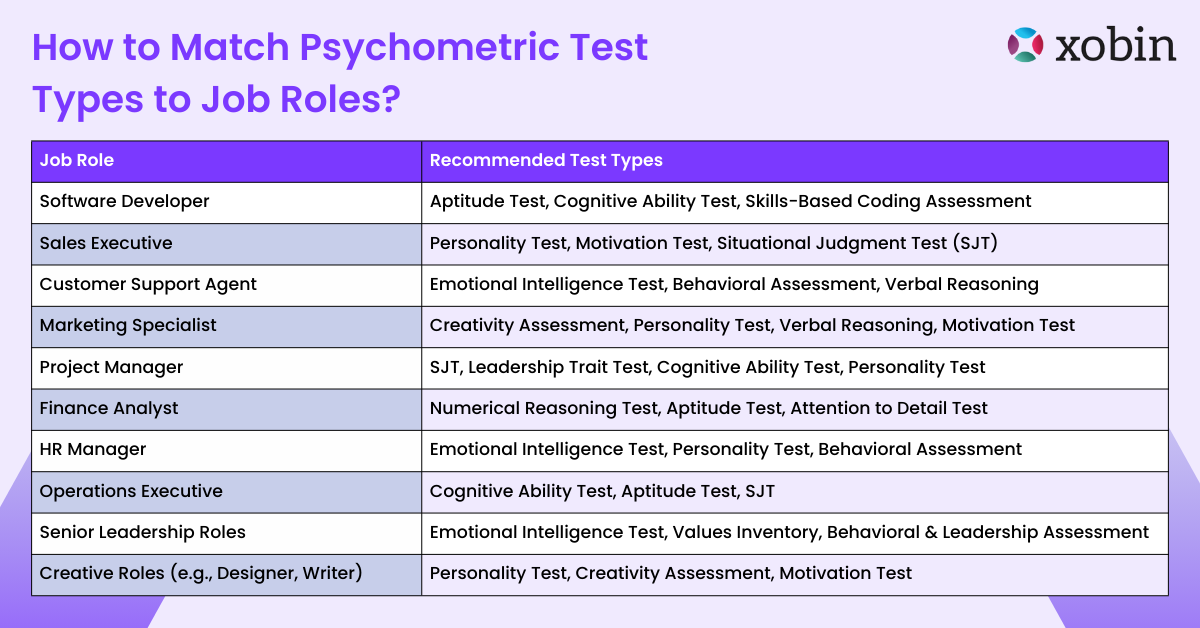
Sales and Business Development
Sales Psychometric (B2B or B2C, matched to motion), DiSC for communication style, and Emotional Intelligence for client relationship quality.
Engineering and Technical Roles
Cognitive Aptitude for learning speed, a skills-based assessment for current technical competency, and HEXACO for conscientiousness and honesty-humility in code quality and documentation.
People Management and Leadership
NEO-FFI (Big Five) for interpersonal style, Leadership Test or DiSC Leadership Profile for management readiness, and Emotional Intelligence for team effectiveness.
Campus and Graduate Hiring
Cognitive Aptitude as the primary screener since work experience is limited, followed by a learning agility assessment (Growth Mindset or Grit) for potential, and a Personality Profiler for culture fit.
Senior Leadership and Succession
Use a comprehensive assessment that measures NEO-FFI personality traits, leadership capability, emotional intelligence, cognitive aptitude, and motivation. These insights make it easier to identify candidates who fit your organization’s long-term vision.

Not sure which combination fits your open roles? Xobin's assessment team can map the right mix to your specific hiring needs.
Book A DemoCommon Mistakes HR Teams Make When Choosing Psychometric Test Types
Running the same test for every role
A personality test optimized for sales hiring generates noise when applied to a compliance analyst position. Test selection should start with a role analysis, not a preference for a familiar framework.
Using tests too late in the process
Psychometric assessments placed at the final interview stage generate data too late to meaningfully influence the decision. Early-funnel cognitive and aptitude tests save the most time. Mid-funnel personality and EI tests improve decision quality where it matters most.
Overlooking Situations Where a Test Isn’t the Right Choice
Every test type has a context where it adds value and one where it adds friction. An EI assessment for a backend developer role, or a generic sales test instead of the B2B/B2C variant, generates data that doesn’t improve the hiring decision.
Treating test scores as verdicts
Psychometric data is most useful as one input among several. A low score on a personality dimension should prompt an interview probe, not an automatic rejection.
See Every Type of Psychometric Test, Ready to Deploy
Xobin’s psychometric assessment library covers all 9 categories outlined above, from aptitude and personality through to role-specific sales assessments, validated and reviewed by Mark Smith, Ph.D. in Industrial-Organizational Psychology.
Every test generates an instant auto-graded report with visual trait maps, role-fit scores, and suggested interview probes. Assessments trigger automatically within your ATS, candidates are ranked against role-specific benchmarks, and an AI proctoring layer ensures the data reflects the actual candidate.
That scale is part of what makes the benchmarking reliable in the first place. Xobin has assessed more than 4 million candidates across 5,000+ organizations in 55+ countries, which means role-fit scores are compared against a peer pool large enough to be statistically meaningful, not a handful of past hires.
Book a Personalized Demo and we’ll walk through which test types fit your specific roles and show you what a real Xobin report looks like for your open positions.
People Also Ask
What are the main types of psychometric tests used in hiring?
There are nine main types of psychometric assessments: aptitude, personality, cognitive ability, emotional intelligence, motivation, behavioral and leadership, situational judgment, learning agility, and role-specific assessments. Most recruiters use a combination of two or three to match the requirements of the role.
What is the most common psychometric test used by employers?
Personality and cognitive ability tests are the most commonly used pre-employment assessments. Cognitive ability tests are especially effective at predicting job performance, which is why employers often use them for graduate recruitment and high-volume hiring.
Is an IQ test the same as a psychometric assessment?
No. An IQ test is one type of psychometric test, but psychometric testing covers a much broader range, including personality, emotional intelligence, behavioral, and role-specific assessments, none of which measure IQ directly.
What is the difference between aptitude tests and cognitive ability tests?
Aptitude tests measure specific reasoning abilities, like numerical, spatial, or mechanical reasoning. Cognitive ability tests measure general mental ability across all reasoning types. Aptitude assesses performance in a specific domain; cognitive ability assesses the underlying capacity driving all of it.
Why do Xobin’s sales assessments split B2B and B2C instead of using one test?
Because B2B and B2C sales reward different behavioral profiles. B2B success depends on relationship-building over long cycles; B2C success depends on speed and resilience to rejection. Splitting the assessments produces more predictive, role-accurate results than a single generic sales test.
How many types of psychometric tests should HR use for one role?
Two to three is the most effective combination. More than three risks of candidate fatigue without meaningfully improving prediction accuracy. Match test types to what the role actually demands rather than running every available assessment.
Which type of psychometric test is hardest to fake?
Cognitive ability and aptitude tests. Performance depends on solving problems within a time limit, so impression management has no effect on the score. Personality tests are more susceptible, which is why well-designed instruments use internal consistency checks to detect artificially inflated results.