


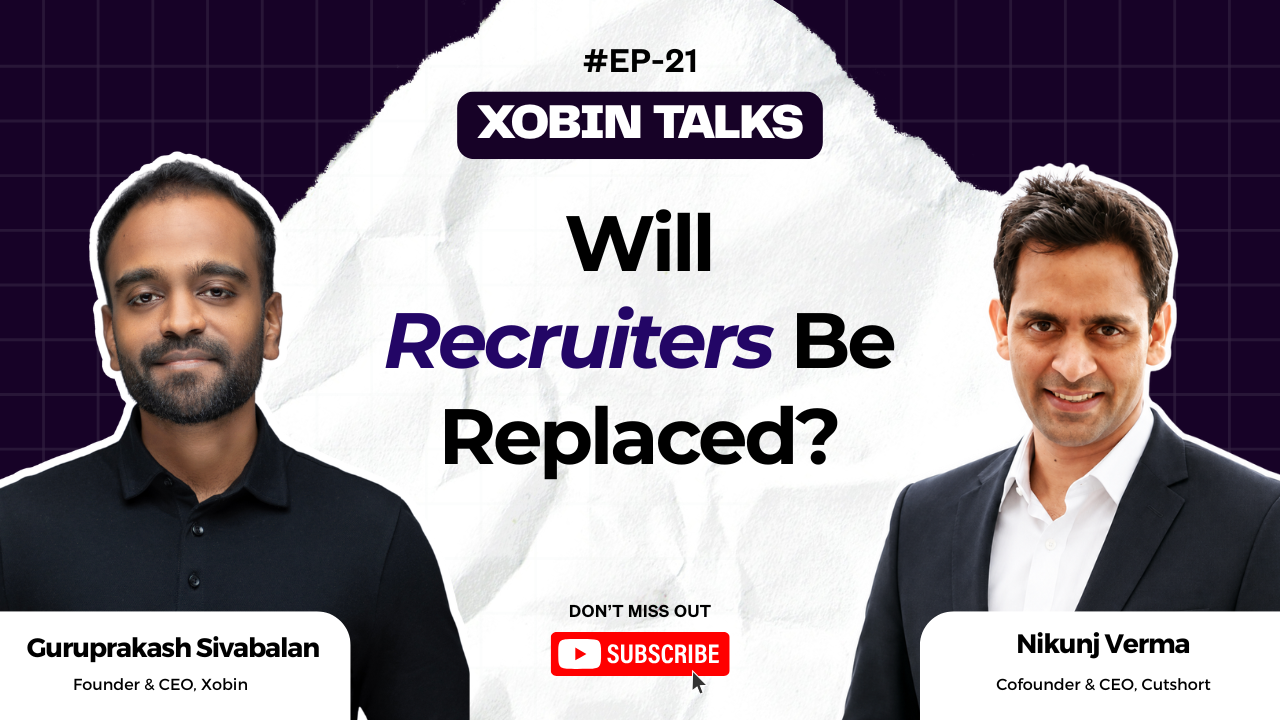
| GUEST PROFILE Nikunj Verma, Co-founder and CEO, Cutshort.ai. Connect with Nikunj Verma on LinkedIn |
This episode was hosted by Guru Prakash Sivabalan, Founder and CEO of Xobin.
Table of Contents
TL;DR – Key Takeaways!
- TA spends 75% of its time on work AI can already do, freeing recruiters for the judgment calls that actually need a human.
- The joining ratio problem is a hiring problem, not a joining problem. Fix the candidate selection, not the offer stage.
- Candidates who leave the hiring process may not have been the right fit from the start. Strong candidates often show interest in the company even before they apply or enter the hiring process.
- A bad hire is a compounding cost, not just a salary line, and the real damage usually outweighs an entire TA technology budget.
- AI is not replacing TA. It’s freeing recruiters to finally do the strategic work the function was always supposed to do.
Nikunj Verma built Cutshort.ai without raising a rupee of external funding, eight years, 3 million candidates, 25,000 recruiters, entirely organic. In an industry where funded competitors spend on billboards and brand campaigns, Cutshort competed on network effects.
In Xobin Talks episode #21, Guru asks the harder questions: whether AI will replace TA professionals, why joining ratios are broken, why companies keep underinvesting in talent, and what the function needs to look like in the next five years.
“What Does a Talent Acquisition Team Really Handle, and Why Is It Important for Growing Companies?”
Nikunj traces the evolution clearly. Recruitment has existed for as long as companies have needed people, newspaper ads, job bulletins, word of mouth. What changed is the difficulty.
Nikunj: “Candidates have plenty of options today. Employers must make their hiring process more appealing to attract the right talent. The best people often have several opportunities in front of them, so companies need to stand out. Show candidates what makes the role valuable, keep them engaged, and guide them through each step of the hiring process. With talent in high demand, hiring teams face new challenges at every stage.”
The function has also grown in strategic importance faster than most companies have recognized. When skill sets change as rapidly as they do today, talent acquisition is no longer just filling headcount. It shows where the business may be heading before major changes happen.
Nikunj: “Hire for the skills your team will need next, not only the ones you need today. Plan for the skills your team will need as the business expands. Look at where you want the business to be in the next one or two years, then plan your hiring around those goals.”
Guru draws an analogy that Nikunj accepts: the TA function today resembles what a founder or CEO does. It requires judgment about people, foresight about skills, relationship management with hiring managers, and an ability to translate business strategy into human capital decisions. That is a strategic function, not a support one.
“Is This Still a Candidate’s Market, Even With All the Job Applications Coming In?”
Guru raises something he sees directly in Xobin’s data: many roles on LinkedIn attract 2,000 applications. That sounds like an employer’s market, but Nikunj’s answer cuts through the confusion.
Nikunj: “You may start with a long list of candidates. Then, factors like location, skills, experience, and culture fit can help you quickly narrow down your options.The strongest candidates usually have several opportunities in front of them, so companies are competing for the same people. That’s where the real hiring challenge lies. A long candidate list means little when most applicants don’t match the role.”
This is the structural tension that defines modern tech hiring: volume is not the problem, relevant volume is. A company with 2,000 applications may still spend six weeks finding three hireable candidates, because the qualified people within those 2,000 all have competing offers and are negotiating from a position of strength.
Nikunj adds a longer-term observation that Guru agrees with: even if the short-term macro situation has softened, the structural skills shortage is not going away. Companies are paying lower salaries and demanding more skills, but the fundamental supply-demand imbalance in specialized roles will only worsen unless there is a major structural change in how skills are produced and recognized.
“Why Candidates Leave Before the Finish Line and How TA Teams Can Keep Them Engaged”
This is the question that generates Nikunj’s sharpest and most counterintuitive answer of the episode.
Nikunj: “The joining ratio problem is not a joining problem, it’s a hiring problem. We are seeing a dropout later and we are thinking it’s a problem that the candidate is unprofessional, but the seeds are sown much before. What’s happening later in the funnel is what’s happening in the hiring process.”
The Sales Analogy
The conventional response to high dropout rates involves doubling down at the wrong end of the process: more calls to candidates, gifts and gestures, better onboarding sequences, more detailed offer letters. Nikunj compares this to a sales analogy that lands cleanly: if customers are asking for refunds three months after signing, the problem is not the closing technique. The problem is targeting the wrong ICPs.
Nikunj: “In sales, if customers are asking for refunds three months later, is this a problem of the salesperson closing the deal or is this a problem of not identifying the right kind of people to go after? If you don’t have the product that fits that need, the salesperson’s brilliance can only get you ahead in the process. Three months later they will not get value because what they wanted was not what they got.”
The same logic applies to hiring. A candidate who backs out on joining day was almost certainly not a genuine fit. They were kept in the funnel through good process management and persuasive communication, neither of which changes whether the job was right for them. The right candidate does not need to be persuaded to join. They have been watching the company, tracking its culture, wanting to be part of it before the process even begins.
Employer Branding as a Fit Signal
Nikunj: “We did it on purpose. We knew exactly who we wanted to reach. So, we shaped our messaging around that audience and made sure it spoke to them. We built our outreach and day-to-day efforts with that ideal customer in mind. The goal was simple: get the right people to notice us and understand what we stand for.”
This is employer branding as a strategic fit signal, not marketing. Every piece of content a company publishes, every internal story it shares, every job posting it writes is either attracting the right candidate profile or the wrong one. Most companies do this accidentally, but Nikunj argues it should be deliberate.
“Why Do Companies Keep Underinvesting in TA, Even When They Know Talent Is Their Most Important Asset?”
Guru names the tension that every TA leader knows: CEOs say people are the company’s greatest asset, then question the budget for a sourcing tool that costs less than one bad hire.
Nikunj: “You have an exposure of crores on your talent but your budget and your attention is in thousands. That’s why the ROI problem exists, everything is cost and less about the ROI. In sales, if you buy HubSpot or Intercom or any revenue tool, it’s always about the outcomes. In TA, the bad decisions are going to hurt you six months, nine months, ten months later when the candidate does not perform or when people don’t join.”
The Invisible Cost of a Bad Hire
One poor hiring decision can cost a company at least 30% of the employee’s first-year pay, according to the U.S. Department of Labor. SHRM also reports that replacing an employee can cost anywhere from 50% to 200% of their annual salary, depending on the role. For example, if a company hires 50 people a year at an average salary of ₹15 lakh, a 20% bad-hire rate can create significant costs through replacement, lost productivity, and wasted time. These costs can often exceed what the company spends on talent acquisition technology.
The Mindset That Changes It
Nikunj: “Successful companies put their people first and actively invest in their growth. That mindset starts first, and then the investment in technology and everything else will come. But if you don’t know what kind of people you want to hire, you can never invest in technology.”
“How AI Is Helping Talent Acquisition Teams Hire Better”
This is where Nikunj moves from diagnosis to framework. He maps four dimensions of TA that AI is reshaping, and argues this wave is structurally different from every technology shift that came before it.
Nikunj: “People often say that new technologies come along, create a lot of buzz, and then fade away. But AI feels different. It’s changing four key areas of talent acquisition at the same time, something we haven’t really seen with earlier technologies.”
Who Gets Hired
Skill configurations that companies need are changing faster than ever, and the question of whether to hire entry-level cohorts and train them or hire for specific skills at the point of need is being actively reconsidered. Recruiters who built expertise in specific domains, campus hiring, diversity hiring, technical screening, find the underlying skill landscape is shifting beneath them.
How Hiring Happens
When most resumes are now generated with AI assistance, the resume as a primary signal is weakening. Assessment has to do more work. How companies verify claims about working on specific technologies, how they evaluate potential rather than listed keywords, all of this is changing.
Who Does the Hiring and What the Business Expects
The composition of TA teams is under review, with roles once done internally shifting to platforms and vice versa. Alongside that, as AI embeds in marketing, sales, and operations, business leaders start asking why TA is not moving at the same speed.
Nikunj: “The business needs are changing. If we have to hire 50 people, do we really need 15 recruiters working on it? Why not automate some of that work? And why not use smarter tools to make the process faster and easier?”
Nikunj: “AI isn’t just another technology shift. It’s changing the way companies build teams from the ground up. It affects the people you bring in, the way you assess and hire them, how they work with AI, and even what the business expects from them.”
“Will AI Replace TA Professionals?”
Nikunj’s answer is more nuanced than most commentators on either side of this debate.
Nikunj: “I think taking a fixed position without looking at your own situation can hurt you. Saying ‘AI is always good’ or ‘AI is not for us’ takes things to two extremes. Instead, every person, team, and company should look at what works for them and then decide how to use AI.”
The 75% Problem
Currently, 75% of recruiter effort is concentrated in sourcing, database searching, initial outreach, and keyword matching, work that is fundamentally a data exercise. AI is not going to do this better eventually; it is already doing it better now.
Nikunj: “Boolean searches are a very very primitive way of searching because we do not have technology but now you can search based on context. You can say I want to hire people in machine learning with computer vision and you don’t have to write any keywords, it will figure out the context by itself. It’s not happening eventually, it’s happening today.”
The 75% Also Kept TA From Its Real Job
The parts of talent acquisition that are genuinely human, understanding candidate motivation, building trust with hiring managers, reading the subtext of why someone is really leaving, none of this is close to being automated.
Nikunj: “No AI is going to talk to your CEO or your hiring manager. No AI is going to look at data about why people have left your company and why they’re sticking. That’s not even where we are today.”
Today at Cutshort, their human recruiters spend none of their time on sourcing. The AI reviews every candidate first. The human then reviews that output, identifies the most promising profiles, and calls, not ten, but every strong candidate. Without automation it was economically impossible, and with it, it is standard practice.
A 2026 industry survey found that the overwhelming majority of hiring managers believe AI is a useful tool but not a substitute for human decision-making in the final call (SSR, 2026).
“What Should TA Professionals Actually Focus On to Stay Relevant?”
Nikunj closes with specific advice, not general encouragement.
Mindset First
Nikunj: “The first and most important thing is a mindset: how are you going to use AI? The mindset is that I want to automate, I want to get better and faster with technology, and I’m not going to use it just for the sake of it.”
Explore Before You Execute
The second piece of advice is counterintuitive coming from a tech founder: do not start with the tool. Use ChatGPT not to execute tasks but to develop perspective, generate angles you have not considered, and surface assumptions in your hiring process you did not know you were making.
Move Toward Higher-Value Work
The third and most durable skill is the one AI cannot replicate: understanding what candidates actually want, what the business actually needs, and whether those two things genuinely overlap.
Nikunj: “Your role is Talent partnership. Your role is Business partnership. Your role is not a low-level data operator. The more value you can pack, the more successful you will get.”
🎧 Watch the Full Episode
Xobin Talks – Episode 21 | Nikunj Verma, Co-founder and CEO, Cutshort.ai | Hosted by Guru Prakash Sivabalan, Founder and CEO, Xobin
▶ Play Episode #21 of Xobin Talks
About Nikunj Verma
Nikunj Verma is co-founder and CEO of Cutshort.ai, a bootstrapped tech hiring platform with 3 million candidates and 25,000+ recruiters on the platform. Cutshort was built entirely through organic growth over eight years, no paid acquisition, no external funding, reaching critical mass through LinkedIn outreach, hiring events, and a product that people found worth recommending. Nikunj is now building Cutshort Lightning, a recruitment agency alternative that combines AI-powered sourcing, automated screening, and human review to place candidates within two to three days.
Connect with Nikunj on LinkedIn | Company: Cutshort.ai
The joining ratio isn’t broken. The hiring process feeding it is. Hear more from Xobin Talks.
Frequently Asked Questions
Will AI replace talent acquisition professionals?
No, but it will replace the tasks that consume most of their time. AI is already better than humans at sourcing, keyword matching, resume screening, and outreach at scale. What cannot be automated is talent planning, candidate motivation, hiring manager relationships, and the judgment to distinguish genuine fit from a pattern match.
Why do candidates back out after accepting an offer?
Usually because they were never the right fit. The dropout problem is a hiring problem, not a candidate engagement problem. When a company attracts the wrong profile through unclear employer branding or weak targeting, no follow-up communication fixes the mismatch.
Why do most companies underinvest in TA technology?
Because the ROI is not immediately traceable. A bad sales tool shows up as lost deals within the quarter. A bad hiring decision shows up as underperformance or dropout months later, by which point there are other plausible explanations for it.
Is this still a candidate’s market for tech hiring?
Yes, for the profiles companies actually want. Large application volumes are misleading. When filtered for relevant skills, experience, and culture fit, most companies compete for a small number of candidates who all have multiple offers.
What should TA professionals focus on to stay relevant?
Comfort with AI tools, the ability to translate business strategy into talent decisions, and the skills AI cannot replicate: reading candidate motivation, building trust over time, and being honest about fit rather than just filling seats.
How do you reduce offer backouts through employer branding?
By understanding who your target candidate segment is and communicating specifically for them. Identify who genuinely thrives at your company, understand what motivates them, and build content that speaks to those motivations rather than a generic pitch.