


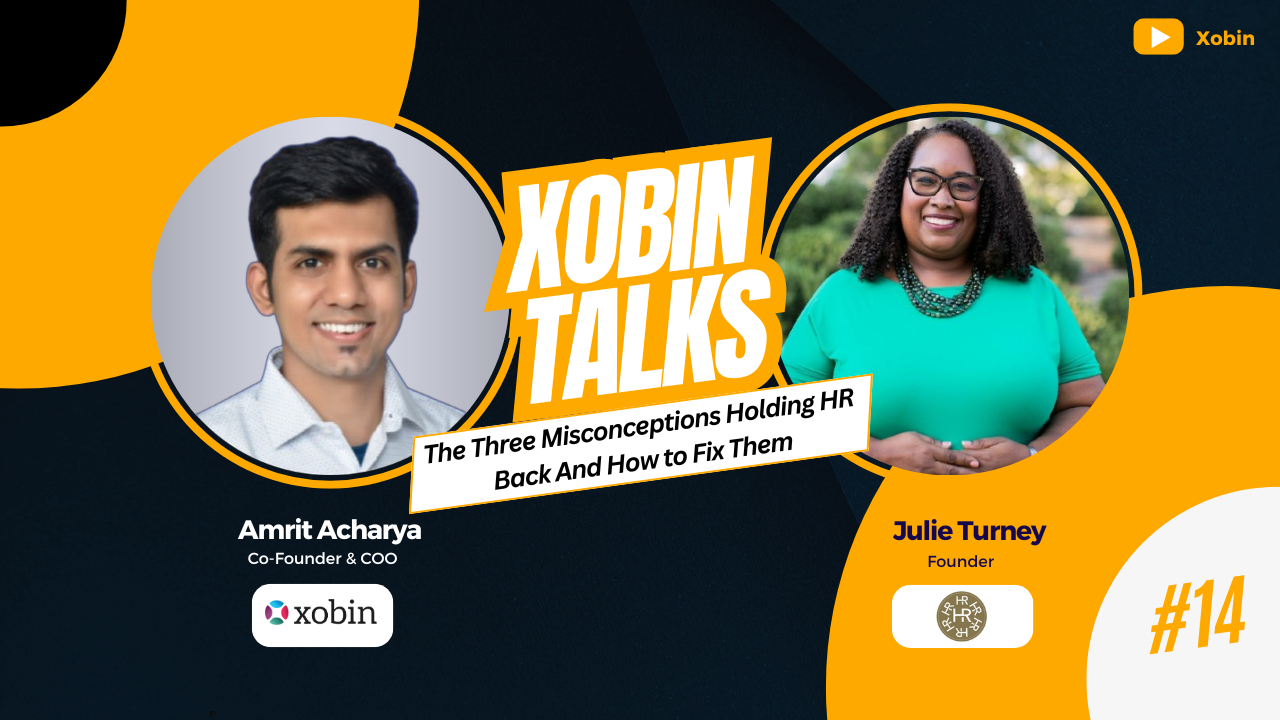
| GUEST PROFILE Julie Turney, Founder and Chief Impact Architect at HR at Heart Consulting Connect: LinkedIn |
This episode was hosted by Amrit Acharya, Co-Founder and COO of Xobin.
Table of Contents
TL;DR – Key Takeaways!
- HR is not responsible for hiring and firing, culture, or employee performance. These three misconceptions set HR up for failure and let leaders off the hook for their own responsibilities.
- High-performing teams are not born; they form, storm, norm, and then perform. The leader’s job is to create psychological safety and trust so the team can survive the messy middle.
- HR professionals face a trifecta of mental health challenges: burnout, compassion fatigue, and vicarious trauma. Only treating it as burnout misses two thirds of the problem.
- Autistic employees in JPMorgan Chase’s Autism at Work program were found to be 90-140% more productive than neurotypical employees in the same roles, and retention rates in similar programs consistently exceed 90% (JPMorgan Chase, cited by MyDisabilityJobs).
- More than 75% of neurodivergent candidates say traditional hiring methods, including timed tests and panel interviews, put them at a disadvantage (MyDisabilityJobs, 2024). As a result, the hiring process often becomes the barrier rather than the candidate’s ability.
Julie Turney did not intend to go into HR. What sent her there was a bad manager, one who she believed would have handled things very differently with better coaching. That experience stuck, and she eventually built an entire career around making HR better: better for employees, better for HR professionals themselves, and better for the organizations that too often misunderstand what HR is actually for.
She is the founder of HR at Heart Consulting, the host of the HR Sound Off podcast, and a community builder across CollaboHR, Disrupt HR, HR for HR, and multiple other spaces where HR people go to figure out what they are doing and why.
In this episode #14 of Xobin Talks, host Amrit Acharya, co-founder and COO of Xobin, sat with Julie. And she walks us through the misconceptions, the mental health realities, the team performance questions, and the neurodiversity conversation that most HR podcasts barely touch.
“Through HR Sound Off, You’ve Spoken With Countless HR Leaders. Which Misconceptions About HR Keep Coming Up Again and Again?”
Julie: “Every week I get lots of different misconceptions. Some are new to me; some I’m very familiar with. But my top three would be these.”
She takes them one by one.
Julie: “Number one: HR is responsible for hiring and firing. We are not. We work with leaders; we try to get their feelings and thoughts on a situation; we make recommendations. And a lot of times we would make recommendations that are contrary to the final results. So to understand that HR doesn’t make the final decision, not even on hiring, that’s one misconception that really needs to be made clear.”
Julie: “Number two: HR is responsible for culture. Culture is everybody’s business. It takes an entire organization to make a really good culture. Leaders who attempt to impose culture on HR are actually doing HR a disservice by making it more likely to fail. But if you say, ‘Let us work together to build our company culture,’ and partner with HR, that is when something truly strong and meaningful can be created.”
Julie: “Number three: HR is in charge of worker performance. I always say, if I am responsible for performance, then everyone should report to me. But they don’t. They are in charge of several departments and answer to you. Therefore, you are responsible for their performance. It is HR’s responsibility to make sure you have the necessary tools and resources and processes to make the performance management process run smoothly. But it is not our responsibility to manage your employees’ performance. That’s totally on leadership.”
“You Brought up High-Performance Teams. To You, What Does That Truly Mean?”
Amrit picks up on a phrase managers throw around constantly and asks Julie to define it with something real rather than something corporate.
Julie: “I go back to the proverb that I was constantly told as a child: “It takes a village to raise a child.” From my perspective, organizations have a real opportunity to create a sense of community. When they do, they lay the foundation for teams that collaborate better, perform at a higher level, and achieve great results together.”
But she is careful about assuming everyone means the same thing.
Julie: “Everybody has a different idea of what makes a high-performing team. For some, it might be a team that consistently achieves its goals. For others, it could be a group that encourages creativity and fresh thinking. At the same time, teams often do their best work when people feel comfortable speaking up, trying new ideas, and learning from their mistakes. When employees know they can share their thoughts without fear of criticism, they are more likely to collaborate, grow, and contribute with confidence. In addition, a strong team supports its members when they are ready to grow into new opportunities. To me, all of these qualities play a role in building a truly high-performing team.”
The Orchestra Analogy
Amrit offers an analogy of his own: a high-performance team is like an orchestra. When everyone is playing their part, it is music, and the moment something is off, you hear it immediately.
Julie: “And that takes me back to when I was learning the cello. In an orchestra, if someone is struggling, you don’t replace them right away. Instead, you help them improve and encourage them to practice more. Sure, feedback can feel uncomfortable at first. However, growth comes from learning through mistakes and making steady progress. The same is true for high-performing teams. They aren’t built overnight; rather, they grow stronger over time through patience, support, and continuous improvement.”
She shifts the focus to a core framework that often gets missed by leaders.
Julie: “If you think about what it takes to build a team, you form, you storm, things normalize, and then you perform. In order to have a high-performing team, you have to go through that process. It’s okay, even if it will be messy. And if you have a good leader who can embrace all of that and help the team get to that performing stage, everybody wins.”
On Annual Performance Reviews
The conversation shifts to how you actually measure a high-performing team, and Julie does not hold back.
Amrit: “I don’t believe a bell curve is the right fit for a team built around high performance. So how do you actually evaluate or appraise one?”
Julie: “I absolutely hate when I hear people say we get reviews once a year. That’s crazy. Because how do you know? You are waiting an entire year to find out what’s gone wrong. That’s the time that most managers will bring up their little black book of all the mistakes you made that you never heard about during the course of the year. That is definitely not how you run a high-performing team.”
Her prescription is specific.
Julie: “Consistent review is necessary. I recommend quarterly reviews. But then I would also say try to meet with your team at the end of every project and do a retrospective. Good leaders will always ask, “What did I do enough to support you?” “What could I have done better? Because good leaders are vulnerable. And once you open up and give your team the psychological safety to do that, teams thrive.”
She adds one more layer, the stay interview, not just the exit interview.
Julie: “At the end of every month within a quarter, I would check in with them and ask, ‘What are you enjoying about working with me? With the organization?’ “What are you not enjoying? Do you feel like your skills are being properly utilized? And what do you think I’m doing well, and where do you think I could improve as a leader? Making those changes, especially if you can fix it fast, is when people feel genuinely valued.”
“HR Teams Have Been Through a Lot Recently. What Does Mental Health Reality Look Like?”
Amrit names what he has seen: hiring freezes, Covid, and remote work transitions, all of it landing on HR. He asks Julie, as an HR coach, what she is actually seeing.
Julie: “Many times, people assume it’s just burnout. I heard this word flying around a lot during the pandemic. But it’s not just burnout. It’s a threefold problem.”
Naming the Trifecta
She names each part of what she calls the trifecta.
Julie: “HR people struggle with burnout; yes, that is one.” But burnout is something that happens when stress is extended over a longer period of time. Before you get to the burnout phase, you experience compassion fatigue. That is that lack of interest and lack of energy to support people. That’s when you as an HR professional get to the space where you’re like, “Just let them do whatever they want.” Just let the organization burn. Because your ability to care about anything is just at zero.”
Julie: “Then you also have trauma. HR is the punching bag of the organization.” If leaders can pass off bad decisions, they pass it off on HR. They will leave HR to deliver those messages and then leave people to think it was an HR decision when it wasn’t. And a lot of HR people allow that to happen to them.”
The Trauma Layer
She pauses on what HR actually hears on any given day.
Julie: “As HR specialists, we frequently find ourselves involved in tasks that go much beyond managing personnel and regulations. Employees come to us with deeply personal challenges, whether it’s workplace harassment, bullying, or even difficult situations at home such as domestic abuse. Because of this, HR teams frequently become a trusted source of support during some of the most challenging moments in an employee’s life. If an employee dies, we deal with the communication. If a termination doesn’t go well, sometimes domestic issues spill from the home into the workplace, and HR is the person asked to deal with that. There’s so much trauma in HR.”
The result, she says, is a trifecta: burnout from sustained stress, compassion fatigue from running dry on the ability to care, and vicarious trauma from absorbing other people’s pain.
Julie: “HR is tired. They’re frustrated. They’re done. And a lot of HR professionals have chosen to navigate themselves out of HR into something else.” Or they don’t want to be a generalist anymore; they want to become a specialist or start their own consultancy. Some who have been in the consultancy space want to navigate back into corporate because they miss what I call “the crazy.” So I’m helping HR professionals at every angle and every stage of their careers.”
“Why Do HR Careers Feel Like They Go Sideways Rather Than Upward?”
Amrit puts a pattern on the table: in sales, marketing, and technology, you can see the career ladder clearly. In HR, it often feels like movement is sideways or nowhere at all.
Julie: “One thing I notice quite often in HR is that we spend a lot of time building career paths for everyone else in the organization, yet we rarely do the same for ourselves. Because of that, the first thing I usually ask HR professionals is, ‘Do you have a clear career path of your own?’ More often than not, the answer is no. In many organizations, there isn’t a structured roadmap for HR teams. As a result, people don’t always know what skills they need to develop or what steps they should take to move from one role to the next. They also lack competency frameworks that can guide their growth and career progression.”
The Perception Problem
She also names the perception problem that keeps HR stuck.
Julie: “Many leaders still view HR through the lens of a single course they took years ago. As a result, they often have a limited understanding of what HR should be. However, you’re the expert, and it’s your job to show leadership what HR needs to look like in your organization. They trust sales, marketing, and finance when those teams ask for resources. Yet HR is constantly questioned because those old perceptions have never been challenged.”
Anyone who has done everything correctly yet is still stuck should follow her counsel.
Julie: “If you know where you want your HR career to go but feel stuck, talk to your organization about your career goals and the opportunities you want to pursue. Ask how they can help you build the skills needed to reach the next level. If they can’t support your growth, it may be time to look for an organization that will invest in your development and help you move toward the role you want.”
“Let’s Talk About Neurodiversity: You Have ADHD. What Should HR Know?”
Amrit sets the topic up for Julie, and she takes it from her own experience first.
Julie: “Neurodiversity recognizes that people think and learn differently, and these differences can add value in the workplace and everyday life. Everybody, some people are neurotypical, which means they’re, you know, normal, essentially. But then you have people like me who are neurodivergent. I have ADHD. And then you have people who are on the autism spectrum, people who have dyslexia, and speech impediments like Tourette’s. Generally these are the people that make up the neurodiverse category in the workplace.”
She moves quickly to the business case because education alone does not move organizations.
Julie: “Studies show that people who are on the autism spectrum have better attention to detail; they’re also more creative. If you’re looking to fill a role that requires serious attention to detail, whether that’s in finance or coding, someone on the autism spectrum would definitely do a better job than someone who is neurotypical. JPMorgan Chase’s Autism at Work initiative tracked outcomes over time and found those professionals made significantly fewer errors while outperforming neurotypical peers in productivity by 90 to 140 percent than neurotypical employees in the same roles. And retention rates in programs like these consistently exceed 90 percent.”
The numbers, she says, should end the hesitation.
How to Redesign Hiring for Neurodiverse Candidates
Julie: “Many employers still hesitate to hire people on the autism spectrum because they are unsure how to understand certain behaviors and provide the right support at work. As a result, talented candidates are often overlooked. But I put that to educating yourself, educating your workforce, and working with organizations that actually help you recruit people who are on the autism spectrum so you know what questions to pose in order to get their responses.”
Companies like Microsoft, HP, and SAP have entire programs built around this. The starting point for organizations that do not have a dedicated program is working with specialist partners who understand both the talent pool and the interview design required to unlock it.
Research shows that more than three quarters of neurodivergent job seekers find conventional hiring methods such as timed tests, panel interviews, and high-pressure formats put them at a direct disadvantage. The standard process is not neutral; it is actively filtering out people it was never designed to include.
Julie: “When you hire someone, it’s important to help the team understand what they need to work comfortably. For instance, some people prefer less physical contact, while others may need a quieter space with softer lighting. Small adjustments like these can make a big difference. Although it may seem like extra effort at first, the value you get in return is often far greater. You may gain an employee with exceptional attention to detail and the ability to work more efficiently in certain areas.”
The ADHD Dimension
Julie: “For someone with ADHD, like me, the key is finding projects that keep their energy up and their attention focused. When the work feels engaging and dynamic, they are far more likely to stay motivated, involved, and productive. And knowing when to pull them back. Because for us as people with ADHD, we can go down lots of different rabbit holes. We’re very creative people, but we can get easily distracted. Shiny new object syndrome, that’s real. So it’s about understanding how to manage that energy.”
Amrit connects this to something he sees on Xobin’s own platform: attention to detail has been one of the most-used assessment skills across every industry for 12 years, appearing consistently in HR, payroll, and finance hiring.
Amrit: “Now it all makes sense. A person from an autistic background can potentially do very well in those roles, and that’s one of the traits that is most needed. I’m just connecting the dots backwards now.”
Julie: “Exactly. And we shouldn’t hold back from hiring such people because we’re afraid of what the outcome would be. Think about the success that will come as a result of recruiting neurodiverse talent. But you’ve got to create the environment, educate your workforce, make any necessary aesthetic changes to the office, and make sure people are aware of the behaviors they need to exhibit around neurodiverse colleagues.”
🎧 Watch the Full Episode
Xobin Talks – Episode 14 | Julie Turney, Founder, HR at Heart Consulting | Hosted by Amrit Acharya, Co-Founder and COO, Xobin
▶ Play Episode #14 of Xobin Talks
About Julie Turney
Julie Turney is the Founder and Chief Impact Architect of HR at Heart Consulting. Her journey into HR began after a challenging experience with a manager who lacked the guidance and coaching skills needed to support her effectively. Because of that experience, she became passionate about helping HR professionals, managers, and employees create better workplace experiences.
Today, Julie hosts the HR Sound Off podcast and actively brings HR communities together through various professional networks. In addition, she coaches HR professionals at different stages of their careers, helping them grow with confidence and purpose.
Julie is also openly neurodivergent and has ADHD. As a result, she is a strong advocate for neurodiverse hiring practices and inclusive workplaces. Her work focuses on preventing burnout, supporting career growth, building high-performing teams, and creating environments where neurodivergent employees can thrive.
Connect with Julie on LinkedIn | Company: HR at Heart Consulting
There’s plenty more to discover. Explore all Xobin Talks episodes and stay ahead with fresh perspectives.
Frequently Asked Questions
What are the three biggest misconceptions about HR?
HR is responsible for hiring and firing (they are not; leaders make the final call). HR is responsible for culture (culture is everyone’s responsibility), and HR is responsible for employee performance (managers own performance; HR provides the tools and processes).
What makes a high-performance team?
Psychological safety, trust, and the freedom to share ideas and feedback openly. A high-performing team is built through the form-storm-norm-perform cycle; it does not skip the messy middle. Good leaders create the conditions for the team to survive that process and reach performance.
How often should performance reviews happen?
Not once a year, Julie recommends quarterly reviews as the minimum, plus retrospectives after each project. Monthly stay interviews asking what is working, what is not, and how the leader can improve give early signals before frustration becomes resignation.
What is the trifecta of mental health challenges HR professionals face?
Burnout (from sustained stress), compassion fatigue (the loss of capacity to care, which comes before burnout), and vicarious trauma (absorbing the pain of others’ experiences). Treating it only as burnout misses two thirds of what HR professionals are actually carrying.
Why do HR careers feel stuck or sideways?
Most HR functions create career paths for everyone else in the organization but not for themselves. Without a clear competency framework and a direct conversation with leadership about the next role, HR professionals often assume they cannot move when the real problem is that no one has defined the path.
What is neurodiversity, and why should companies hire for it?
Neurodiversity describes natural variations in how brains work, including autism, ADHD, dyslexia, and Tourette’s. Participants in JPMorgan Chase’s Autism at Work program outperformed neurotypical colleagues in productivity by 90 to 140 percent. Organizations running structured neurodiverse hiring programs report retention rates above 90%.
How should recruitment change for neurodiverse candidates?
Traditional interviews exclude a significant majority of neurodivergent job seekers. The fix is partnering with specialist organizations who understand neurodiverse hiring, redesigning interview questions to draw people out rather than testing composure under pressure and building post-hire onboarding that helps the team understand how to work well with each person.
What workplace adjustments help neurodiverse employees thrive?
Sensory adjustments for employees on the autism spectrum (low lighting, calm colors, and designated quiet spaces); clear written instructions rather than verbal-only communication; and project-based work for employees with ADHD that keeps them engaged and moving. Education for the wider team is as important as any physical adjustment.