


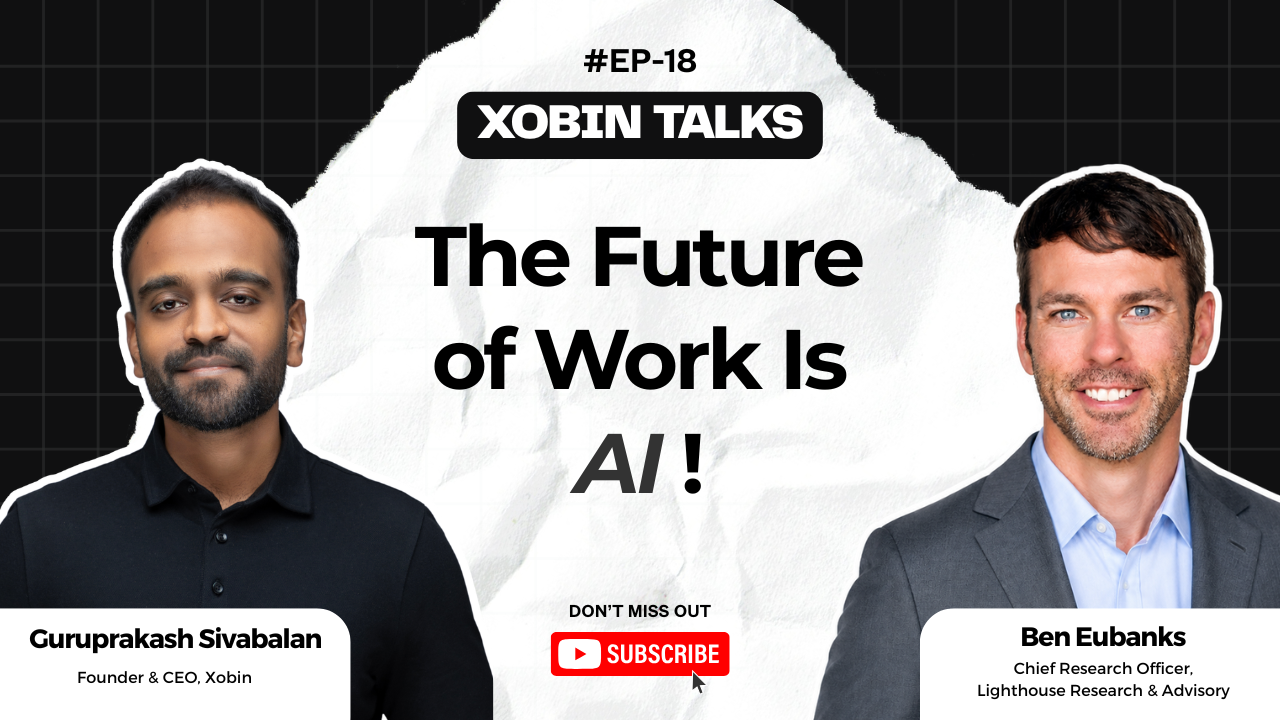
| GUEST PROFILE Ben Eubanks is the Chief Research Officer at Lighthouse Research and Advisory. Connect with Ben Eubanks on LinkedIn |
This episode was hosted by Guru Prakash Sivabalan, Founder and CEO of Xobin.
Table of Contents
TL;DR – Key Takeaways!
- HR leaders’ hesitation on AI is partly misplaced. The top reasons organizations avoid AI in hiring, fear of replacing humans, employer brand risk, and concern that AI cannot handle basic tasks, are the same risks that come with any junior recruiter. The difference is we already accept those risks from humans.
- Talent scarcity is a demographic problem, not a market problem. The US fertility rate sat at 1.6 births per woman in 2025, well below the 2.1 needed to sustain the workforce (CBO). Immigration has historically softened this, but that buffer is now shrinking too. The shortage is structural and long-term.
- AI-generated resumes have broken traditional screening. Making every application look similar and rendering the CV an unreliable hiring signal. The answer is not better resume screening but a different kind of screening altogether, one that tests actual skills.
- Candidates prefer skills-based assessment over resume submission alone. When given the choice between sending a resume or sending a resume plus completing a short job-related test, candidates prefer the second option. It lets them show what they can do, not just what they have done.
- The skills that protect HR careers from automation are human ones. Compassion, creativity, critical thinking, building genuine connections, and working in unpredictable environments are things no algorithm has been trained to replicate reliably. These are the skills worth developing deliberately.
Ben Eubanks wanted to work in HR as a teenager. After years in the field, he moved to the research side, tracking trends and writing the books CHROs keep on their shelves. His first book, Artificial Intelligence for HR, became the most-cited resource on that topic. The second, Talent Scarcity, addressed the question every HR leader had been asking: where have all the workers gone?
In this Xobin Talks episode #18, Guru pushes on the hard questions. He asks why HR leaders still hesitate on AI and what talent scarcity means demographically. He also asks whether global pay equity is realistic and what sourcers should do before automation catches up.
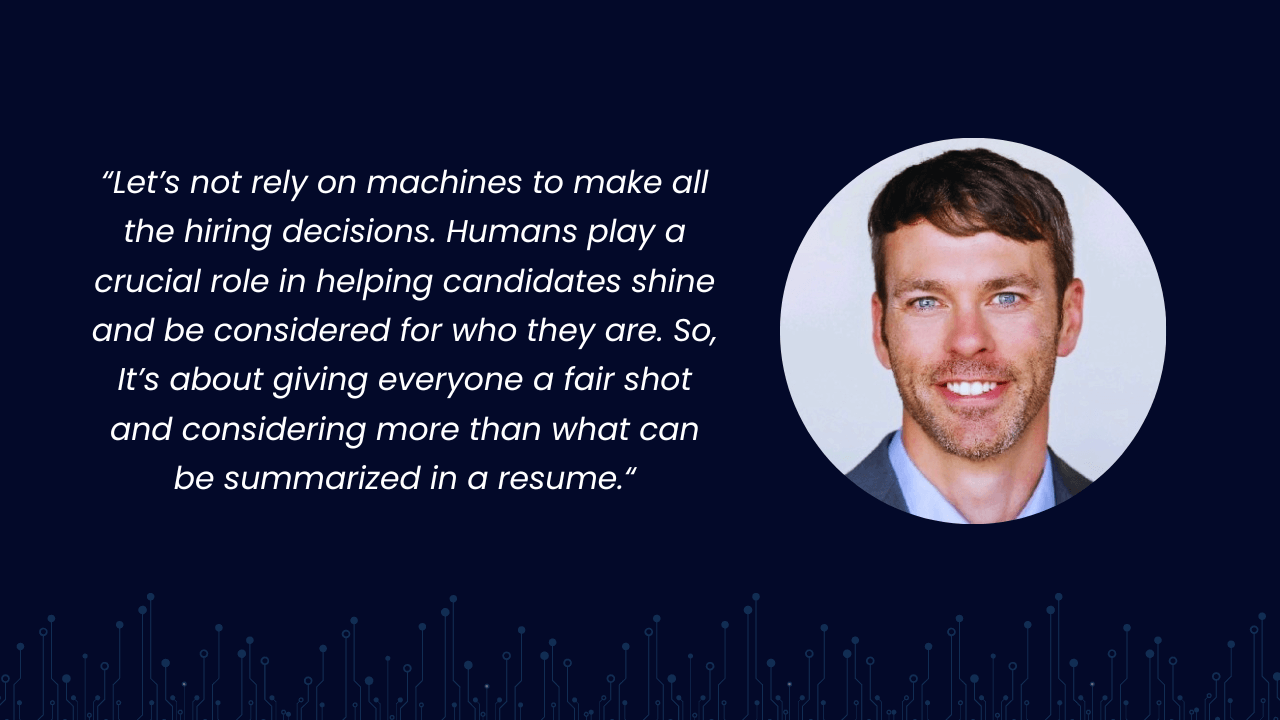
“Are HR Leaders Ready to Put Money Into AI, or Are They Still Holding Back?”
Guru opens with a question he hears often from the Xobin customer base: despite all the conversation around AI, many CHROs and HR buyers are still hesitant. Is that hesitation rational?
Ben: “AI has quickly become part of everyday hiring, with companies using it across tasks like sourcing candidates, screening applications, matching people to roles, and evaluating potential hires. But there are some who are more hesitant. There are concerns, especially when it comes to legal requirements globally around whether we can use this to select someone for a job.”
Lighthouse Research runs a major annual study on talent acquisition. This year’s data surfaced something telling: a segment of employers said they will not use AI in hiring. When asked why, the top three answers followed a clear pattern.
Ben: “The number one reason was: we don’t want to replace the humans. We want a human in the mix of this decision. The second answer was: we don’t want to hurt our employer brand. The AI might say or do things we can’t always control or predict. And the third most common reason was: we don’t think AI is ready to handle the basic recruiting tasks.”
The Junior Recruiter Analogy
He stops at this point to make an observation that reframes the entire debate.
Ben: “A junior recruiter that we hire onto our team is going to create those same risks. They may say the wrong thing. They might post something inappropriate online, mess up a process, or struggle with a common task. We’re placing all this fear and concern on the AI systems when some of those fears have always been there and will always be there. We assume AI has to be perfect out of the box. That’s one of the problems.”
The analogy cuts through the conversation cleanly. No organization would refuse to hire junior recruiters because they might make mistakes. Tolerating human error while demanding algorithmic perfection is not a principled position but an emotional one. Ben is clear that adoption is happening regardless.
Ben: “There are a lot of companies already that have adopted this and are using it as their competitive advantage. We expect to see that gap start to widen as those companies that are using it outpace the others who can’t keep up.”
Three-quarters of HR professionals, per SHRM’s 2024 Talent Trends report, agree that AI will increase the value of human judgment in hiring over the next five years (SHRM). For Ben, the more pressing concern is the gap that is already forming between the organizations using AI as a competitive tool and those still waiting to feel ready.
“Do Different Generations Approach AI Decisions Differently?”
Guru raises something he sees directly in Xobin’s data: a significant majority of resumes submitted to the platform are now created or heavily modified using generative AI. Candidates arriving in the workforce today are native AI users, while the leaders making purchasing decisions often are not.
The Automated Offer That Made HR Leaders Recoil
Ben: “When I’m educating and teaching on the use of AI, I share the story of what Amazon built. Someone applies for a job, it reads their degree and experience, sends them an assessment automatically, they pass it, and it generates an offer at market rate, with no interaction with the recruiter, no conversation with the hiring manager. When I share that example with an audience of HR leaders, you can see them shrink back in horror.”
That reaction, Ben argues, reflects something genuine: for corporate roles, fully automated selection is not what candidates want, and not what quality decisions require. But it also reflects something that will need to shift as the younger generation of native AI users moves into leadership.
Why the Resume Is No Longer a Reliable Signal
Ben: “The new research says about 70% of college graduates are using GPT and generative AI tools to create and match their resume to a job posting. That means it’s going to be even harder than ever to hire from that population because all the resumes are going to look the same. So what do we do about that? We have to have different ways of screening.”
The answer is not to detect AI-generated resumes and reject them but to stop treating the resume as the primary signal at all. Ben draws a direct parallel to universities: they are no longer sending assignments home and expecting original work. Recruiters face the same reckoning. The signal has changed, so the screening method has to change with it.
“If Most Resumes Are Now AI-Generated, What Does That Mean for Screening?”
This is the question Guru presses on most directly, because it is a problem Xobin exists to solve. Ben’s answer is grounded in candidate research, not just employer preference.
Ben: “When we look at the data on candidates, they tell us they actually prefer it: when given the choice of just sending your resume in or getting to submit your resume and complete some sort of short job-related test, they prefer that second option. Because it allows them to see what the company cares about, know more about what’s important in that job, and show off what they’re about. Not just based on how well the resume was written.”
This reframes the assessment conversation entirely. Pre-employment testing is often positioned as something organizations do for their own benefit: screening efficiency, reduced bias, better signal. Ben’s point is that candidates want it too, because a world where every resume looks identical is a world where good candidates have no way to differentiate themselves. A job-related test gives them that surface.
Why Speed to Market Isn’t the Same as Trust
For Guru, this validates Xobin’s core approach: parse the resume, build a targeted assessment, verify that the person who submitted it can actually do the job.
Ben: “What I was going to say is I’ve actually shared that exact example a couple of times recently. There’s a company in the HR technology space that has built a tool that would allow you to generate an entire job description automatically. They developed this three or four years ago and it was really incredible. And then right now, any one of us can go to ChatGPT and do that same exact thing with no investment at all. It took them years and hundreds of thousands of dollars to build what is now free.”
The pace of commoditization is real and Guru feels it directly. Ben’s response is instructive: being fast to market is not the same as being trustworthy. As he puts it, a buyer of HR technology would trust a company with Xobin’s track record far more than one that appeared two months ago. The competitive edge is not a novelty. It is the accumulated evidence that the product solves real problems and the organization listens when new ones appear.
“What Is Actually Causing Talent Scarcity? Is It Real or Is It Just a Cycle?”
The conversation shifts to the book. Guru acknowledges there is no simple answer to talent scarcity and says he does not want one. He wants to understand the direction.
Ben: “The demographics experts around the world say that if a population is going to sustain itself long term, you need about 2.3 births per family. The last time the US was at that rate was 50 years ago. So we aren’t producing enough people to fill all the opportunities, all the roles, all the jobs. The answer so far has been immigration: bring more people in. But that’s a short-term solution. At some point, those other countries are going to stop giving their people away. They’re going to need them themselves.”
The Numbers Since This Conversation Was Recorded
Since this conversation was recorded, the numbers have continued to worsen. The US fertility rate sat at 1.6 births per woman in 2025 (CBO), well below the 2.1 benchmark generally cited as needed for long-term workforce sustainability. Labor force participation held in a narrow 62.4%-62.7% band through most of 2025 before falling further in 2026. Net migration fell sharply to about 515,000 people in 2025, down from roughly 2.2 million in 2024 (Federal Reserve Bank of San Francisco).
Ben: “India is at about two births per family right now. So you’re below that threshold. It’s still higher than most other developed countries but India is still below that threshold. And generally the trend goes: once that number starts to fall, it just continues that trend for as long as we can see.”
This is not a cyclical hiring problem that recovers with the next economic upturn. It is a structural demographic shift, and automation fills only part of the gap, by changing the number and type of jobs available, not by creating more workers.
“With Fewer People to Go Around, What Do Employers Actually Do?”
Ben identifies two levers, and makes the case that most organizations are pulling only one of them.
Recruit Smarter or Retain Better
Ben: “We’ve got two different levers we can pull. We can recruit more intelligently: look more carefully, open up our talent pools. Or we can keep the ones we already have: keep those high-quality people who are already performing well, who have the knowledge and expertise that we do not want to lose. And the big thing I see in the research over and over again, either on the hiring side or the retention side, is we can’t use a one-size-fits-all approach and have good results.”
Ben’s research finding here is direct: one-size-fits-all approaches do not work for either recruiting or retention. The problem is that tailoring to each individual requires juggling variables no single manager can hold in their head simultaneously. That is the specific gap AI is suited to fill, not replacing judgment, but ensuring the right information surfaces at the right moment.
How AI Surfaces Retention Risk Before It’s Too Late
Ben: “There’s a company we worked with that has a retention prediction algorithm. It predicts which of your people are going to be quitting. It looks at over a hundred different signals. And once they start to see indicators that someone’s going to leave, they can flag specific transparent factors: Ben hasn’t had a one-on-one with his manager in three months. The last time he had a pay adjustment was four years ago. His last performance review went down. Those are indicators that Ben may be getting ready to leave.”
AI does not replace the manager’s conversation. It ensures the manager has the information needed to have that conversation before it is too late. Great managers do this intuitively for the people they pay closest attention to. AI extends that capability to the people who are quietly disengaging without anyone noticing.
“Should Talent Be Paid the Same Regardless of Where They Live in the World?”
Guru raises a question from Xobin’s own data: why does an engineer in San Francisco earn five times what an equivalent engineer in India earns for the same work? And is that gap closing?
Ben: “Equal Pay for equal work, I think that’s an important call out. If you have a team in the US with substantially similar skill sets and deliverables to someone in the Philippines or Singapore and you’re paying one of them a fraction of the other, I would have issues with that.”
A Real Example: Paying Global Talent at Local Rates
He gives a personal example. Lighthouse Research employs an administrator in the Philippines, Jessa, at US admin rates because they want her to prioritize their work and they do not want to lose her.
Ben: “We already kind of practice that method. But for a lot of companies, that’s a challenge. Even within the US, there was this weird dynamic when things went remote: should we pay someone less if they live in a remote region where there’s no real local job market? A lot of companies said no. We should just have a remote pay rate and let you decide where you want to live. I wonder why they haven’t done that same thing for teams outside the US.”
The conversation does not arrive at a clean answer, because Ben is honest that the data does not have one. But Guru’s framing sharpens why the question is becoming harder to avoid. He points out that LLMs are bridging communication gaps across languages, remote work has normalized distributed teams, and platforms like Xobin now measure capability the same way regardless of geography. The technical case for equal pay is getting harder to dismiss, even as the organizational will to act on it has not caught up.
“What Should Sourcers and Early-Career HR People Do Before Their Role Gets Automated?”
This is the question Guru says no one has ever asked Ben quite that directly. He writes it down before answering.
Ben: “The skills that matter, the skills that are hard for an algorithm to replicate, are the human skills. Not specific to HR, by the way. Compassion. Creativity. Critical thinking. Those are hard to program an algorithm to actually replicate.”
He maps a two-by-two grid he uses with HR leaders: one axis runs from human-focused to process-focused, the other from routine and repetitive to novel and unpredictable. Tasks toward the human-and-unpredictable quadrant are the least replaceable, while those toward the process-and-routine quadrant are the most exposed to automation.
Building Connections an Algorithm Can’t
Ben: “If your best skill is looking at data and pulling out trends, you better find another skill quickly because AI is better than us at doing that. But building connections, building relationships, finding that point in someone’s resume that you can say ‘hey, I saw this, let’s talk about that’ and generating a conversation from there, that’s the thing that sets a human apart from an algorithm that’s blindly reaching out through sheer volume.”
He learned this early, recruiting Blackhawk helicopter instructor pilots.
Ben: “I learned quickly I can’t send this email out to 20 people because not a single one of them will respond. I’ve got to find a way to tailor it. Hey Mark, I saw that you’re also a hot air balloon pilot, that’s incredible, tell me more. Hey Jamie, I saw this thing on your resume, did you actually know this person? They were also in your same military unit. I found ways to connect with people that an algorithm can’t do from a blind search.”
Why Unpredictability Is the Real Moat
He also points to a structural feature of most human work that most AI researchers underestimate: unpredictability.
Ben: “Algorithms operate only within structured environments. They have a limited set of variables, guard rails, and a clear prediction on the back end. Most of us work in what’s called an unkind learning environment, where there’s little to no feedback, the feedback loop is so long you may not find out for months if you made the right decision, and every situation is a little unpredictable. You can’t program an algorithm to work in that sort of environment.”
The directive for people in early or mid-career HR roles is clear: move toward the unpredictable. Move toward the deeply human. Find the part of the work where you have to read a room, manage a relationship, navigate ambiguity, or make a judgment call with incomplete information. That is the territory that automation has not yet touched and will not touch for a long time.
🎧 Watch the Full Episode
Xobin Talks – Episode 18 | Ben Eubanks, Chief Research Officer, Lighthouse Research and Advisory | Hosted by Guru Prakash Sivabalan, Founder and CEO, Xobin
▶ Play Episode #18 of Xobin Talks
About Ben Eubanks
Ben Eubanks is Chief Research Officer at Lighthouse Research and Advisory, a human capital management research and advisory firm that supports HR, talent, and learning leaders across the globe. He wrote Artificial Intelligence for HR, the world’s most-cited resource on AI in hiring, development, and employee experience. His second book, Talent Scarcity: How to Hire and Retain a Shrinking Workforce, tackles the labor shortage directly.
Ben has more than a decade of experience as both an HR and recruiting executive and as a workforce researcher. He hosts the We’re Only Human podcast and has spoken to tens of thousands of HR professionals worldwide. He founded the HR community upstartHR in 2009, which has helped more than a million readers since.
Connect with Ben on LinkedIn | Organization: Lighthouse Research and Advisory
From talent scarcity to AI adoption, Xobin Talks brings you more conversations with the people studying what’s actually changing in HR. Browse more such episodes.
Frequently Asked Questions
Why are HR leaders still hesitant to buy AI hiring tools?
The most common reasons are fear of replacing human decision-makers, worry about employer brand damage, and doubt that AI can handle basic recruiting tasks. Ben Eubanks points out that all three are the same risks that come with hiring any junior recruiter, yet organizations accept them from humans without the same fear.
Can AI really replace human judgment in hiring?
Not for most roles. AI is well suited to matching, initial screening, and scheduling, where high volume and consistency matter. For professional and corporate roles, candidates expect and deserve human interaction at key points. Fully automated offers work for some hourly roles but not for complex positions.
What is causing the talent shortage and how long will it last?
The core driver is demographic. Birth rates across the developed world have fallen well below what’s needed to sustain the workforce long term. Immigration has also sharply declined at the same time, making this a structural shift with no short-term fix.
Why does a good resume no longer predict who will do the job well?
Because a large and growing share of job seekers now use generative AI to create and tailor their resumes. When every application looks well-crafted and keyword-matched, the resume stops being a useful signal. Skills-based assessments tied directly to the role are now a more reliable way to separate capability from polished presentation.
Do candidates actually like taking pre-employment tests?
Yes. Research shows candidates prefer applying with a resume plus a short job-related test over submitting just a resume. The test lets them demonstrate real capability rather than hoping their CV reads well, and it shows them what the company values.
What can HR professionals and sourcers do to stay relevant as AI takes over routine tasks?
Focus on the skills that are genuinely hard to automate: compassion, creativity, critical thinking, relationship-building, and navigating unpredictable situations. Most human HR work happens in unpredictable conditions where judgment and genuine connection matter more than pattern recognition.
Is equal pay across different countries realistic in an AI-driven world?
It is becoming more of an active question than it was. Remote work has normalized global teams, and skills assessment platforms are standardizing capability measurement across geographies. Many companies already pay global team members at local-market rates. Whether that becomes the norm depends more on organizational will than technical feasibility.
What is the best way to use AI in recruitment without damaging the candidate experience?
Use it where candidates are comfortable with it: matching them to relevant roles, providing unbiased initial screening, letting them demonstrate skills fairly, and scheduling efficiently. Candidates are fine with AI when it gives them a fair chance to be seen, and object when it sorts them out without any human ever reviewing their application.