


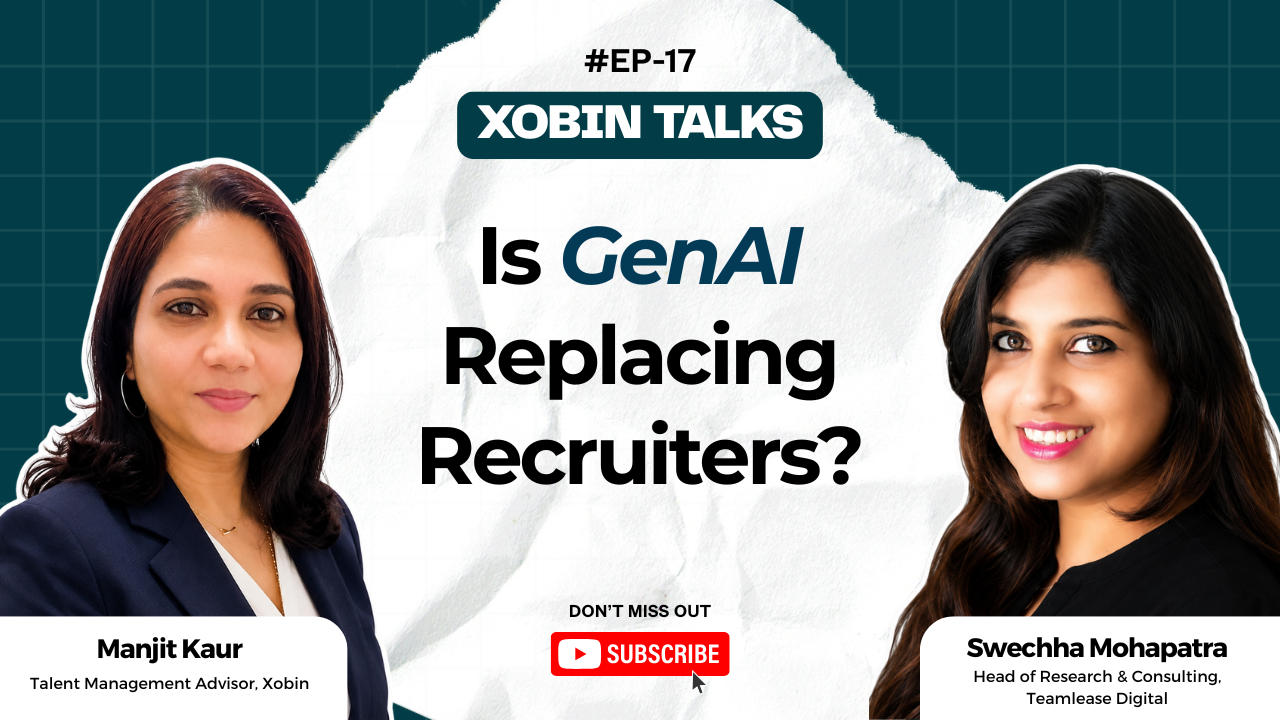
| GUEST PROFILE Swechha Mohapatra, Assistant Director, Workplace Transformation, Institute for Human Resource Professionals (IHRP). Connect with Swechha Mohapatra on LinkedIn |
This episode was hosted by Manjeet Kaur, Xobin.
Table of Contents
Key Takeaways
- AI is rapidly becoming a core part of HR. SHRM found that 43% of organizations used AI in HR and recruiting in 2025, up from 26% in 2024. As adoption grows, companies that lag behind risk falling further behind.
- Generative AI changes what HR does, not just how fast it does it. By automating scheduling, screening, content generation, and onboarding, it frees HR professionals to focus on the judgment calls that require actual human expertise: empathy, ethics, stakeholder relationships, and strategic thinking.
- Starting with the tool is the wrong move. Organizations that buy technology without defining the problem they are solving almost always fail to see ROI and develop a negative attitude toward future adoption. Start with the problem, then find the tool.
- Bias does not start in the algorithm. It starts in the data. If historical hiring data reflects past discrimination, any AI trained on it will replicate those patterns. HR professionals have a responsibility to audit both the data and the outcomes, not just the tool.
- Skills are more important than credentials in the AI era. With job roles evolving faster than any degree curriculum can track, hiring for learning agility, adaptability, and potential matters more than hiring for a specific technology someone mastered two years ago.
Swechha Mohapatra did not start her career in HR. A computer science engineering graduate with an MBA, she now advises enterprises at the Institute for Human Resource Professionals in Singapore on digital HR transformation.
In this episode #17 of Xobin Talks, host Manjeet Kaur asks the questions HR communities are most anxious about: how to integrate AI into recruitment, what happens to the human element, how to avoid bias, and why most organizations are still getting it wrong.
“What Is Generative AI Actually Doing to HR Job Roles Right Now?”
Before getting into recruitment, Swechha sets the broader context. Generative AI is not one tool but a category of technology becoming as fundamental as internet access, and just as disruptive to those who try to ignore it.
Swechha: “AI won’t replace you. But if you don’t embrace AI, someone who is using AI will. To get that competitive edge, riding the generative AI wave is indispensable. We need to unlock its vast potential.”
The most immediate effect on HR job roles is the removal of operational and administrative tasks that currently consume large portions of every working day. Swechha walks through where this is already happening.
HR assistants are being augmented by tools that answer employee FAQs, surface policy information, and handle self-service requests automatically. Onboarding specialists can personalize the new hire journey based on role, location, and individual data rather than running the same generic process for everyone. Recruitment coordinators no longer need to spend hours coordinating interview schedules across candidates and hiring managers.
Swechha: “I think most of us already use tools like Calendly to take care of the routine operational work. That frees up more of our time to actually engage with candidates and have meaningful conversations with them. Ultimately, it helps us get more done without having to spend more time on the administrative side of things.”
The result is not a smaller HR team. It is an HR team doing different work: more strategic, more relational, more judgment-dependent. That shift is only possible if HR professionals actually understand what the tools do and choose to retrain rather than resist.
“How Can AI Help Companies Attract the Next Generation of Talent, Especially Gen Z?”
Manjeet asks the question most talent leaders are wrestling with: how does generative AI help attract the right candidates, especially from a generation that grew up as native users of these tools?
Swechha: “Most job postings are flooded with every key skill and candidates get confused. It is not personalized because we are trying to put everything in. Either your company culture does not show up or your employer value proposition does not reflect. If you are able to train your LLM properly, you should be able to create very creative, attractive job postings that expand your applicant pool and improve your hiring rates.”
This is a sharper critique than most recruiting conversations acknowledge. AI-generated job descriptions, when trained well, can strip out the credential inflation and jargon that turns strong candidates away. They can reflect culture more accurately, use inclusive language by default, and be tailored for different audiences. That matters for Gen Z candidates, who evaluate employer brands as seriously as the role itself.
Beyond job postings, Swechha identifies candidate engagement as a use case that is often underestimated.
Swechha: “Unlike human employees, a chatbot can keep working around the clock without needing to take a break. It can handle routine HR queries, explain company policies, support compliance-related tasks, engage employees, and even assist with hiring. During recruitment, it can help schedule interviews, sort through resumes, and answer candidates’ questions about the company and the hiring process. In short, HR teams can use chatbots across several stages of the employee lifecycle, depending on what they need to automate.”
For Gen Z specifically, always-on communication from employers is less of a nice-to-have and more of a baseline. A recruiter who responds to a candidate inquiry three days later is already at a disadvantage against an organization that responds in minutes.
“How Is AI Changing the Entire HR Lifecycle, Not Just Recruitment?”
Swechha maps AI use cases across the entire employee journey. Recruitment gets most of the attention, but the applications extend significantly beyond it.
Talent Planning and Workforce Forecasting
Swechha: “Talent planning means identifying skill gaps, forecasting your workforce based on industry trends, and understanding where your organization wants to be in the future. AI can help organizations not just upskill for today but prepare for tomorrow. More future-focused. More future-fit.”
The practical application here is using AI to model where current workforce capabilities fall short against future business goals, then informing learning and development investment accordingly. Organizations doing this well are identifying strategic gaps years before they become hiring crises.
Skills-Based Hiring
This is where Swechha lingers longest, and for good reason. The shift toward skills-based hiring is one of the most significant structural changes in recruitment, and AI is both enabling and accelerating it.
Swechha: “There are jobs that did not exist when today’s workforce even started schooling. Technologies keep evolving. Python was trending five years ago but has been overtaken by other tools. So how do I ensure I am not hiring for a specific technology but hiring for attitude, for potential, for whether the person is able to learn and upskill and be agile and adaptive? That is a very important aspect.”
AI-powered assessment platforms like Xobin enable exactly this: evaluating candidates on the skills and cognitive attributes that predict performance, rather than the credentials that predict what someone knew when they graduated.
Research from Harvard Business School and the Burning Glass Institute, examining more than 11,000 roles at large firms, found that fewer than 1 in 700 annual hires actually gained access to a role because a degree requirement was removed (HBS/Burning Glass Institute). The gap between announcing skills-based hiring and practicing it is still wide.
Performance, Engagement, and Talent Development
Beyond hiring, Swechha covers AI use in goal setting, KPI tracking, performance reviews, employee surveys, and sentiment analysis. Learning personalization is particularly relevant here.
Swechha: “Once you understand your skill gap, how do you ensure you are able to personalize learning plans and give suggestions to employees to take up courses relevant to their job roles? It aligns to their aspirations as well: what they are doing today and what they would want to do tomorrow.”
The ambition is a continuous loop where the AI that identifies a skills gap during hiring continues working after the person joins, suggesting development pathways and flagging when capabilities drift out of alignment with business needs.
“How Should HR Professionals Actually Develop Their AI Skills?”
Manjeet pushes on the practical question: knowing AI is important is not the same as knowing how to use it. What should HR professionals actually do?
Swechha: “We need to upskill ourselves and acquire AI-related knowledge so we are able to understand what the tool does and leverage it to our own benefit. Many times in our interactions with clients and the HR community, they are scared of embarking on technology because they feel it is going to be a headache, or it will take too much time, or it will take their job away. But if you are able to reduce operational tasks, your job is not going to go away. The type of job that you do is going to be more fulfilling.”
Curiosity and Strategic Reorientation
Curiosity first. Her analogy is instructive: just as Google made internet access usable for everyone, ChatGPT has done the same for AI. You do not need to understand the underlying model to benefit from it, but you do need enough curiosity to experiment and understand what the output means.
Strategic reorientation. The hours saved from automating operational tasks should be consciously reinvested into higher-value activities: building stakeholder relationships, designing inclusive processes, and contributing to business strategy. That reinvestment requires a deliberate choice, not just a new tool.
Why Data Literacy Matters Most
Data literacy. This is the skill most HR professionals are least prepared for, and the one that matters most.
Swechha: “We always say in analytics: never start with the data. Always start with the problem. Once you have your hypothesis, once you have your problem, then start looking at the data. If you don’t, then definitely the younger generation, Gen Z who are already native users of ChatGPT, will. AI is not going to take your job, but someone using AI will take your job.”
“Why Is AI Adoption in HR Still Lower Than Everyone Expects?”
Manjeet cuts straight to the point, questioning whether the reality actually lives up to all the hype. Swechha doesn’t hesitate to address the disconnect and shares her candid perspective.
Swechha: “The adoption is not as much as we were expecting or would want it to be. There are many reasons. Costs are one aspect. But awareness is a significant factor: awareness of the tools and what they can do and how they can help.”
She names a pattern she sees repeatedly on the consulting side: organizations chasing the latest technology rather than solving a defined problem.
Swechha: “Talent marketplace is a very buzzy term. But if you don’t have your upstream and downstream source of data, if you don’t have your skills taxonomy in place, if your organization is not mature enough, investment in a talent marketplace might not be helpful. You have to start with the problem and not the solution. And typically that’s what we call the shiny object syndrome.”
The consequence is predictable: technology gets implemented without the change management to make it stick, adoption drops, and the tool gets blamed rather than the process. Over time, the organization develops a skeptical attitude toward the next investment, making future adoption even harder.
Swechha: “If change management has not been done properly, it will fail, and hence adoption will further reduce because you don’t see the ROI.”
“Where Should HR Set Boundaries When Using AI?”
Here, Swechha shifts from what AI can do to what HR must actively prevent it from doing, and her tone becomes noticeably more emphatic.
Swechha: “It’s also important to understand what happens to your data after you share it. You should know how it’s being used, whether there’s enough transparency around the process, and who is accountable for it. Technology can support these decisions, but it shouldn’t replace human judgment. That’s why we make sure there’s always proper human oversight throughout the process.”
Bias Inheritance and Regulatory Risk
Bias inheritance. AI models learn from historical data. If past hiring decisions were discriminatory, the model trained on them will replicate those patterns. This is not a hypothetical. A 2025 ResumeBuilder survey of companies using AI in hiring found specific bias patterns: 47% noticed their tools skewing toward younger candidates, 44% found socioeconomic bias favoring candidates from certain educational backgrounds, 30% identified gender bias, and 26% identified racial or ethnic bias (ResumeBuilder, 2025). The EU AI Act now classifies recruitment AI as high-risk, requiring strict oversight and auditing, and New York City already mandates independent bias audits of automated hiring tools.
Swechha: “Fairness and bias: Technology can sometimes carry hidden biases into hiring decisions, even when that isn’t the intention. HR teams need to keep an eye on these risks and make sure technology supports fair, consistent decisions rather than reinforcing existing bias. As HR professionals, we have a responsibility to make sure the tools we use support fair and consistent decisions. More importantly, we need to set the standard for ethical practices across the organization and make sure our employees are treated with fairness, respect, and accountability.”
Privacy and the Limits of Automation
Privacy and data protection. Questions about who sees candidate data, where it is stored, and how long it is retained have legal dimensions across every jurisdiction. HR professionals, not IT, not legal, are typically the ones employees hold accountable for the answers.
Loss of human oversight is Swechha’s deepest concern. Tools are trained on patterns and cannot exercise judgment the way a human can. When a candidate falls outside the training distribution, an unconventional career path, a background the model has not seen often, the tool defaults to the pattern it knows.
Swechha: “Technology and tools can do everything but they can’t think. They can only come close to thinking about how you have trained them. Use technology to augment and not let it take over. Keep the human aspect intact because that is something nobody can replace.”
“What HR Teams Need to Keep an Eye on in the Years Ahead”
Swechha closes with where she sees the field heading.
Swechha: “The generative AI wave is going to continue and we are going to see more of it. LinkedIn Recruiter, LinkedIn Learning, Workday, SAP SuccessFactors: they have all come out with generative AI features. Seeing that maturity is one trend for today and beyond.”
She identifies three areas she is watching closely.
Skills-based organizations. The shift from hiring for credentials to hiring for capability is accelerating. Organizations building robust skills taxonomies now will be better positioned to use workforce AI effectively, because the tools need clean, structured data to surface meaningful recommendations.
Diversity and inclusion through better tooling. Not through targets and quotas, but through bias-audited processes, inclusive job description tools, and assessment platforms that evaluate capability rather than background.
Swechha: “Diversity should be about creating equal opportunities, not labeling someone as a “diversity hire.” It means being hired for your potential and your capabilities. The opportunity needs to come with maturity: from organizations, from the workforce, from recruiters. It is an ecosystem thing that we need to develop.”
AI upskilling at scale. The organizations that will outperform over the next three years are not the ones that buy the most AI tools. They are the ones that build organizational capability to use those tools with judgment, oversight, and strategic intent.
🎧 Watch the Full Episode
Xobin Talks – Episode 17 | Swechha Mohapatra, Assistant Director, Workplace Transformation, IHRP | Hosted by Manjeet Kaur, Xobin
▶ Play Episode #17 of Xobin Talks
About Swechha Mohapatra
Swechha Mohapatra is Assistant Director for Workplace Transformation at the Institute for Human Resource Professionals (IHRP) in Singapore, where she supports enterprises on their digital HR transformation journeys. She has more than a decade of experience spanning HR Tech consulting, digital transformation, talent management, recruitment, and business partnering. Her background combines a computer science engineering degree with an MBA, giving her a technical and commercial lens on how organizations should think about AI in HR. She advises clients on everything from technology selection to change management, with a focus on ensuring that AI investment translates into actual outcomes rather than shiny object syndrome.
Connect with Swechha on LinkedIn | Organization: IHRP
Curious what other HR leaders are getting right, and wrong, with AI? Xobin Talks has more conversations like this one. See what’s next.
Frequently Asked Questions
Is AI going to take over HR jobs?
Not exactly. AI will reshape HR more than replace it. It can handle routine tasks like screening, scheduling, and onboarding, giving HR professionals more time for judgment, empathy, and strategy. The bigger risk is falling behind by not learning how to work with AI.
What is generative AI actually doing in recruitment today?
The most common uses are writing and optimizing job descriptions, screening and ranking resumes, scheduling interviews, running chatbot-driven candidate engagement, and powering assessments. Writing job descriptions and resume screening remain the two most widely adopted applications.
Does AI make hiring more biased or less biased?
It depends entirely on the data it is trained on. If past hiring decisions were biased, the AI learns and replicates those patterns. Companies using AI in hiring have reported it skewing toward certain age groups and showing gender bias. The fix is auditing your training data, not just the tool.
How do you choose the right AI tool for HR?
Start with the problem, not the tool. Define what you are trying to solve before evaluating any technology, since buying tools because they are buzzy almost always fails to show ROI. Once the problem is clear, evaluate tools against it, involve the teams who will use them, and invest in change management alongside the technology itself.
Why are most organizations still behind on AI adoption in HR?
Three main barriers: cost, awareness, and organizational readiness. Many HR teams do not have a clear picture of what AI tools actually do, making it hard to build a business case. Others buy tools but skip change management, leading to low adoption and a negative impression that makes future investment harder to justify.
What role does the human element play when AI is handling recruitment tasks?
The most important role, and it is not passive. AI can screen, schedule, and surface patterns, but it cannot read a room, sense a candidate’s nerves, or exercise the ethical judgment that protects against discriminatory outcomes. Human oversight is an ongoing, active responsibility that sits with HR professionals, not a backup for when AI fails.