


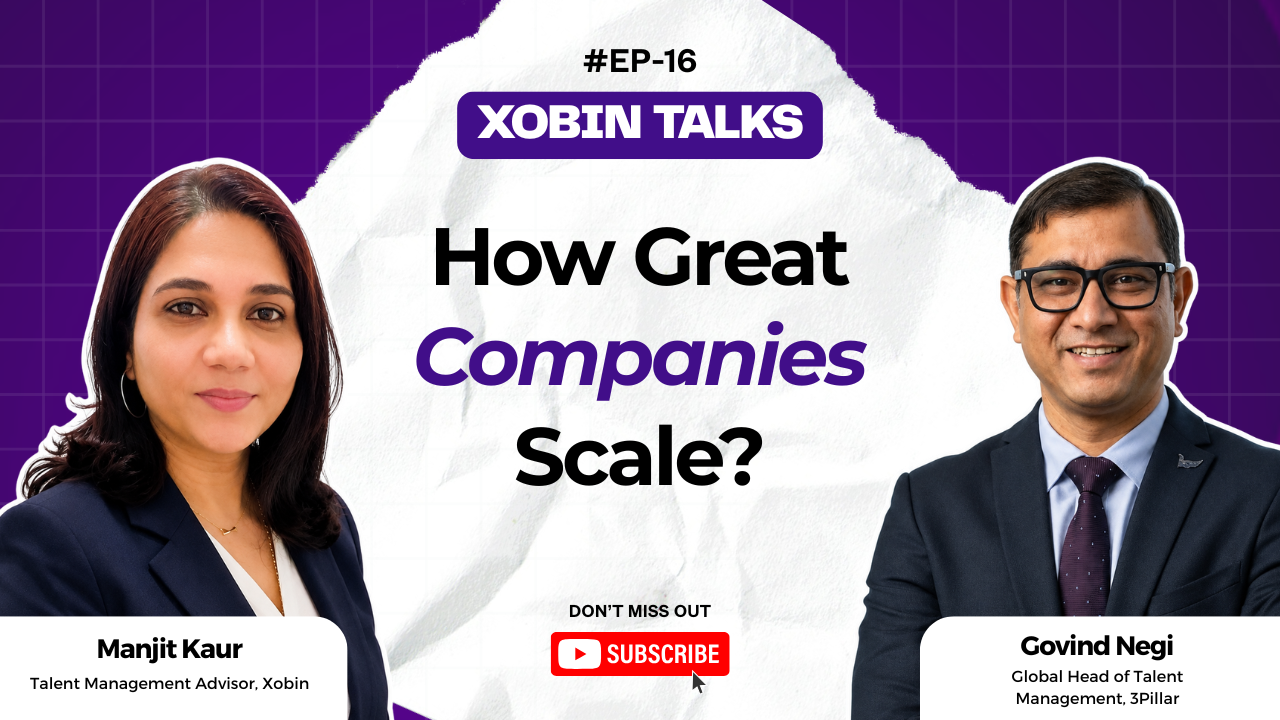
| GUEST PROFILE Govind Singh Negi, CEO, Incredible Workplaces, Head of Talent for Europe and India at Three Pillar Global (3,000 employees across 9 countries), Founder and Global CEO, HR Success Talk. Connect with Govind Singh Negi on LinkedIn |
This episode was hosted by Manjeet Kaur, Xobin.
Table of Contents
TL;DR – Key Takeaways!
- Hybrid work is no longer a perk. It is a hiring lever. Remote policies have turned all of India into a single talent pool. Organizations that design for this, with market-benchmarked compensation, flexible policies, and strong remote evaluation, attract and close candidates that location-bound competitors cannot reach.
- Pre-assessment tools are the foundation of credible remote hiring. Without structured screening and identity verification, remote hiring carries real fraud risk. Govind’s own team hired someone who was never the person interviewed. Instead of returning to in-person assessments, improve your hiring process and rely on technology that keeps evaluations fair and secure.
- AI in recruitment has moved from experiment to standard practice. Organizations that treat AI output as a prompt for better decisions, rather than just better reports, are seeing the clearest returns. Knowing which metrics to focus on, rather than how many you monitor, is what makes a difference.
- The office is becoming a social workplace, not a work workplace. People come in for kickoffs, celebrations, and peer connection, not desk work. Redesigning around collaboration zones and wellness spaces increases voluntary attendance more reliably than return-to-office mandates.
- Data only becomes valuable when it is applied to improve decision-making. Too many talent leaders collect reports they never act on. When pre-assessment results show candidates failing in one area, the question is whether the standard is wrong or the market is wrong, and those are two completely different problems with completely different solutions.
Govind Singh Negi had no intention of becoming an HR professional. With a degree in computer applications, he entered the talent space unexpectedly. Over the years, he grew HR Success Talk into a thriving community of more than 150,000 members and now works closely with HR-tech startups as an investor and advisor.
In the episode #16 of Xobin Talks, host Manjeet Kaur delves deeply into the conversation about how the workplace has evolved in the years after the pandemic. The discussion focuses on how growing organizations are putting technology to work and what that might mean for the next generation of workplaces.
“How the Last Few Years Have Changed Recruitment”
Geography Has Stopped Being a Filter
The most fundamental shift Govind names is geographic. Before the pandemic, a company headquartered in Noida was effectively hiring from Noida, or at best from candidates willing to relocate. Talent from Chandigarh, Jaipur, or Manali was largely inaccessible for most roles.
Govind: “Today, businesses can hire talented people from virtually anywhere instead of restricting their search to a single city. The right candidate could be in Chennai, Bangalore, Manali, or anywhere else in India. If your organization supports remote work, you can build a team based on skills rather than location. That shift has completely changed how recruiters approach hiring.”
That expansion comes with a catch: when your talent pool widens, so does everyone else’s. The 2022 IT hiring surge, what Govind calls a “talent hire war,” made this visible. Tier-two and tier-three city professionals suddenly received offers from multinational companies at salaries once reserved for metro candidates. Compensation benchmarking became urgent, and many organizations found their location-based pay bands no longer made sense.
AI and Technology Have Gone from Optional to Operational
The second major shift is technological. Govind notes that the IT industry was already using ATS platforms before 2020. AI has come a long way from being a trendy topic. Today, it plays a practical role in day-to-day business operations, and more organizations are adopting it at scale.
Govind: “In our opinion, technology should enhance hiring rather than take its place. Our focus is on using AI to reduce routine administrative work, keep hiring moving, and provide data that supports better decisions. Recruiters remain in control throughout the process while spending less time on repetitive tasks and more time connecting with the right candidates.”
The data backs up his point. In just one year, the share of organizations using AI across HR and recruitment jumped significantly, rising to more than 43% worldwide between 2024 and 2025 (Limelightdigital, 2025). Recruiters now expect tools like AI-powered candidate screening, automated video interviews, and smart applicant tracking systems to be part of the hiring process instead of standout features.
Candidate Experience Has Become a Real Variable
The third shift is subtler but consequential. When hiring happens entirely through screens, every friction point, a lagging call, a clunky scheduling process, a generic message, costs you something. Govind frames it as a design problem.
Govind: “Recruiting employees from various regions of India isn’t always as easy as it seems. When recruiters and candidates are located in multiple cities, coordinating interviews, maintaining clear communication, and tracking every hiring stage can become difficult. That’s why many organizations are moving toward hiring models that make recruiting across locations faster, smoother, and easier to manage.”
This goes beyond making candidates feel welcome. The way a company handles hiring gives people a real glimpse into its culture, priorities, and the way work actually gets done. A disjointed remote interview signals a disjointed remote work culture. Organizations that have closed that gap through better tooling and deliberate interview design tend to see it reflected in offer acceptance rates.
“Talent from Everywhere Sounds Great. What Are the Actual Challenges?”
Manjeet points to a challenge many companies face in practice. Expanding the talent pool certainly creates more opportunities, yet turning that advantage into successful hires is often far from simple. What does that process actually look like when organizations put it into action?
Govind: “The top candidates often attract attention from multiple employers, making it more challenging to stand out during the hiring process. Everybody else has the same pool. You have to ask yourself: how do you balance the compensation you are giving without necessarily having a dent on your business? That is one of the key strategies organizations need to work on.”
He outlines three levers that high-growth organizations pull.
Compensation and Flexible Policy
Compensation benchmarking has become far more important in today’s hiring market. Remote work has changed how companies set salaries, making location less important than before. A candidate in Jaipur can now apply for the same position as someone in Bengaluru, and both expect competitive, transparent pay. Organizations that keep a close eye on salary benchmarks and update their pay based on current market conditions usually hire faster. Competitive compensation also helps reduce the chances of candidates walking away during the offer stage.
Beyond salary, the other lever is flexible working policy. When everyone is advertising remote-friendly culture, the policy details matter: does flexibility mean choose-your-hours or just choose-your-location? Candidates are sophisticated enough to ask, and vague answers are a red flag.
Govind: “There are difficulties while working from home, however not all teams have the same issues. At the same time, remote work offers significant benefits for both employers and employees. The key is to find the right balance and choose a work model that aligns with your business goals while helping you attract and hire the right talent.”
Evaluating Candidates Fairly Across Distance
Technology to evaluate fairly across distance. When you cannot meet a candidate in person, the quality of your remote evaluation process determines the quality of your hires. This is where pre-assessment tools, structured video interviews, and skills-based screening matter most. Govind is direct about this.
Govind: “Recruiting talent across cities, states, and international borders adds a new layer of complexity to the remote evaluation process. That is where pre-employment assessment tools can come into the picture. These Platforms let you screen candidates before they have their first level of interaction, which is a huge win for us.”
“Has Remote Hiring Changed How You Assess Candidates?”
This is where Govind shares something most organizations would quietly bury rather than learn from publicly.
Govind: “The interview left us with a strong impression, so we felt comfortable moving ahead with the candidate. But something felt strange when the new employee joined. As we looked more closely, we realized the person who appeared on the first day wasn’t the same individual we had evaluated during the interview. The interview participant had kept their camera on throughout the process, but the actual hire had never appeared on camera. That’s when it became clear that two different people were involved.”
The team had to take action. But more importantly, they ran the incident back to the process rather than the individual.
Govind: “After looking into everything, we realized the process itself was causing the problem. We need to leverage technology to make sure we are not doing that. Video verification, identity checks, and proctored assessments are not optional for remote hiring at any meaningful scale.”
In remote-heavy hiring, interview impersonation is a known and expanding issue, especially in technical professions. Govind believes the problem isn’t remote hiring itself. The real challenge is trying to run it without reliable technology. Instead of bringing everyone back for face-to-face interviews, organizations need stronger hiring processes backed by the right tools.
“How Are High-Growth Organizations Reimagining Office Space?”
Manjeet shifts the conversation to physical space: if hybrid is the standard, what actually happens to the office?
Why the Office Layout Is Changing
Govind: “People are visiting offices for many reasons now. Nowadays people are not necessarily coming to the office for work. They are using office space to socialize with colleagues, to brainstorm. A manager is calling their team because they have a kickoff. Someone is coming because they want to celebrate something. An individual is coming for networking, for time to think, not for routine work they are doing from home.”
The shift in workplace design reflects how employees use the office today. Since people now come together to collaborate, exchange ideas, and strengthen team connections instead of simply completing tasks, the space should support those interactions. That’s why Three Pillar’s new office includes fewer fixed desks and more collaborative areas, wellness spaces, gaming zones, and quiet rooms where employees can focus without distractions.
Govind: “The workplace has evolved well beyond long rows of desks and silent cubicles. Today, companies create office environments that encourage employees to connect, collaborate, and share ideas more naturally. Instead of relying on fixed workstations, many organizations dedicate more space to collaboration zones where teams can brainstorm and solve challenges together. They also include wellness areas, breakout lounges, quiet rooms, and game spaces, giving employees opportunities to recharge, refocus, and return to work with fresh energy, greater creativity, and a stronger sense of teamwork.”
A Nicer Office Doesn’t Guarantee Attendance
The ambition is clear: create a space people actually want to come to, rather than a space they feel obligated to return to. And yet Govind tells a story that complicates the employer branding angle.
Govind: “We had the perfect opportunity to celebrate the opening of our new office with friends, coworkers, and an entertaining Bhangra performance. Then I asked a couple of my team members: ‘How did you like it?’ They said it looked like a premium airport lounge. I said, great, so you’re coming to the office now, right? They said no.”
People appreciated the space and still chose not to come. The pull of remote work, flexibility, autonomy, the ability to drop kids at school and start a call on your own schedule, had become the settled default. A nicer office changes the equation at the margin, but it does not reverse two years of settled habits.
“Is Return to Office Making a Comeback, or Will Hybrid Work Continue to Lead the Future of Work?”
Govind: “I am not a big fan of that. Our organization is not a big fan of that. We would love to have people in office if they want to come. We have provided everything there for them. But if they choose not to, they’re happy in what they are happy doing. We don’t want to lose productivity. We don’t want engagement to go down.”
This is a meaningfully different position from the return-to-office mandates that have generated headlines and attrition at other organizations. Govind’s framing is outcome-based rather than presence-based. If the work is getting done and the team is engaged, the location is secondary.
The data backs up the practical wisdom here. The latest findings from Gallup’s 2024 State of the Global Workplace suggest that flexible work models keep employees more engaged. Remote workers top the list with 36% engagement, hybrid employees reach 35%, and fully office-based teams come in at 27%. And nationwide, only 44% of workers said they would comply with a five-day return-to-office mandate by the end of 2024; 41% said they would look for another job and 14% said they would quit outright (WFH Research, via Fortune, 2024).
Forcing the return without solving the underlying pull of remote work does not bring people back engaged. It brings them back looking.
“How Is Technology Actually Changing Day-to-Day Recruitment?”
Govind breaks this into two distinct areas: technology for hiring and technology for working.
On the Hiring Side
Beyond pre-assessment, Govind highlights social media as an underused sourcing channel.
Govind: “There are so many AI-enabled tools to leverage social media. I think that is a huge thing people should start learning. We are also learning how to leverage those tools to support us in recruitment.”
He also highlights the generational leap in ATS platforms. Where the old system was a filing cabinet, the new generation surfaces patterns: which postings attract which demographic, where candidates drop out, and which sourcing channels convert.
Govind: “An applicant tracking system (ATS) gives you a clear view of every candidate’s journey, starting when they submit an application. It shows how each person progresses through every stage of your hiring process, making it easier to track activity and spot delays. Instead of making assumptions, you can use that data to fine-tune your recruitment marketing and attract people who are a better fit for the role.”
On the Working Side
For distributed teams, the tooling question shifts from hiring to collaboration and security.
Govind: “Security is becoming a massive concern when you’re using a lot of these tools. We go through a lot of security training. And the use of employee engagement platforms through AI-enabled tools is also becoming very popular: Employee Self-Service portals, automation, making sure people in a remote environment have what they need to do their work well.”
The risk he flags is real: as remote work infrastructure expands, so does the attack surface. The remote work security market is projected to grow from $51.7 billion in 2023 to $136 billion by 2028, a 21.3% annual growth rate (MarketsandMarkets, 2023), a trajectory that reflects exactly the concern Govind is naming.
“Is your technology actually simplifying work, or just adding more dashboards to keep track of?”
This is the question Manjeet asks that Govind seems to enjoy most.
Govind: “Businesses today can tap into far more data and advanced technology than they could just a few years ago. Even then, staying focused on the end goal is often harder than it should be. The end goal should always come first. When you have so much data, you can find yourself wanting this report, that report, and then you are losing your productivity. What you need to decide as a talent acquisition leader is what reports you actually want to see.”
He gives a concrete example. Large numbers of candidates failing in one area signals either a standard that is too high for the market, or a city that lacks that skill in sufficient supply. Both interpretations are valid, but they call for completely different responses.
Govind: “The talent market isn’t always the problem. Our expectations may have become so specific that the pool naturally shrinks. So either we change our strategy and say we need to be more lenient on those aspects, or we say maybe Delhi NCR is not the market for this. Let’s try South India. How you leverage the data is exactly on you.”
The real maturity marker for tech-enabled recruitment is whether you use AI output to make better decisions, not just more informed ones.
🎧 Watch the Full Episode
Xobin Talks Episode 16 | Govind Singh Negi, CEO, Incredible Workplaces | Hosted by Manjeet Kaur, Xobin
About Govind Singh Negi
Govind Singh Negi is CEO of Incredible Workplaces and heads talent for Europe and India at Three Pillar Global, a 3,000-person technology company operating across nine countries. He is the founder and global CEO of HR Success Talk, a community of 150,000 HR and business professionals across ten countries and one of the largest global HR communities with an Indian origin. Recognized as one of the Top 100 HR Tech Influencers, he is also the founder and trustee of the Amrita Devi Foundation, an NGO working in Uttarakhand. Govind has invested in multiple HR-tech companies and advises them on business strategy and growth. His career began accidentally, a computer applications graduate who stumbled into HR and never left.
Connect with him on LinkedIn | Community: HR Success Talk
Xobin Talks features more conversations like this one, real HR leaders on what’s actually working (and what isn’t) in hiring today. Explore all Xobin Talks Episodes.
Frequently Asked Questions
Can Indian companies hire talent from smaller cities now?
Yes. Remote and hybrid work policies have effectively turned all of India into a single hiring market. A company based in Noida can now hire someone in Manali or Chandigarh without asking them to relocate. The only real catch is that salary benchmarks need to reflect the national market, not just the local one.
How is AI being used in recruitment today?
AI is most commonly used for resume screening, pre-employment assessments, interview scheduling, and candidate sourcing on social media. Adoption is growing fast: nearly half of organizations globally now use AI in some form for hiring. The real difference is whether companies use that output to make decisions, or just generate more reports.
How do you stop someone from sending a different person to the interview?
Use proctored assessments, video identity verification, and a camera-on policy at every stage of the process. Interview impersonation, where the person interviewed differs from the person who shows up on day one, is a real and growing problem in remote hiring, especially for technical roles. Treat it as a process gap, not a candidate issue.
Why are companies changing how their offices look?
Because the reason people come to the office has changed. Most employees now do their focused, routine work at home. They come to the office to meet colleagues, kick off projects, celebrate milestones, and brainstorm. Companies are replacing rows of desks with open collaboration zones, wellness areas, and informal gathering spaces.
Is it a good idea to force employees back to the office?
Generally, no. Engagement data consistently shows that remote and hybrid employees are more engaged than fully in-office workers. Mandating a return without addressing why people prefer working from home tends to produce quiet disengagement or outright attrition, rather than the productivity boost companies expect.
How do you know when your recruitment data is actually useful?
When it provides you with actionable information. If pre-assessment results show candidates consistently failing in one area, that means either your standard is too high for the market or you are recruiting in the wrong city. Those are different problems with different solutions.
What tools should a hybrid company invest in first?
For hiring, invest in a good pre-assessment platform and an ATS that surfaces candidate insights rather than just storing resumes. For day-to-day work, invest in solid collaboration tools and security infrastructure, since every new tool added for remote workers also adds a potential vulnerability.
Does working from home hurt productivity?
No, based on most available evidence. Remote and hybrid employees consistently report productivity equal to or better than in-office levels, and that finding holds across industries and company sizes. The more useful question is whether your remote setup is structured well enough to support it.