


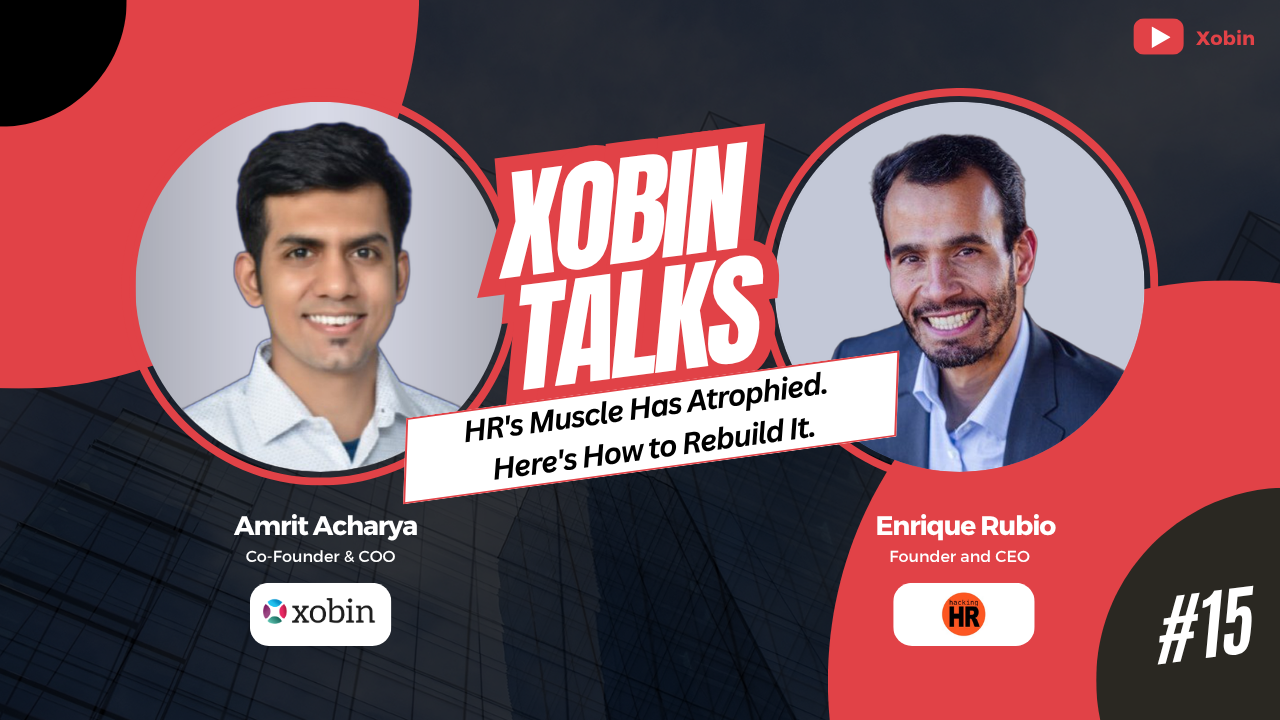
| GUEST PROFILE Enrique Rubio, Founder, Hacking HR, a global community at the intersection of the future of work, technology, and people. Connect with Enrique Rubio on LinkedIn |
This episode was hosted by Amrit Acharya, co-founder and COO of Xobin.
Table of Contents
TL;DR – Key Takeaways!
- HR has been a transactional function for 100 years. Asking it to become strategic and proactive overnight without giving it the chance, the resources, or the seat at the table is setting it up to fail.
- The two things Enrique tells every HR professional: wear the business hat and learn things outside of traditional HR. P&L, financial metrics, and how other functions think. Not to become a finance expert, just to connect the dots.
- Innovation centers fail at a 30-40% attrition rate because the culture, leadership behaviors, and structure that made innovation impossible inside the company do not disappear just because you gave the team a new room.
- Monitoring software like mouse tracking, keystroke counting, and webcam surveillance does not measure intellectual output. It measures compliance theater. You see people typing, not thinking.
- Enrique’s advice to his younger self: experiment. Be open-minded. Reinvent yourself. “I tried it and it didn’t work,” rather than “I never tried,” is what you want to say on your final day.”
Enrique Rubio started his career as an electronic engineer, got bored, tried something on the side, got fired for it, and walked straight into the HR manager’s office to ask why nobody had stood up for him. That conversation changed the direction of his life.
He is now the founder of Hacking HR, one of the largest global HR communities at the intersection of the future of work and technology, and among the most outspoken voices on why HR needs to stop doing the bare minimum and why that is partly HR’s fault, partly CEOs’ fault, and partly the result of a hundred years of building the wrong muscle entirely.
In this episode of Xobin Talks, host Amrit Acharya, Co-Founder and COO of Xobin, gives Enrique space to say the uncomfortable things out loud.
“How HR Spent Years Measuring Impact Rather Than Cost”
Amrit: “What are the top two or three things you recommend community members do to keep ahead of the curve, and how has the HR function actually changed?”
Enrique starts with history because he thinks you cannot understand the problem without understanding where it came from.
Enrique: “For a very long time, HR was considered a cost center, the necessary evil that you needed in your company to run transactions, to hire, fire, pay people, and have some policies in place. This was true for a very, very long time. The first time the concept of HR came to exist, which was actually called personnel management, was in the 1920s, when companies started to grow and the manufacturing sector started to grow. And for a very long time, that was all they did: hiring, firing, paying, and ensuring compliance.”
He pauses on the timeline.
Enrique: “For a long time, HR was mostly focused on administrative duties, paperwork, and processes. But HR’s position changed along with businesses. Organizations have begun to look to HR for much more than operational help during the past between 10 and 15 years. These days, HR is crucial to developing personnel, formulating strategy, and promoting company expansion.”
The Atrophied Muscle Analogy
Enrique: “It’s been difficult to change the mindset of HR as a function because we were so used to doing something one way. It’s like if you try to go to the gym today after 25 years of not going. You can’t lift a heavy weight. You won’t be able to run too long. Your muscles are atrophied. It’s going to hurt if you try. The same thing happened with HR. The muscle of change and transformation was atrophied because nobody ever asked us to be innovative; nobody ever asked us to do more than what we were doing before. But now they do. So now we’ve got to go to that gym.”
The two things he tells his community to do:
Enrique: “Number one: you have to remove your HR hat and think as a business leader who happens to work in HR, sales, IT, marketing, and finance; they all went through their own transformations years ago. Now it’s HR’s turn. So number one: put on the business hat.”
Enrique: “Number two is very closely related to the first; you have to learn things that are outside of traditional HR but that impact the work you do and the impact you make in the rest of the business.” If you’re talking to someone in finance, you may need to learn some P&L. You may need to learn how to read financial metrics. That doesn’t mean you become a finance expert—we’re just asking HR to have a minimum understanding of those functions and how HR impacts them, and vice versa.”
“A lot of CEOs say that their HR departments are constantly in response mode. What’s Your Take on That?”
Amrit says many CEOs share a common concern: HR often steps in after problems arise. Instead of addressing attrition once employees leave or retention drops, leaders want HR to anticipate challenges early and take action. In other words, they expect HR to be a strategic growth partner, not just a support function.
Enrique: “Since leaders across many organizations are raising the same issue, I share the perspective those CEOs have expressed. But I want to go back to something I said before. HR was not supposed to think and act in this manner for many years. Consequently, the tendency to be creative and proactive either gradually diminished or was never given the opportunity to grow in the first place.”
He is quick to add that this is not an excuse.
Enrique: “That doesn’t mean we should be irresponsible and say nobody invested in me and therefore I decided never to learn. That would be a very irresponsible position to assume. However, what executives are requesting from HR now is something they have never requested from HR before. So there’s a transition that needs to happen. The body of knowledge that HR has built for decades, most of the competencies, and most of the training models were never designed for HR to be proactive or innovative or stay ahead of the curve. That baseline has set us up for a little bit of failure.”
He names three things that need to change simultaneously.
Three Levers for a More Proactive HR
Enrique: “First of all, a CEO cannot just declare, “I want you to be more proactive,” and then abandon HR. They must be brought inside the room. You must give them an opportunity. Bring them to your high-level business conversations. Maybe they’re going to be quiet for a little bit because they are learning things they didn’t know about before. That’s okay. That’s how we all start. Give them the chance to show that they can add more transformational value.”
Enrique: “At the same time, CEOs and business leaders are giving HR an opportunity to prove its strategic value. Instead of being seen only as a cost center, HR can play a key role in driving business success. Help us by including us in the conversation so we can understand what you’re talking about and connect the dots between that and the work we do in HR.”
Enrique: “The third and final piece of advice is for HR: you need to shift your perspective. What you did in the past is not enough anymore. If you are invited to those high-level conversations and you go through those meetings and never say anything, never learn anything, never add any value, one day they are going to realize you’re not adding value here, and they’re not going to invite you anymore. The bare minimum transactional HR, the administrator of processes, is not enough. You are going to have to go way beyond that. And that is on HR.”
“You Were Fired Because You Started a Side Project. That’s How You Got Into HR?”
Amrit wants the origin story. Enrique’s career path—engineer, then fired, then HR, then entrepreneur—is unusual enough to be worth understanding.
Enrique: “I’ve always been the kind of person who needs new challenges. I don’t get bored instantly, but I do lose interest faster than most people when I’m stuck doing the same thing for too long. About 18 to 20 years ago, I was working at a company where every day felt exactly the same. Over time, I realized I had already learned everything the role could teach me. Since it was a small company, there weren’t many opportunities to grow further. So, instead of waiting for something to change, I started building something of my own on the side. I kept my full-time job, but at the same time, I began exploring a new path that excited me.”
Enrique: “The president of the company found out. He got really upset, and he fired me. And HR, the Personnel Manager, was my friend. I will never forget coming to her office and saying, “What happened? First of all, this is illegal; I’m not doing anything against the company.” “Second, why are you not saying anything? You’re HR, and you’re my friend.” And things ended the way they ended. That was a motivator for me to enter into HR, because I was like, “I can’t believe that things work this way.”
What Drives an Entrepreneur
Several years later, he found himself in another company, bored again within three years. He created an internal innovation event, a TED Talk-style conversation, without asking permission.
Enrique: “My employer became really furious when I assembled it for the first time. “Why are you doing this?” she said. This is not your job; you didn’t ask permission.” And I told her, “If you want me to cancel this thing, you’re going to have to talk to everybody who registered for the first conversation, which was about 250 people, and tell them that you are the one asking me to cancel, not me.” She said, “No, no, you do your own thing.”
He reflects on what drives entrepreneurs, and it is not what most people assume.
Enrique: “An entrepreneur is very often that person who wants to do something that creates value, but I don’t think their main idea is how do I make more money for the shareholders.” What drives them is: I am so bored, and I need to do something else. When a company invests in me, I naturally want to give my best in return. So, I’m more willing to take on challenges that help me learn new skills, grow in my career, and make a positive impact on the business over the long term.”
The Science Behind Entrepreneurial Drive
He references two books that shaped his thinking: Flow by Mihaly Csikszentmihalyi, the idea that when you are doing something you are passionate about, the entire world disappears and the support-challenge theory from psychologist Nevitt Sanford, which argues that too much support produces boredom, too much challenge produces anxiety, and the sweet spot is a calibrated balance between the two.
Enrique: “Most organizations are designed to hire somebody, get them learning to do something for six months, get them doing that thing forever, and that’s it.” The learning programs offer incremental improvements, and those increments are not enough to hook someone’s attention or keep them genuinely engaged. That is what happens with entrepreneurs.”
“Why Do Innovation Centers Keep Failing? You Have Strong Opinions.”
Amrit raises a pattern he keeps observing: banks, tech firms, and large companies set up innovation centers. Innovation centers tend to lose 30-40% of their people within the first year. People leave and they leave to start their own companies, taking the ideas with them.
Enrique: “Not only that, think about this. What do they do when they quit those companies? They don’t go to find another job. They go to create their own company. With the thinking, the ideas that they wanted to develop in those innovation centers but were never allowed to. They leave, and they say, “I wanted to do this.” And maybe they are so fixated on an idea that the business never believed in, they leave and go create their own thing.”
He names the pattern from a business history perspective, WhatsApp, invented by a Facebook employee who showed it to leadership and was ignored, who left and came back years later selling it to the same company for $20 billion. Steven Sasson built the world’s first digital camera inside Kodak in 1975, a company that then controlled roughly nine in ten dollars spent on photography globally, told his leaders it might disrupt film photography within a decade and was effectively told, “Interesting, we’ll patent it, but we’re not changing anything.”
Enrique: “Kodak went bankrupt. Digital photography is the king today. When you don’t find those outlets, you just have to leave. Otherwise you’re going to be very uncomfortable, very frustrated, every day.”
Why the Innovation Center Model Fails
Enrique: “Innovation doesn’t come from an innovation center alone. It happens when leaders appreciate great work and managers encourage people to try new ideas without fearing failure. On the other hand, when employees are discouraged from taking risks, creativity starts to disappear. Simply asking everyone to return to the office won’t suddenly lead to breakthroughs either. Instead, innovation thrives in workplaces where people feel trusted, respected, and comfortable experimenting with new approaches.”
He gives a personal example: he is a competitive runner. Most of his best ideas come during a two-hour run, not during eight hours at a desk.
Enrique: “Imagine telling a traditional manager, “I need a two-hour run to think and come up with new ideas.” Most would probably say, “Get back to your desk and do your work.” Yet, if I returned with great ideas and creative solutions, those two hours would suddenly seem worthwhile. You have to be very open-minded to believe that’s even possible. And only if you are will you say, “Enrique, go for your two-hour run.” We are so stuck in stupid conversations about whether people come back to the office or stay remote. Who cares? If people work remotely and take a two-hour run and create something incredible in those two hours rather than sitting at a desk for eight hours, just give them the chance.
“You Built an AI Recruitment Platform. If You Were Building It Today, What Would You Do Differently?”
Amrit raises Cotopaxi, Enrique’s AI-based recruitment platform for Latin America, which he co-founded years earlier. With today’s AI tools, especially ChatGPT, how would he build it differently?
Enrique: “We didn’t rely on the kind of AI that exists today. For us, it was more basic machine learning.” I use ChatGPT every single day now, for pretty much everything. Write-ups, emails, and even just shifting something from informal to formal writing. I don’t agree with everything it says, but it guides me in the right direction.”
He is equally candid about why the original platform did not succeed.
Enrique: “From a business perspective, what happened with that company is that I thought people had a problem that either they didn’t have, or they had but didn’t care about enough. I created a product for something that people didn’t need. That’s something that happens to entrepreneurs very often: you create something that nobody wants, or maybe they don’t need it at that moment. It’s not the right time.”
He tells the Post-it story: an engineer at 3M accidentally invented the Post-it note’s adhesive, showed it to everyone, got zero reaction, and a decade later someone else picked it up, changed the colors, and it became a global product.
Enrique: “Some ideas definitely don’t work. Some ideas may work, but they don’t have the right market. Some ideas are good, but they are not at the right time.” That’s what happened to my idea. But I would definitely build something today that feeds from an internal knowledge base and from GPT’s own database, something that produces comprehensive, personalized responses to what people are looking for.”
“What Are Your Current Thoughts on HR Technology? Chatbots and mouse trackers. Everything.”
Amrit lays out the landscape: time-tracking software that monitors keystrokes and mouse movement, management tools employees distrust, chatbots posing as HR, and surveillance tools that management buys but employees hate.
Enrique: “I have very, very strong opinions on this. Technology that monitors whether people are working by the clicking of a keyword or the moving of a mouse. And I think that is the most absurd thing that has ever happened in management. You hear this from companies that call themselves innovative. It’s stupid. It’s the stupidest thing that has probably happened in a long time.”
His logic is simple and devastating.
Enrique: “If you’re watching me and I have to spend eight hours typing instead of going for my two-hour run, then that’s what I’m going to do. You’re not getting my intellectual value or my talents. What you’re getting from me is my physical movement of typing something on a computer. Because that’s what you’re measuring. I had a boss who had a webcam on all the time, watching the office in another country. Like Big Brother. Like 1984. That is not going to give you intellectual value from anybody.”
Where Technology in HR Actually Works
He draws a sharp line between surveillance technology and genuinely useful technology.
Enrique: “I recently had the opportunity to talk to a leader from a company with 200,000 people. It is impossible for their HR team to respond to all the questions that come from 200,000 employees. Imagine one question per employee per week; that’s 200,000 questions a week. Managing that volume is just not feasible for an HR department with only 100 employees. So you use ChatGPT because some of those questions are not deep questions that require a human conversation. Things like, “You changed the PTO policy; I had three days before.” “How many do I have now? A machine can answer that.”
He states his principle clearly.
Enrique: “I believe technology should handle routine HR and administrative tasks, so HR teams can focus on more meaningful work. This way, HR teams can spend less time on repetitive processes and focus more on meaningful interactions with employees. After all, technology can improve efficiency, but it cannot replace the genuine human conversations that build trust, engagement, and stronger workplace relationships. If you don’t have to use your time responding to 200,000 policy questions, now you can start talking to people about mental health, well-being, and employee experience. You are using your time in a different, more valuable way.”
“What Would You Tell Your Younger Self If You Were Graduating Today?”
Amrit: “You’ve spent almost 20 years in the industry, 12 of them in HR. If you were a student graduating today, what would you tell your younger self to be prepared for?”
Enrique: “I would say: experiment with things. Don’t get stuck with one idea. Be open-minded. Try new things. Some things will work; some things won’t. You may get fired from one job. Another job may beg you to never leave them, and you will still leave because you want to do something else. Just be open-minded. Try new things. Experiment with new ideas. Because things that are significant now might not be relevant tomorrow. And what doesn’t make sense today may be the most valuable idea in the world tomorrow.”
He turns the advice toward a generation that may not need it.
Enrique: “I don’t think we need to teach this mindset to younger generations, they already live it. Just look at Gen Z. They’re unlikely to stay long at companies that call themselves innovative but don’t give them room to grow. Instead, they move on quickly. If one opportunity doesn’t work out, they try another. Sometimes they build something of their own. And if that fails, they start again. For them, reinventing themselves is just part of the process.”
His closing thought is personal
Enrique: “When you look back on your life, you probably won’t wish you had played it safer. Instead, you’ll be glad you took a chance, even if things didn’t always go as planned. After all, it’s far better to say, “I tried, and it didn’t work out,” than to live with the regret of never trying at all. I’ve had plenty of ideas that failed, yet each one gave me a story, a lesson, and a new perspective. So stay curious, keep an open mind, and don’t be afraid to experiment. Most importantly, give yourself the freedom to grow, change, and reinvent who you are along the way.”
🎧 Watch the Full Episode
Xobin Talks – Episode 15 | Enrique Rubio, Founder, Hacking HR | Hosted by Amrit Acharya, Co-Founder and COO, Xobin
▶ Play Episode #15 of Xobin Talks
About Enrique Rubio
Enrique Rubio is the Founder of Hacking HR, a global community that brings together conversations about the future of work, technology, business, and organizational growth. In addition, he serves as the Head of Global Community at Transform and co-founded Cotopaxi, an AI-powered recruitment platform focused on the Latin American market.
His professional journey began in electronic engineering. Later, he worked in telecommunications and sales before making an unexpected move into HR. That transition came after witnessing how organizations often overlooked and mistreated talented individuals simply because they failed to understand them.
Since then, Enrique has dedicated his career to building communities, questioning outdated HR practices, and advocating for a stronger role for HR in business strategy. Along the way, he has become a recognized voice in the HR space. He is also a Fulbright Scholar and earned an Executive Master of Public Administration from the Maxwell School.
Connect with Enrique on LinkedIn | Community Hacking HR
Looking for more insights from Xobin Talks? Explore all our podcast episodes!
Frequently Asked Questions
Why has HR been stuck in a transactional role for so long?
HR was designed in the 1920s to manage a growing manufacturing workforce, hiring, firing, paying people, and ensuring compliance. That was the function for nearly a century, and the muscle of strategic thinking and proactive innovation was never developed because nobody asked for it. Asking HR to transform overnight after 100 years of a different mandate is asking it to sprint without having trained.
What are the two most important things HR professionals need to do differently?
Start by thinking like a business leader who understands people, rather than limiting yourself to an HR role. At the same time, learn the basics of finance, business metrics, and other departments. This way, you can link workforce decisions to real business goals and challenges.
Who is responsible for making HR more proactive, HR or the CEO?
Both. CEOs need to bring HR into high-level business conversations and give them time to learn before expecting them to contribute. HR needs to take that opportunity seriously, change their mindset, and stop expecting that doing transactions is sufficient. And the historical body of HR knowledge needs to be rebuilt to include strategic and proactive capabilities that were never part of the original design.
Why do corporate innovation centers have such high attrition?
Because the culture, leadership behaviors, and management structures that made innovation impossible inside the company do not disappear just because you created a new room. If managers punish failure, do not give people credit, demand physical presence, and keep people boxed into job descriptions; an innovation center label changes nothing. The culture has to change first.
What HR technology is actually useful versus harmful?
Surveillance technology such as mouse tracking, keystroke monitoring, and webcam oversight measures compliance theater, not intellectual output. It gets you people typing, not thinking. Genuinely useful technology handles repetitive, low-level transactions at scale, answering policy questions for thousands of employees simultaneously, freeing HR professionals to have the deeper human conversations that technology cannot replace.
What is Enrique’s lesson from his own failed AI recruitment platform?
Build for problems people actually have and care about enough to pay to solve. Enrique built for a problem that either did not exist at the scale he assumed or was not a high enough priority for customers. Timing matters too. The Post-it note adhesive was invented in the 1970s and ignored for a decade before someone reframed it, and it became a global product. Some ideas are good but early.
How should entrepreneurs think about the decision to leave a company and start something independently?
The decision usually makes itself. You exhaust what you can do within the company’s constraints, you keep getting punished for trying to do things differently, and eventually you realize the company will not give you the conditions you need to grow. At that point, leaving is not a leap of faith; it is the only logical next step.
What advice does Enrique give to people starting their careers today?
Experiment. Be open-minded. Do not get attached to one idea, one path, or one identity; some things will work, and many things will not. Reinventing yourself continuously is not a sign of instability; it is the only way to stay curious, engaged, and genuinely useful. The last day of your life, you want to say you tried, not that you were too afraid to.