


In today’s hyper-competitive talent market, top candidates are no longer actively applying; they’re scrolling, networking, and evaluating employers on social platforms. Traditional job postings alone fail to capture their attention or trust. This is where a social recruiting strategy becomes critical. When done right, it helps organizations humanize their employer brand, reach passive candidates, and build long-term talent pipelines. In this blog, we break down how leaders can design a scalable, data-driven social recruiting approach that consistently attracts high-quality talent.
Table of Contents
TL;DR – Key Takeaways!
- Top candidates are passive and evaluate employers on social media, not job boards.
- A strong social media recruitment strategy builds trust, employer brand, and long-term talent pipelines.
- Success starts with clear goals, defined talent personas, and platform-specific focus.
- Authentic employer branding and engaging, value-driven content outperform job-only posts.
- Measuring the right metrics turns social activity into predictable hiring outcomes.
- Xobin converts social reach into quality hires using skills-first, bias-free assessments and AI-driven insights.
Why Social Recruiting Matters Today
Social recruiting means using social media platforms to attract, engage, and hire talent. Instead of relying on traditional recruitment channels, social recruiting prioritizes relationship-building over quick transactions. Candidates get to know your company culture through posts, employee stories, leadership viewpoints, and continuous conversations, often well before any role becomes available.
For CHROs and talent leaders, this shift matters because candidate behavior has changed at its core. According to LinkedIn, more than 70% of the global workforce is passive talent, willing to explore the right opportunity but not actively searching for jobs. Social platforms are where these professionals spend their time, shape opinions, and assess employer credibility.
In addition, social recruiting improves employer branding. Candidates tend to trust peer voices and authentic content more than polished career pages. As a result, organizations that consistently show transparency, values, and growth opportunities on social media earn trust at scale, which gradually reduces time-to-hire and cost-per-hire.
5 Steps in Building a Social Media Hiring Strategy
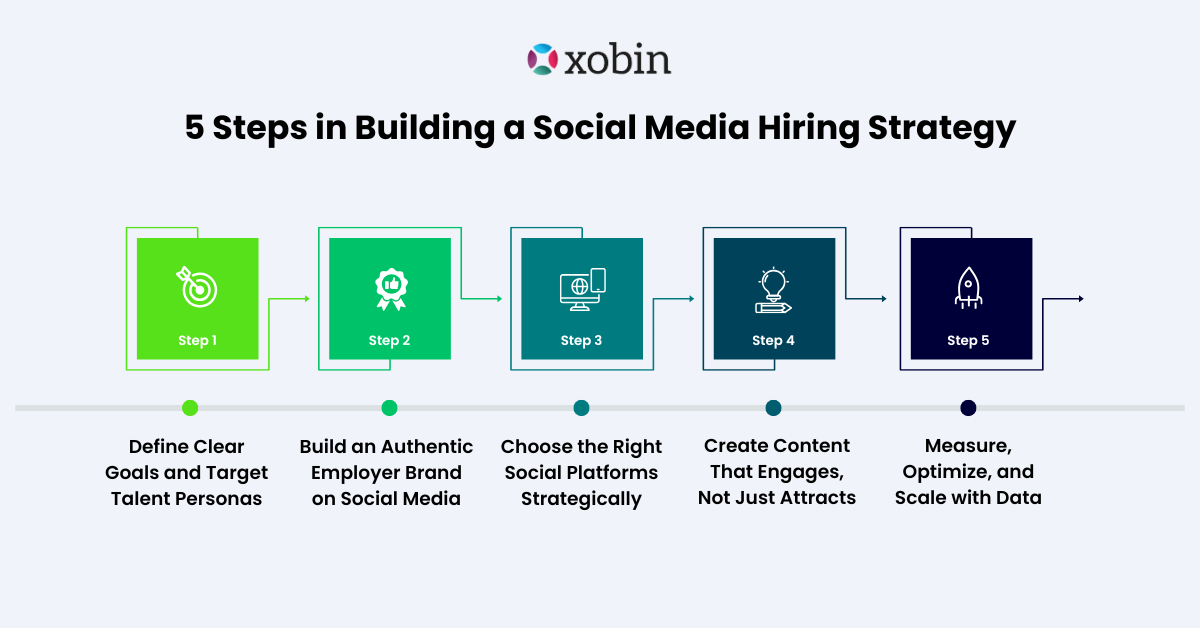
Step 1: Define Clear Goals and Target Talent Personas
A successful social recruiting strategy starts with clarity. Too many organizations post sporadically without a defined objective, leading to low engagement and poor ROI. Leaders must first align social recruiting goals with broader workforce planning priorities.
Begin by answering strategic questions:
- Are you hiring for niche, hard-to-fill roles or building long-term pipelines?
- Do you want to improve employer brand awareness or drive immediate applications?
- Which geographies and seniority levels matter most?
Next, define candidate personas. For instance, a senior data engineer engages with thought leadership on LinkedIn, whereas early-career talent responds better to Instagram or YouTube content. By understanding where ideal candidates spend time and which content they value, you ensure relevance and consistency.
Additionally, aligning these personas with business goals helps you prioritize platforms and content formats, preventing wasted effort and fragmented messaging.
💡 Pro Tip: Think of candidate personas like customers, and map motivations, pain points, and career goals to shape content strategy.
Step 2: Build an Authentic Employer Brand on Social Media
Employer branding is the backbone of social recruiting. Without it, even high-budget campaigns fail to convert interest into trust. Candidates today evaluate employers on culture, leadership credibility, diversity, and growth opportunities.
Authenticity is key. Instead of overly promotional posts, focus on real stories:
- Employee-generated content showcasing day-to-day work
- Leadership insights on company vision and values
- Behind-the-scenes glimpses into team collaboration
Consistency also matters. An inactive or over-curated profile sends warning signs to candidates. Regular posting shows stability and transparency, two qualities top talent values today.
From a strategic lens, employer branding acts not only as a hiring tool; it becomes a reputational asset. Companies with strong employer brands achieve up to 50% lower cost-per-hire and higher offer acceptance rates, as studies show.
Step 3: Choose the Right Social Platforms Strategically
Not all platforms deliver equal value for every role. An effective social recruiting strategy prioritizes quality over presence everywhere.
- LinkedIn: Best for professional roles, leadership hiring, and employer branding through thought leadership.
- Instagram: Ideal for showcasing culture, early-career roles, and visual storytelling.
- X (Twitter): Useful for tech hiring, employer voice, and engaging in industry conversations.
- YouTube & Shorts: Highly effective for employer videos, employee stories, and office culture narratives.
Strategic platform selection ensures your message reaches the right audience without diluting impact. Leaders should also encourage employees to act as brand ambassadors, amplifying reach organically.
Step 4: Create Content That Engages, Not Just Attracts
Engagement is the real metric of success in social recruiting. Posting job links alone rarely works. High-performing organizations design content that educates, inspires, and invites interaction.
Effective content formats include:
- Career growth stories and internal mobility examples
- “Day in the life” employee features
- Hiring manager insights on what success looks like in a role
Every piece of content should clearly answer one core candidate question: “What’s in it for my career?” As content consistently adds value, candidates naturally self-select into your talent pipeline, improving quality-of-hire.
Step 5: Measure, Optimize, and Scale with Data
Without data, social recruiting becomes guesswork. Leaders must track metrics beyond likes and impressions to understand true business impact.
Key metrics include:
- Source-of-hire from social channels
- Application conversion rates
- Quality-of-hire and retention from social-sourced candidates
Advanced analytics help identify which platforms and content types drive the strongest talent outcomes. Over time, this supports predictive workforce planning, one of the most valuable advantages for executive teams.
Moreover, integrating social recruiting insights with hiring systems creates faster feedback loops and continuous improvement.
How Xobin Strengthens Your Social Recruiting Strategy
Xobin bridges the gap between social reach and hiring outcomes by helping recruiters scientifically evaluate candidates sourced from platforms like LinkedIn, X, and Instagram using skills-first, bias-free assessments. Instead of relying on resumes or social profiles alone, hiring teams gain data-backed confidence in every decision.
AI-Based Skill & Psychometric Assessments
Xobin evaluates real job skills, cognitive ability, and behavioral traits; therefore, it assesses candidates attracted via social channels beyond surface-level impressions.
Video Interviews & Communication Analysis
One-way and automated video interviews help recruiters assess clarity, confidence, and communication skills early, improving screening efficiency for high-volume social sourcing.
AI-Powered Proctoring & Fair Evaluation
Advanced AI proctoring ensures assessment integrity, while standardized scoring removes unconscious bias from social-profile-driven decisions.
Actionable Reports for Hiring Leaders
Detailed, executive-ready reports provide clear benchmarks, fitment scores, and recommendations, turning social engagement into data-driven hiring insights.
Seamless Integration with Hiring Workflows
Xobin fits into existing ATS and recruitment processes, allowing teams to scale social recruiting without adding operational complexity.
Ready to Turn Social Reach into High-Quality Hires with Xobin?
Attracting talent through social recruiting is only half the battle; however, Xobin evaluates and converts that interest into confident hiring decisions, where it delivers impact.
Whether you’re hiring at scale or for niche roles, Xobin ensures your social recruiting efforts translate into faster, fairer, and data-driven hiring outcomes. Book a personalized demo today and see how Xobin helps you hire smarter from every social touchpoint.
FAQs
1. What is a social recruiting strategy?
It is a structured approach to using social media platforms to attract, engage, and hire candidates through employer branding and relationship-building.
2. Which social platform is best for recruiting?
It depends on the role. LinkedIn works best for professional hiring, while Instagram and YouTube are effective for culture-driven and early-career recruitment.
3. How does social recruiting improve quality-of-hire?
It attracts passive candidates and builds trust early, resulting in better-aligned and more engaged hires.
4. Can social recruiting reduce time-to-hire?
Yes. By nurturing talent pipelines in advance, organizations fill roles faster when openings arise.
5. How does Xobin support social recruiting outcomes?
Xobin evaluates social-sourced candidates using AI-based assessments, ensuring objective, skills-first hiring decisions.