

Hiring the right talent today goes far beyond skills and experience. As organizations scale, many leaders realize that hiring only for “culture fit” often creates similar teams and causes missed innovation opportunities. Therefore, the Culture Add Assessment becomes a strategic differentiator. Rather than asking, “Will this candidate fit in?” forward-thinking companies ask, “What new perspectives will this candidate add?” In this blog, we explain how culture-add assessment works, why it supports business growth, and how leading HR teams can apply it effectively today.
Table of Contents
TL;DR – Key Takeaways!
- Culture Add Assessment focuses on hiring candidates who enhance, not replicate, existing culture.
- It promotes diversity of thought, innovation, and long-term adaptability.
- Unlike culture fit, culture add reduces bias and groupthink.
- Structured, data-driven assessments make culture add measurable and scalable.
- Organizations using culture add hiring see stronger engagement and retention.
What Is a Culture Add Assessment?
Culture add assessment is a clear method for evaluating candidates by understanding how their values, behaviors, and perspectives complement and strengthen an organization’s current culture rather than just copying it. Instead, culture-add hiring focuses on people who contribute fresh ideas, experiences, and viewpoints while staying aligned with the company’s core values and long-term direction goals.
Traditionally, culture fit assessments focused on similarity, whether a candidate “feels like us.” While well-intentioned, this approach often reinforces unconscious bias and limits diversity. Culture-add assessments shift the lens from similarity to value alignment plus contribution. The question becomes: How does this person help our culture evolve?
For leadership teams, this difference remains critical. Culture never stays static and evolves as markets, technologies, and workforces change. Therefore, hiring for culture add helps new employees keep the organization relevant and resilient today. Over time, this approach drives innovation, adaptability, and sustainable growth without weakening shared values.
Culture Fit vs. Culture Add: Key Differences That Matter
Understanding the difference between culture fit and culture add is essential for modern hiring strategies.
| Aspect | Culture Fit | Culture Add |
| Core Focus | Similarity to existing employees | Complementary values & perspectives |
| Risk | Groupthink, bias, stagnation | Balanced diversity & innovation |
| Diversity Impact | Often limits inclusion | Actively promotes inclusion |
| Long-Term Outcome | Short-term harmony | Long-term growth & adaptability |
Culture fit hiring often feels comfortable in the short term because teams share similar communication styles and backgrounds. However, over time, this comfort can turn into stagnation. Decisions go unchallenged, innovation slows, and teams struggle to adapt.
In contrast, a Culture add assessment deliberately creates healthy friction. As a result, candidates think differently, solve problems creatively, and question assumptions respectfully. Consequently, leaders gain decisions while driving stronger organizational performance.
💡 Pro Tip: Replace “Would I enjoy working with this person?” with “How will this person help us perform better?” in interviews.
Why Culture-Add Hiring Is Critical for Business Growth
Culture-add hiring is not a “nice-to-have” HR idea; instead, it is a business lever. Moreover, research consistently shows diverse teams outperform homogeneous ones in problem-solving, innovation, and financial results.
From a leadership perspective, the benefits of the culture add assessment include:
1. Stronger Innovation and Decision-Making
When teams include varied perspectives, they challenge assumptions and explore alternatives. This reduces blind spots in strategy and leads to more robust decisions.
2. Reduced Hiring Bias
Culture fit assessments often rely on subjective judgment. Culture-add assessments, when structured, focus on observable behaviors and values, minimizing hiring bias.
3. Higher Engagement and Retention
When employees feel valued for their unique contributions, they stay more engaged. Over time, this builds stronger retention and employer branding.
4. Scalable Culture for Growth
As organizations grow, repeating identical hiring patterns becomes risky. Therefore, culture add ensure the culture evolves alongside changing business needs.
What Does a Culture Add Test Measure?
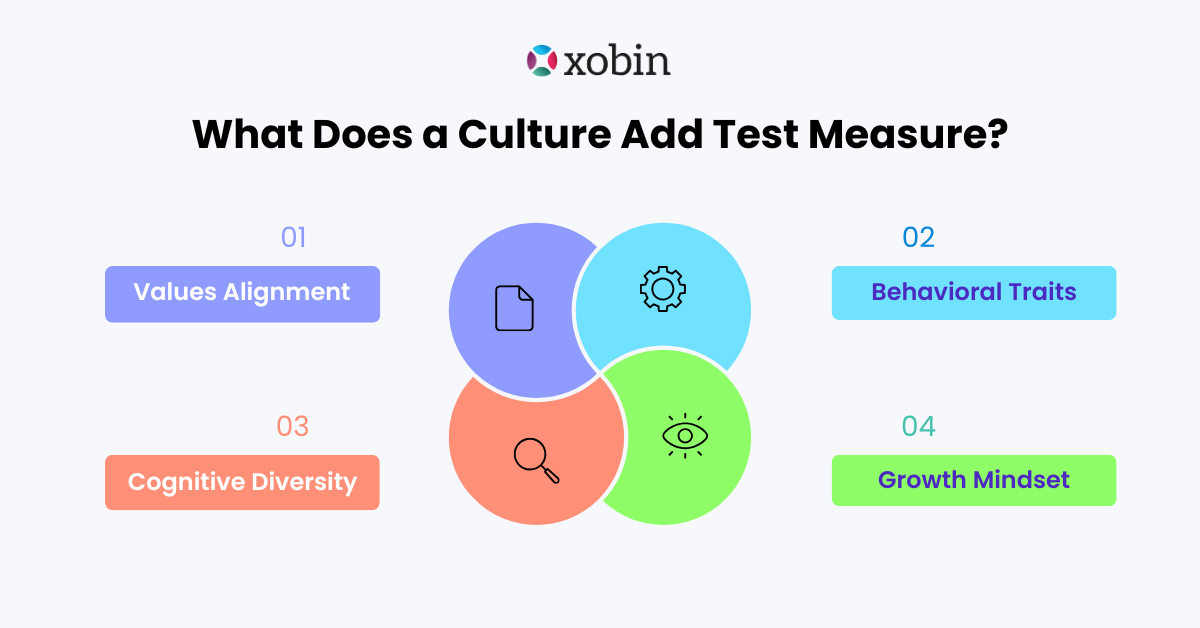
A well-designed culture add assessment evaluates specific, job-relevant attributes rather than vague “fit” signals. Common dimensions include:
Values Alignment
This measures whether a candidate aligns with the organization’s non-negotiable core values, such as integrity, accountability, or customer focus, while still bringing a fresh perspective.
Behavioral Traits
Assessments examine how candidates respond to real-world scenarios, including conflict, ambiguity, and collaboration. These behaviors indicate how someone will influence team dynamics.
Cognitive Diversity
Candidates may differ in problem-solving approaches, creativity, or risk tolerance. Cognitive diversity strengthens innovation without undermining shared goals.
Growth Mindset
Culture-add candidates typically demonstrate curiosity, adaptability, and openness to learning, essential traits in fast-changing environments.
💡 Pro Tip: Avoid personality stereotypes. Focus on behaviors and values that directly impact performance and collaboration.
How to Implement Culture Add Assessment in Your Hiring Process
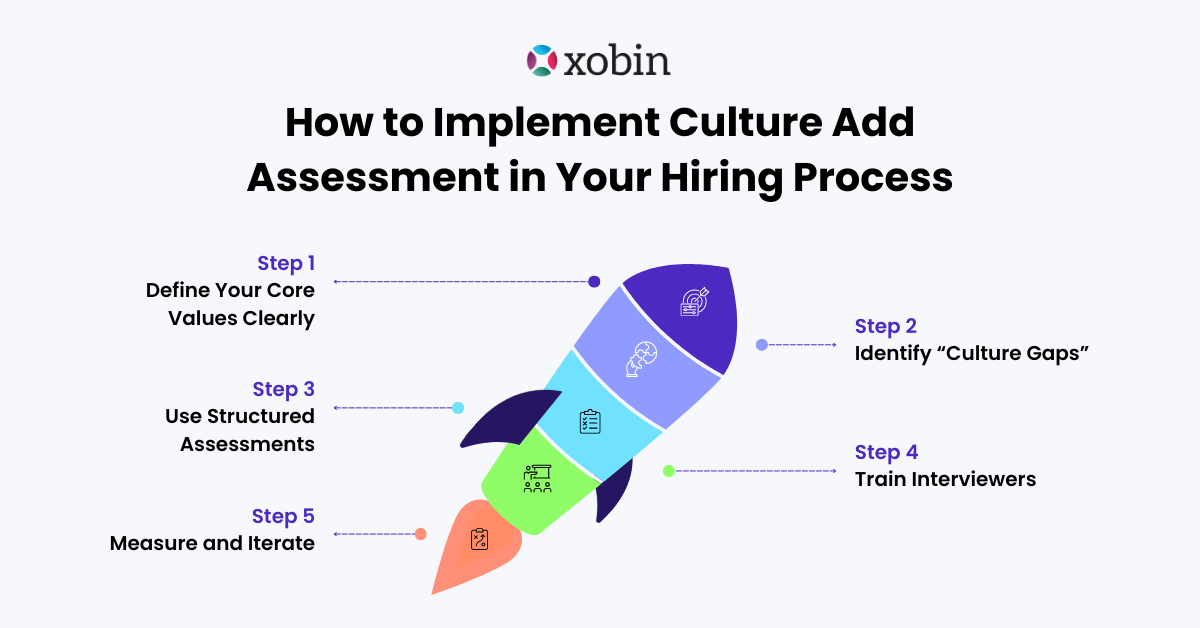
Implementing culture-add hiring requires intentional design, not gut feeling. Here’s a structured approach leaders can adopt:
Step 1: Define Your Core Values Clearly
Before assessing candidates, leadership must articulate which values are non-negotiable and which areas welcome diversity of thought. Ambiguity here leads to inconsistent hiring.
Step 2: Identify “Culture Gaps”
Analyze your current workforce. Where are perspectives missing? What skills or mindsets will the organization need in the next 2–5 years?
Step 3: Use Structured Assessments
Replace informal interviews with structured questions, behavioral assessments, and situational scenarios tied to real work challenges.
Step 4: Train Interviewers
Hiring managers should understand the difference between comfort and contribution. Training reduces bias and improves consistency.
Step 5: Measure and Iterate
Track outcomes such as performance, engagement, and retention of culture-add hires. Use this data to refine your assessment approach.
Evaluate Candidate for Culture Add Using Xobin!
Xobin enables organizations to operationalize Culture Add Assessment at scale through data-driven, AI-powered evaluations. Instead of relying on subjective impressions, Xobin’s psychometric and behavioral assessments measure values alignment, workplace behaviors, and cognitive traits relevant to each role.
With customizable assessments, recruiters can map candidates against defined cultural dimensions while identifying unique strengths they bring to the team. Xobin’s AI-based reports provide actionable insights, highlighting not just “fit” but value-addition potential. This ensures hiring decisions are fair, consistent, and aligned with long-term business goals.
By combining clear values, structured assessments, and data-driven insights, companies can ensure every hire strengthens culture and drives growth. Ready to future-proof your hiring strategy? Book a personalized demo with Xobin today.
FAQs
1. What is a culture add assessment in simple terms?
A culture add assessment evaluates how a candidate can positively contribute new perspectives and strengths to an organization’s culture while aligning with core values.
2. How is culture add different from culture fit?
Culture fit focuses on similarity, while culture add emphasizes complementary skills, values, and viewpoints that help the culture evolve.
3. Does culture add hiring increase conflict?
Healthy debate may increase initially, but structured culture add hiring improve decision quality and long-term collaboration.
4. Can cultural add be measured objectively?
Yes. Psychometric tests, behavioral assessments, and structured interviews make culture add measurable and scalable.
5. Is culture add assessment suitable for all roles?
Yes, especially for roles requiring innovation, leadership, or cross-functional collaboration.
6. How does culture add impact diversity and inclusion?
Culture add naturally supports diversity by valuing differences that align with shared organizational values.