


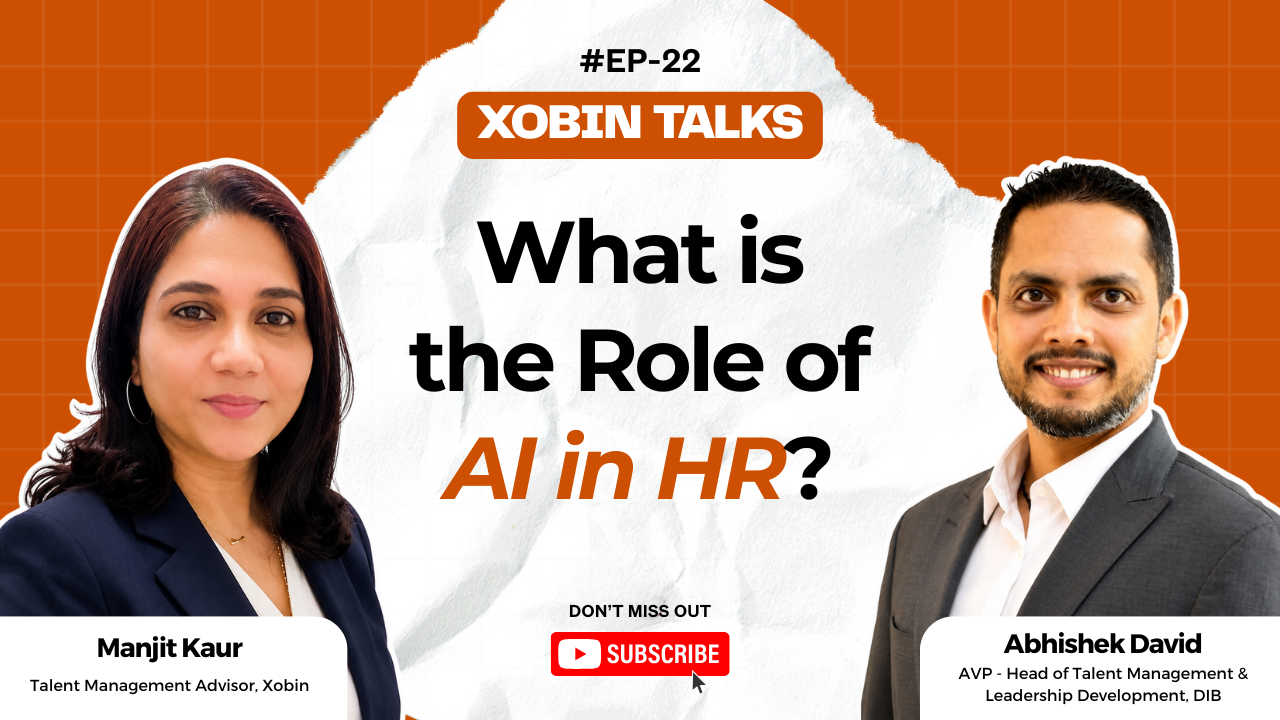
| GUEST PROFILE Abhishek David, Doctoral Research Student, Indian School of Business. NUS Alumni Connect with Abhishek David on LinkedIn |
This episode was hosted by Manjeet Kaur, Xobin.
Table of Contents
TL;DR – Key Takeaways!
- Many HR teams are adopting AI faster than they can prepare for it. They have the technology in place, but they still need clear ethical guidelines and strong data practices to use AI responsibly.
- The medical field analogy explains it well: surgical robots existed long before surgeons trusted them, because the data wasn’t there yet. HR AI is at the same stage.
- HR tracks the wrong thing. Attrition tells you who already left; retention prediction tells you who’s about to, early enough to actually do something about it.
- Removing bias from AI isn’t automatic, it’s ongoing work. Models trained on historical HR data inherit the biases already baked into that history.
- Work is changing, but the bigger question is whether people have the skills to keep up. HR teams need to focus on building those skills across the workforce so employees are ready for the roles that come next.
Abhishek David spent 16 years in HR practice before moving into research. He is now a doctoral student at the Indian School of Business, where his work focuses on the future of work, ESG and individual behavior, and a concept he has been developing around belongingness: the idea that DEI initiatives fail not because diversity targets are wrong but because belonging itself is driven by different motivations for different people, and one-size-fits-all approaches miss that entirely.
In Episode #22 of Xobin Talks, host Manjeet Kaur explores Abhishek’s insights from both his research and hands-on experience.The conversation covers where AI in HR is actually working, where it is being misunderstood, what responsible adoption looks like, and what organizations need to do to avoid creating new problems while solving old ones.
“How Is AI Really Helping HR? Let’s Look at Some Practical Examples.”
Abhishek starts with IBM Watson, one of the earliest examples of AI applied directly to employee retention.
Abhishek: “IBM was ahead when it came to automation, using data, and data modeling. They started with Watson to improve employee engagement and retention. Over time, they turned it into a business tool and monetized it. It also helped them save millions of dollars.”
From there, the adoption curve moved quickly into recruitment. AI-powered candidate management systems, resume screening tools, and JD-CV matching platforms became the first widespread HR AI applications because recruitment is the function with the most structured, high-volume data.
Chatbots and Operational Automation
Abhishek: “Chat bots, NLPs and all of that have been used to answer your questions, more of your HR operations, the jobs which were more operational, wherein you answer a lot of questions to your internal customers as an employee.”
Sentiment analysis, predictive retention modeling, robotic process automation for admin tasks, and generative AI for learning content creation have all followed. Talent marketplace platforms, enabling internal mobility and gig workforce management, represent the most recent wave.
The Medical Field Analogy
Abhishek’s most clarifying observation draws a parallel with healthcare technology.
Abhishek: “Doctors were also using 3D imaging and surgical robots to support medical procedures. However the doctors were still not using them because of lack of data. The machines only got more useful as they accumulated more patient data. Bring that same example back into HR. Recruitment was told that resume parsing had biases in terms of race, gender. But with time, more data and more label correction is making it much more useful.”
Less than half of all organizations will use AI in HR in 2026, and its application is concentrated in specific practice areas: recruiting at 27%, HR technology at 21%, learning and development at 17%, and employee experience at 14% (SHRM State of AI in HR, 2026). The data maturity gap is exactly why adoption is still concentrated at the top of the funnel, where the data is most abundant, rather than across the full employee lifecycle.
“How Can Companies Get Better Results From AI Without Ignoring Ethics?”
This is where Abhishek shifts from describing what AI can do to prescribing what organizations must build before deploying it.
Build the Ethics Infrastructure First
Abhishek: “Companies that use AI tools should set clear rules for how their teams use them. They should also create an independent ethics committee to review these practices. This keeps the oversight separate from the business team. It should be very transparent and explainable. Any model, any communication, any tool or algorithm which has been used should be very transparent, otherwise you are basically inheriting biases.”
Only 18% of surveyed firms have established an AI ethics board within their HR governance framework, and 41% of HR professionals cite algorithmic bias as a top concern in AI adoption (SQ Magazine, 2025). The gap between the concern and the structural response is wide.
GDPR and Regulatory Compliance Is Not Optional
Abhishek: “Data privacy measures should be there. Complying with GDPR and other regulatory guidelines is very very important for anyone to operate in the digital and AI era.”
The pressure to adopt fast and the imperative to govern carefully are in direct tension, and most organizations are resolving that tension by moving fast and hoping compliance catches up.
Continuous Monitoring, Not One-Time Deployment
Abhishek: “Continuous monitoring and evaluation because no one knows what is the outcome of all of this. Studies from McKinsey and Deloitte say there will be a multifold increase in business outcome but no one has seen that outcome yet. We are yet to monitor the benefits of tools which are getting implemented. That’s where caution is required.”
This acknowledgment matters: the return on AI investment in HR is still largely theoretical at scale, and organizations are betting on a promised outcome that has not yet been fully demonstrated in practice.
“What HR Teams Often Misunderstand About AI”
Abhishek names four, all of which he encounters regularly in his research and consulting work.
Misconception 1: AI Will Take Our Jobs
Abhishek: “The job is changing fast, so we need to prepare for the skills we’ll need tomorrow. That applies to employees and HR teams alike. Both need to keep learning and stay ready for what’s next. Utilizing AI tools means AI professional HR professionals need to look at AI as their aid in decision making, not the replacement. What I was doing before, A B C, now my A and B will be done by machine but C will be done by me. It is not a complete replacement. It’s the optimal utilization of augmentation.”
Misconception 2: AI Will Fix All Problems Instantly
Abhishek: “This AI tool if we implement it is going to fix all my problems or this is going to respond faster, make decisions faster.”
The speed of implementation does not determine the quality of outcomes. Tools deployed without adequate training data, without change management, and without clear definitions of what problem they are solving will underperform regardless of their technical capability.
Misconception 3: AI Removes Bias
Abhishek: “We continuously say that when we bring in AI we’re going to remove the biases from the system. These misconceptions are by and large the ones to address.”
29% of companies paused or restructured AI recruitment tools in 2025 due to bias findings (SQ Magazine, 2025). AI trained on historical hiring data learns who was historically hired, which means it replicates the biases that produced that history unless the training data and labeling are actively corrected over time.
Misconception 4: One Size Fits All
Abhishek: “Not one size fits all. Bring the tools, measure the changes, look at how transparent they are, look at how they are in terms of the whole employee experience journey. Simplicity is also one of the keys when it comes to any tech or digital implementation.”
“How Will AI Shape Workplace Culture and Employee Wellbeing Over Time?”
Abhishek answers this from two directions: the business case and the human case.
The Business Case: Fintech and the Blurring of Industry Lines
Abhishek: “Just two or three years back we used to say there is fintech and there are banks. There’s no difference now. The line is being blurred. Fintech has to operate like a bank because they are regulated by some authority, and a bank also needs to be digitized and automated as fintech has been doing. No one wants to become Nokia because everyone wants to move forward with the right amount of creativity and innovation to maintain market capital and the bottom line.”
Going digital is no longer a choice for businesses; it is a necessity. Companies that delay AI adoption could fall behind just like businesses in the 1990s that underestimated the impact of the internet.
The HR Case: Stop Measuring Attrition, Start Predicting Retention
Abhishek: “HR has always been sitting on a large scale of data. We always look at attrition. Why don’t we look at retention? We always look at lag data, we look at attrition percentage and we will not look at retention percentage and retention factors so that we can look at data from a futuristic perspective. HR looking at those lead data to make predictive decisions and analytics, that is what I see is going to be changing.”
The reframe matters more than it might first appear: attrition data tells you who left and when. Retention prediction data tells you who is likely to leave before they start looking. That gap is the difference between a postmortem and preventive intervention, and most HR teams are still running postmortems.
The People Case: Wellbeing, DEI and the Reduction of Bias Over Time
Abhishek is optimistic about the long-term DEI trajectory, but measured about the timeline.
Abhishek: “I see biases and differentiation reducing. The line is getting blurred over the course of time. In the next 5 to 10 years we see gender diversity being there. If it’s not there as an organization you will be questioned. It’s going to become a bare minimum.”
He also names the risks that come with greater AI dependency: over-reliance on technology, persistent privacy concerns as data volumes grow, and the ongoing challenge of bias in systems that learn from imperfect historical data.
The framing he returns to is one of human evolution. Every major technology shift, computers in the 1980s, then the internet, then mobile, required humans to adapt. AI is the next chapter of that same story.
Abhishek: “Continuously evolving and learning is what human evolution is all about. Hopefully we will be prepared for AI and digital transformation as we were prepared for computers, the internet and mobile.”
🎧 Watch the Full Episode
Xobin Talks – Episode 22 | Abhishek David, Doctoral Researcher, Indian School of Business | Hosted by Manjeet Kaur, Xobin
▶ Play Episode #22 of Xobin Talks
About Abhishek David
Abhishek David brings 16 years of HR practice experience to his doctoral research at the Indian School of Business. His work sits at the intersection of organizational behavior, technology adoption, and HR strategy, with a particular focus on the future of work, ESG goal achievement, and the concept of belongingness in DEI. Before moving into academia, he held senior HR roles across industries in India and the UAE, giving him a practitioner’s grounding for the questions his research explores. He is a NUS alumni and active thought leader in the UAE HR community, with expertise spanning HR transformation, OD, talent retention, culture and change management, and business dynamic partnerships.
The tools showed up first. The frameworks are still catching up. Hear other HR leaders on Xobin Talks.
Frequently Asked Questions
Is AI actually being used in HR or is it still mostly hype?
It is being used, but adoption is narrower than the headlines suggest. AI is most concentrated in recruiting and HR technology, where structured, high-volume data already exists. Strategic workforce planning and performance development remain largely human-led.
Does AI remove bias from hiring?
No, not automatically. AI trained on historical HR data learns the patterns in that data, including any biases it contains. Removing bias requires actively correcting training data, auditing model outputs regularly, and maintaining human oversight at decision points.
How should organizations set up an AI ethics framework for HR?
Build a dedicated ethics committee that sits outside the business division. Require every AI tool to be transparent and explainable, with no black boxes. Comply with GDPR and relevant local data privacy regulations, and conduct regular bias audits with clear feedback loops for employees to flag concerns.
What is the difference between lag data and lead data in HR analytics?
Lag data tells you what already happened: attrition rates, exit interviews, turnover numbers. Lead data tells you what’s likely to happen next, early signals that someone may be at risk of leaving before they start looking. Retention prediction models built on lead data let HR intervene proactively instead of reacting after the fact.
How can HR stay relevant as AI takes over more tasks?
By moving up the value chain. Answering policy questions, scheduling, and screening at volume were never the most valuable things HR did. The real work is understanding what the business needs from its people and building the systems that keep them. AI frees up time for that; the question is whether HR uses it deliberately.
Is the future of work about job loss or skill change?
Skill change, primarily. The more useful question is not which jobs will disappear but what skills will be needed in the roles that remain. Most organizations are preparing for only a partial picture, developing some skills while leaving others unaddressed.