


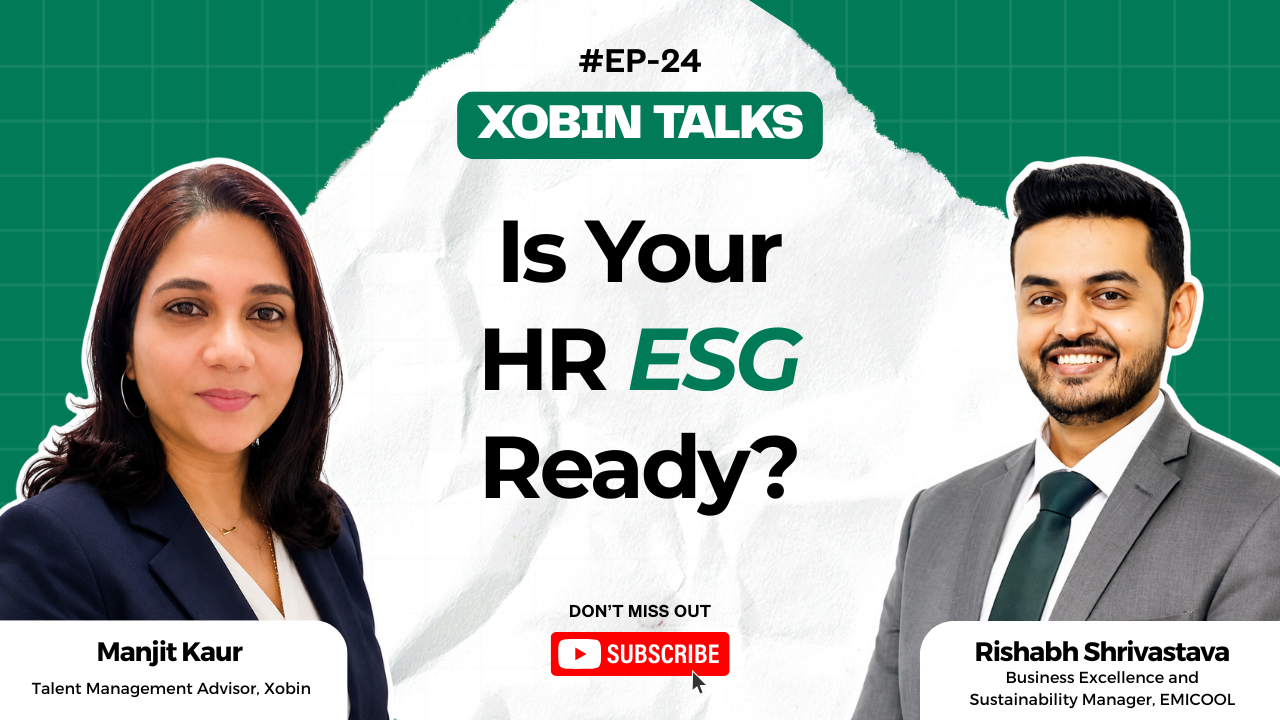
| GUEST PROFILE Rishabh Shrivastava, Business Excellence and Sustainability Manager, EMICOOL, a district cooling company operating in Dubai. Connect with Rishabh Shrivastava LinkedIn |
This episode was hosted by Manjeet Kaur, Xobin.
Table of Contents
TL;DR – Key Takeaways!
- DEI fails when diversity becomes the hiring goal instead of the candidate pool goal. Build a diverse pool, then hire the best fit.
- Go upstream. If the diverse talent pool doesn’t exist yet in your industry, build it, don’t just keep searching the same narrow one.
- AI won’t replace jobs. It will rewrite job descriptions, taking the mundane work and leaving the strategic, judgment-driven work behind.
- Predictive hiring is already possible. AI can correlate attrition patterns with incoming candidates to flag organization-fit risk before the interview.
- Remote work can support your ESG goals, not just serve as an employee perk. When people work from home, companies can cut commuting and office energy use, which helps lower Scope 2 and Scope 3 emissions.
Rishabh Shrivastava is not a typical HR guest. He is a computer science engineer with an MBA in Energy and Petroleum who has spent 12 years at the intersection of business excellence, sustainability, and ESG strategy across some of the most resource-intensive industries in the world. Based in Dubai, where global culture, regional regulation, and sustainability mandates intersect in ways that create a distinctive set of hiring and organizational challenges.
In this episode #24 of Xobin Talks, host Manjeet Kaur asks him how organizations in the GCC region are approaching diversity, equity, and inclusion, and what they are getting wrong. The conversation moves into AI in HR, remote work as a sustainability tool, and data quality as the overlooked foundation of every analytics initiative.
“What Are Organizations Still Getting Wrong About DEI?”
Rishabh opens with the distinction that most DEI discussions skip over entirely: the difference between a diverse workforce and a diversity-based hiring decision.
Rishabh: “Across developed countries, developing countries, and the GCC, many organizations treat DEI as a box they need to tick rather than something they truly understand. Having a diverse workforce alone doesn’t mean an organization has achieved equity or created an inclusive workplace.”
Diversity as Pool, Not Outcome
His argument is precise: organizations should pursue diverse candidate pools, not diversity-based hiring outcomes. The distinction matters because conflating the two produces exactly the problem DEI is supposed to solve: decisions that are not about merit.
Rishabh: “I always tell my HR colleagues and other professionals not to hire based on diversity alone. Instead, build a candidate pool that brings together people with different backgrounds and perspectives. What matters most is cognitive diversity, having people who think differently and bring fresh ideas to the table.”
Companies in the top quartile for ethnic diversity are 39% more likely to outperform financially (McKinsey, 2023). BCG found that companies with more diverse leadership teams get 45% of their revenue from innovation, compared with 26% for companies with less diverse leadership. The business case for diversity is well established. The mechanism for achieving it is less so, and Rishabh’s framing addresses the mechanism directly.
Rishabh: “An organization requires an individual who can fulfill its objective. Sometimes, in a DEI ticking-box exercise, they actually forget about the main motive behind why we are hiring. Yes, a fair representation can happen in the pool of candidates. But the candidate who suits the most, who fits the most, should be hired.”
76% of job seekers view a diverse workforce as critical in their employment decisions (Glassdoor, 2020). The pressure on organizations to demonstrate diversity is real. Rishabh’s point is that the response to this pressure should be building a genuinely diverse pool, not engineering a diverse outcome from a narrow one.
“How Do You Actually Build a Diverse Candidate Pool in a Male-Dominated Industry?”
The GCC’s district cooling industry relies heavily on technical and engineering skills, which makes it harder to find diverse talent, especially women. Instead of seeing this as a limitation, Rishabh looks for practical ways to improve the hiring process.
Go to the Universities Before the Job Opens
Rishabh: “The right candidates may not always be available in the market, especially when location limits our options. So, instead of waiting for the talent pool to grow, we decided to build it ourselves. We started reaching out to universities and talking to students about opportunities in this industry. We want them to see it as a career they can explore in the future. By doing this, we’re building a diverse pipeline of future candidates and reducing the risk of facing a talent shortage later.”
EMICOOL offers training programs, graduate schemes, internships, hackathons, and events for university students. These efforts go beyond hiring for open roles. They also help introduce students and job seekers to the district cooling industry and encourage people who may never have considered this field to explore it.
Build the Pool for the Industry, Not Just Your Organization
This is where the approach becomes distinctive. Most university recruitment programs are designed to attract candidates to a specific employer. EMICOOL’s approach explicitly creates candidates for the industry as a whole.
Rishabh: “We want to build a strong candidate pool that benefits our organization and the wider industry. We would be approaching hundreds of students, creating this pool. As per our organization requirement, we would be proceeding with five or ten candidates. But the other remaining candidates also have good potential. We may not pursue these candidates because of our current needs, but they can still bring valuable diversity to the district cooling industry as a whole.”
The UAE’s Emiratisation program Nafis targets a minimum of 10% Emirati representation in skilled private-sector roles by 2026, and by 2024 the UAE had already surpassed its interim goal, with over 131,000 Emiratis placed in private-sector jobs (PwC, 2024). EMICOOL’s university engagement strategy works alongside these national initiatives, building the pipeline that makes representation targets achievable rather than imposed.
“How Do You See AI Changing the Way HR Teams Work in the Years Ahead?”
Rishabh’s answer to the AI question is grounded in a specific use case that his organization has been developing: using historical attrition data to predict organizational fit for incoming candidates.
AI Will Rewrite the Job Description, Not Eliminate the Job
Rishabh: “AI probably won’t take your job, but it may change the way you work and even reshape what your role looks like. We should use AI to handle repetitive, routine tasks so people can focus on work that needs real thinking and creativity.”
Predicting Organizational Fit Before the Hire
Rishabh: “We have behavioral assessment tools in place. We have skills assessment tools in place. We have the past data of each and every employee. With the help of AI we can actually now predict that the potential candidate whom we are going to hire will be an organization fit or not, based upon our attrition data. The employees who have left, we can actually correlate the behavioral pattern with the skill pattern, and we can see whether the potential candidate who is about to join will be an organization fit.”
The implication is significant. Most hiring processes evaluate skill fit and then make a judgment call on culture fit based on interview impressions. A model built on attrition data can surface the behavioral and skill signatures of candidates who historically stayed and performed, and those who did not, before the first interview happens.
The Strategic Shift That Follows
Rishabh: “With the help of these mundane tasks being delegated to the AI, you automatically start thinking more on the strategic frontier. That’s the change of the job description that will happen. From the operational, mundane tasks, all will be removed and deleted from your job description. Your role will involve more strategic thinking, decision-making, and contributions.”
Rishabh’s framing sidesteps the anxiety around AI replacing HR judgment by focusing on what it actually enables: freeing people for work that requires judgment, rather than replacing the judgment itself.
“How Flexible and Remote Work Can Support Sustainability”
This is where Rishabh’s ESG background produces a perspective that most HR conversations do not access. Remote work is usually discussed as a productivity or wellbeing question. Rishabh approaches it as a carbon question.
Scope 2 and Scope 3 Emissions
Rishabh: “Countries created their own plans to achieve net-zero emissions by 2050 after signing the Paris Agreement. The UAE has also committed to this goal. To get there, we need to know how much carbon we’re producing and keep a close eye on our emissions.”
He maps three emission scopes: Scope 1 (direct emissions such as vehicles and diesel generators), Scope 2 (indirect emissions from electricity and grid consumption), and Scope 3 (everything else, stationery, water, employee commute, business travel).
Rishabh: “When employees work from home, companies can reduce emissions from office use and everyday operations. If there is remote working, then definitely the employee will not be commuting to the office. So there will be less carbon emission. Since the employee is not commuting, the electricity consumption inside the office will not be required. Employees will not use stationary, they will not use other tools, maybe coffee vending machines, coffee cups, so everything will be reduced.”
When Remote Is Not Possible: Satellite Offices and Carpooling
Rishabh acknowledges that not every industry or role supports remote work, since manufacturing, retail, and operations-heavy environments require physical presence. His recommendation for these contexts is practical: satellite offices closer to employee residential areas, and organized carpooling to reduce per-journey emissions.
Rishabh: “One practical option is to set up smaller offices in different locations. This gives employees a closer place to work and cuts down on long commutes. That can also help in reducing carbon emission. And if nothing can be avoided, at least promote carpooling for the employees.”
EMICOOL has taken this logic further by establishing a virtual customer office, reducing the need for physical customer visits and cutting associated Scope 3 emissions in the process.
“What Is the Data Quality Problem That Organizations Keep Ignoring?”
Rishabh closes with a point that cuts across every data initiative in any organization: data-driven decision-making is only as good as the data it rests on.
Two Problems Organizations Face
Rishabh: “There are two challenges. One is the data quality. Usually data, if you need to create information out of that data, you might be requiring multiple data sources. Those multiple data sources can either be manual, handwritten, Excel sheets, or fantastic software. But to derive your information, you need all of these data sources. And if you see in terms of data quality, manual versus a full-fledged data repository, we know the bandwidth of data quality. The information that is being inferred gets distorted because of the diverse data quality.”
Build Data Quality Before Building Analytics
The sequence matters. Most organizations try to build analytics on top of data quality problems, which produces impressive dashboards built on unreliable foundations. Rishabh’s prescription is to solve the source problem first.
Rishabh: “Every organization should pursue that in order to proceed with data-driven decision-making, they should first look into the source of the data quality and source of the data. Once they achieve this particular frontier, then the opportunities are limitless.”
He illustrates this with EMICOOL’s operational context: using customer profiling and consumption data to redirect district cooling output toward the buildings and times where demand is highest, offices during work hours, schools during school hours, residential clusters at night. The same data discipline that enables that optimization applies directly to HR analytics, from attrition prediction to workforce planning.
🎧 Watch the Full Episode
Xobin Talks – Episode 24 | Rishabh Shrivastava, Business Excellence and Sustainability Manager, EMICOOL | Hosted by Manjeet Kaur, Xobin
▶ Play Episode #24 of Xobin Talks
About Rishabh Shrivastava
Rishabh Shrivastava is Business Excellence and Sustainability Manager at EMICOOL, a district cooling company based in Dubai. His career spans 12 years across oil and gas, energy services, aviation fueling, facility management, and district cooling, industries where sustainability, operational efficiency, and ESG reporting intersect directly. He holds a Computer Science Engineering degree, an MBA in Energy and Petroleum, and multiple certifications including Six Sigma Black Belt, Design Thinking Coach, Certified Measurement and Verification Professional, and Certified Energy Manager. Outside work, he is a lead guitarist and multi-instrumentalist who has played in a rock band since his college days.
Connect with Rishabh on LinkedIn
Building the pool your industry doesn’t have yet, that’s the real DEI work. Explore more such conversations on Xobin Talks.
Frequently Asked Questions
What is the difference between diverse hiring and a diverse candidate pool?
Diverse hiring focuses on bringing in candidates from different backgrounds, but relying too much on diversity criteria can sometimes lead to decisions that overlook merit. A diverse candidate pool means people from different backgrounds all get a fair opportunity to be evaluated. The hiring decision itself is then made on merit and fit. The pool should be diverse; the selection should be fair.
Why do DEI initiatives fail in practice?
Because organizations focus on outputs rather than inputs. They set diversity targets for hires without fixing the process that produces the candidate pool. When the pipeline stays narrow, targets just create pressure to compromise on fit. Fixing the pipeline, not the target, is what makes DEI sustainable.
How can companies find diverse candidates in male-dominated industries?
By going upstream. If the market doesn’t yet have diverse candidates, engage universities before they graduate. Build awareness of the industry among students who wouldn’t otherwise consider it, through internships, hackathons, and graduate programs. It takes longer than job-board recruiting, but builds a pipeline for the whole industry.
How can AI help with organizational fit in hiring?
By correlating behavioral and skill patterns in historical attrition data with incoming candidate profiles. Employees who left share identifiable behavioral and skill signatures. AI can compare candidates against these patterns to flag potential fit risks before the interview stage, adding organization-fit to skill-fit.
Does remote work actually reduce carbon emissions?
Yes, measurably. Working from home cuts Scope 3 emissions from commuting and Scope 2 emissions from office electricity use, since fewer people in the building means less air conditioning, lighting, and equipment running. For organizations with net zero targets, flexible work is a practical, quantifiable lever.
How does ESG connect with HR?
ESG stands for Environmental, Social, and Governance. HR sits mainly in the Social pillar: fair hiring, DEI, wellbeing, labor practices. It also connects to the environment through remote work and commute reduction, and to Governance through ethical hiring and pay equity. Strong DEI increasingly reads as a resilience marker to investors.
What is the first step toward data-driven HR decision-making?
Auditing your data sources and quality before building any analytics layer. Most organizations pull insights from a mix of manual records, spreadsheets, and software exports, each with different reliability. The insight is only as good as the worst source in the mix, so cleaning that up comes first.
What is cognitive diversity and why does it matter more than demographic diversity?
Cognitive diversity is differences in how people think, solve problems, and approach decisions, shaped by background, experience, and discipline. Demographic diversity is visible; cognitive diversity is the actual mechanism behind better team performance. One increases the odds of the other, but doesn’t guarantee it.