


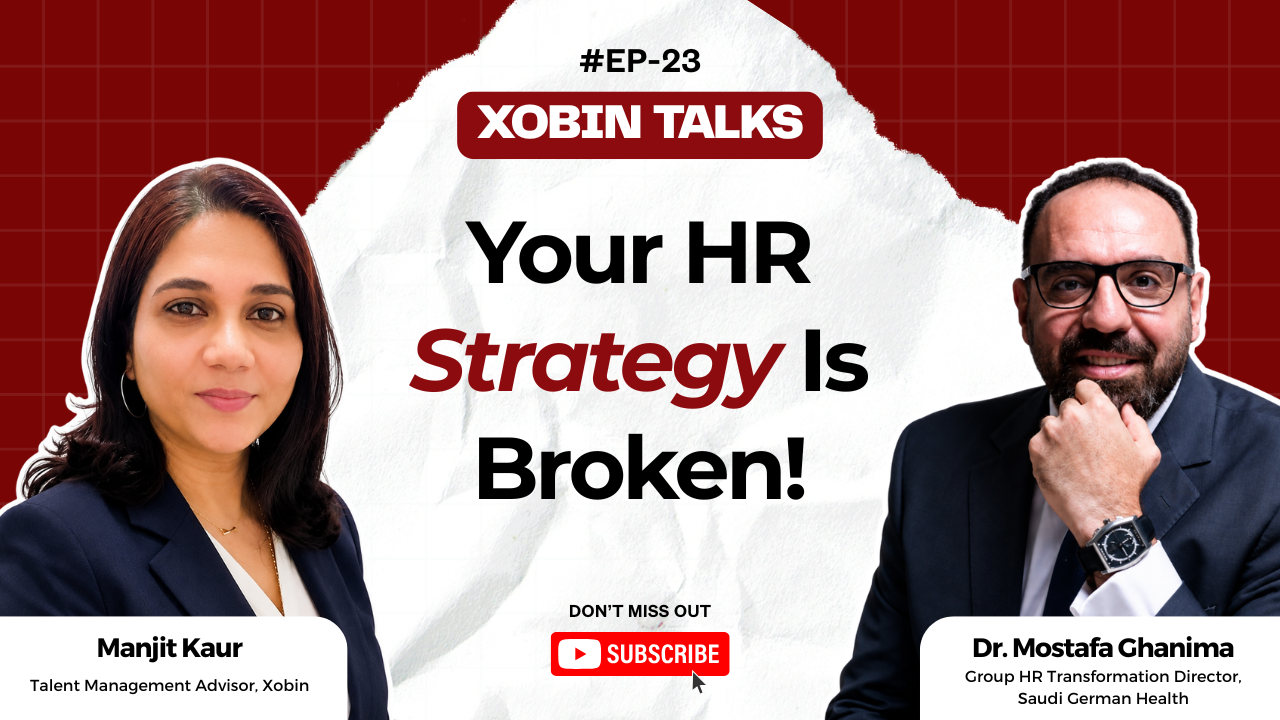
| GUEST PROFILE Dr. Mostafa Ghanima, Group Total Rewards and Wellbeing Director, Saudi German Hospital. PhD in Human Resources. CHRO Certified | Global Executives Certified | CIPD Certified. Connect with Dr. Mostafa Ghanima LinkedIn |
This episode was hosted by Manjeet Kaur, Xobin.
Table of Contents
TL;DR – Key Takeaways!
- Saving money on a hire is how you lose money on a hire. A candidate below market rate can cost far more in lost production and leadership failure than the salary ever saved.
- HR credibility with management is built on numbers, not theories. Every recommendation needs a market survey, a cost of vacancy, a cost of mis-hire behind it.
- Salary benchmarking is a conversation, not a decision. The quartile framework gives management a structured choice instead of a headcount fight.
- AI accelerates HR but can’t replace the judgment it requires. A skilled HR professional can read what a smiling candidate might be hiding; AI can’t.
- HR without business knowledge will fail. Understanding finance and operations is what makes HR a credible partner, not a support function.
Dr. Mostafa Ghanima’s career did not begin in HR. He started out as a call center agent in Egypt, where he often wondered what the HR team actually did. When an HR position opened internally, he decided to take a chance and applied. He moved from a senior call center role to an HR data-entry position, accepting an 80% pay cut in the process. At the same time, he began pursuing an MBA in Human Resources to build the skills he needed for his new career.
Sixteen years later, he holds a PhD in Human Resources, CHRO certification, Global Executives certification, CIPD certification, and leads Group Total Rewards and Wellbeing at one of the largest hospital groups in the Middle East.
In Episode #23 of Xobin Talks, Manjeet Kaur sits down with him to share key lessons from his 20-year HR career across three countries.
“What Made You Choose HR Even With an 80% Pay Cut?”
The question Manjeet asks is the one most people would want to ask: why did you do it?
Dr. Mostafa: “I enjoy working in HR because I get to connect with people, solve workplace challenges, and communicate with them every day. HR is not traditional for me. HR is not a tradition. This is really interesting to learn.”
The pay cut and the risk were both real. Most of the people around him told that he was making a mistake by leaving a well-paying multinational role for a junior HR data entry position. His answer was that building was more important than earning at that stage.
The Balance Role
He was drawn to more than just the way people interacted. What really stood out to him was HR’s balancing act between protecting employee interests and supporting the organization’s goals.
Dr. Mostafa: “My legal background shapes how I look at workplace issues. I tend to approach them with a legal lens. In HR, you have to protect both employees and the organization. At the same time, you need to remember that a company has to run as a business. Focus on what is fair, practical, and based on facts.”
The framing is useful. HR sits in a structural tension: too far toward employee advocacy and you lose organizational credibility; too far toward management interests and you lose employee trust. The professionals who navigate this well are the ones who stay at the table for both conversations.
“What Is the Most Challenging Part of Hiring?”
Dr. Mostafa’s answer is immediate and specific: hiring the right candidate at the right time, and at the right cost.
Dr. Mostafa: “The toughest part is finding the right person when you actually need them. Sometimes I receive a call from one of the directors and the management. I’d like to hire a factory manager. I tell him the market salary is different, the market is higher. He says no, this is our budget.”
The Factory Manager Story
This part of the episode really stands out. Dr. Mostafa shares a time when he had a budget of 50,000 for a role that normally paid around 80,000. He told the director the budget was too low, but the director wouldn’t increase it. Instead of stopping there, Dr. Mostafa looked for another option. He found a deputy from a different factory who saw the role as a promotion and agreed to take the lower salary.
Dr. Mostafa: “When we last talked, I asked him what went wrong. He said, ‘We lost. We lost millions.’ He managed to save around $20,000 or $30,000, but the company still lost millions because we missed our targets. Looking back, he didn’t have the skills we needed in leadership, finance, or production. But I don’t blame him for what happened. We made the bigger mistake by putting him in a role he wasn’t ready for.”
This story points to an issue HR teams often face when trying to explain hiring decisions to management. A poor hire can cost far more than their salary. When someone underperforms, the whole team may lose time, leadership can take a hit, and everyday work can suffer. The company may also need to start the hiring process all over again. So, saving money on the initial hire can end up costing the business much more later.
The next time the same director called, he said: hire the factory manager at market price.
“How Can Salary Data Help You Get Management on Your Side?”
Dr. Mostafa takes a clear, structured approach to salary discussions with senior leaders. He relies on one key framework: quartile positioning.
Dr. Mostafa: “I start by looking at the current market salary ranges, including the first quartile, median, and third quartile. Then, I sit down with management and ask where they want to position the organization. If the goal is to attract the best talent, we need to compete at the higher end of the market, usually around the third or fourth quartile. That gives us a clear view of what we need to offer based on current market data.”
The Quartile Conversation
The framework shifts the conversation from negotiation to decision. Instead of an HR professional asking management for a higher salary budget and management pushing back, the quartile structure gives management a structured choice: first quartile, median, or third quartile. Each position carries a clear implication for the quality of candidate the organization can attract.
Organizations that pay at the first quartile usually offer less than the market rate, so they often attract candidates with fewer outside options. Pay at the median tends to bring in solid performers. Pay at the third quartile helps organizations attract more of the top talent in the available pool.
Dr. Mostafa: “Maybe he will say our organization is not mature, so we can start with the median. I’m giving him rationality, data and basis. We are taking our decision and determining mainly the area of salaries and scale in the organization.”
HR works alongside the business, not just on administrative tasks. Management makes the final call, while HR provides the structure and guidance behind that decision.
“How Do You Think AI Is Changing HR? Is It Really Making a Difference?”
Dr. Mostafa’s view on AI is practical rather than ideological, and he both uses it and tests its limits.
Dr. Mostafa: “AI is now playing almost 40% of the human resources role. AI can screen the resume through ATS. AI can conduct interviews through some applications and read body language. But I’m always saying you can use AI to help HR but not to replace HR. There is a big difference between these words.”
Where AI Reads Wrong
His challenge to AI body language analysis is concrete, grounded in a specific interview observation.
Dr. Mostafa: “During my interview I like this and I use my ruddy face and smile. The AI will tell he’s smiling. But as an HR professional I know that he’s smiling maybe to hide something. The body language while he’s talking and doing something like this, as an HR professional I know that there is something hidden. So I’m always saying: you can use AI to enhance your process, accelerate your process, but you can’t replace HR.”
Where AI Actually Helps
His practical recommendation is power tools, AI applied to data analysis rather than to human judgment.
Dr. Mostafa: “Right now, I see data analysis as one of the biggest areas for AI. When you connect your data and analyze it in Power BI, AI can spot patterns and point out where things need attention. For example, if I feed it our manpower data over time, it might tell me that overtime has gone up in recent months. So, I’d use AI to understand the data and find insights, not to make the decisions for us.”
That distinction matters: AI as an analytical accelerator is genuinely useful, while AI as a decision-maker in human processes remains premature and risky.
“How Saudi Arabia’s HR Sector Has Evolved in the Past 10 Years”
Dr. Mostafa works in Saudi Arabia and speaks from direct experience of how dramatically the market has shifted under Vision 2030.
The Talent Availability Transformation
Dr. Mostafa: “Hiring certain professionals used to be much harder, especially in healthcare. Many of these candidates had graduated from UK, US, or Canadian boards, and bringing them to Saudi Arabia was not easy at the time.”
Female labor force participation in Saudi Arabia has more than doubled, rising from 17% in 2017 to 36.3% in Q1 2025, exceeding Vision 2030 targets. Since 2020, more than 2.48 million Saudis have entered the private sector (Saudi Ministry of Human Resources and Social Development), and the local talent pool that Dr. Mostafa describes as limited ten years ago has fundamentally changed.
Dr. Mostafa: “Now local caliber are well qualified, well trained, they are studying abroad, mastered around the world, UK, Australia, Europe. The manpower or the human capital is totally different in Saudi Arabia from 10 years ago.”
The Culture Shift
The reasons candidates once hesitated to relocate to Saudi Arabia, cultural restrictions, limited entertainment, limited mobility for women, have shifted visibly under Vision 2030.
Dr. Mostafa: “Women once faced barriers to driving. Now once I arrive I can get my driving license, have a driving license, and can drive a car. This mindset of candidates who were in the UK and Europe, now they are willing to come to Saudi Arabia for stability, for security. Saudi Arabia is one of the top five secure countries to live in.”
Saudi Arabia’s Vision 2030 projects are changing the hiring landscape fast. NEOM, Red Sea Global, PIF-backed companies, and digital transformation initiatives need experienced leaders, transformation experts, and skilled technical professionals. As these projects grow and attract talent from around the world, they are also creating more opportunities for senior professionals. This steady growth is making Saudi Arabia’s HR market one of the most active in the region.
“What should someone new to HR focus on early in their career?”
Dr. Mostafa gives three pieces of advice, each grounded in his own experience.
Study Business, Not Just HR
Dr. Mostafa: “Many people said no, I have to study HR only. No, you have to study business because HR is a business partner and a strategic partner. If you hire someone as an HR who thinks only about HR, he will fail because he doesn’t know what is the mechanism of other departments.”
His specific recommendation is finance for non-financial professionals. Understanding budgets, salary cost as a percentage of revenue, and the financial implications of hiring earlier or later are the tools that make an HR professional credible in a board conversation. Without them, every HR recommendation sounds like an administrative request.
Apply Justice Without Bias
Dr. Mostafa: “HR teams should make sure every candidate and employee gets a fair chance. People look to HR as an example, so you have to lead by example. Don’t let someone’s nationality, gender, or personal connections affect how you treat them. When you stay fair and unbiased with everyone, you build trust and become a stronger HR professional.”
How to Stand Out as a Candidate
He closes with the most direct advice in the episode: prepare, and tell the truth.
Dr. Mostafa: “I once called a candidate for a manager-level interview and asked, “Have you heard of our company?” He said no. Don’t talk about your previous company in a bad way. Prepare yourself. Read about the company well. Read your resume again well. Be prepared to answer with numbers.”
His clearest example: a candidate he interviewed who claimed his achievement was raising his company’s stock market price. Dr. Mostafa checked the market price during the conversation and found it had gone down. The advice that follows is unambiguous: tell the truth, because the numbers will be checked.
🎧 Watch the Full Episode
Xobin Talks – Episode 23 | Dr. Mostafa Ghanima, Group Total Rewards and Wellbeing Director, Saudi German Hospital | Hosted by Manjeet Kaur, Xobin
About Dr. Mostafa Ghanima
Dr. Mostafa Ghanima leads Total Rewards and Wellbeing for Saudi German Hospital, one of the Middle East’s largest healthcare groups. He holds a PhD in Human Resources and is certified as CHRO, Global Executive, and CIPD, and is among the first Egyptians to complete a global CHRO program. His 16-year HR career has spanned Egypt, the UK, and Saudi Arabia, covering roles in retail, automotive, consulting, engineering, and healthcare. He started his career as a call center agent, took an 80% pay cut to enter HR at data entry level, and has built expertise across total rewards, talent acquisition, HR transformation, and people analytics.
Connect with Dr. Mostafa on LinkedIn
More conversations with HR leaders who’ve actually been in the room. Catch the next Xobin Talks episode.
Frequently Asked Questions
Why does hiring below market salary cost more than paying market rate?
Because the salary saving is a one-time cost, while the performance gap compounds. Dr. Mostafa describes saving 30,000 in salary while losing millions in production targets. The right candidate at market rate delivers value from day one; a candidate hired below their worth often delivers a fraction of that, or fails entirely.
What is salary quartile benchmarking and how does HR use it?
Compare your organization’s pay with the market by setting clear benchmarks: pay below the market at the first quartile, match the market at the median, or pay above the market at the third quartile. Each attracts a different quality of candidate. HR presents all three options to management and asks where they want to be positioned. The decision belongs to management; the data belongs to HR.
How should HR professionals present recommendations to senior management?
With data, not theory. Managers usually don’t act on ideas from cited authors or HR frameworks. They respond to numbers: market survey results, cost of vacancy, salary comparison data, attrition cost analysis. Every recommendation should be backed by evidence that connects the HR decision to a business outcome.
Can AI replace HR professionals?
No. AI can accelerate the screening, scheduling, and data analysis work that consumes HR time. It cannot replicate the contextual judgment that comes from experience or read candidate behavior in real time. Dr. Mostafa uses AI for data analysis and treats its body language assessments with informed skepticism.
What should HR professionals study beyond HR?
Finance is the most critical adjacent skill. Understanding budgets, headcount costs, and the financial consequences of hiring decisions gives HR professionals the vocabulary to participate in strategic conversations. The more an HR professional understands how the business makes money, the more credible their recommendations become.
What makes a job candidate stand out in an interview?
Three things: preparation, honest achievement data, and no negative commentary about previous employers. Research the company thoroughly. Be ready to quantify achievements with real numbers. If something went wrong at a past job, own your part in it rather than badmouthing the employer.
How has the HR talent market in Saudi Arabia changed under Vision 2030?
Significantly. Vision 2030 megaprojects and cultural reforms have made Saudi Arabia one of the most attractive markets in the Middle East for senior talent that was once reluctant to relocate. Female labor force participation has more than doubled since 2017, and the local Saudi talent pool is substantially more qualified than a decade ago.
What is the most important quality for someone entering an HR career?
A commitment to fairness and zero bias. HR professionals are the role models of the organization, and bias toward any nationality, gender, or personal relationship undermines the entire function. Beyond ethics, the most valuable quality is genuine curiosity about how every other department actually works.