

Hiring the right talent has become increasingly complex as roles evolve and competition intensifies. Resumes alone no longer reveal how well a candidate can think, analyze, or solve problems under pressure. This is where different aptitude tests used in hiring play a critical role. They help organizations objectively evaluate a candidate’s cognitive abilities, learning potential, and job readiness before making costly hiring decisions. In this guide, we’ll break down the key types of aptitude tests, explain how each works, and share practical examples to help you choose the right approach for smarter, bias-free hiring.
Table of Contents
TL;DR
- Aptitude tests assess cognitive abilities, problem-solving skills, and learning potential.
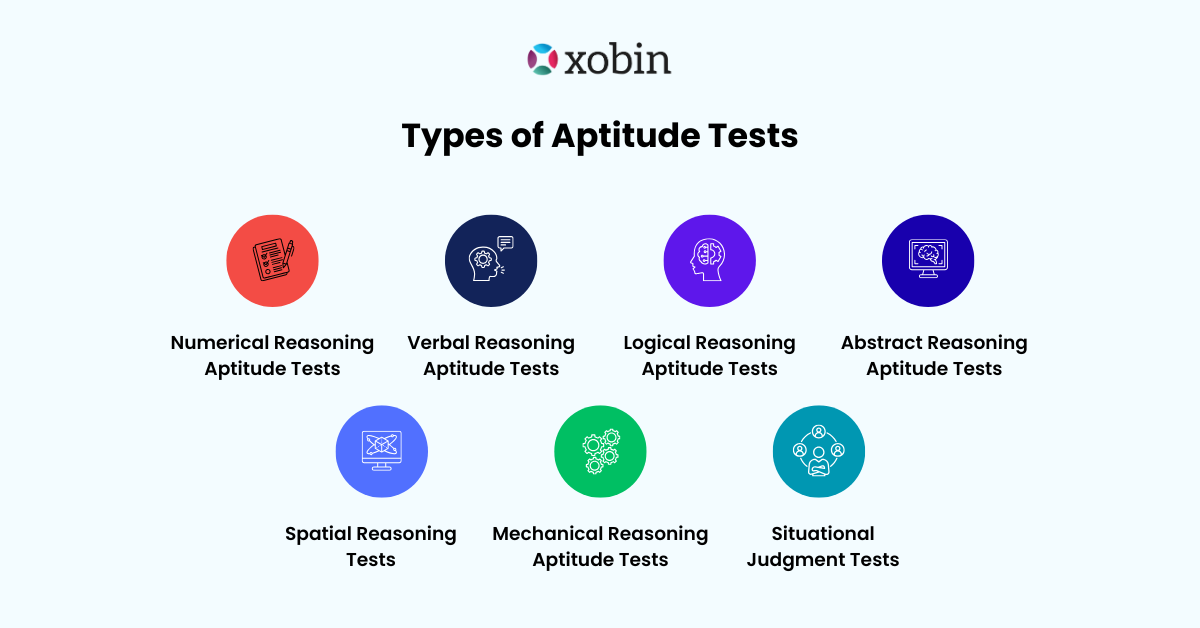
- Common types include numerical, verbal, logical, abstract, mechanical, and situational aptitude tests.
- Each aptitude test type aligns with specific job roles and hiring goals.
- Using the right mix of aptitude tests improves quality of hire and reduces mis-hires.
- AI-powered assessment platforms like Xobin help scale aptitude testing with accuracy and fairness.
Why Companies Use Different Types of Aptitude Tests
Not all roles require the same abilities. A sales manager needs verbal reasoning and decision-making skills, while an engineer relies more on logical and numerical reasoning. That’s why organizations use different types of aptitude tests in hiring, each designed to assess specific competencies aligned with job requirements.
Using a single generic test can lead to poor hiring outcomes. Instead, combining multiple aptitude tests creates a holistic view of a candidate’s capabilities. This role-based approach ensures better job fit, higher productivity, and improved retention.
Types of Aptitude Tests
1. Numerical Reasoning Aptitude Tests
Numerical reasoning tests assess a candidate’s ability to work with numbers, interpret data, and make logical decisions based on quantitative information. These tests typically include questions on percentages, ratios, averages, charts, graphs, and basic statistical concepts.
In hiring, numerical aptitude is especially important for roles that involve data-driven decision-making. Finance professionals, analysts, operations managers, and even sales leaders rely heavily on numerical insights to forecast trends, evaluate performance, and optimize outcomes. A strong score indicates not just mathematical ability but also attention to detail and analytical thinking.
Example: A financial analyst role may include questions asking candidates to interpret revenue growth from a bar chart or calculate profit margins based on given data. The goal is not advanced math but practical numerical reasoning under time constraints.
💡 Pro Tip: Use numerical aptitude tests early in the hiring funnel to quickly identify candidates who can handle data-heavy responsibilities without relying solely on past job titles.
2. Verbal Reasoning Aptitude Tests
Verbal reasoning tests measure a candidate’s ability to understand, interpret, and evaluate written information. These tests typically include reading passages followed by questions that assess comprehension, logical conclusions, and language clarity.
In today’s workplace, verbal aptitude is critical across almost all roles. Whether it’s understanding client requirements, interpreting policies, or collaborating across teams, employees must process written information accurately. Poor verbal reasoning often leads to miscommunication, errors, and inefficiencies.
Example: A customer success manager might be tested on short business emails or policy documents, followed by questions asking what conclusions can be drawn or which statements are true or false based on the text.
From a leadership viewpoint, verbal reasoning assessment helps recruiters identify candidates who communicate clearly and think critically and therefore prevent misinterpretation during high-stakes and decision-heavy situations.
3. Logical Reasoning Aptitude Tests
Logical reasoning tests evaluate a candidate’s ability to identify patterns, sequences, and relationships between abstract shapes or concepts. These tests are language- and culture-neutral, making them ideal for global hiring.
Logical aptitude reflects pure problem-solving ability. It shows how candidates approach unfamiliar challenges, recognize structures, and apply consistent rules. This makes logical reasoning assessment highly predictive of success in technical, analytical, and strategic roles.
Example: Candidates may be asked to identify the next shape in a sequence or determine which figure does not belong in a group. While abstract, these questions mirror real-world problem-solving scenarios where solutions are not immediately obvious.
💡 Pro Tip: Logical reasoning tests are excellent for identifying high-potential candidates in early-career or lateral hiring where past experience may not fully reflect capability.
4. Abstract Reasoning Aptitude Tests
Abstract reasoning tests are closely related to logical reasoning but focus more on novel problem-solving without relying on prior knowledge. They assess how quickly candidates learn new rules and apply them consistently.
These tests are particularly valuable for roles in fast-changing environments, such as technology, consulting, and leadership development programs. Abstract reasoning scores often correlate strongly with learning agility and innovation potential.
Example: A management trainee assessment may include abstract puzzles where candidates must infer rules governing shapes, colors, or movements, then apply those rules to new situations.
For organizations building future-ready teams, abstract reasoning tests help identify individuals who thrive amid ambiguity and complexity.
💡 Pro Tip: Use abstract reasoning tests early in the funnel to identify high-potential candidates with strong learning ability.
5. Spatial Reasoning Tests
Spatial reasoning tests measure a candidate’s ability to visualize objects, manipulate shapes mentally, and understand spatial relationships. These tests are essential for roles that involve design, engineering, architecture, or technical troubleshooting.
Strong spatial aptitude reflects practical intelligence, helping people understand how components fit together and how systems function in real space clearly. Therefore, this directly improves efficiency, safety, and quality across operational roles.
Example: An engineer may be asked to identify how a 3D object would look when rotated or which unfolded shape would form a specific structure when assembled.
Although niche, spatial reasoning tests are highly valuable when aligned correctly with job requirements.

Looking to reduce mis-hires and identify high-potential talent faster? Structured aptitude testing can transform your hiring outcomes.
Book A Demo6. Mechanical Reasoning Aptitude Tests
Mechanical reasoning tests evaluate knowledge of basic physical and mechanical concepts like force, motion, leverage, and energy. Therefore, employers widely use these tests in manufacturing, maintenance, and technical operations hiring.
Rather than testing theoretical physics, mechanical aptitude focuses on practical reasoning and how systems behave in real-world scenarios. Candidates with high mechanical aptitude tend to troubleshoot faster and make safer decisions on the job.
Example: Questions may involve gears, pulleys, or fluid systems, asking candidates to predict outcomes when conditions change.
For safety-critical roles, mechanical reasoning tests significantly reduce hiring risk.
7. Situational Judgment Tests (SJT)
Situational judgment tests show candidates realistic workplace scenarios and then ask how they respond. However, SJTs are not purely cognitive and assess reasoning, decision-making, and judgment.
These tests are especially effective for evaluating leadership potential, ethics, and interpersonal skills. They bridge the gap between aptitude and behavior.
Example: A candidate might be asked how they would handle a conflict between team members or prioritize tasks under a tight deadline.
SJTs provide context-rich insights that traditional aptitude tests alone may miss.
Comparison of Common Aptitude Tests Used in Hiring
| Aptitude Test Type | Skills Assessed | Best Suited Roles |
| Numerical Reasoning | Data analysis, math | Finance, Analytics |
| Verbal Reasoning | Communication, comprehension | HR, Sales, Leadership |
| Logical Reasoning | Problem-solving, patterns | Engineering, Consulting |
| Abstract Reasoning | Learning agility | Graduate, Innovation roles |
| Mechanical Reasoning | Technical understanding | Engineering, Operations |
| Situational Judgment | Decision-making, behavior | Managers, Customer-facing roles |
Ready to Hire Smarter with Aptitude-Based Assessments?
In today’s skills-first hiring landscape, choosing the right aptitude tests used in hiring can be the difference between a high performer and a costly mis-hire. From numerical and logical reasoning to situational judgment, aptitude tests help you move beyond resumes and make objective, data-backed decisions with confidence.
By leveraging structured aptitude assessments, organizations can improve quality of hire, reduce bias, and build future-ready teams at scale.
If you’re looking to streamline aptitude testing and gain deeper insights into candidate potential, now is the time to act. Book a personalized demo with Xobin today and see how AI-powered aptitude assessments can transform your hiring outcomes.
FAQs
1. What are aptitude tests in recruitment?
Aptitude tests measure a candidate’s cognitive abilities, problem-solving skills, and learning potential to predict job performance.
2. Which aptitude test is best for hiring?
There is no single best test. The right aptitude test depends on the role: numerical for finance, verbal for communication roles, and logical for technical positions.
3. Are aptitude tests biased?
When designed and administered correctly, aptitude tests reduce bias by providing objective, standardized evaluation.
4. Can aptitude tests predict job performance?
Yes. Studies show cognitive and aptitude tests are strong predictors of future job performance.
5. How long do aptitude tests take?
Most aptitude tests take 20–45 minutes, depending on the complexity and number of sections.
6. Can aptitude tests be used for remote hiring?
Absolutely. AI-powered platforms like Xobin offer secure, remote aptitude testing with advanced proctoring.