

A psychometric test that isn’t reliable is noise. A test that isn’t valid is worse: it’s noise you’re making hiring decisions from.
Most articles on this topic stay at the surface: “Reliability means consistency; validity means accuracy.” That’s true but not useful if you’re trying to evaluate whether a vendor’s test is actually worth using or defend your assessment process to a skeptical CHRO or legal team.
This guide goes beyond the basics. It covers the measurement science behind the reliability and validity of psychometric tests in simple terms. You’ll also learn how Xobin validates its assessments in real hiring scenarios. Finally, we’ll cover the key questions every hiring team should ask before trusting a psychometric test to make hiring decisions.
Table of Contents
TL;DR – Key Takeaway!
- Reliability means a test produces consistent results across time, raters, and test versions. Validity means it actually measures what it claims to measure. A test may be reliable but still not valid.
- Cronbach’s alpha above 0.70 is the standard threshold for internal consistency. Below that, the test is measuring noise, not a real construct.
- Schmidt & Hunter’s (1998) meta-analysis found cognitive ability tests predict job performance with a validity coefficient of 0.51, the strongest single predictor across 19 selection methods.
- Xobin’s psychometric testing software uses a three-layer validation methodology: Classical Test Theory (CTT) for initial item validation, Item Response Theory (IRT) for latent ability measurement, and Computer Adaptive Testing (CAT) for real-time difficulty adjustment.
- Before trusting any vendor’s reliability and validity claims, ask for criterion-related validity data, sample sizes, and Cronbach’s alpha scores. Vendors who can’t produce this data shouldn’t be trusted with high-stakes hiring decisions.
What Is the Difference Between Reliability and Validity in Psychometric Testing?
These two concepts are distinct, and conflating them is one of the most common mistakes hiring teams make when evaluating psychometric assessment tools.
Reliability is about consistency
A reliable test gives you the same result when you measure it under the same conditions.
- If a candidate takes a personality assessment today and retakes it two weeks later with no meaningful life change in between, their scores should be very similar.
- If they’re not, the test is measuring something unstable (test conditions, mood, or random variation) rather than the underlying trait it claims to measure.
Validity is about accuracy
A valid test measures what it claims to measure, and that measurement predicts the outcome you care about. The test can be perfectly reliable and completely invalid: imagine a test that consistently measures typing speed and applies it to assess leadership potential. You’ll get a consistent score every time. It won’t tell you anything about leadership.
The relationship between the two is directional: validity requires reliability, but reliability does not guarantee validity. This is the most important technical distinction for any hiring team evaluating psychometric vendors.
What Are the Types of Reliability in Psychometric Tests?
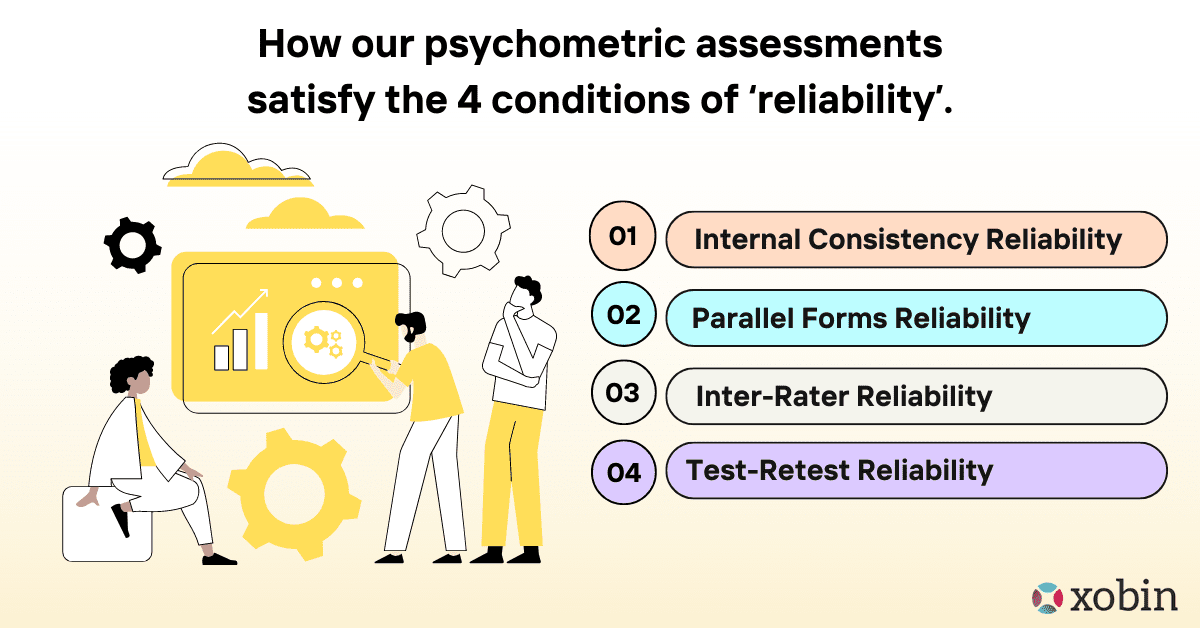
Understanding psychometric test reliability is the first step toward evaluating whether an assessment is worth trusting. The reliability and validity of psychometric tests depend on four distinct reliability types, each measuring a different dimension of consistency.
Test-Retest Reliability
Test-retest reliability measures whether scores are stable over time. Administer the same test to the same candidate at two different points, typically two to four weeks apart, and compare the scores. High correlation between the two results indicates strong test-retest reliability.
This matters most for stable traits like personality dimensions and cognitive ability, which shouldn’t fluctuate significantly over short periods. A personality test with poor test-retest reliability is measuring mood, not character.
Xobin validates test-retest reliability across cognitive ability and personality assessments by administering equivalent test versions to candidate cohorts at two separate intervals and measuring score stability using Pearson correlation coefficients. Traits measured include stable constructs (Big Five dimensions, cognitive aptitude, and HEXACO profiles) where high test-retest reliability is both expected and verifiable.
Internal Consistency Reliability
Internal consistency measures whether all the items within a test are actually measuring the same underlying construct. If a personality test claims to measure Conscientiousness, every question in that dimension should correlate with the others. Questions that don’t belong weaken the construct and produce noisy data.
The standard measurement tool is Cronbach’s alpha, a coefficient ranging from 0 to 1. The widely accepted threshold for a hiring context is α ≥ 0.70. Below that, the test has too much internal noise to generate trustworthy results. Above 0.90 can indicate over-redundancy (questions that are too similar), which inflates the coefficient without adding real measurement value.
Xobin applies Cronbach’s alpha as a standard quality gate across its test bank, revising or removing any items that fall below the threshold during validation before the assessment reaches a live candidate pool. Item difficulty indices from Classical Test Theory (CTT) also help evaluate whether each question contributes meaningfully to the overall score distribution.
Inter-Rater Reliability
Inter-rater reliability measures how consistently different evaluators score the same response. It is especially important for open-ended questions, video interview evaluations, and behavioral assessments that rely on subjective judgment.
The standard measure is the Intraclass Correlation Coefficient (ICC). An ICC above 0.75 indicates good inter-rater reliability, and above 0.90 is excellent. Anything below 0.50 signals that the scoring is too subjective to produce comparable results across evaluators.
Xobin uses clearly defined scoring rubrics with behavioral anchors for all subjective assessment components, reducing rater drift and keeping ICC scores within the good-to-excellent range. For fully automated assessments, algorithmic consistency checks replace inter-rater reliability entirely, removing rater subjectivity from the equation.
Parallel Forms Reliability
Parallel forms reliability verifies that two different versions of the same test measure the same construct with equal accuracy. This matters for high-volume hiring, where candidates take different test versions, and for retesting scenarios, where using the identical test would introduce memory effects.
Xobin validates parallel forms by drawing from a calibrated item bank, splitting items into equivalent sets, administering both versions to the same candidate cohort, and measuring score correlation between versions. This ensures no version is systematically harder or easier than another, keeping the scoring fair and comparable across the entire candidate pool.
What Are the Types of Validity in Psychometric Tests?
Psychometric test validity determines whether a test is actually worth acting on. Even a highly reliable test can produce data that doesn’t predict job performance if the validity hasn’t been established. The reliability and validity of psychometric tests together form the scientific foundation every hiring team should verify before deploying an assessment.
Content Validity
Content validity asks whether the test covers all the relevant dimensions of the construct it claims to measure. A leadership assessment that only measures communication misses decision-making, strategic thinking, and resilience, which are all core leadership dimensions. The test has gaps that make it an incomplete measure.
Building content validity starts with input from subject matter experts instead of relying only on statistical analysis. At Xobin, I-O psychologists review the framework during the item design stage to confirm every competency is fully represented before statistical validation takes place. As a result, a Xobin leadership assessment measures more than communication skills. It evaluates the complete set of competencies the role requires, giving hiring managers a well-rounded view of each candidate instead of an incomplete snapshot.
Construct Validity
Construct validity asks whether the test actually measures the theoretical psychological construct it claims to (intelligence, conscientiousness, emotional regulation) rather than something correlated but distinct.
Establishing construct validity requires confirmatory factor analysis (CFA): a statistical method that checks whether the item response patterns match the theoretical structure of the construct. If a Big Five personality test shows that Conscientiousness items cluster together and don’t load onto Extraversion or Agreeableness, the test has strong construct validity for that dimension.
Xobin applies CFA across its validated frameworks (Big Five, DISC, HEXACO, Dark Triad, and Emotional Intelligence) to confirm that each dimension is measuring what it’s designed to measure rather than a proxy for something else.
These properties can vary depending on the type of assessment you use. Read our guide to psychometric properties of a test to understand them in greater detail.
Criterion-Related Validity
Criterion-related validity is the most commercially important type for hiring teams. It measures whether test scores actually predict the outcome you care about: job performance, retention, or promotion readiness.
This is where the foundational research matters. Research has consistently shown that cognitive ability tests are one of the most effective tools for predicting workplace success. Schmidt and Hunter’s 1998 meta-analysis found a validity coefficient of r = 0.51, which outperformed every other individual hiring method included in their review of 85 years of selection studies. Combining a cognitive ability measure with a structured interview produces a composite validity of 0.63, making it one of the most effective evidence-based hiring combinations available.
It’s worth noting that more recent research has added nuance: Sackett et al. (2022) re-examined the Schmidt & Hunter meta-analysis using corrected statistical methods and found that structured interviews may in fact be the strongest single predictor of job performance, with cognitive ability remaining a highly valid but potentially slightly lower contributor than originally reported. The practical takeaway for hiring teams: use both, not one in isolation.
Xobin field-tests its assessments against actual role performance outcomes across client organizations to build and maintain criterion-related validity data specific to each psychometric assessment type and role category.
Face Validity
Face validity is the most subjective type: it describes how relevant and professional the test appears to candidates. A test with poor face validity generates candidate resistance and drop-off, even if it’s technically sound. For high-volume hiring where candidate experience matters, face validity has real operational consequences beyond measurement science.
Xobin builds its assessments with this in mind. Section-level timers, a clear welcome screen explaining what the test covers and how long it takes, and mobile-friendly delivery all contribute to a test experience that candidates perceive as fair and purposeful, which directly reduces drop-off rates before you lose candidates you haven’t even evaluated yet.
If you’re still weighing whether the investment makes sense, our breakdown of whether psychometric testing is worth it for recruitment walks through why they are important—a must-read!
How Does Xobin’s Validation Methodology Work?
Most psychometric vendors rely on a single validation framework, which means their psychometric test validation standards often stop at surface-level reliability metrics. Xobin uses three frameworks in combination, each serving a distinct purpose in the validation pipeline.
Layer 1: Classical Test Theory (CTT)
CTT is the foundation. Before any Xobin assessment reaches a live candidate pool, every item in the test bank goes through CTT analysis covering the following:
- Observed score decomposition: separating true score variance from measurement error
- Item difficulty indices: identifying questions that are too easy, too hard, or generating unexpected response patterns
- Internal consistency measurement: Cronbach’s alpha calculated for every dimension, with items below threshold revised or removed
- Traditional reliability metrics: test-retest, inter-rater, and parallel forms reliability all calculated using CTT methods
CTT gives Xobin a verified baseline: a test bank of items that are statistically sound before any adaptive logic kicks in. For hiring teams, this means every question in a Xobin assessment has already cleared a quality gate before a single candidate sees it.
Layer 2: Item Response Theory (IRT)
While CTT looks at the overall test, IRT examines each question independently, no matter who takes the assessment. This difference is important because CTT results can shift based on the ability level of the test group. For instance, a challenging question may appear easier when a group of high-performing candidates answers it. IRT avoids this issue by measuring how a candidate’s underlying ability affects the probability of answering each question correctly.
To improve cognitive and aptitude assessments, Xobin uses IRT models to:
- Measure each candidate’s true ability level based on how they respond, not just which questions they happened to answer.
- Set consistent difficulty, discrimination, and guessing benchmarks for every item so scores stay stable across test versions
- Make candidate comparisons meaningful even when two people took different sets of questions.
This is what makes Xobin’s scoring comparable at scale. Whether a candidate takes version A or version B of a cognitive assessment, their score reflects their actual ability level rather than the luck of which questions they happened to draw. For CHROs hiring across multiple regions or cohorts, this means you can compare candidates fairly even when they didn’t take identical tests.
Layer 3: Computer Adaptive Testing (CAT)
Computer Adaptive Testing (CAT) is the method that puts IRT into action. Instead of presenting every candidate with the same fixed set of questions, Xobin’s adaptive engine chooses each next question in real time based on the candidate’s previous response. The test raises the difficulty after a correct answer. It lowers the difficulty after an incorrect one.
The outcome is a more accurate measure of a candidate’s ability with far fewer questions. While a traditional fixed-form cognitive test may require around 40 questions to deliver reliable results, Xobin’s CAT engine achieves a similar level of accuracy in just 20 to 25 questions. This shorter approach cuts testing time without compromising the quality of the assessment.
As a result, an assessment that previously lasted about 45 minutes on Xobin now usually wraps up within 25 to 30 minutes. With more than 4 million candidates evaluated across 5,000+ organizations worldwide, this level of precision has been proven through large-scale hiring rather than only controlled research studies.
How to Evaluate Psychometric Tests: Reliability and Validity Claims
Knowing how to evaluate psychometric tests before committing to a vendor is one of the most overlooked steps in the assessment buying process. Understanding the reliability and validity of psychometric tests at a conceptual level is one thing; verifying that a specific vendor actually meets those standards is another. Here are the specific questions to ask before trusting any assessment with a hiring decision.
Ask for criterion-related validity data
What does your research suggest about this test’s ability to predict job success? Ask for the correlation coefficient, the sample size, and the job families studied. A vendor who claims “high predictive validity” without a specific number and study is making a marketing claim, not a scientific one.
Ask for Cronbach’s alpha by dimension
Not an aggregate score, but per dimension. A composite alpha can mask weak sub-scales. You want α ≥ 0.70 for every dimension the test claims to measure.
Ask about the validation sample
Was the test validated on a diverse, global sample? A test validated on a US-based sample of recent graduates may not hold up when used to hire operations managers in India or compliance officers in the UAE. Ask for demographic breakdown and geographic coverage.
Ask about ongoing validation
A validation study conducted in 2018 is not evidence of current validity. Norms drift, job requirements change, and the candidate pool evolves. Find out how regularly the vendor refreshes its validation data and what events lead to a new round of validation.
Ask about adverse impact analysis
Does the test produce differential selection rates across demographic groups? Ask for pass-rate data by gender, ethnicity, and age group. Any vendor unwilling to share this data is a liability, not a partner.
See our full breakdown of psychometric testing challenges for more on adverse impact risk.

Already know what to ask? Put Xobin's validation to the test.
Book A DemoXobin Sets the Standard for Psychometric Test Reliability and Validity
Many psychometric testing providers talk about scientific accuracy. However, only a few can back those claims with clear evidence when you ask for it. Xobin takes a different approach. Instead of relying on marketing promises, our platform provides documented and verifiable evidence of its reliability and validity. It combines three complementary validation frameworks that many competing platforms do not offer.
Every assessment on the Xobin platform passes through a three-step validation process. We apply Classical Test Theory to check the quality of every question, use Item Response Theory to measure ability without depending on the test group, and leverage Computer Adaptive Testing to improve accuracy as candidates progress. Mark Smith, Ph.D. in Industrial-Organizational Psychology, reviews each framework. We benchmark every score against the actual competency profile for your role instead of a general population standard. You also receive validation documentation that your legal team can confidently review when needed.
Xobin earned recognition in the Gartner Market Guide for Developer Skills Assessment and Interview Platforms (2024). More than 5,000 organizations across 55+ countries trust our platform to make confident hiring decisions. It helps hiring teams create assessments that stand up to scientific standards, legal requirements, and real-world business needs.
Our platform delivers detailed psychometric insights for every candidate. You can confidently identify people who truly match your organization and culture. When evaluating potential, don’t just ask, “Are they qualified?” Make sure you’re using the right tools to assess their strengths. Choose Xobin for accurate, reliable, and scientifically backed psychometric testing. Schedule a personalized demo today!
People Also Ask
What does Cronbach’s alpha measure in a psychometric test?
Cronbach’s alpha measures internal consistency: whether all items in a test dimension are measuring the same construct. A score of 0.70 or above is the accepted minimum for hiring assessments. Below that, the test is generating noise, not reliable data.
What is criterion-related validity and why does it matter in hiring?
Criterion-related validity measures whether test scores predict actual job performance. Schmidt & Hunter (1998) found cognitive ability tests achieve a validity coefficient of 0.51, the highest of any single selection method. It is the most commercially important validity type for hiring teams.
What is Item Response Theory (IRT) and how does it improve psychometric testing?
IRT models the relationship between a candidate’s latent ability and their probability of answering each item correctly. Unlike Classical Test Theory, IRT produces stable item-level parameters regardless of which candidate group was tested, enabling accurate score comparisons across different test versions.
How do I know if a psychometric test has good validity?
Ask the vendor for criterion-related validity data: the correlation coefficient, sample size, and job families studied. Also ask for Cronbach’s alpha per dimension, not an aggregate. Vendors who cannot produce specific numbers are making marketing claims, not scientific ones.
What is the ICC and when does it apply to psychometric testing?
The ICC measures how consistently different evaluators score the same candidate response, with scores above 0.75 considered good and above 0.90 excellent. It applies specifically to assessments with subjective components like open-ended questions or behavioral interviews, where scoring involves human judgment rather than automated grading.
Does Xobin’s psychometric testing meet professional validation standards?
Yes. Xobin uses Classical Test Theory for item validation, Item Response Theory for latent ability measurement, and Computer Adaptive Testing for real-time precision. All assessments are reviewed by Mark Smith, Ph.D. in Industrial-Organizational Psychology.