

Talent intelligence platforms use AI, skills data, analytics, and talent-market information to help organizations make better hiring and workforce decisions. In practice, they can support candidate sourcing, skills assessment, talent matching, internal mobility, workforce planning, or people analytics.
You’ve been asked to bring more intelligence into hiring. Maybe recruiters are spending too much time searching through resumes, or your organization needs better visibility into skills, talent supply, internal mobility, or future workforce needs.
The challenge is that talent intelligence platforms don’t all solve the same hiring problem. Some focus on candidate sourcing and matching, while others specialize in skills assessment, internal mobility, labor-market intelligence, or workforce planning. Instead, this list compares them by the job each one is best equipped to solve, based on published capabilities, positioning, available pricing, and public product information.
Table of Contents
TL;DR – Key Takeaways
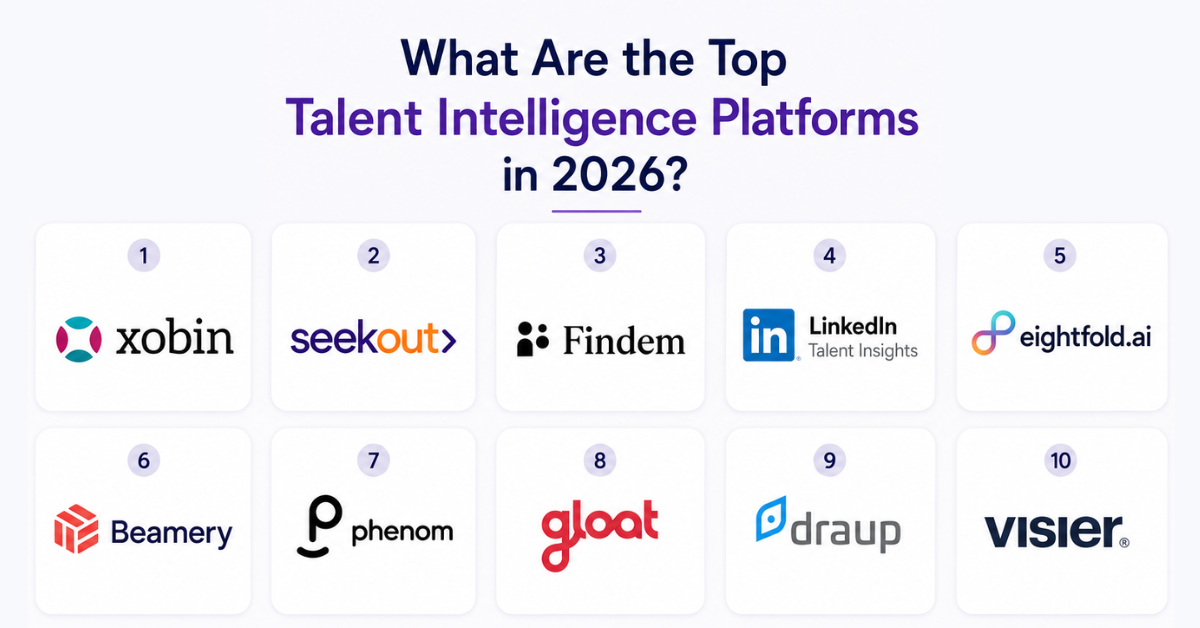
- The 10 Talent Intelligence Platforms compared here are Xobin, SeekOut, Findem, LinkedIn Talent Insights, Eightfold AI, Beamery, Phenom, Gloat, Draup, and Visier.
- However, these platforms solve different problems: Xobin focuses on skills assessment and candidate evaluation, SeekOut and Findem on talent discovery, LinkedIn Talent Insights on labor-market intelligence, Eightfold on broader talent matching, Gloat on internal mobility, and Draup and Visier on workforce intelligence and planning.
- No single platform is automatically the best choice for every organization. The right one depends on your hiring volume, data maturity, workflow, and primary use case.
What Is a Talent Intelligence Platform?
Talent intelligence platforms use data, skills information, AI, analytics, or labor-market intelligence to help organizations make better talent decisions. The term covers several different categories:
- A sourcing platform helps recruiters find candidates.
- A skills assessment platform helps organizations measure what candidates can actually demonstrate.
- A talent matching platform connects people with roles based on skills, experience, or career trajectories.
- An internal talent marketplace helps organizations move existing employees into roles, projects, mentorships, or learning opportunities.
- A workforce intelligence platform helps leaders understand workforce trends, skills gaps, people data, and future talent requirements.
That’s why the right comparison starts with the problem you need to solve, not the size of a vendor’s feature list.
Best Talent Intelligence Platforms at a Glance
| Platform | Best For | Key Differentiator |
| Xobin | AI-powered talent intelligence and potential assessment | Assessments, AI-powered interviews, proctoring, and skills-based hiring workflows |
| SeekOut | External technical and diversity sourcing | AI-powered search across 1B+ profiles and advanced sourcing filters |
| Findem | Attribute-based talent discovery | Multidimensional talent data and attribute-based search |
| LinkedIn Talent Insights | Labor market benchmarking | Workforce and talent-pool insights based on LinkedIn data |
| Eightfold AI | Enterprise talent intelligence and matching | Talent intelligence trained on 1.6B career trajectories and 1.6M skills, according to Eightfold |
| Beamery | Talent CRM and skills-based workforce planning | Talent Graph and TalentGPT |
| Phenom | Talent experience and workforce intelligence | Candidate, employee, recruiter, and manager experiences combined with AI |
| Gloat | Internal talent mobility | AI-powered talent marketplace connecting skills, aspirations, and opportunities |
| Draup | Workforce and labor-market intelligence | Talent, skills, location, and market intelligence |
| Visier | People analytics and workforce planning | Workforce intelligence, Vee, and AI-powered analytics |
How We Ranked the Talent Intelligence Tools
This is an editorial ranking, not an independent performance benchmark. Even so, the platforms operate across different parts of the talent lifecycle, so comparing them as if they were interchangeable products would be misleading.
We evaluated each platform across four criteria:
- Data and intelligence depth: how much relevant talent, skills, labor-market, or workforce intelligence the platform provides
- Core use-case fit: how directly the product addresses the problem it’s being recommended for
- Workflow breadth: how many connected activities the platform supports beyond its primary use case
- Pricing transparency: whether the vendor publishes pricing or requires a sales conversation
We reviewed publicly available product documentation, company information, and review sources for each entry. In addition, where a figure comes directly from a vendor, we identify it as vendor-reported rather than an independent benchmark. Because pricing, features, and positioning change, treat this as a point-in-time comparison rather than a permanent ranking.
How to Choose a Talent Intelligence Platform?
Skip the vendor comparison until you’ve answered these for your own organization. In fact, most failed rollouts trace back to skipping this step, not to picking the wrong vendor.
Name your bottleneck in one sentence.
Not “we need better AI hiring tools,” but “we can’t tell which candidates actually have the skills they claim” or “recruiters spend three weeks sourcing before a single interview.” Otherwise, a vague problem statement leads to a vague, overpriced purchase.
Audit what data you actually have.
Workforce planning and internal mobility tools need structured skills and performance data already sitting in your HRIS. If that data doesn’t exist yet, you’re not ready for Gloat or Visier, you’re ready for a data cleanup project.
Get the right people in the room before the demo.
A sourcing tool decision belongs to TA leads. By contrast, a workforce planning tool decision belongs to finance and HR together. Bringing the wrong stakeholders to the eval means re-litigating the purchase after it’s made.
Pilot on one team before rolling out company-wide.
Run the platform against a single job req or department first. That way, it surfaces integration gaps and adoption friction while the cost of walking away is still low.
Prior to signing, establish a 90-day success metric.
Time-to-fill, quality-of-hire, or internal mobility rate, whichever maps to your bottleneck from step 1. Without a number to check against, “it feels like it’s working” is the only signal you’ll get.
10 Talent Intelligence Platforms to Consider in 2026
1. Xobin
Best for AI-Powered Talent Intelligence and Potential Assessment
Xobin is a talent assessment and candidate evaluation platform that combines skills assessments, AI-powered interviews, proctoring, and candidate analytics. It serves medium to large enterprises and combines validated assessments with AI-driven interviewing in one workflow.
Its core differentiator is AI-powered interviews with configurable skills, evaluation criteria, follow-up questions, interview settings, and proctoring options, framed as a shift from measuring a static skill snapshot to surfacing a candidate’s underlying potential.
Key features:
- NURA, an AI interview agent assessing job skills plus communication and leadership skills
- Automation and advanced analytics across screening, tracking, and interviewing in one workflow
- AI-powered proctoring for secure testing across campus drives and technical, non-technical, and psychometric evaluations
- Question library across technical and non-technical domains
Pricing: Custom quote-based. No public pricing tier listed.
Pros:
- G2 rating of 4.7 out of 5, with users specifically praising ease of use and customer support
- Used by more than 5,000 teams across 55+ countries
- The AI interviewing layer (NURA) extends assessment beyond hard skills into communication and leadership signals
Cons:
- Smaller firms may find the custom pricing model less flexible than tiered self-serve competitors
- Meanwhile, some users want deeper integration options and more advanced proctoring features
Best for: TA teams that want AI-driven interviewing and potential-based talent intelligence, not just a static skills test.
2. SeekOut
Best for External Technical and Diversity Sourcing
SeekOut was built by engineers with backgrounds at Microsoft, aiming to fix a simple problem: most sourcing tools reflect a single talent pool and hand every recruiter the same shortlist. To address this, it indexes candidate signals most competitors miss, including GitHub contributions, academic papers, patents, and conference speaking history.
Key features:
- 1 billion+ indexed profiles across LinkedIn, GitHub, and Google Scholar
- DEI module that infers diversity attributes from open-web signals without requiring self-identification
- Security clearance filters covering multiple US clearance levels
Pricing: Roughly $15,000 to $30,000+ per year with a 3-seat minimum. Enterprise deployments can run to $90,000+.
Pros:
- DEI and diversity sourcing filters described as among the most capable in the sourcing category
- Strong for hard-to-source technical and security-cleared roles
Cons:
- Entry pricing and 3-seat minimum are steep relative to lighter sourcing tools
- Additionally, coverage has historically been stronger in the US and Canada than other regions
Best for: Technical recruiting teams that have exhausted LinkedIn as a primary sourcing channel.
3. Findem
Best for Attribute-Based Candidate Discovery
Findem takes a different angle on sourcing than SeekOut or LinkedIn: it indexes candidates by attribute rather than by keyword or title, using multidimensional candidate and company data to support attribute-based talent discovery, from tangible traits like location to intangible ones like leadership quality or entrepreneurial drive.
Key features:
- Attribute-based search built on 1B+ mapped career paths and 2M+ labeled Success Signals
- Talent Data Cloud combining public and internal data into “3D data” for context-aware AI
- Diversity maps and benchmarking alongside standard sourcing filters
Pricing: Custom, based on seats and modules selected; contact sales for a quote.
Pros:
- Attribute-level search surfaces candidates that keyword-based tools miss entirely
- Publicly transparent about AI hallucination risk in analytics and how it mitigates it through data separation
Cons:
- Founded in 2020, making it newer with a smaller public track record than incumbents like SeekOut or LinkedIn
- As a result, it also has less brand recognition among generalist TA teams outside sourcing specialists
Best for: Teams that want attribute-level candidate search beyond standard keyword filters.
4. LinkedIn Talent Insights
Best for Labor Market Benchmarking
LinkedIn Talent Insights solves a narrower problem than the enterprise suites below: labor market benchmarking, not candidate sourcing or internal mobility. It answers where a skill is concentrated, how a competitor’s headcount is shifting, and what talent supply looks like in a target market, pulling directly from LinkedIn’s own professional network.
Key features:
- Talent pool and supply-and-demand analysis by skill, location, and industry
- Competitor headcount and hiring trend benchmarking
- Built on LinkedIn’s own member data rather than aggregated third-party profiles
Pricing: Not publicly listed; contact LinkedIn for a quote.
Pros:
- Direct access to LinkedIn’s professional network for market data, without needing a separate data vendor
- Useful complement to a sourcing tool rather than a replacement for one
Cons:
- Competitors like Draup for Talent and Korn Ferry Intelligence Cloud cover similar ground with deeper cost modeling in some cases
- Also, it doesn’t execute sourcing or outreach; it’s purely an analytics layer
Best for: TA leaders and workforce planners who need market data to inform strategy, not to execute sourcing.
5. Eightfold AI
Best for Enterprise-Wide AI Matching
Eightfold AI is designed for enterprise-wide talent intelligence and matching. According to Eightfold, its AI is powered by 1.6 billion career trajectories and 1.6 million skills. Notably, it’s the only platform on this list built to run external hiring, internal mobility, and workforce planning through one AI model instead of three connected tools.
Key features:
- Deep-learning matching engine scored on inferred skills, not keyword overlap
- AI Interviewer for autonomous, structured candidate interviews at high volume
- Unified data layer across acquisition, mobility, and workforce planning
Pricing: Sales-led. Enterprise contracts typically run into six figures annually, with multi-quarter implementation timelines.
Pros:
- Deepest AI matching model in the category, trained on a very large global talent dataset
- Some customers report cutting time-to-fill to as little as 1.3 days for high-volume roles using AI Interviewer (a vendor-reported case study figure, not a typical average)
Cons:
- Sales-led pricing with six-figure typical commitments puts it out of reach for smaller TA teams
- In addition, long implementation cycles are common to full-suite enterprise platforms
Best for: Large enterprises that want acquisition, mobility, and workforce planning run through a single AI vendor.
6. Beamery
Best for Talent CRM and Skills-Based Planning
Beamery earns its spot on talent CRM strength because its AI is grounded in relationship data, not just resumes. TalentGPT is built on the Beamery Talent Graph, which tracks over 17 billion data points about candidates, companies, skills, and jobs, layering Beamery’s proprietary models with pre-trained large language models including GPT-4.
Key features:
- TalentGPT generative AI assistant for job descriptions, outreach, and candidate insights
- Combined CRM, internal talent marketplace, and skills inference in one system
- Independent AI bias audits, a differentiator among enterprise talent CRMs
Pricing: Custom, subscription-based annual licensing that varies by user count and modules selected.
Pros:
- Strong long-term candidate relationship layer for passive talent nurturing
- Skills-based workforce planning built on the same data as sourcing and CRM
Cons:
- Reviewers note the platform’s value is “clearly designed for larger enterprises,” with less payoff for smaller teams
- On top of that, pricing isn’t published, requiring a sales conversation to scope cost
Best for: Enterprises that need a long-term candidate relationship layer alongside internal mobility.
7. Phenom
Best for Candidate, Employee, and Recruiter Experience
Phenom’s talent experience platform relies on 25 billion interactions annually across more than one billion candidate profiles spanning 180 countries and 400 million jobs. Where competitors optimize around the recruiter’s dashboard, Phenom built its architecture around four personas: candidates, employees, recruiters, and managers.
Key features:
- Talent Experience Engine for personalized candidate, employee, and alumni campaigns
- Career sites, chatbots, and internal mobility portals unified on one talent graph
- Workforce intelligence layer strengthened by its early-2026 acquisition of Included, an AI-native people analytics platform
Pricing: Roughly $7 to $13 per employee per month, with minimum annual contracts around $100,000 for large organizations.
Pros:
- Only platform on this list explicitly built for four distinct stakeholder experiences
- Strong reported outcomes on time-to-fill reduction and internal mobility
Cons:
- One reviewer notes standard analytics are “good, but not elite level” compared to dedicated people analytics tools
- Beyond that, initial setup and feature-flag configuration can be complex
Best for: Large enterprises (1,000+ employees) that want one connected system across the full talent lifecycle.
8. Gloat
Best for Internal Talent Marketplaces
If internal mobility is the current bottleneck, Gloat is the platform most reviewers point to first. Ben Reuveni founded Gloat in 2015 alongside Amichai Schreiber and Danny Shteinberg, after discovering that a majority of employees’ next career move was already available inside their own company.
Key features:
- Skills-based internal marketplace matching employees to open roles, gigs, and mentorships
- Workforce insight dashboards surfacing skill abundance and impending gaps
- Deployed across 120+ countries with major global enterprise clients
Pricing: Custom, scoped to workforce size and modules; contact sales for a quote.
Pros:
- First-to-market internal mobility marketplace with proven enterprise deployments at Unilever, PepsiCo, Standard Chartered Bank, Schneider Electric, Nestlé, HSBC, and Seagate
- Deep specialization in transferable-skills matching that generic ATS tools miss
Cons:
- Doesn’t address external candidate sourcing; by design, this is an internal-only tool
- It also requires structured internal skills and performance data to be useful, which many mid-sized companies haven’t built yet
Best for: Enterprises with 1,000+ employees trying to cut external hiring costs through internal redeployment.
9. Draup
Best for Workforce Planning and Location Cost Modeling
Draup for Talent is a multidimensional labor and market data platform trusted by more than 300 global enterprises, including 5 of the Fortune 10 and companies like Microsoft, PepsiCo, Citizens Bank, and Moderna. Its standout features are practical rather than flashy.
Key features:
- Cost-modeling tool showing what it costs to hire a specific skill set in a specific location
- Reskill navigator for planning internal upskilling initiatives
- Talent dashboards combining location and skill-pool trend data
Pricing: Custom, scoped per engagement; no self-serve tier.
Pros:
- Responsive, consultative account team that scopes specific talent intelligence report requests
- Strong fit for pre-hiring location and cost-of-labor strategy work
Cons:
- No self-serve tier; every engagement routes through a custom scoping process
- As a result, it’s better suited to planning-stage decisions than active day-to-day sourcing
Best for: Enterprises doing location strategy and reskilling planning ahead of active hiring.
10. Visier
Best for People Analytics and Workforce Planning
Founded in 2010 by pioneers of business intelligence, Visier serves over 65,000 customers across 75 countries, including BASF, Panasonic, Experian, Amgen, eBay, and Ford Motor Company. Unlike the sourcing-focused platforms above, Visier’s category is people analytics, turning HRIS, ATS, and performance data into forecasts a CFO would actually trust.
Key features:
- Real-time People Data Platform unifying HR and business data
- Vee, a generative AI assistant for conversational workforce queries
- Prebuilt Vee Boards for C-suite-ready analysis on cost, attrition, and skills gaps
Pricing: Custom, scaled to organization size; contact sales for a quote.
Pros:
- Industry analyst Josh Bersin distinguishes Visier as excelling at analyzing transaction data, where matching-focused platforms like Eightfold, SeekOut, and Beamery excel at identifying and matching people
- Large, long-tenured enterprise customer base across industries
Cons:
- No candidate sourcing or matching capability; it’s purely an analytics and planning layer
- Best value requires integrating multiple existing HR systems, which takes setup time
Best for: HR and finance leaders who need trusted, board-ready workforce metrics rather than candidate matching.
Final Verdict
Match the platform to the job, not the other way around. If skills validation is broken, fixing it with Xobin pays off before you spend six figures on Eightfold or Beamery to match candidates against unreliable data. When sourcing is the wall you keep hitting, SeekOut or Findem solve that specific problem faster than a full enterprise suite ever will. And if you’re already running a mature TA function, Draup or Visier turn the workforce data you have into decisions leadership will actually act on.
The single biggest mistake buyers make in this category is purchasing a full-lifecycle suite to fix a one-stage problem. In other words, it’s the fastest way to end up with expensive software nobody logs into by month three.
The decision rule that actually works: name your current bottleneck first (validation, sourcing, matching, mobility, or planning), shortlist the one or two platforms built specifically for that stage, and only evaluate broader suites once a point solution has been outgrown.
Disclamer: August, 2026, initial publication. Rankings and pricing sourced from vendor sites, G2, and Gartner Peer Insights current as of this date; we revisit this guide as pricing or features change and will log updates here.
Frequently Asked Questions
What’s the difference between a talent intelligence platform and an ATS?
An ATS manages application workflow: postings, pipelines, and interview stages. By contrast, a talent intelligence platform layers AI and analytics on top of that workflow data, plus external market data, to answer bigger questions like which skills the company will need in three years or where untapped internal talent already exists.
Do small companies need a talent intelligence platform?
Most teams under roughly 1,000 employees don’t yet have the structured skills data, performance history, or hiring volume these platforms are built to analyze. As a result, buying the platform before that data exists usually produces an expensive dashboard rather than better decisions.
Which talent intelligence platform is best for skills verification?
Xobin combines validated skills assessment and psychometric testing with NURA, its AI interview agent, to evaluate candidates across job skills plus communication and leadership traits, as a standalone skills-validation layer.
Can one platform cover both external sourcing and internal mobility?
Eightfold AI, Beamery, and Phenom are the three platforms on this list built to span both external hiring and internal mobility in one system. By comparison, purpose-built single-use-case tools (SeekOut for sourcing, Gloat for internal mobility) tend to go deeper in their specific lane.