

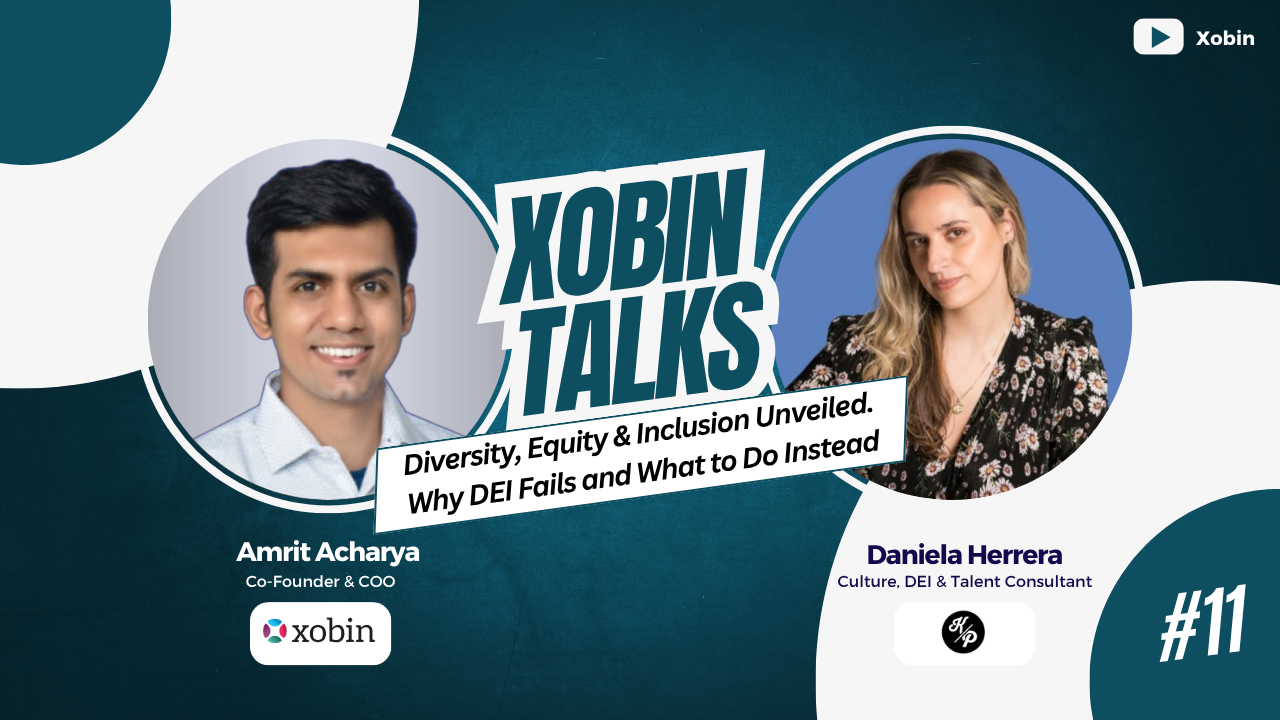
| GUEST PROFILE Daniela Herrera, Culture, DEI and Talent Consultant, Speaker, Facilitator and Trainer with 17 years of experience across Talent Operations, Recruitment and People Management Connect: LinkedIn |
This episode was hosted by Amrit Acharya, Co-Founder and COO of Xobin.
Table of Contents
TL;DR – Key Takeaways
- The average CDO tenure is just 1.8 years, compared to over 5 years for other C-suite roles (Russell Reynolds Associates). CDOs are not failing. They are being set up without the executive support needed to succeed.
- DEI should not report into HR. It should report directly to the CEO or board. The function responsible for deconstructing HR’s inequitable practices cannot operate effectively as a sub-function of HR.
- Performative DEI focuses on celebrations and hiring numbers. Real DEI focuses on equity in processes: promotion cycles, performance review language, interview question design and accessibility of job applications.
- Bias in performance reviews is one of the most underdiscussed DEI problems. People often judge women, especially women of color, based on their personality instead of their skills, while men showing the same behavior usually receive neutral or positive feedback.
- DEI data should be split into three buckets: recruiting data, retention data and exit data. Exit data is where you find out whether your DEI program was performative or genuinely working.
Most companies think they are practicing DEI. However, they usually rely on a diversity team, a Pride Month campaign, inclusive job descriptions, and an ERG to prove it.
And then they wonder why the numbers are not moving.
Daniela Herrera has 17 years of experience watching this pattern repeat. Born and raised in Buenos Aires, she was doing what we now call diversity recruiting long before the function had a name. Moving to New York seven years ago, she discovered her work had a formal profession built around it, and she has spent the years since helping organizations move past the performative version.
In this episode #11 of Xobin Talks, host Amrit Acharya, Co-Founder and COO of Xobin, asks the questions to Daniela that most DEI discussions purposefully avoid.
“DEI, ED&I, D&I – Why Does Nobody Agree on What to Call This?”
Amrit opens with a question that trips up many HR leaders: the nomenclature is everywhere and completely inconsistent. Is it DEI, ED&I, D&I, or Diversity and Belonging? More significantly, does it really matter what label you choose?
Daniela: “Every DEI professional you speak with will likely give you a different answer, and there is a real reason behind that. Different organizations are at different stages of the work, and the name they choose reflects where they are placing emphasis. Some are still primarily focused on representation, ‘the diversity piece.’ Others have moved into equity and inclusion as their operational priorities. And that is how they name their teams and their disciplines.”
She prefers the term ED&I (Equity, Diversity, and Inclusion) because she strongly believes equity must come first, and she is specific about “why”.
Daniela: “I strongly believe that we need to focus on equity first. Making sure we have equitable processes and systems and policies that will support talent. And then what happens inherently is, if your processes are equitable and they are inclusive, the diverse talent will actually come to you. It will be easier to recruit them and to retain them.”
The distinction sounds cosmetic, but in practice it reflects a completely different operating model.
- A diversity-first company asks, “How do we hire more people from underrepresented groups?”
- An equity-first company asks: Are our hiring, promotion and retention processes systematically excluding certain groups, and if so, what specifically needs to change?
The second question is more challenging because it involves reviewing long-standing practices that people have accepted for years without question. That is precisely why addressing it is so important.
“Should DEI Even Report into HR? Because I Think the Answer Might Be No.”
This is where Amrit puts the controversial question on the table and Daniela does not hesitate.
Daniela: “DEI, in my opinion, is not an HR problem. HR policies, recruitment practices, promotion cycles, and the entire talent experience have been inequitable and inaccessible and uninclusive by design for way too long. So, I am of the opinion that we cannot deconstruct something that is inequitable by following the same systems we have been following for decades without even questioning them.”
Her recommendation is unambiguous: DEI should be a completely separate department, reporting directly to the CEO, the board, or the most senior business leader available. Not HR. Not a sub-function of people operations.
Daniela: “This approach, among millions of quotes, makes it easier to integrate diversity and inclusion into all policies, practices, and systems. And at the same time, you have an external professional who can come in; take a look at the processes you have been following and the platforms you have been using with a completely different set of eyes and a completely different set of experience; and let you know, “Hey, the way we have been recruiting or promoting talent is inequitable, and here is a better way.”
And If You Really Commit – Should HR Report Into DEI?
Amrit pushes further, asking, if you really commit to this, would you actually have HR report into DEI for a period?
Daniela: “If you push me? Yes, especially in the beginning. After all, we are discussing how to break away from outdated practices in hiring, promotion, and employee retention. Until organizations make every system fair and inclusive, I believe HR teams should continue reporting on diversity and inclusion for some time. That way, companies can create more equitable workplaces before easing those efforts.”
The reason is simple: the entity under audit should never control the auditing process itself. Otherwise, it creates a clear structural conflict. Yet, many organizations continue to operate within this flawed setup without fully recognizing the risk.
“93% of HR Leaders Say DEI Is a Priority. But That Number Drops to 33% When You Ask the CXO. How Do You Bridge That Gap?”
Amrit shares a data point that stops Daniela mid-thought: when Xobin speaks with HR leaders, 93% cite DEI as a top-five priority. When those same conversations happen with CXOs outside HR, that number falls to 33%.
Daniela: “I love this question and I know my answer is a little tricky, especially to people in HR because they often do not agree with me right away. But there is no one-size-fits-all solution for how to convince your business leader. As DEI specialists or consultants, we start by attempting to identify the company’s current state, the leader’s location in particular, and the obstacles. Then, we try to make them see and understand how diversity, equity and inclusion will make their own company better and more successful at the end of the day.”
Some companies are still operating on the business case model. They need data, projections, and ROI. Others have moved beyond that. The starting point is always the same: find out where this specific leader is, what they are resistant to, and what language will reach them.
Daniela points to a difficult reality: without genuine commitment from leadership, a CDO cannot succeed in their role. Simply put, no amount of data, strategy, or persuasion can replace true executive support and involvement.
“Companies Are Celebrating Pride Month and Black History Month. Is Any of That Actually Moving the Needle?”
Amrit points to something both of them have watched happen across the industry: in 2015, tech companies started publishing diversity statistics. Many people assumed the numbers would improve within a couple of years. That did not happen. And now, in 2024, many of those same companies are quietly pulling back.
Daniela: “However, a lot of businesses still exclusively concentrate on performative behaviors. Especially after 2020, after the murder of George Floyd, every single company was focused on hiring diverse talent, hiring Black talent, and hiring DEI teams. And then fast forward three years, every single company is kind of reversing back to 2019, both from a work-from-home situation and from a diversity and inclusion point of view.”
She is specific about what makes something performative versus real.
Daniela: “They are jumping on just the celebration part of diversity and inclusion. They are just focusing on hiring without focusing on building equitable and accessible and inclusive processes. And I know I have said that a couple of times already, so let me give you an example.”
Her example is the job description. Most companies have some version of inclusive language in their JDs, but what does that actually mean in practice?
Daniela: “Are we focusing only on gender-inclusive language? Or are we also speaking in plain language that everyone can comprehend, irrespective of their upbringing, degree of education, culture, or first language? Because when companies write job descriptions in plain language, they make them clear, simple, and accessible for everyone.”
The Audit That Most Companies Skip
From there, she walks through the rest of the audit that most companies skip entirely.
Can someone using a screen reader access and complete your job application page? Are your interviewers trained on how to evaluate candidates equitably, or are they asking the same questions they used fifteen years ago? Are hiring managers trained to write feedback in a way that minimizes bias?
Daniela: “None of this is sexy. But it is exactly what I mean when I say that we need to look at every single process and make sure it is equitable by design instead of uninclusive or inequitable.”
“Behavioral Questions Are Supposed to Be Unbiased. But Are They Really?”
Amrit asks about behavioral interview questions that are widely considered the gold standard for fair hiring. Daniela’s answer is characteristically direct.
Daniela: “They are better than unstructured interviews. But they are not inherently unbiased. Because performance in the past does not guarantee performance in the future. Past performance is usually based on opportunity and privilege and a lot of other things.”
She gives a concrete example to make the point.
Daniela: “If I were to ask someone, could you elaborate on how you oversaw a nine-million dollar project? I may think I’m asking a behavioral question. However, it is biased. We are assuming that person had the privilege and the opportunity to work on nine-million-dollar projects.”
The fix, she says, is not to abandon behavioral questions but to decouple them from specific circumstances.
Daniela: Daniela: “After asking, ‘Can you tell me a little bit more about how you handle a significant project?’ you might ask follow-up questions to ensure objectivity. To you, what does “large” mean? With a little more money, how would you spend it?
The same logic applies to cultural references and paid subscriptions. Asking a candidate to discuss a specific trade publication that requires a paid subscription disadvantages candidates who could not afford access, even if interviewers do not notice it. The same judgment is tested without the financial barrier by rephrasing the question to inquire about any book or article that inspired them.
Daniela: “These are small changes. But across dozens of interviews and hundreds of decisions, they add up to a meaningfully different candidate pool.”
“CDOs Have the Highest Turnover in the C-Suite. Why Are They Leaving So Fast?”
Amrit flags the uncomfortable reality: Chief Diversity Officers are a job title that famously does not last. The average CDO tenure is just 1.8 years – compared to over five years for other C-suite roles. Sixty percent of CDOs at S&P 500 companies left their jobs between 2018 and 2021 alone. Why?
Daniela: “First of all, it is quite difficult to obtain support from executives like CEOs, CXOs, and business leads. And when they fail to understand the true value of DEI or choose not to commit to it, the CDO cannot perform their role effectively.”
She gives an example she has seen repeatedly.
Daniela: “The CDO says, ‘Hey, let’s remove the college degree needed so we can erase that barrier and amplify our candidate pool,’ after reviewing the job description. And then the business lead says ‘NO.’ I don’t have a particular reason for it, but this is the way the company has hired talent for decades, and we are not going to do that. Right? And that is a very tiny, minuscule example. Imagine if that same resistance meets every single aspect of their job.”
The Burnout Is Real – and It Runs Deeper Than Overwork
The second cause is burnout, and it runs deeper than overwork.
Daniela: “The majority of DEI professionals come from historically excluded communities. So they are fighting and living their own exclusion day-to-day. They feel it and live it at work as well. And they also see it in their teams. They see that sometimes the change they are making is not enough or that change is not happening fast enough. There is a very, very high level of burnout in DEI professionals, and it usually comes from the inability to do the job they were hired for.”
Nearly nine in ten CDOs say their roles have become more stressful in the past two years. Seventy-seven percent say the work has grown more upsetting and the burnout is not a personal failure. It is the inevitable result of asking one department to change the culture of a whole company without the management support or institutional authority to do so.
“There Is a Lot Written About Bias in Hiring. But Almost Nothing About Bias in Promotions. Why?”
This is the question Amrit says his customers ask constantly and never feel fully answered to. Daniela’s response is blunt.
Daniela: “Most companies are purely focused on the hiring piece. We hire the talent; what happens afterwards is not a problem. Right? So that is what is happening.”
The promotion audit starts with a set of simple but powerful questions. Who is being promoted, by whom, and how often? Is it breaking down by department? Are client-facing teams promoting at higher rates than engineering? Are certain managers consistently promoting while others consistently are not? And when you break it down further, are Black employees receiving promotions at the same rate as white employees? Are Black women receiving comparable promotions to Asian women?
The same audit applies to salary increases: who has gone two or more years without a raise, and what does the demographic profile of that group look like?
Daniela: “Something else I like to do is take a look at whoever was not promoted or given a salary raise in more than two years. That gives us indicators of what is happening behind the scenes.”
Then she gets to the point most people miss entirely: biased language in performance reviews.
Daniela: “There are a lot of studies indicating that women are generally evaluated more on their personalities than their abilities. And when we break it down further, Black women and Latina women are not only assessed on their personality as a whole, but the personality traits being assessed are actually negative. Whereas those same traits are assessed as positive on men, especially white men.”
Her example is precise.
Daniela: “We could argue that Mary is quite forthright, which makes the other members of the team uncomfortable dealing with her. When we forget about Mary and say John is very assertive, it is extremely unlikely that John’s teammates or his manager are going to give John a negative performance review based on that same assertiveness.”
That assessment of Mary becomes part of her permanent record. A new manager picks it up a year later and treats it as objective data. The bias compounds invisibly, one performance cycle at a time. These tools can identify this kind of language, but organizations face a bigger challenge: when people ignore biased language instead of addressing it, the behavior spreads.
“Data Is Everyone’s Answer to DEI. But Data Keeps Failing Companies. What Are They Getting Wrong?”
Amrit raises the bottleneck he hears about from almost every company: they say they are data-driven on DEI, but the data never seems to actually change anything.
Daniela: “As a business, you must first ask yourself, ‘What do I need this data for, and what am I going to do with it?’ Simply asking candidates or employees for their demographic details without a clear purpose does not benefit the company or the people sharing the information.”
Her framework is three separate data buckets, each measuring a different stage.
Recruiting Data: Who Is Not Getting In
The first bucket focuses on who the company hires and, more importantly, who it leaves out. The disaggregated funnel reveals the real insights. At what stage are underrepresented candidates dropping off?
- Is it sourcing, meaning you are not finding them at all?
- Is it the interview stage, which means something in the process is filtering them out?
- Is it the offer stage, meaning they are being offered lower compensation than comparable candidates?
Daniela: “Each of these problems has a different solution. Treating them all as a single diversity hiring problem leads to the wrong interventions.”
Retention and Belonging Data: Who Is Staying – and Why
Daniela: “The second set I want to see is the talent that is currently living and breathing in the company. I want to analyze demographic data to understand who receives promotions and who does not. But I also want to see data about inclusion. Whether the talent we have currently feels at home and whether there is anything we can do to make that better.”
A company can have strong representation numbers and terrible belonging scores. The surface data looks like success. The belonging data reveals that diverse employees are present but not thriving, and attrition risk is higher than it appears.
Exit Data: The Truth About Whether Any of It Worked
Daniela: “Exit data is the type of information that many businesses are not even considering. I want to see why our employees are leaving. Was it because they got a new opportunity? Good for them. But was it because we did not give them the promotions we talked about? Was it about a particular manager? Because that is the data we actually want to see.”
Her test is sharp.
Daniela: “If you hired ten Latina women and six months after nine of them left your company, there is something wrong in there. And that is exactly where you can fully identify whether your DEI efforts were performative or not.”
“What About Ageism? Nobody Talks About This in the Context of DEI.”
Amrit raises ageism as an often-overlooked dimension: after a certain age, candidates face significantly higher rejection rates, and the mainstream DEI conversation rarely addresses it directly.
Daniela: “Absolutely, it has to be part of the DEI conversation. And I agree with you because unfortunately, people still do not discuss it enough. Women are negatively impacted by ageism at every single stage of their careers: when they are just getting started, when they are trying to get to a manager role, and then after forty. But it also impacts men.”
The mechanism is the same as any other form of bias: language.
Daniela: “The way we perceive and understand the environment is actually influenced by language. So if we are using ageist language, like saying something is ‘old school’ or looking for talent that is ‘digitally native,’ we are already embedding our own biases into the way the interviewer or the hiring manager is looking at candidates.”
Her practical advice focuses on reducing bias during the hiring process. She recommends removing graduation years and profile photos from early-stage screening because neither factor reflects a candidate’s actual job performance. However, both details can trigger age and appearance bias before recruiters even speak with candidates. She also advises companies to design interview questions that assess real skills instead of testing familiarity with specific tools. And employers should give candidates access to the same tools they ask about during interviews.
Daniela: “It should be the other way around. As we figure that out, let’s make sure the talent gets their foot in the door. So that should be the first thing. Make sure our talent understands they don’t need to add those details so as not to bias our hiring process.”
🎧 Watch the Full Episode
Xobin Talks – Episode 11 | Daniela Herrera, DEI Consultant, Speaker and Facilitator | Hosted by Amrit Acharya, Co-Founder and COO, Xobin
▶ Play Episode #11 of Xobin Talks
About Daniela Herrera
Daniela Herrera is an award-winning DEI consultant, speaker and facilitator with 17 years of experience in talent operations, recruitment and people management. Born and raised in Buenos Aires, she began practicing diversity recruiting before the function had a formal name in Latin America.
After relocating to New York, she built a consulting practice focused on helping organizations identify, deconstruct and rebuild inclusion practices across the full talent lifecycle. Her work has been featured in Forbes and Business Insider. She advises organizations on equity-first DEI strategy, promotion equity audits, inclusive job description and interview design, and building DEI data infrastructure that goes beyond representation numbers.
Connect with Daniela: LinkedIn
Want more from Xobin Talks? Read all our episodes.
Frequently Asked Questions
What is the difference between DEI and ED&I?
ED&I placed Equity first. Daniela prefers it because equitable processes are the prerequisite for diversity outcomes. Fix the system and diverse talent follows. Chasing diversity numbers without fixing the system means hiring people into a broken process.
Should DEI report into HR or directly to the CEO?
Directly to the CEO or board. DEI is responsible for auditing and reforming HR practices that have been inequitable by design. Reporting into HR creates a structural conflict where the function cannot effectively reform the function it reports to.
Why do Chief Diversity Officers have such short tenures?
The average CDO tenure is 1.8 years, compared to over five years for other C-suite roles. Two main causes: lack of genuine executive buy-in, which prevents CDOs from making meaningful changes, and burnout from fighting systemic inequity while personally experiencing it. The CDO are often set up to fail before they start.
What does performative DEI look like versus real DEI?
Visible acts, such as celebration months, diversity statements, and representation statistics, are the emphasis of performative DEI. Real DEI examines the processes behind those numbers: application accessibility, interview question design, performance review language and whether promotion decisions are equitable across demographic groups.
How do you remove bias from behavioral interview questions?
Decouple the question from specific past circumstances. Replacing “tell me about a nine million dollar project” with “tell me how you manage a large project” tests the same capability without assuming a specific career history. Apply the same logic to questions that assume access to paid resources or industry-specific platforms.
How should companies structure DEI data?
Three buckets. Recruiting data reveals the points at which underrepresented prospects leave the funnel. Retention and belonging data assesses whether diverse employees feel included and are advancing. Exit data reveals why people are leaving and whether the pattern is demographic.
How does bias appear in performance reviews?
Research shows that managers often evaluate women based on personality instead of skills, while women of color frequently face criticism tied to negative personality traits. People often label the same behavior, such as assertiveness, negatively in women but positively in men. Over time, these biased comments become part of permanent records and continue to influence promotion decisions, even after the original manager leaves the organization.
How does ageism fit into the DEI framework?
Ageism belongs in the framework because the mechanism is the same as any other bias. Language in job descriptions and interview questions encodes assumptions about age that disadvantage candidates before anyone evaluates their actual capabilities. Removing graduation years and photos from early screening is a practical starting point.