


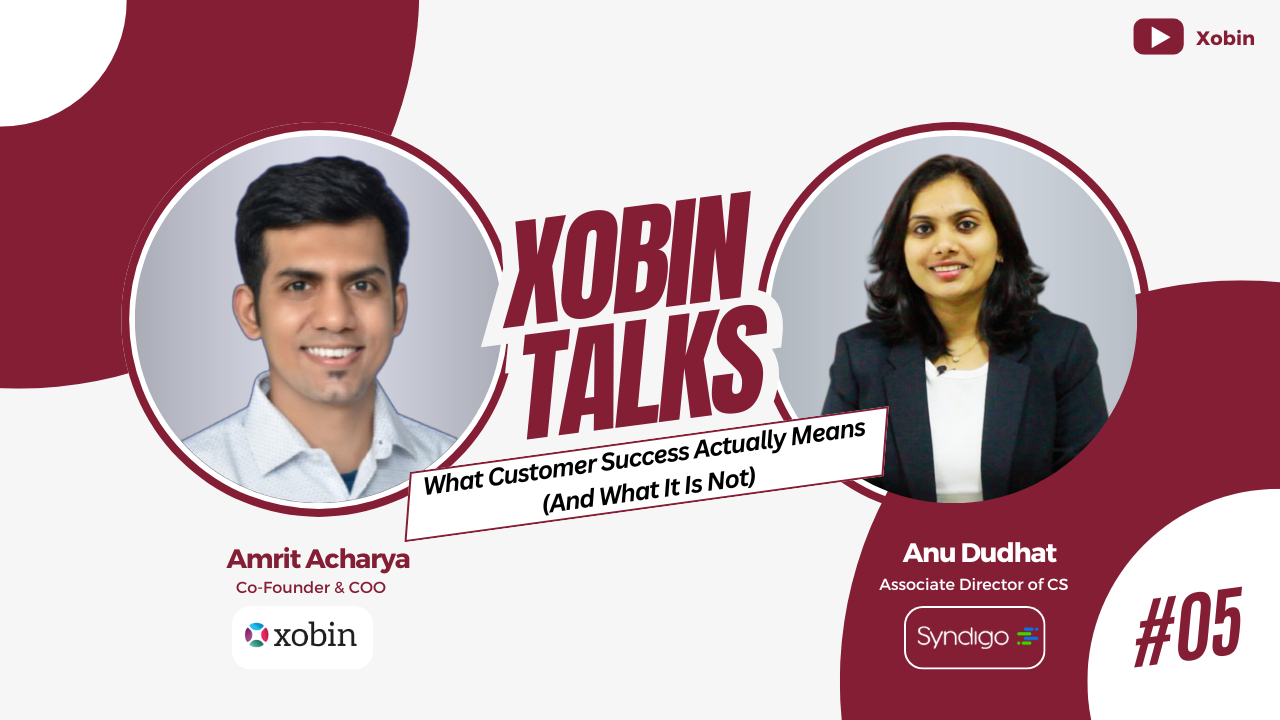
| GUEST PROFILE Anu Dudhat works as Associate Director of Customer Success at Syndigo. Connect: LinkedIn |
This episode was hosted by Amrit Acharya, Co-Founder and COO of Xobin.
Table of Contents
TL;DR – Key Takeaways
- Companies with dedicated Customer Success Managers see up to 25% higher Net Revenue Retention than those without (Benchmarkit, 2025). Customer success is not just a cost center. It drives revenue growth.
- The average B2B SaaS annual churn rate is 3.5%. Top-performing companies with mature customer success programs push NRR above 120% by turning retention into an expansion engine (Vitally, 2025).
- Customer success is not customer service. It is not a postman. A CSM is the long-term strategic partner of a customer, not the solver of individual tickets.
- SMB and Enterprise CSMs require completely different skill sets. Hire accordingly. Putting a strategic person on an SMB portfolio is as damaging as putting a volume-oriented person on an enterprise account.
- Before your first Customer Success hire, build a working support team. A customer success function cannot be proactive when it is still fighting fires all day.
Customer success has become one of the most misunderstood roles in SaaS.
Everyone wants to hire for it. Everyone claims to do it. But most organizations confuse it with customer service, then wonder why their churn numbers are not improving.
Anu Dudhat has dedicated her career to fixing this gap. To begin with, she built the customer success function at iMocha from scratch as the company’s 15th employee. Later, she led CS at Customer Success Box, where the entire product focused on customer success. Now, she heads customer success at Syndigo, a $200 million enterprise.
In this episode #5 of Xobin Talks, host Amrit Acharya, Co-Founder and COO of Xobin, sat down with Anu to get her insights on what customer success actually is, what it is not, how to hire for it, how to structure the team, and how to build it from zero.
What Is the Difference Between Customer Success, Customer Service and Program Management?
Customer success is not about solving problems. It is about preventing them. The average B2B SaaS company sees 3.5% annual churn, but companies with dedicated CSMs see up to 25% higher NRR than those without (Benchmarkit, 2025). That gap is the difference between a customer success function and a customer service function.
Anu draws three clear lines.
Customer service works in a transactional way. For example, you call when your internet is down. Then, the agent fixes the issue. After that, the interaction ends. However, that agent does not build a relationship with you. In addition, they do not focus on your long-term success. Instead, their main goal is to close the ticket.
Program management is milestone-driven. A program manager runs an onboarding project. It has a defined scope, a timeline, a budget and stakeholders to align. When the project ends, their job ends. They are loyal to the project, not to the customer.
Customer success is neither of these. A CSM is loyal to the customer’s evolving journey. When a company buys Xobin to fix their screening process, that is the initial problem. But once Xobin is implemented, the problem statement changes. Now they want to hire more senior talent, expand coverage, or build out a different function. The CSM’s job is to evolve with the customer as those goals shift.
The Three Pillars of a Genuine CSM
Three things define a genuine CSM: deep understanding of the customer’s business, deep understanding of the product they have bought, and an understanding of the SaaS metrics that determine the impact of both. Without all three, you are moving information around, not driving outcomes.
Anu’s framing of the CSM as “not a postman” is one of the most useful diagnostic tools for any organization trying to evaluate whether its CS function is operating at the right level.
Why Is Customer Success Now Critical to SaaS Revenue Growth?
MRR depends on it. Median Net Revenue Retention across B2B SaaS reached 106% in 2025, with top performers exceeding 120% (Wudpecker, cited by Vitally, 2025). That above-100% number is only possible through expansion revenue, and expansion revenue is what a well-functioning customer success team drives.
Anu explains why the world moved here. Products are abundant. SaaS marketing is sophisticated. Sales cycles are optimized. But once a customer is in, the question investors ask at every valuation round is about Monthly Recurring Revenue. MRR does not grow from acquisition alone. It grows from retention and expansion.
A CSM acts as the link that connects product to revenue at the customer level. Moreover, they provide marketing with real use cases and clear business value to shape better website copy. At the same time, they share meaningful feedback with the product team, adding context instead of passing along unexplained bug reports. In addition, they gather customer testimonials and build strong advocacy. As a result, they spot upsell and cross-sell opportunities even before the sales team starts looking for them.
Wrong feedback from a CS team means the product team builds the wrong thing. Low-context feedback means engineering cannot prioritize correctly. A CS function that is only resolving tickets is not a CS function. It is an expensive support layer with a misleading job title.
How Do You Know If Your CS Team Is Operating Strategically?
Count how many emails they are composing versus replying to. This is Anu’s simplest diagnostic tool. Everyone in SaaS is busy responding. Strategic CS means starting conversations. It means your team is the one reaching out.
A team that only replies is reactive. They are managing fires and they are answering questions that customers already had to ask. That is fine for support. It is a failure mode for customer success.
Composing emails means running product roadmap sessions with customers before they ask. Sharing best practices before a problem surfaces. Creating advocacy conversations before a renewal deadline creates urgency. Reaching out to a customer who has gone quiet rather than waiting for them to escalate.
Anu challenges CS managers to track their team’s outbound-to-inbound ratio every week. If people only reply and never start conversations, then you don’t have a true customer success team. Instead, you are running a reactive support layer. The solution is not to hire more people. Rather, you must create time and clear expectations for proactive outreach. This begins by having a support team handle urgent issues, so your CSMs can focus on what truly matters.
What Should You Build Before Hiring Your First Customer Success Manager?
Build your support team first. This is the mistake Anu makes most often when she joins a new organization. Customer success cannot be proactive if it is doing support’s job.
Anu learned this directly at iMocha. When she joined as the first CS hire, there was no support team. Every customer issue landed on her. She was fighting fires all day. There was no bandwidth for proactive outreach, for strategic conversations, or for expansion plays.
The sequence matters. Build a support function that is working, reliable and known to customers. That is the team customers go to when there is a fire. Once that foundation exists, your CS hire has actual time to do customer success work. Without it, you are hiring a CS manager who will spend their first year doing support, become frustrated, and leave.
Anu’s first hire for a new CS function should be someone patient and collaborative above all else. Process matters less than personality at that stage. There are no processes yet. What matters is someone who can work with founders and engineers directly, bring empathy to customers in an imperfect product environment, and build the function from scratch alongside a team that is still figuring itself out.
How Should You Segment and Structure a Growing CS Team?
Segment your customers before you segment your team. The biggest structural mistake in CS is applying the same attention to every customer regardless of revenue, potential or strategic value.
The Three-Bucket Segmentation Model
Anu structures every CS team around three customer buckets: SMB, Enterprise and Strategic. Strategic accounts may not be your highest-paying customers today. They are the ones with the highest potential. A smaller brand that will grow with you deserves early strategic attention even if their current contract value does not justify it on a spreadsheet.
Matching Skill Sets to Segments
Once those three buckets exist, the team structure follows naturally. SMB requires different skills than enterprise does. An SMB CSM is managing volume. They need to think in one-to-many terms. They need to be analytical, process-oriented and comfortable with templates and automation. A strategic enterprise CSM is managing depth. They need to present to the C-suite, run quarterly business reviews, build account plans and identify expansion opportunities that require a consultative mindset.
Putting the wrong person in the wrong segment is a common and expensive mistake. A strategic thinker managing 50 SMB accounts will try to create custom plans for everyone. They will burn out in three months. A volume-oriented person managing your enterprise anchor accounts will miss the nuance those relationships require.
Building Complementary Skills Inside the Team
Within each segment, Anu recommends building complementary skill sets into the team. One analytical person who owns CS technology and data. One social extrovert who owns customer advocacy and interviews. One process-oriented person who manages onboarding frameworks. These are not separate roles. They are portfolio responsibilities layered on top of normal account work. This approach builds organizational capability gradually and retains employees who would otherwise plateau.
Anu took a $3,600 account to a $100,000 renewal at iMocha within 8 months by treating that first enterprise customer as a strategic relationship from day one. That deal changed how the entire organization thought about customer success.
How Do You Hire for Customer Success? SMB vs Enterprise?
The hiring approach is completely different for SMB and enterprise, and most companies treat them the same. Companies with dedicated CSMs see up to 25% higher NRR than those without. But only when the CSM is matched to the right segment (Benchmarkit, 2025).
For SMB, Anu looks for analytical thinkers who naturally gravitate toward templates, automation and one-to-many communication. They must write well in a business context, not creatively but clearly. They must be comfortable with data and product tools. The interview signal she watches for: does this person naturally think about how to scale a process, or do they instinctively want to personalize everything?
For Enterprise, the profile shifts entirely. These CSMs need to present confidently to senior stakeholders. They need to understand a customer’s business deeply enough to show how the product maps to their strategy. The evaluation method Anu uses is a case study. Candidates are asked to review the company, understand its customers and build an onboarding plan. They present it as if they are already in the role. This single exercise reveals comprehension, business acumen, communication quality and preparation in one session.
The Webinar-First Hiring Funnel
The most creative part of Anu’s hiring process is what happens before the interview. She runs a 45-minute webinar on who the company is, what the CS role involves, what the team culture looks like and what the hiring process will entail. Around 150 people registered. Fifty show up. During the webinar, she tracks who asks sharp, substantive questions. She calls those individuals personally on Monday morning to say she is especially interested in them.
That call does two things. It creates genuine excitement in the candidate. And it means the case study stage is filled with people who are already invested, not people who applied to 40 jobs that day.
What Is the Career Path Into Customer Success from Account Management or BD?
Account management and Business Development are excellent preparation for customer success. The skills transfer well. The mindset shift is the only real challenge.
Anu explains this clearly. In fact, Business Development and account management professionals already show extroverted traits. They handle difficult conversations well. Also, they negotiate confidently and they can talk about a product with conviction. These are strong foundations for CS work.
The one thing that needs to change is the time horizon. In Business Development, a deal closes and you move on. In customer success, closing is the beginning. The relationship extends indefinitely. The value has to be demonstrated again and again. That shift from sprint to marathon requires a genuine mindset adjustment.
Anu’s practical advice: do a structured customer success course before making the move. Not to learn everything from scratch, but to understand how what you are already doing connects to CS outcomes. The Success Hacker course is one she recommends, at around 7-8 hours of material. Understanding the vocabulary and metrics of CS, NRR, churn, health scores, and QBRs accelerates the transition from someone with the right instincts to someone who can perform at the right level.
🎧 Watch the Full Episode
Xobin Talks – Episode 5 | Anu Dudhat, Associate Director of Customer Success, Syndigo | Hosted by Amrit Acharya, Co-Founder and COO, Xobin
▶ Play Episode #5 of Xobin Talks
About Anu Dudhat
Anu Dudhat serves as the Associate Director of Customer Success at Syndigo, a $200 million content intelligence platform. She started her career in edtech; however, she soon shifted into customer success after joining iMocha as its 15th employee, where she built the CS function from the ground up.
After that, she led customer success at Customer Success Box, one of India’s early dedicated CS platforms, before moving to Syndigo. Moreover, she earned recognition as one of the Top 100 Customer Success Strategists globally and consistently worked at companies where CS acts not just as a function but as a core competitive edge.
Her most notable achievement came when she grew a $3,600 account into $100,000 within eight months at iMocha; as a result, this success became a benchmark that reshaped how the company approached customer success going forward.
Connect with Anu on LinkedIn | Company: Syndigo
Want more insights like this? Explore all Xobin Talks episodes.
Frequently Asked Questions
What is the difference between customer success and customer service?
Customer service is transactional: resolve the ticket and move on. Customer success is relational: stay invested in the customer’s evolving goals across their entire journey with the product. A CSM thinks about MRR, expansion and long-term outcomes. A customer service agent thinks about ticket resolution time.
What is customer success not?
A CSM is not a postman. Forwarding a bug report to engineering without context is not customer success. A real CSM gives engineering the business impact, the customer context and the urgency framing. They make the right people accountable. They drive alignment. They do not just move messages.
When should a SaaS startup make its first CS hire?
After a reliable support function is in place. If there is no support team, your first CS hire will spend their time doing support. They will have no bandwidth for proactive relationship work and will burn out and leave. Support comes first. CS comes after.
What skills should you look for in an SMB CSM?
Analytical thinking, one-to-many communication, business writing and comfort with data and product tools. SMB CS is a volume game. The right hire thinks in templates and systems, not custom plans for every account.
What skills should you look for in an Enterprise CSM?
Consultative depth, executive presence, business acumen and strong written and verbal communication. Evaluate through a case study: ask candidates to build an onboarding plan for a real customer scenario. This reveals how they think, communicate and prepare.
How do you build a CS team with complementary skills?
Hire deliberately for different strengths: one analytical person for CS technology and data, one extrovert for advocacy and interviews, and one process person for onboarding frameworks. Give each a small portfolio project in their area. You build organizational capability without creating a new headcount.
How should a company transitioning from BD or account management approach customer success?
The skills are already there. The mindset shift is the main work. BD closes deals and moves on. CS starts when the deal closes and stays. A focused CS course of 7-8 hours, like Success Hacker, helps bridge the vocabulary and metric gap quickly.
What is the most creative hiring approach Anu uses for CS roles?
A 45-minute pre-interview webinar on the role, team and process. 150 registered, 50 attended. Sharp questioners get a personal Monday call. By the case study stage, only genuinely interested candidates remain.