


Top candidates don’t drop out because they lack skills; they leave because assessments feel long, confusing, or unfair. A poor assessment experience quietly damages employer brand and hiring outcomes. This blog breaks down practical steps to fix the problem and create assessments candidates actually respect and complete.
Table of Contents
TL;DR – Key Takeaways!
- Candidate experience during assessments directly impacts offer acceptance and employer brand.
- Shorter, job-relevant, and transparent assessments reduce candidate drop-offs.
- Clear communication, accessibility, and timely feedback are critical trust-builders.
- Technology can enhance fairness and experience when used thoughtfully.
- A positive assessment journey improves both candidate satisfaction and quality of hire.
Why Candidate Experience in Assessments Matters More Than Ever
Candidate experience doesn’t start at interviews; it begins the moment a candidate opens your assessment invite. Research from SHRM consistently shows that candidates who have a negative assessment experience are far less likely to accept an offer or reapply in the future. More importantly, they often share that experience publicly, impacting employer branding.
From a business perspective, assessments are a high-stakes touchpoint. They sit at the intersection of speed, fairness, and perception. If candidates feel tests are irrelevant, excessively long, or technically frustrating, they question the organization’s culture and decision-making maturity. Conversely, well-designed assessments signal respect, clarity, and professionalism, the qualities that top performers look for.
Moreover, with remote and global hiring now mainstream, assessments often replace early human interaction. This makes them the first real “experience” candidates have with your organization. Improving candidate experience in the assessments isn’t about making the test easier; it’s about making it clearer, fairer, and more human.
8 Steps to Improve Candidate Experience in Tests
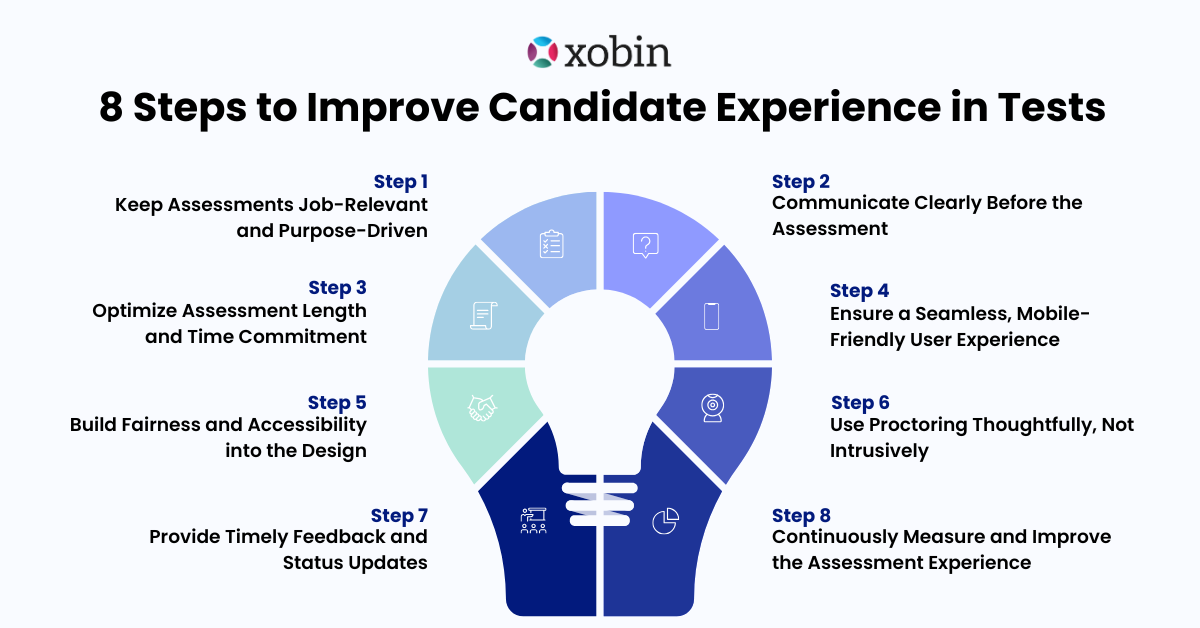
Step 1: Keep Assessments Job-Relevant and Purpose-Driven
One of the fastest ways to damage candidate experience is using generic or outdated tests. Candidates quickly disengage when they can’t see how an assessment relates to the role they’ve applied for.
Job-relevant assessments focus strictly on skills, behaviors, and competencies required for success in the role. This reduces cognitive overload and builds trust. When candidates feel the test reflects real job challenges, they’re more motivated to perform well.
Additionally, relevance improves perceived fairness. Candidates are far more accepting of rigorous assessments when they believe outcomes are based on actual job performance rather than abstract puzzles. From a strategic lens, relevance also improves quality-of-hire by filtering for practical capability rather than test-taking ability.
Pro Tip: Map every assessment section to a specific job competency. If it doesn’t tie back to performance, remove it.
Step 2: Communicate Clearly Before the Assessment
Uncertainty is a major source of candidate anxiety. Many candidates drop off not because the test is hard but because they don’t know what to expect.
Clear pre-assessment communication should explain:
- Why the assessment is used
- What skills are being evaluated?
- Expected duration and format
- Any technical or environmental requirements
This transparency sets expectations and reduces stress. It also positions your organization as respectful of candidates’ time. Importantly, communication should feel human, not automated jargon.
Clear instructions also reduce support queries and technical failures, improving operational efficiency for recruiters. When candidates feel guided rather than “tested in the dark,” their perception of fairness improves significantly.
Step 3: Optimize Assessment Length and Time Commitment
Assessment fatigue is real. Long or unnecessarily complex tests frustrate candidates and disproportionately impact working professionals and passive talent.
Top-performing organizations design assessments to be as short as possible and as long as required. They aim for precision, not endurance. Therefore, micro-assessments, adaptive testing, and role-specific modules preserve rigor while respecting time.
From an employer brand view, valuing candidate time shows maturity and empathy. Meanwhile, in candidate-centric recruitment outcomes, shorter assessments often deliver accurate results because candidates remain focused and engaged throughout the process.
Step 4: Ensure a Seamless, Mobile-Friendly User Experience
Technology should enable, not obstruct, candidate performance. Poor interfaces, browser issues, or non-mobile-friendly platforms instantly erode trust.
A seamless assessment experience includes:
- Clean, intuitive UI
- Cross-device compatibility
- Clear navigation and progress indicators
- Minimal technical dependencies
Candidates shouldn’t need IT expertise to complete a test. When technology “disappears,” candidates focus purely on demonstrating their skills.
From a strategic standpoint, usability directly impacts completion rates and data quality. Friction-heavy platforms disproportionately disadvantage certain candidate groups, unintentionally introducing bias.
Step 5: Build Fairness and Accessibility into the Design
Candidate experience is inseparable from fairness. Assessments must accommodate diverse backgrounds, abilities, and geographies.
This includes:
- Accessibility features for differently-abled candidates
- Language clarity and localization where relevant
- Reasonable time accommodations
- Bias-aware question design
Fairness isn’t just ethical; it’s strategic. Inclusive assessments expand your talent pool and strengthen employer credibility. Candidates who feel respected are more likely to remain engaged, even if they don’t progress.
Moreover, fairness safeguards your organization against reputational and compliance risks, especially in global or high-volume hiring.
Step 6: Use Proctoring Thoughtfully, Not Intrusively
Assessment integrity matters, but overly aggressive proctoring can feel invasive and intimidating. Candidates often worry about privacy and false flags.
The key is balanced proctoring, including clear communication about what’s monitored, why it’s needed, and how data is handled. Transparency transforms proctoring from a threat into a fairness mechanism.
When candidates understand that proctoring ensures equal opportunity, not suspicion, they’re more accepting. Subtle, AI-assisted monitoring is far less disruptive than heavy-handed surveillance.
Expert Insight: Trust is built when integrity measures are explained upfront, not hidden in fine print.
Step 7: Provide Timely Feedback and Status Updates
Silence after assessments becomes one of the candidate experience killers. However, even automated status updates work better than no communication. Therefore, prompt feedback after the assessment is essential to maintain candidate-first experience.
While not every organization can offer detailed feedback, basic closure matters. Let candidates know:
- Their assessment was received
- What the next step is
- When they can expect an update
Feedback, even high-level reinforces fairness and professionalism. Candidates who receive closure are significantly more likely to reapply or recommend your employer brand.
From a leadership lens, feedback loops signal operational excellence and respect, the qualities that top talent associates with strong cultures.
Step 8: Continuously Measure and Improve the Assessment Experience
Candidate experience isn’t static. What worked last year may frustrate candidates today.
High-performing talent teams regularly track:
- Assessment completion rates
- Drop-off points
- Candidate satisfaction scores
- Time-to-complete metrics
Analyzing this data reveals friction points and improvement opportunities. Continuous optimization ensures assessments evolve alongside candidate expectations and market trends.
Importantly, involving candidates via short post-assessment surveys demonstrates humility and a willingness to improve, further strengthening employer trust.
Reimagine Your Candidate Assessment Experience With Xobin!
If improving candidate experience in assessments is a strategic priority, Xobin is purpose-built to solve exactly these challenges without compromising hiring rigor or integrity. Xobin combines AI, usability, and fairness to ensure assessments feel professional, transparent, and respectful to candidates while delivering high-quality hiring signals to recruiters.
- Job-relevant, role-based assessments
- Shorter, adaptive test design
- Clear candidate communication & instructions
- Mobile-friendly, intuitive interface
- Fair & inclusive assessment design
- Non-intrusive, transparent AI proctoring
- Timely status updates & analytics
- Enterprise-grade security & compliance
Xobin turns assessments into a positive brand touchpoint where candidates feel respected, fairly evaluated, and engaged, and hiring teams gain faster, data-backed decisions. If you’re ready to modernize your assessment experience while maintaining hiring rigor, it’s time to take a closer look at how the right technology can help.
Book a personalized demo with Xobin today and reimagine your candidate assessment experience.
FAQs
1. Why is candidate experience important in assessments?
Because assessments are often the first real interaction candidates have with an employer. A poor experience can lead to drop-offs, offer rejections, and brand damage.
2. How long should a candidate assessment ideally be?
Most role-based assessments should be completed within 30–60 minutes. Shorter, focused tests generally yield better engagement and data quality.
3. Can assessments be fair and candidate-friendly at the same time?
Yes. Fairness improves experience when assessments are job-relevant, transparent, and accessible to diverse candidates.
4. Does proctoring negatively affect candidate experience?
Only when it’s intrusive or poorly explained. Transparent, minimal proctoring focused on fairness is generally well accepted.
5. How can companies measure candidate experience in assessments?
By tracking completion rates, drop-offs, candidate feedback surveys, and time-to-complete metrics.
6. What role does technology play in candidate experience?
Technology shapes usability, accessibility, fairness, and communication, making it a critical driver of assessment experience.