

Hiring mistakes are expensive, both financially and strategically. As roles evolve faster than resumes can keep up, employers are shifting toward skills-based hiring to make smarter decisions. Today, resumes and degrees are no longer enough to predict success. Instead, organizations focus on assessing real-world capabilities before interviews. Understanding the top skills to test in job applicants before hiring helps leaders reduce mis-hires, improve productivity, and build future-ready teams.
Table of Contents
TL;DR
- Employers increasingly test job-specific, cognitive, and behavioral skills before hiring.
- Skills-based assessments outperform resumes in predicting job success.
- Soft skills like communication and adaptability are as critical as technical ability.
- Structured pre-employment testing reduces bias and improves quality of hire.
- AI-powered assessment platforms help scale skill evaluation reliably.
Why Employers Are Moving Beyond Resumes to Skills Testing
Traditional hiring methods rely heavily on resumes, degrees, and past job titles. However, these indicators often fail to predict on-the-job performance. According to LinkedIn’s Future of Hiring report, nearly 75% of recruiters say skills-based hiring is a priority, driven by rapid skill obsolescence and the rise of non-linear career paths.
Key reasons employers test skills before hiring:
- Resumes don’t reveal problem-solving ability or adaptability.
- Job titles vary widely across companies and industries.
- Degrees don’t guarantee job-ready skills
- Interviews alone introduce unconscious bias.
By testing skills early, employers ensure candidates are evaluated objectively on what truly matters: their ability to perform in the role. This approach also improves fairness, widens talent pools, and supports diversity-focused hiring strategies.
Skills to Evaluate Before Recruiting Candidates
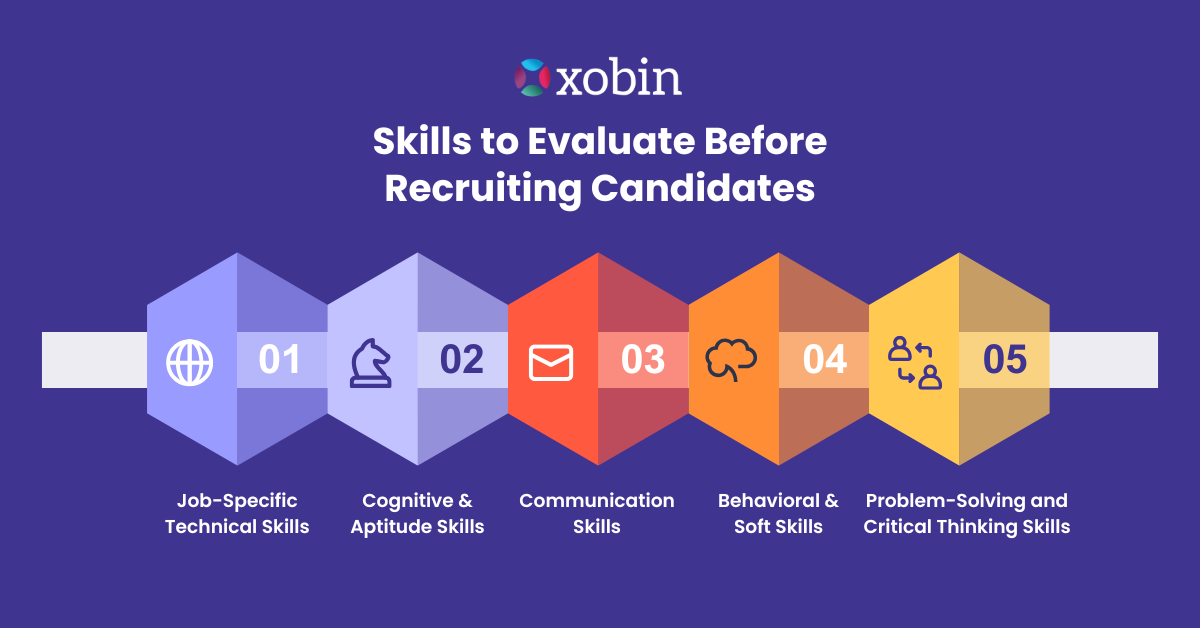
1. Job-Specific Technical Skills
Technical skills are the foundation of any role and are often the first skills employers test in job candidates. These assessments validate whether candidates can perform core job tasks effectively.
Examples of technical skills employers assess:
- Coding and debugging for software engineers
- Financial modeling for finance roles
- CRM usage and pipeline management for sales
- Campaign analysis and SEO for marketing roles
Instead of relying on theoretical questions, employers increasingly use hands-on simulations and role-based tests. These assessments replicate real work scenarios, offering a much clearer signal of job readiness.
Why technical skills assessment matters:
- Reduces false positives from impressive resumes
- Filters unqualified candidates early
- Shortens time-to-hire
- Improves confidence in hiring decisions
2. Cognitive and Aptitude Skills
Cognitive ability remains among the strongest predictors of job performance across industries today. Therefore, employers use aptitude tests to understand how candidates think, learn.
Common aptitude skills assessed include:
- Logical reasoning
- Numerical ability
- Pattern recognition
- Analytical thinking
These skills are especially valuable for roles requiring decision-making, strategic thinking, or rapid learning. For entry-level candidates or career switchers, aptitude tests help employers assess potential rather than past experience.
Benefits of aptitude testing:
- Identifies high-potential candidates early
- Supports fair comparison across backgrounds
- Predicts long-term performance and learning agility
3. Communication Skills
In today’s collaborative and remote work environments, communication skills are critical across almost every role. Employers now actively test both verbal and written communication skills before hiring.
Communication assessments typically evaluate:
- Clarity and structure of responses
- Professional tone and language
- Ability to explain ideas concisely
- Listening and comprehension skills
Poor communication often leads to misunderstandings, delays, and disengagement. That’s why employers prefer structured communication tests over subjective interview impressions.
Why employers test communication skills:
- Ensures effectiveness in cross-functional teams
- Improves customer and stakeholder interactions
- Reduces workplace friction and errors
💡 Pro Tip: Structured communication assessments reduce bias by focusing on clarity and relevance, not confidence alone.
4. Behavioral and Soft Skills
Technical skills may get candidates hired, but behavioral skills determine long-term success. Employers increasingly test soft skills to evaluate how candidates behave in real workplace situations.
Key soft skills employers assess:
- Adaptability and resilience
- Accountability and ownership
- Collaboration and teamwork
- Integrity and work ethic
Behavioral assessments, including psychometric and situational judgment tests, help employers predict cultural fit and team compatibility. These insights are especially critical for leadership, people-facing, and high-impact roles.
Why soft skills testing is essential:
- Improves retention and engagement
- Reduces toxic hires
- Aligns behavior with company values
5. Problem-Solving and Critical Thinking Skills
Modern roles demand employees who can navigate ambiguity and solve unfamiliar problems. As a result, employers test problem-solving and critical thinking skills early in the hiring process.
Common assessment formats include:
- Case studies
- Scenario-based questions
- Role simulations
What employers evaluate is not just the answer, but:
- How the candidate structures the problem
- Decision-making logic
- Ability to balance trade-offs
- Learning from constraints
These skills are particularly valuable in fast-changing industries where adaptability is critical.
Implement Skills-First Hiring Using Xobin!
Testing multiple skills at scale requires the right technology. Xobin enables organizations to implement skills-first hiring through AI-powered, role-based assessments that are fair, secure, and scalable.
With 3,400+ customizable skill tests, Xobin helps employers evaluate:
- Technical and functional skills
- Cognitive and aptitude abilities
- Communication and behavioral traits
AI-based evaluation, advanced proctoring, and actionable reports ensure data-driven hiring decisions while minimizing bias and manual efforts. Organizations that adopt skills-based hiring today will be better prepared for tomorrow’s workforce challenges.
If you want faster, fairer, and more accurate hiring outcomes, it’s time to move beyond resumes and focus on what candidates can actually do. Book a personalized demo today and see how Xobin enables skills-first hiring at scale.
FAQ’s
1. Why do employers test skills before hiring?
To predict job performance, reduce bias, and avoid costly hiring mistakes.
2. What are the most important skills employers test in candidates?
Technical skills, aptitude, communication, behavioral traits, and problem-solving.
3. Are soft skills really measurable?
Yes. Psychometric and situational tests reliably assess workplace behavior.
4. Do skills-based assessments improve diversity?
Yes. They reduce reliance on pedigree and focus on capability.
5. When should employers conduct skill assessments?
Ideally at the early screening stage, before interviews.